
Adam Isacson

Adam Isacson
Director for Defense Oversight
Adam Isacson has worked on defense, security, and peacebuilding in Latin America since 1994. He now directs WOLA’s Defense Oversight...With this series of updates, WOLA seeks to cover the most important developments at the U.S.-Mexico border. See past updates here.
Your donation to WOLA is crucial to keeping these paywall-free and ad-free Updates going. Please contribute now and support our work.
We will not publish a Border Update on September 4, 2026.
THIS WEEK IN BRIEF:
- Migrant apprehensions decline only slightly from June to July despite summer heat: Border Patrol’s July migrant apprehensions dropped 6 percent from June, a decline less pronounced than expected for the peak of summer. This may be because some people deported from the U.S. interior after many years in the United States are attempting to return. Border Patrol’s Rio Grande Valley in south Texas, where the apprehended population is significantly less Mexican than elsewhere, leads all sectors in migrant apprehensions. Recoveries of the remains of migrants who have died in the desert increased from last year in Arizona.
- Outcry continues over border barrier construction in protected areas: Empowered by the 2025 “Big Beautiful Bill Act” and a 2025 waiver authority, the Trump administration is moving quickly to build border barriers in Big Bend National Park, the Tohono O’odham Nation’s lands, Organ Pipe Cactus National Monument, Arizona’s San Rafael Valley, Texas’s Santa Ana National Wildlife Refuge, and other sensitive areas. Litigation continues amid a growing public outcry, which is distinctly bipartisan in the case of Big Bend, where construction is now temporarily halted.
- Big increase in deportations of Mexican citizens to Guatemala and Honduras: CBS News revealed that the Trump administration has been deporting citizens of Mexico to Guatemala and Honduras, even though Mexico’s government willingly accepts its own citizens. Guatemala’s president recognized that ICE has flown nearly 2,300 Mexicans there so far this year. A series of alarming media reports have covered what happens to migrants sent to unfamiliar and often dangerous countries in Latin America and Africa, often without even having their identity documents returned to them. ICE deportation flights hit a new record in July, with 18 taking people to third countries.
- U.S. military gains new detention powers near the border: A Justice Department memo gives U.S. military personnel stationed at the border permission to detain civilians, including migrants, both within and in the vicinity of a thin fringe of territory along much of the border. This reinterpretation of the 1878 Posse Comitatus Act departs from longstanding norms limiting the U.S. military’s non-emergency role in domestic law enforcement.
THE FULL UPDATE:
Migrant apprehensions decline only slightly from June to July despite summer heat
U.S. Customs and Border Protection (CBP) released monthly data about the agency’s apprehensions of migrants and other security-related measures at the U.S.-Mexico border. It found that:
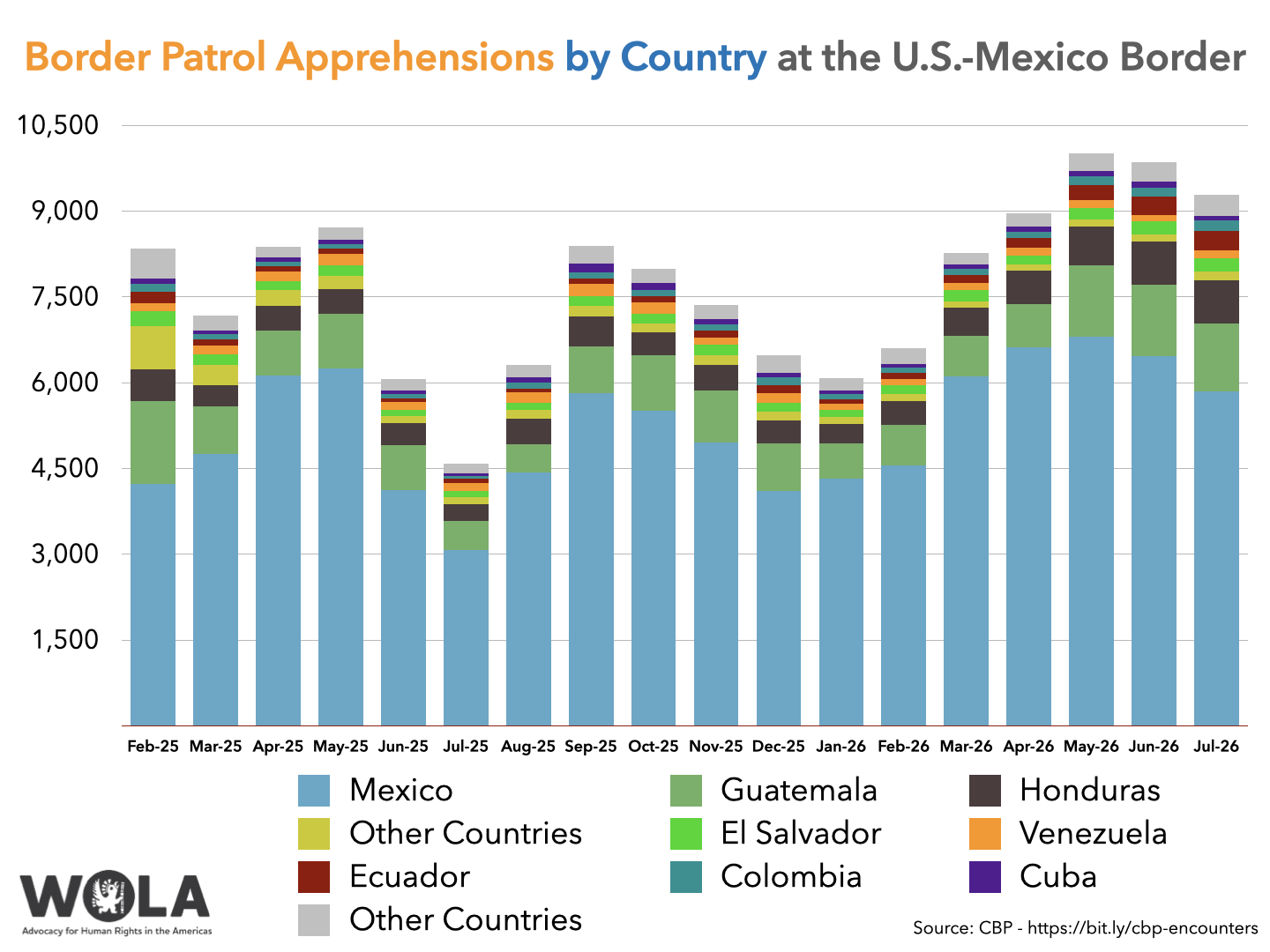
- Border Patrol apprehended 9,295 people between the border’s ports of entry (official border crossings) in July, down 6 percent from 9,855 in June.
- 3,435 people entered CBP custody at the ports of entry in July, a typically low figure for the Trump administration. Since the administration continues to ban access to asylum (legal challenges continue) and to “meter” noncitizens’ access to the border crossings, port-of-entry migrant encounters now change little from month to month.
- Border Patrol’s July migrant apprehensions doubled from July 2025 (4,592), which was the lowest monthly total of the entire Trump administration. While apprehensions have declined for two straight months, the drop is less pronounced than expected at the height of summer, when the border zone’s intense heat usually causes migration to fall. In fact, apprehensions in July 2026 were the third-highest of the Trump administration’s 18 full months.
- The Trump administration’s “mass deportation” policy may be a key reason for the relative lack of a summer decline. Immigration and Customs Enforcement (ICE) is deporting record numbers of people, often into Mexico, after arresting them in the U.S. interior—not the border. Many interior arrests are of people who have spent significant portions of their lives in the United States, and who are now separated from families and communities. One can only hypothesize because data on the characteristics of apprehended migrants are not available, but it is likely that many of those apprehended near the border this summer are people whose deportation implied a genuine uprooting and who have a strong motive to return.
- Though July was a relatively busy month at the border by the standards of the second Trump administration, which has cut migration by suspending asylum and cracking down on migrants in the United States, it was still a historically low month for Border Patrol apprehensions. Though the July 2026 total was double July 2025, it was down 84 percent from July 2024 and 93 percent from July 2023.
- 63 percent of Border Patrol’s apprehended migrants in July were citizens of Mexico. That is generally typical of the second Trump administration, though it is down from a high of 74 percent in March and April, indicating somewhat more diversity in nationalities. While apprehensions of citizens of Mexico, Guatemala, and Cuba declined from June to July, most other nationalities increased.
- 88 percent of July Border Patrol apprehensions were of single adults, with families and unaccompanied children comprising the rest. This is typical of the second Trump administration.
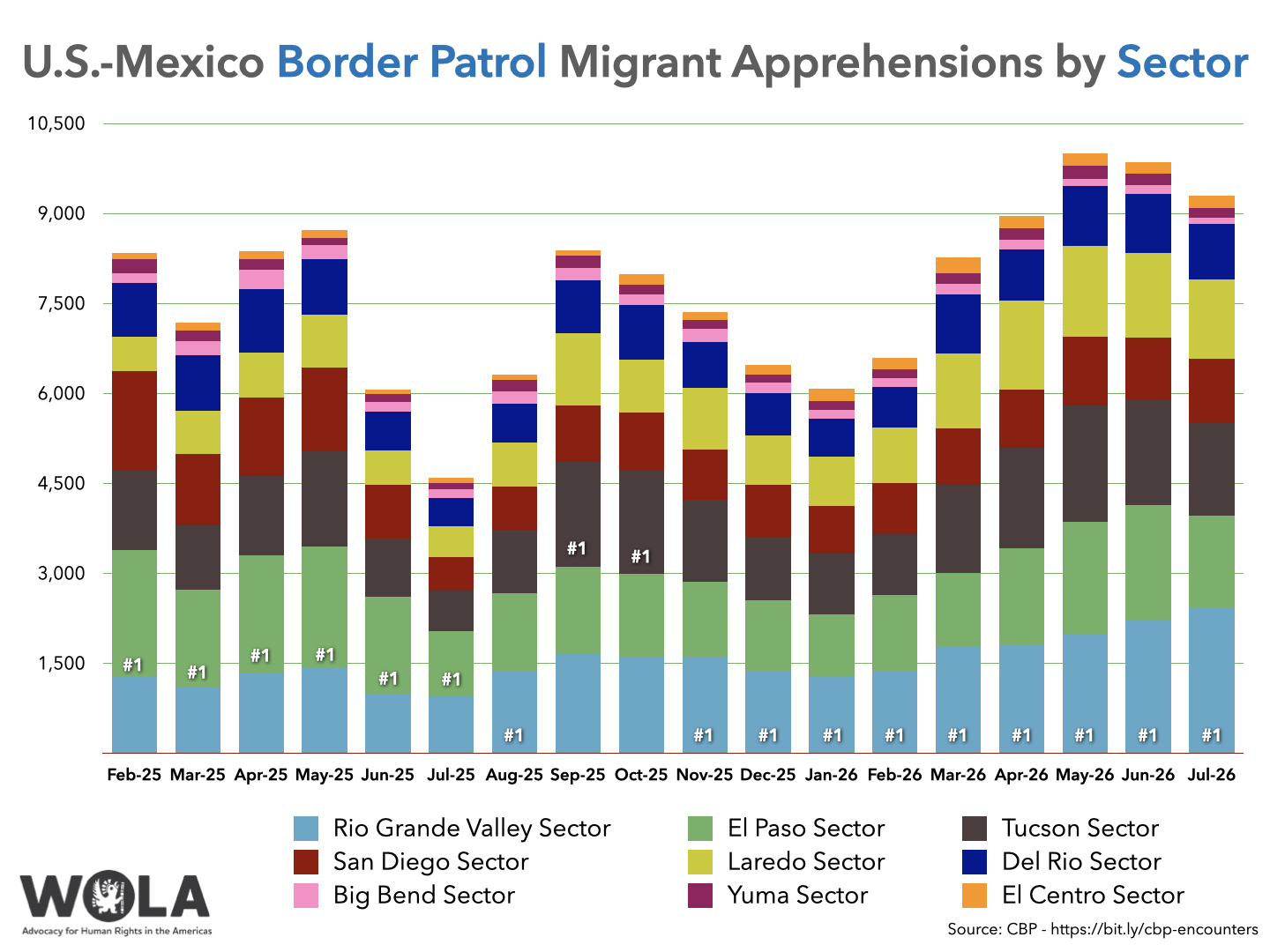
- For the ninth straight month, Border Patrol apprehended the most migrants in its Rio Grande Valley Sector, in south Texas (the agency divides the U.S.-Mexico border into nine geographic sectors). July was the seventh straight month of increased apprehensions in the Rio Grande Valley: they have roughly doubled from 1,273 in January to 2,438 in July. Only 47 percent of migrants apprehended in the Rio Grande Valley in July were citizens of Mexico; Border Patrol also apprehended at least 100 migrants there last month from Guatemala (16%), Honduras (14%), El Salvador (5%), and Ecuador (4%). Like the rest of the border, 85 percent of migrants apprehended in the Rio Grande Valley were single adults.
- “Trump Administration Delivers 15 Straight Months of Zero Releases at the Border” (U.S. Customs and Border Protection, August 13, 2026).
The Atlantic’s Nick Miroff sounded an alarm about the future of Department of Homeland Security (DHS) data quality and reporting: Marc Rosenblum, the longtime head of the Department’s Office of Homeland Security Statistics who had worked under both Democratic and Republican administrations, resigned in late July. “Presidential administrations from both parties have tried to spin or delay the release of certain data categories, such as illegal border crossings, when the numbers aren’t favorable,” Miroff noted. “The Trump administration has taken the distortions to extremes.”
- Nick Miroff, “The Man in Charge of Immigration Data Just Resigned” (The Atlantic, August 10, 2026).
The Department of Homeland Security has stopped releasing timely, reliable statistics on immigration enforcement
The Tucson Sentinel reported that deaths of migrants in Arizona’s deserts, usually from heat and dehydration, are not declining. The Arizona humanitarian group Humane Borders reported recoveries of the remains of 73 people in Arizona in 2026 through August 12, a 24 percent increase over 59 during the same period in 2025. The 2026 total includes 13 remains recovered in June and 19 in July.
- Paul Ingram, “Migrants Still Dying in Arizona’s Deserts Despite Drop Border Crossings” (The Tucson Sentinel (Tucson Arizona), August 12, 2026).
While the number of people taken into custody along the U.S.-Mexico has dropped to historic lows, the number of bodies of dead migrants found in Arizona’s remote deserts increased this summer, Humane Borders said Tuesday
- David Baker, “Woman Swept Away by Floodwaters After Illegal Crossing Near Arizona Border” (Arizona’s Family, August 6, 2026).
Search crews fear a woman may have drowned after floodwaters swept her away in the San Pedro River near the Arizona-Mexico border
Outcry continues over border barrier construction in protected areas
Funded by over $46.5 billion in last year’s “One Big Beautiful Bill Act” and enabled by a 2005 authority to waive environmental, cultural, historic preservation, and other laws, the Trump administration is advancing border barrier construction in sensitive areas along the entire border. 287 miles of walls and other barrier infrastructure are under active construction, with about seven miles completed per week. CBP has awarded more than 30 construction contracts since September.
Projects in protected areas are generating vigorous and growing opposition, often bipartisan, from local communities and environmental advocates.
- Gaby del Valle, “Trump’s Border Wall Push Is Back — and It’s Destroying National Parks and 200-Year-Old Trees” (The Verge, August 17, 2026).
Border crossings are down. High-tech surveillance is more effective than physical barriers. Still, the Trump administration wants destructive walls anyway
Big Bend
Facing a bipartisan firestorm of complaints after bulldozers began clearing land for an access road, CBP Commissioner Rodney Scott announced a pause of all construction activity in Big Bend National Park on August 17, and on August 19 met with local sheriffs and county judges. Scott said he would consider scrapping new road-building plans in favor of using existing roads, and said that vehicle barriers, if installed, could be designed to fit the scenery (he suggested they could be made to resemble petrified trees).
The $1.7 billion Southwest Valley Constructors contract covers vehicle barriers, surveillance technology, and a patrol road: not a 30-foot bollard wall, but enough to disfigure a wilderness visited by tens of thousands each year. Bulldozers cleared terrain near Santa Elena Canyon on August 12–13, followed over the weekend of August 16–17 by contractors digging into Mariscal Mountain.
CBP plans about 230 miles of border wall elsewhere in Border Patrol’s Big Bend Sector, which comprises 517 miles of border. Though that is a quarter of the entire U.S.-Mexico border, migrant apprehensions in the Big Bend Sector are nearly always in a distant last place among Border Patrol’s nine border sectors. In July, the agency apprehended just 98 border-crossers there, about 1 percent of the border-wide total.
- Sam Karas, “Texans Urge Agency to Keep Border Walls Out of State Parks” (Big Bend Sentinel, The Texas Tribune, August 19, 2026).
After bulldozers entered Big Bend National Park, hundreds of Texans came to Wednesday’s meeting to ask the agency to keep federal border barriers out of state parks
- Ashley Killough, Maria Aguilar Prieto, “What We Know About the Controversial Border Security Project in and Near Big Bend National Park” (CNN, August 19, 2026).
While the federal government has paused work to build border security infrastructure in Texas’ Big Bend National Park, people opposing such construction in the broader region attended a state commission meeting Wednesday, offering often emotional pleas, hoping to persuade the panel to stop it on state land
- Uriel J. Garcia, “What to Know About Possible Border Barriers in Big Bend” (The Texas Tribune, August 18, 2026).
The Trump administration has said the remote West Texas region needs measures to stop illegal immigration. But a bipartisan group of elected officials is pushing to halt that plan, especially in the national park
- Rodney Scott, “Statement From CBP Commissioner Rodney S. Scott on Big Bend Border Security Projects” (U.S. Customs and Border Protection, August 17, 2026).
- Rebecca Santana, “Trump Administration Briefly Pauses Contentious Border Project in Texas’ Big Bend National Park” (Associated Press, Associated Press, August 17, 2026).
The Trump administration says it is temporarily pausing construction of a controversial border construction project in the Big Bend National Park while the head of the agency tasked with building the wall visits Texas to do an “on-the-ground evaluation”
- J. David Goodman, “Border Construction in Big Bend Is Halted After Drawing Criticism” (The New York Times, August 17, 2026).
The Trump administration has been carving a path through some of the beloved national park’s major natural attractions
- “Emergency Injunction Sought to Block Big Bend Border Construction Despite Government Pause” (Center for Biological Diversity, August 17, 2026).
- J. David Goodman, “Trump Backed Away From a Wall at Big Bend. But the Bulldozers Are Here.” (The New York Times, August 15, 2026).
Over the objections of environmentalists, local sheriffs and some state leaders, the Trump administration appears to be moving ahead with border infrastructure in one of Texas’ most beloved parks
- Alicia A. Caldwell, Joe Lovinger, “Texas’ Big Bend National Park Getting Border Barriers That Even Some Trump Supporters Dislike” (Bloomberg, The Los Angeles Times, August 14, 2026).
The Trump administration has begun building border barriers, patrol roads and surveillance infrastructure in Big Bend National Park in Texas despite bipartisan concern about environmental damage seen as unwarranted
- Roque Planas, “‘Devastating’: Bulldozers Plough Through Big Bend National Park as Trump’s Border Work Pushes Ahead” (The Guardian (Uk), August 14, 2026).
Heavy machinery seen operating in famous Santa Elena Canyon amid outcry over new wall infrastructure in beloved Texas park
- Manuela Silva, “CBP Boss Set to Visit Big Bend Region Amid Border Construction Backlash” (NOTUS, August 14, 2026).
Two county sheriffs told NOTUS that Commissioner Rodney Scott’s staff reached out to them this week after the agency began bulldozing in Big Bend National Park
- Ayden Runnels, Gabby Birenbaum, “New Lawsuit Seeks to Stop Big Bend Border Wall Construction” (The Texas Tribune, August 14, 2026).
A tribal nonprofit and an outdoor recreation company filed the federal lawsuit, arguing the work threatens archeological sites and sacred grounds
- Billal Rahman, Dan Gooding, “Trump Admin to Dynamite Mountain for New Border Wall” (Newsweek, August 13, 2026).
Trump’s border wall project could require blasting through Mariscal Mountain in Big Bend National Park, drawing backlash
- Ashley Killough, Ed Lavandera, Rachel Clarke, “Bulldozers Rip Into Big Bend National Park, Driving Anger and Heartbreak” (CNN, August 13, 2026).
Environmentalists and a bipartisan coalition of state officials and border sheriffs are part of a growing chorus of opposition to ongoing border security amid the wilds of Big Bend National Park in Texas
- Arelis R. Hernandez, Jake Spring, John Muyskens, “Bulldozing Begins at Big Bend National Park for Border Construction” (The Washington Post, August 12, 2026).
Environmentalists say the planned patrol roads, vehicle barriers and cameras will irreversibly reshape the renowned park in Texas
- Gabby Birenbaum, “Paxton Stays Quiet on Big Bend Wall as Texas Republicans Revolt” (The Texas Tribune, August 12, 2026).
The attorney general’s campaign said he wants strong border security that considers Big Bend’s “unique characteristics” — but did not say whether he supports building a wall there
- Sen. John Cornyn (R-Texas), “Cornyn Sends Letter to DHS Outlining Stakeholders’ Concerns on Big Bend Park Border Barriers” (U.S. Senate, August 11, 2026).
U.S. Senator John Cornyn (R-TX) sent a letter to Department of Homeland Security (DHS) Secretary Markwayne Mullin outlining Texas stakeholders’ concerns on federal plans to construct physical border barriers in Big Bend National Park and Big Bend Ranch State Park
- Peter Holley, “Trump’s Border-Wall Construction Is Set to Bulldoze the Porvenir Massacre Site” (Texas Monthly, August 7, 2026).
It is considered sacred ground for the descendants of those killed in a mass execution. The border wall threatens to erase it from history
- “Federal Contractors Begin Border Construction in Big Bend National Park” (Center for Biological Diversity, August 6, 2026).
Bulldozers broke ground today on border barrier and road construction in Big Bend National Park amid widespread bipartisan opposition. Videos shared with the Center for Biological Diversity show contractors plowing through native vegetation along the Rio Grande’s riparian corridor, with the iconic Santa Elena Canyon visible in the background
Tohono O’odham Nation dealt setback in federal court
In Washington, DC federal district court, Judge Richard Leon denied the Tohono O’odham Nation’s preliminary injunction seeking to block the Trump administration from building a wall through its territory, which incorporates 62 miles of the border between Arizona and Sonora, Mexico. Leon’s August 14 decision cited a 1907 “Roosevelt Reservation” proclamation declaring a fringe of land along the U.S. side of the border west of Texas to be federal property.
“Too many critical issues were not adequately addressed, such as inevitable impacts construction will have on the Nation’s land and the permanent destruction of sacred sites,” the Nation’s chairman, Verlon Jose, said. The Nation is exploring its legal options, while construction could begin in October.
- Levi Rickert, “Federal Judge Rejects Tohono O’odham Nation’s Bid to Halt Border Wall Construction” (Native News Online, Yahoo!, August 15, 2026).
A federal judge has denied the Tohono O’odham Nation’s request to temporarily halt construction of a border wall on its reservation, prompting Nation leaders to consider their next legal options
- Mandy Taheri, “Trump Scores Border Wall Legal Win: Map Shows Impacted Area” (Newsweek, August 15, 2026).
A federal judge rejected The Tohono O’odham Nation’s request to block construction of a 62-mile border wall in southern Arizona
- Michael Kunzelman, “Judge Refuses to Block Trump Administration From Building Border Wall Along Tribe’s Reservation” (Associated Press, Associated Press, August 14, 2026).
A federal judge has refused to block the Trump administration from taking steps to build 62 miles of international border wall along part of a Native American tribe’s reservation without its consent
- Mia Kortright, “O’odham Weigh Options After Judge Denies Bid to Block Border Wall on S AZ Reservation” (The Tucson Sentinel (Tucson Arizona), August 14, 2026).
The Tohono O’odham Nation is assessing its next move in its lawsuit against the Trump administration over construction of the border wall through reservation land. A federal judge denied the tribe’s motion to prevent DHS from building the wall as the suit proceeds
- Howard Fischer, “Judge Won’t Block New Border Wall Through Tohono O’odham Land” (The Arizona Daily Star, August 14, 2026).
A federal judge refused a bid by the Tohono O’odham Nation to immediately block construction of 62 miles of new border wall along the reservation’s southern boundary with Mexico
- Jonathan Van Harmelen, “The Arizona Tribe That’s Been Dragged Back Into Trump’s Border Wars” (The New Republic, August 10, 2026).
For years the Tohono O’odham Nation worked collaboratively with the federal government on border security. Now they’re facing an administration that wants to rip through their ancestral home
Arizona cottonwood trees and other fragile sites
In the San Rafael Valley of southeast Arizona, contractors continue building a full double-wall system of 30-foot steel bollards under a $1.5 billion Fisher Sand and Gravel contract. A tree-sit protest protecting a 200-year-old cottonwood tree near Lochiel has entered its fourth week. Alarms are also sounding about the building of a second layer of border wall in Organ Pipe Cactus National Monument, which abuts the Tohono O’odham Nation’s lands in south-central Arizona.
- Henry Brean, “Arizona Tree-Sit Protest Against Border Wall Branches Into Mexico” (The Arizona Daily Star, August 19, 2026).
A tree-sitting protest on the Arizona border is now an international affair with the addition of an activist camped in a tree on the Mexican side of the line
- Alisa Reznick, “Trump’s Border Wall Extension Is Slated to Slice Through Some of Arizona’s Most Cherished Sites” (KJZZ Arizona, August 11, 2026).
Since last year, the Trump administration has awarded billions of dollars in construction contracts for its so-called Smart Wall, and work has been ongoing for months in various parts of Arizona
- Henry Brean, “Organ Pipe Monument Closes Roads to Clear Path for 2nd Border Wall Construction” (The Arizona Daily Star, August 9, 2026).
Organ Pipe Cactus National Monument closes roads during work on the second border wall, as a tree-sitting protest continues in Lochiel
”Cinco” the jaguar, in Arizona
Trail camera footage shows a very rare jaguar, “Cinco,” moving through the Arizona construction zone, while new research documents a female (“Adela”) just two miles from the border in northern Sonora—the first evidence of a female near the border in over 70 years. Researchers say double-wall construction would cut off three of the four remaining wildlife corridors between Mexico and Arizona, making natural jaguar recolonization “very unlikely.”
- Celia Talbot Tobin, Douglas Main, “Jaguars Are Ready to Come Back. The Border Wall Might Stop Them.” (The New York Times, August 17, 2026).
A lone male roves the Arizona mountains, and a female has been spotted just across the border in Mexico. The sightings raise hopes for the species, despite serious threats
- Sarah Henry, “Cinco the Jaguar Roams Arizona Border Near Trump Wall. See the Video” (The Arizona Republic, August 11, 2026).
The endangered cat was spotted on trail camera video wandering through Arizona’s San Rafael Valley not far from a border wall construction site
- “New Videos: Jaguar Still in Arizona as Border Wall Construction Threatens Critical Corridor” (Center for Biological Diversity, August 11, 2026).
Santa Ana National Wildlife Refuge
In south Texas, a U.S. magistrate judge in McAllen has continued a temporary restraining order halting border barrier construction in the Santa Ana National Wildlife Refuge, a site that earlier appropriations legislation had protected from construction. (The “Big Beautiful Bill Act” appropriated wall-building money without prior years’ language exempting Santa Ana and other sites.) The next hearing in this litigation, brought by Hidalgo County’s Irrigation District and recently moved from state to federal court, is August 26.
- Sandra Sanchez, “Judge Upholds Temporary Halt on Border Wall Construction Along Wildlife Refuge” (Border Report, August 17, 2026).
- Berenice Garcia, “Border Wall Construction Paused at Santa Ana Wildlife Refuge” (The Texas Tribune, August 13, 2026).
An irrigation district claims border wall construction is damaging its property and canal
- Sandra Sanchez, “Feds Step in After State Court Halts Border Wall Construction Along Wildlife Refuge” (Border Report, August 12, 2026).
In nearby Roma, Texas, the city is blaming “border-security infrastructure” work for “foul, unusual smells in the municipality’s water.”
- Mark Reagan, “Roma Blames Foul-Smelling Water on ‘Border-Security Infrastructure’ Work” (The Brownsville Herald, August 12, 2026).
The city of Roma says complaints of foul, unusual smells in the municipality’s water follow “border-security infrastructure” work and “law enforcement activity in the river near the City’s raw-water intake”
Buoys
Border Report posted photos of newly installed Rio Grande buoys near Roma that are partly lying on land—Roma Island, in the middle of the river—rather than floating in the river. “It looks crazy,” a local resident told reporter Sandra Sánchez.
- Sandra Sanchez, “Newly Installed Border Buoys Snake Over Island in Rio Grande” (Border Report, August 19, 2026).
Big increase in deportations of Mexican citizens to Guatemala and Honduras
The Trump administration’s removals of migrants to countries other than their own—even when their home nations’ governments are willing to accept them—are accelerating. This policy is getting more attention as new information comes to light, and as media outlets cover painful accounts from deportees sent to insecure nations, some in Africa, where they have no connections or resources and, in some cases, are at risk of government repression and imprisonment.
Guatemala, Honduras, Mexico
CBS News reported August 18 that the administration has been quietly flying Mexican nationals to Guatemala and Honduras, apparently as a deterrence measure, bypassing Mexico despite that government’s longstanding willingness to accept all its citizens. “The Government of Mexico accepts the return of all its nationals. It therefore rejects the deportation of Mexican nationals to third countries,” read a statement from Mexico’s Secretariat for Foreign Affairs.
Guatemalan President Bernardo Arévalo confirmed on August 19 that Guatemala had received 2,284 Mexican citizens in 2026 (plus 15 in 2025) on the same flights carrying Guatemalan deportees, a much larger figure than previously believed. Arévalo described them as transit passengers who remain in Guatemala City for less than 24 hours before transfer to Mexico. “There is no stay, there is no shelter,” Arévalo said, explicitly ruling out any “safe third country” arrangement implying access to Guatemala’s asylum system. Honduran media reported 37 Mexicans arriving at San Pedro Sula aboard a U.S. military flight on August 16.
- Camilo Montoya-Galvez, “U.S. Quietly Deporting Mexican Migrants to Guatemala and Honduras, Angering Mexico” (CBS News, August 18, 2026).
The Trump administration has been quietly deporting migrants from Mexico to Central America, despite the Mexican government’s willingness to accept the return of all its citizens
- Erick Gutierrez, Paula Carranza, “Guatemala Ha Recibido a 2,284 Mexicanos Deportados de EE. UU.: Arevalo Dice Que Permanecen Menos de 24 Horas y Descarta “Tercer Pais Seguro”” (Prensa Libre (Guatemala), August 19, 2026).
El presidente Bernardo Arévalo confirmó que mexicanos deportados desde EE. UU. llegan a Guatemala junto con guatemaltecos y permanecen en el país únicamente en tránsito
- “37 Mexicanos Deportados de Estados Unidos Fueron Trasladados a Honduras” (La Prensa (Honduras), August 16, 2026).
Mexicanos se dirigían a trabajar cuando fueron capturados por ICE en Estados Unidos y trasladados a San Pedro Sula, donde deberán completar trámites antes de regresar a su país natal
Other third-country deportation arrangements
A series of other media reports since early August, some of them quite painful to read, recount the experiences of other migrants, often citizens of Latin American and Caribbean nations, whom DHS has sent to distant third countries. These destinations are often African nations that the administration has compelled to accept other countries’ citizens.
Liberia announced on August 18 that it has agreed to accept up to 1,200 third-country deportees from the United States over 12 months, with an initial group of 20 expected to arrive this week. The government characterized the deported individuals as “guests” who could leave when they wanted and apply for Liberian asylum, and stated that it would receive “support to help manage the program.” Other African nations accepting third-country deportees include the Democratic Republic of the Congo, the Central African Republic, Equatorial Guinea, Cameroon, Ghana, and Sierra Leone. Many of these nations have highly repressive governments —many asylum seekers flee them—or deep insecurity challenges including ongoing or recently terminated armed conflicts.
In Equatorial Guinea, armed men in ski masks dragged five detained U.S. deportees from a hotel at gunpoint on July 31. Roberto Mosquera, a 59-year-old Cuban-born man who had lived in the United States since age 12, remains indefinitely imprisoned in Eswatini, with no charges, more than a year after being deported there. Rogelio Bolufé, a Cuban man, was deported to Ecuador and left in the high-crime port city of Guayaquil with no money, phone, or ID.
The Caribbean island of St. Lucia has agreed to a safe-third-country agreement allowing the United States to send asylum seekers there to seek protection in the local immigration system. Uruguay’s government “has shown discomfort” with a year of Trump administration pressure to accept third-country deportees, particularly Cuban citizens, report local media.
Third-country deportation agreements or arrangements now exist with 35 countries in four continents, according to the Third Country Deportation Watch project run by Human Rights First and Refugees International.
- Alphonso Toweh, “Liberia Agrees to Accept Up to 1,200 Third-Country Deportees From US” (Reuters, Reuters, August 18, 2026).
First group of 20 deportees expected to arrive Thursday
- “St Lucia Signs Third-Country National Migration Agreement With US” (The Gleaner (Jamaica), August 16, 2026).
- Jose Pagliery, “No Id, No Money, No Way Out: DHS Deports a Man to a Country He Doesn’t Know” (NOTUS, August 12, 2026).
The Trump administration sent Rogelio Bolufé, a Cuban national, to a cartel city in Ecuador with no means of escape
- Nicholas Casey, “He Was Deported to a Country He’d Never Heard Of. He May Never Go Free.” (The New York Times, August 12, 2026).
As the Trump administration sends a growing number of immigrants to countries they have no connection to, some find themselves imprisoned with no way out
- Joaquin Silva, “Uruguay Busca una Mejor Estrategia para Resistir Presion de EE.UU. Para Recibir Deportados y Observa la Postura Argentina” (La Nacion (Argentina), August 11, 2026).
El gobierno de Orsi pone condiciones a un eventual acuerdo con Washington y toma como referencia las dificultades que enfrenta Buenos Aires para avanzar con una iniciativa que genera fuertes reparos dentro del Frente Amplio
- Emily Bregel, “U.S. Deportees Assaulted, Threatened at Gunpoint in Equatorial Guinea, Three Say” (The Arizona Daily Star, August 8, 2026).
Immigrants deported from the U.S. to Equatorial Guinea say they have been threatened at gunpoint and fear for their lives while detained at a former hotel
- “Migrantes de Ecuador, Honduras y Cuba Denuncian Deportacion Forzada ‘por Sorpresa’ Desde Estados Unidos a Africa” (Primicias (Ecuador), August 6, 2026).
Un grupo de latinoamericanos, entre ellos un ecuatoriano, denuncian que el Servicio de Inmigración y Aduanas (ICE) los trasladó bajo amenazas a la República Centroafricana
ICE Flight Monitor July report
Human Rights First’s ICE Flight Monitor project published its latest monthly report with July data about the agency’s aerial removals of migrants. It found that ICE conducted a record number of at least 329 removal flights to 37 countries, up 14 percent from June, which was also a record. July 30 set a single-day record of 22 flights. Guatemala received a record 63 flights, Honduras 45, and Mexico—where land-border deportations have been rare since mid-April—128. Forced third-country transfers reached 18 flights to 10 countries. Deportation flights to Venezuela resumed on August 3, after a lull following devastating June 24 earthquakes.
- “ICE Flight Monitor July 2026 Report” (ICE Flight Monitor, Human Rights First, August 14, 2026).
There were at least 329 removal flights to 37 countries this month, up by 14% from the 288 flights over the previous month
U.S. military gains new detention powers near the border
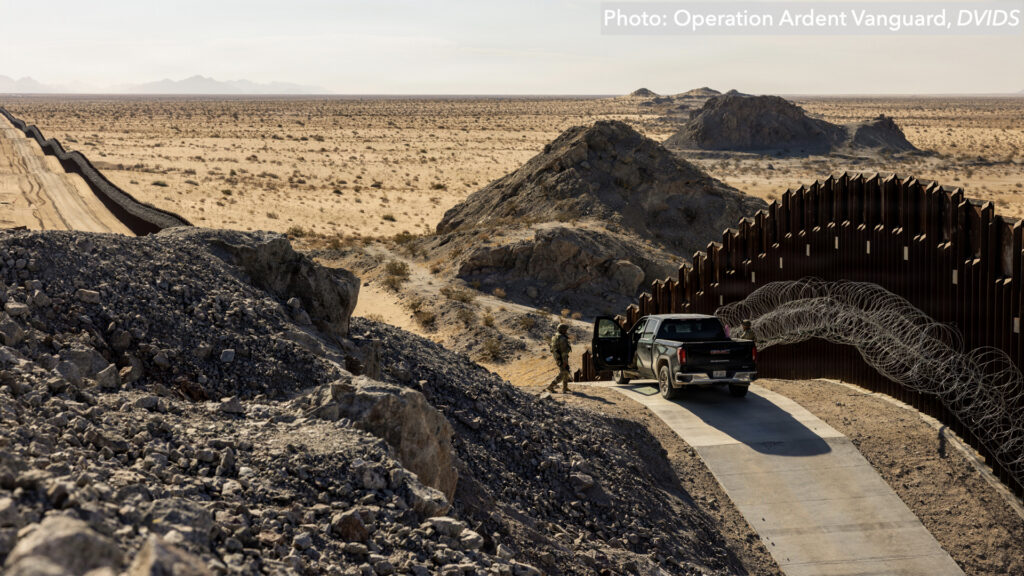
The Trump administration’s U.S. military mission at the Mexico border, which the Defense Department rechristened from “Joint Task Force-Southern Border” to “Operation Ardent Vanguard,” continues with approximately 8,000 active service members and National Guard personnel. More than 20,000 have now rotated through the border region on deployments since January 2025.
On August 14, the Justice Department’s Office of Legal Counsel issued an opinion concluding that military personnel may pursue and arrest civilian migrants on U.S. soil within and near the so-called “National Defense Areas” (NDAs), a thin fringe of territory along much of the border that the Trump administration has designated as an extension of existing nearby military installations. Soldiers may now carry out arrests in those areas and just outside NDA boundaries, and transfer them to civilian law enforcement, without violating the Posse Comitatus Act, an 1870s law that has long prohibited the use of military personnel for policing and other law enforcement except in emergencies. The memo explicitly limits its conclusions to arrests in the “immediate vicinity” of an NDA, but does not specify how far away that is.
Military personnel have temporarily detained 161 civilians since 2025; many of those apprehended in the NDAs—whether by soldiers or by civilian Border Patrol agents—have faced federal charges of trespassing on a U.S. military installation.
- Camilo Montoya-Galvez, Eleanor Watson, “Justice Department Expands Military’s Power to Detain Migrants Accused of Trespassing” (CBS News, August 15, 2026).
The Justice Department issued a legal opinion giving the U.S. military broader powers to detain migrants near certain areas along the southern border
- Stephen Dinan, “Justice Dept. Says U.S. Troops Can Arrest Illegal Immigrants Beyond Military Property Near Border” (The Washington Times, August 14, 2026).
The Justice Department has issued a new opinion deciding that military personnel can arrest some illegal immigrants without running afoul of the Posse Comitatus Act
- “Memorandum for Earl G. Matthews General Counsel Department of War” (Office of Legal Counsel, U.S. Department of Justice, August 14, 2026).
Other news
As it is now carrying out most deportations to Mexico by air, not across the land border, the Trump administration has deported hundreds of Mexican children who arrived at the border unaccompanied all the way to Mexico’s far south, alone, to cities thousands of miles from the U.S. border. Advocates say that this increases the chances of young people being recruited (or re-recruited) by organized crime groups, and that some children may have died trying to return home to Mexico’s north.
- Kate Morrissey, “U.S. Has Deported Hundreds of Children to Cities in Southern Mexico” (Capital & Main, Daylight San Diego, August 11, 2026).
Human rights organizations said the minors lack the resources to go home safely and that some may have died trying
“Camp East Montana,” the grim tent facility at the Fort Bliss military base in El Paso that is currently ICE’s largest detention center averaging nearly 2,000 people in custody, has now existed for a year. “Camp East Montana has been marked by three migrant deaths, accusations of inhuman treatment and documented poor management, which cost taxpayers millions of dollars in fraud and waste,” wrote Jeff Abbott at the El Paso Times. Rep. Veronica Escobar (D-Texas), whose district includes the camp, has paid 10 oversight visits and found alarming conditions. Migrants tell of frequent beatings by guards and lack of access to medicines and medical care.
- Jeff Abbott, “Camp East Montana: A Year of Deaths, Controversy and Management Woes” (The El Paso Times, August 17, 2026).
Camp East Montana is marking one year of operation on Fort Bliss in El Paso. The year has been marked by criticism and calls for its closure
On El Paso’s eastern outskirts, in Socorro, Texas, ICE is abandoning plans to use three warehouses that it purchased in January for $123 million. During Kristi Noem’s tenure as DHS secretary, the buildings were to be used as part of a plan to hold migrants in gigantic facilities around the country, holding 8,500 people. That purpose was then scaled back to an “ICE campus” with offices and some detention space. Now, ICE will sell off the warehouses.
- Jeff Abbott, “US Rep. Escobar: Socorro Warehouses No Longer Eyed for ICE Detention” (The El Paso Times, August 11, 2026).
U.S. Rep. Veronica Escobar has announced that the Department of Homeland Security will sell the three warehouses purchased by ICE in Socorro, Texas
- Alejandro Santos Cid, Uriel J. Garcia, “Feds to Sell Texas Warehouses It Bought for Migrant Detention” (The Texas Tribune, August 11, 2026).
U.S. Rep. Veronica Escobar said the government will put the warehouses on the market rather than convert them to house 8,000 immigrants for deportation
- “Congresswoman Escobar Announces Socorro Warehouses Will No Longer Be Used by ICE” (U.S. House of Representatives, August 11, 2026).
The Associated Press first revealed that ICE plans to spend up to $20 million on “Generated Low Output Voltage Emitter” (G.L.O.V.E.) devices, manufactured by Kentucky-based Compliant Technologies. The company’s founder has voiced a belief that President Trump is “anointed” by God. Agents would wear “shock gloves” that emit painful electric pulses but leave no marks on skin, making misuse of force harder to prove. Amnesty International and the Center for Victims of Torture have described similar devices as easily misused for torture. White House “Border Czar” Tom Homan framed the gloves as a non-lethal option for agents to “help someone get compliant when they are not.” Democratic lawmakers voiced strong opposition; Sen. Jacky Rosen (D-Nevada) called the plan to use the gloves “horrifying and infuriating.”
- Anna Giaritelli, “Are ICE Shock Gloves a Safer Way to Police or a Danger to the Public?” (The Washington Examiner, August 16, 2026).
The shock gloves were meant to give ICE a nonlethal way to deal with violent agitators and illegal immigrants, but Democrats see it differently
- Sophie Hurwitz, “The Orwellian Company Behind ICE’s New Electric Shock Gloves” (Mother Jones, August 15, 2026).
“With a glove, there are no burn marks or scars.” That makes it hard for victims to sue
- Spencer Ackerman, “The Coward’s Handshake” (Forever Wars, August 12, 2026).
ICE agents are about to get electric-shock gloves—ideal for ‘smaller officers or weaker officers or older officers,’ says an ex-cop
- Joseph Cox, “Here’s the Manual for ICE’s Electric Shock Gloves” (404 Media, August 12, 2026).
ICE plans to spends tens of millions of dollars on the gloves, which are supposed to incapacitate people. A manual 404 Media found says the gloves may even contribute to “sudden death.”
- Ryan J. Foley, “AP Exclusive: ICE Plans to Give Officers Gloves That Can Deliver Painful Electric Shocks” (Associated Press, Associated Press, August 11, 2026).
Immigration and Customs Enforcement officers may soon be outfitted with gloves that can deliver painful electric shocks that are intended to gain compliance from combative individuals
The Texas Tribune and the Cato Institute reported new details that contradict Border Patrol’s account of an agent’s killing of Isaías Sánchez Barbosa, a 31-year-old Mexican man, in Starr County, Texas, last December. In June, a grand jury did not indict the agent, Armando Flores, who shot and killed Barbosa. Further evidence points to Sanchez Barbosa being unarmed and fleeing into Mexico when he was shot.
- Lomi Kriel, “Details Emerge in Case of Migrant Killed by Border Patrol in RGV” (The Texas Tribune, August 6, 2026).
The federal agent said he shot the man in self defense last December amid a fight that erupted after agents tried to arrest the migrants who were retreating to Mexico
- David J. Bier, “New Docs Show Another Border Patrol Agent Under Investigation for Killing” (The Cato Institute, August 6, 2026).
On December 11, 2025, a Border Patrol agent killed a Mexican man in Starr County, Texas
Other stories raising concerns about the organizational culture at CBP and Border Patrol include: a new Ohio Immigrant Alliance report finding that of 152 identified immigration officials or contractors accused or convicted of criminal behavior, 131 were charged with rape and other sexual offenses, 78 of them against children; a Wired report that CBP personnel have misused databases to spy on former romantic partners or to stalk people of romantic interest; body-camera footage showing routine use of slurs and racial profiling; and the August 7 conviction, to nine years in federal prison, of a former CBP officer who facilitated Sinaloa Cartel drug shipments through San Diego-area ports of entry.
- Spencer Ackerman, “The Sex Criminals and Child Abusers of ICE and CBP” (Forever Wars, August 18, 2026).
Rape. Domestic violence. Epstein friendship. It’s all tolerated by our valiant homeland-security apparatus. PLUS: COINTELPRO 2026
- Yulia Almazova, “CBP Workers Allegedly Used Government Databases to Spy on Exes, Crushes, and Colleagues” (Wired, August 13, 2026).
Records obtained by WIRED detail hundreds of allegations of Customs and Border Protection workers misusing internal tools to look up romantic interests and track colleagues’ cell phones
- Jazmine Ulloa, Jill Cowan, Maia Spoto, “New Evidence Shows Agents Using Slurs, Bolstering Profiling Claims” (The New York Times, August 11, 2026).
Body-camera video and other court evidence capture federal agents using slurs and targeting Latinos while bypassing white bystanders during immigration sweeps in Chicago and Los Angeles
- Quinn Welsch, “Former San Diego Border Officer Sentenced to 9 Years for Sinaloa Cartel Drug Smuggling Scheme” (Courthouse News, August 7, 2026).
Another officer was sentenced last year to 15 years for helping Sinaloa Cartel-linked smugglers bring fentanyl, methamphetamine and cocaine across the U.S.-Mexico border in exchange for thousands of dollars
Border Patrol’s El Paso Sector staged a large binational rapid-response exercise along the Rio Grande on August 13, mirrored by Mexico’s Army and National Guard on the Ciudad Juárez side of the border. CBP special operations agents carried out a helicopter insertion exercise, while the Texas Military Department and other federal agencies accompanied the show of force. The event was framed as a response to the State Department’s July designation of the Juárez cartel, a long-present organized crime group, as a foreign terrorist organization. Chihuahua state and city police report a sharp increase in coordinated operations with U.S. counterparts along this part of the border; they found a notable number of makeshift ladders that migrants and smugglers use to scale the area’s border wall.
- Teofilo Alvarado, “Aqui Dejan los “Polleros” Sus Escaleras para Brincar el Muro” (Norte (Ciudad Juarez Mexico), August 14, 2026).
Anapra-Santa Teresa y el Valle de Juárez concentran los hallazgos; aunque bajó la migración, los cruces indocumentados no han desaparecido
- Jeff Abbott, “Border Patrol Sends Message to Cartels With Show of Force in el Paso” (The El Paso Times, August 14, 2026).
U.S. and Mexican federal law enforcement agencies sent a message to drug cartels in show-of-force operation
- Mauricio Rodriguez, “Operativo en el Rio Bravo Envia Mensaje a Grupos Criminales para Que Desistan de Cruzar: Border Patrol” (Norte (Ciudad Juarez Mexico), August 13, 2026).
El despliegue de fuerzas y equipamiento realizado esta mañana es una muestra de la preparación y el blindaje con el que se cuenta en la frontera, afirmó
- Aracely Lazcano, “Strong Security Presence at the Us-Mexico Border Aims to Disrupt Cartel Operations” (Border Report, August 13, 2026).
- “Manana Jueves Habra Operativo Militar Conjunto en la Frontera Juarez-el Paso” (Norte (Ciudad Juarez Mexico), August 12, 2026).
Autoridades de EU y México realizarán un ejercicio de respuesta rápida con helicópteros, fuerzas especiales y un patrullaje espejo; no se prevén afectaciones en los puentes internacionales
- “Mexico y Eua Realizan Operativos en la Frontera para Evitar Contrabando de Armas y de Personas” (NMAS (Mexico), August 11, 2026).
En la frontera norte autoridades de México y Estados Unidos realizan operativos para prevenir delitos como el transporte ilegal de armas, que continúa inundado el mercado negro en nuestro país
Ciudad Juárez security officials noted that criminals continue to kidnap migrants for ransom in the city, though the incidence of such cases is down. Kidnappers recently released an Ecuadorian couple, dazed, beaten, and still in handcuffs, in the city’s Álvaro Obregón neighborhood.
- Teofilo Alvarado, “Siguen Secuestrando a Migrantes Grupos Delincuenciales, Lamenta Jefe Policiaco” (Norte (Ciudad Juarez Mexico), August 7, 2026).
Anoche quedó liberada una pareja de ecuatorianos, pero presuntos plagiarios atacaron a un hombre y a su hija ajenos a los hechos; no hubo detenidos
The New York Times’s Hamed Aleaziz reported that the Trump administration deported back into Mexico a group of Mexican citizens whom an immigration court had granted Convention Against Torture protections prohibiting their return. In a highly unusual move, ICE director David Venturella “reversed the protections, citing diplomatic assurances received by the State Department from the government of Mexico that the deportees would not be harmed.”
- Hamed Aleaziz, “Trump Officials Deport Group of Mexicans Despite Torture Risk” (The New York Times, August 7, 2026).
Immigration authorities used a rare authority to deport them, even though their removal was blocked over concerns they would be tortured if returned
Kilmar Abrego Garcia’s case remains unresolved, even as the Salvadoran man whom the Trump administration wrongfully sent to El Salvador’s CECOT prison last year has said he is willing to be deported to Costa Rica, whose government would accept him. The Justice Department asked the 6th Circuit to reinstate criminal charges against him after a Tennessee judge, in May, dismissed human trafficking charges as vindictively motivated. ICE is separately seeking to deport Abrego Garcia to Liberia; a federal judge has blocked that for now.
- Camilo Montoya-Galvez, “Justice Department Asks Court to Reinstate Criminal Charges Against Kilmar Abrego Garcia” (CBS News, August 17, 2026).
In May, a federal judge dismissed a criminal indictment against Abrego Garcia, who had been accused of smuggling immigrants in the U.S. illegally
Cancellations of Temporary Protected Status (TPS) continue to reverberate, following the Supreme Court’s June 25 ruling clearing the way for TPS terminations. At the New Yorker, Dara Lind of the American Immigration Council called the ongoing stripping of legal status from more than 1.3 million people “the Great Delegalization.” As a result of the Supreme Court decision, hundreds of thousands of Haitians have lost their ability to live and work in the United States, strongly impacting some service sectors like elder care. TPS for approximately 170,000 citizens of El Salvador ends September 9, 2026; no decision has been announced, and it is unclear how the Trump administration will act, as a mass return and loss of remittance revenue would challenge Salvadoran leader Nayib Bukele, a close administration ally.
- Alejandro Maciel, “TPS for Salvadorans Ends on Sept. 9. Thousands of Families at Risk of Deportation” (Times of San Diego, August 13, 2026).
About 170,000 Salvadorans could lose protection, including thousands living in Southern California
- Dara Lind, “These Immigrants Lived in the U.S. Legally. Now Trump Is Changing Their Status.” (The New Yorker, August 10, 2026).
More than a million immigrants are seeing protections that granted them safe lives in the U.S. suddenly swept away
- Laura C. Morel, “Building a Soft Landing for Haitians Heading Back to the Island” (Mother Jones, August 10, 2026).
Now without TPS, can they build a new life in the struggling nation? One organization says yes
- Hamed Aleaziz, Madeleine Ngo, “After Supreme Court Win, Trump Officials Under Pressure to Deport Haitians” (The New York Times, August 8, 2026).
The lack of visible raids aggressively targeting Haitians who lost temporary status has frustrated some of President Trump’s most fervent supporters
- Maye Primera, “‘Nobody Should Be Forced to Return to Haiti’: UN Expert Warns the Island Is Unfit to Receive Deportees” (El Pais (Spain), August 9, 2026).
Controlled by gang violence and with 1.5 million internally displaced people, the country is in a ‘catastrophic’ situation that could worsen with the end of TPS in the United States
Remittances sent home by migrants from Guatemala, Honduras, and El Salvador grew 7.8 percent during the first half of 2026, compared to the same period in 2025, totaling over $24 billion. The Inter-American Dialogue attributes the increase partly to migrants, amid heightened ICE raids, sending money more frequently and in larger amounts as a precaution should they be deported.
- “Las Remesas a Guatemala, el Salvador y Honduras Crecen 7.8% en el Primer Semestre de 2026” (EFE, La Hora (Guatemala), August 15, 2026).
Las remesas familiares recibidas por Guatemala, El Salvador y Honduras incrementaron un 7.8% en el primer trimestre del año
- Eduardo Smith, “Guatemala Recibio en Julio Usd 2 Mil 468 Millones en Remesas, el Monto Mas Alto Mensual, Segun el Banguat” (La Hora (Guatemala), August 6, 2026).
Las remesas siguen al alza; en julio pasado, Guatemala recibió el monto más alto de los datos registrados por el Banguat. Acá le decimos el monto.
The Trump administration is moving ahead with a plan to collect steep fines—approximately $423 million, mainly for immigration violations—from about 66,387 already-deported migrants in Central America and Mexico, hiring contractors using “skip tracing” techniques to locate them in their countries of origin. This is generating an outcry in the region. Guatemalan President Arévalo stated that any company operating in Guatemala must comply with national laws, but his government has not yet taken a formal position.
- Pavel Arellano, “Cobro de Ee. Uu. A Migrantes Deportados: Lo Que se Sabe del Plan de Trump y la Postura de Guatemala” (Prensa Libre (Guatemala), August 11, 2026).
EE. UU. planea localizar en Guatemala y otros países a migrantes deportados que mantienen multas y sanciones pendientes, según información del DHS
- Cesar Perez Marroquin, “Arevalo Marca Limites Ante Cobros de Ee. Uu. A Migrantes Guatemaltecos y Advierte Que Deberan Respetar la Legislacion Nacional” (Prensa Libre (Guatemala), August 10, 2026).
El presidente Bernardo Arévalo marcó la posición de su Gobierno ante el endurecimiento de la política migratoria de Estados Unidos
- Diego Estuardo Guzman, Kenneth Jordan, “Gobierno Aun Sin Postura Sobre Plan de Ee. Uu. Para Cobrar Multas Migratorias en Guatemala” (La Hora (Guatemala), August 7, 2026).
EE. UU. pretende contratar una empresa para buscar en Guatemala a connacionales que deban multas migratorias y cobrarlas. El Gobierno aún no tiene postura sobre ello
A New York Times investigation detailed Operation Sisyphus, a Federal Bureau of Investigation (FBI) and ICE Homeland Security Investigations (HSI) task force targeting a Cuban criminal network that stole hundreds of boats from southwest Florida to smuggle thousands of migrants from Cuba to Mexico, and then to the United States. About 25 died during boat voyages; those who couldn’t pay the $10,000 fee were held captive in Mexico and tortured. Raúl Rodríguez Castro, Fidel Castro’s grandson, stands accused—but not charged—of helping the criminal operation from within Cuba.
- David C. Adams, Frances Robles, “What to Know About the Cuban Mafia in Quintana Roo” (The New York Times, August 11, 2026).
A group of Cuban men in Mexico was charged with smuggling people to the United States. One of its leaders said Raúl Castro’s grandson helped, according to interviews and court records
Mexico’s National Migration Institute (INM) announced a 36-hour maximum stay limit in the country’s immigration detention centers, formalizing a requirement established in 2023 when Mexico’s Supreme Court declared longer periods of administrative detention unconstitutional. INM Commissioner Sergio Salomón Céspedes cited “a principle of non-repetition” following a March 2023 fire at the Lerdo-Stanton station in Ciudad Juárez that killed 40 migrants locked inside. Francisco Garduño, the INM commissioner at the time who still faces civil charges, returned to Ciudad Juárez in August, this time as an education official overseeing vocational training centers.
- “Mexico Ajusta Politicas de Estaciones Migratorias y Limita a 36 Horas la Estancia Maxima” (EFE, Swissinfo.ch, August 14, 2026).
El Instituto Nacional de Migración (INM) de México aplicará a partir de ahora un límite máximo de 36 horas de permanencia en las estaciones migratorias (zonas en las que los migrantes irregulares son retenidos) y mantendrá supervisiones permanentes y aleatorias, como parte de las medidas para evitar abusos y sucesos como el incendio en una estación de Ciudad Juárez en 2023
- Teofilo Alvarado, “Garduno Vuelve a Juarez Como Funcionario de la Sep; Le Recuerdan Sus Pendientes” (Norte (Ciudad Juarez Mexico), August 19, 2026).
Mientras el excomisionado del INM Francisco Garduño recorrió cuatro planteles educativos como parte de sus nuevas funciones, organizaciones que acompañan a víctimas recuerdan que el proceso por la muerte de 40 migrantes sigue abierto y que deberá enfrentar una nueva audiencia
Links: “mass deportation” and human rights in the U.S. interior
Abusive ICE detention
- Isabel del Mastro, Rene Kladzyk, “Inside ICE’s Broken System for Inspecting Detention Facilities” (Project on Government Oversight, August 18, 2026).
New data reveals a twisted ICE detention oversight system where facilities get glowing grades, even amid deadly conditions
- Jazmine Ulloa, “Judge Orders New Oversight of Immigrant Children’s Detention” (The New York Times, August 18, 2026).
After reviewing claims of persistent safety and sanitary failures, the court named two experts to monitor detention conditions across several facilities
- Adam Rose, “ICE Shot a Journalist and Threw Him in Detention. He’s Approaching 300 Days Behind Bars With a Festering Wound.” (The Intercept, August 16, 2026).
With the case of Carlitos Ricardo Parias, the U.S. has broken its own record for holding a journalist in custody
- Steve Janoski, “ICE Releases Name of Third Detainee Who Died After Being Held at Delaney Hall” (The Jersey Vindicator, August 12, 2026).
- Alex Ford, Alex Nguyen, Colleen Deguzman, Uriel J. Garcia, “Texas Detention Center Holding Kids Beyond Court-Ordered Limit” (The Texas Tribune, August 12, 2026).
The nation’s only detention center for families is routinely holding children beyond the 20-day limit, including an Iranian-born “average American kid” who’s been locked up for 123 days and counting
- Aliya Schneider, Andrea Padilla, Michelle Myers, “Edwin Lopez Cornejo Prayed for Another Year to See His Daughter Grow Up. He Died in ICE Custody.” (The Philadelphia Inquirer, August 11, 2026).
Documents and social media posts paint a picture of a loving father. His death launched a civil rights investigation into the Delaney Hall ICE detention center
- David Kurtz, “First at TPM: Judge Orders Immigrant Released After Surreal Journey Through Trump’s Gulag Archipelago” (Talking Points Memo, August 10, 2026).
The Bureaucratic Hellscape of Trump Authoritarianism
- Gabby Birenbaum, “Democrats in Congress Say ICE Lockup Conditions Are Worsening” (The Texas Tribune, August 7, 2026).
Immigration officials denied the allegations, but Reps. Joaquin Castro and Veronica Escobar said they’ve come across numerous problematic examples
Civil liberties and constitutional protections in the United States
- Greg Sargent, “Trump’s Secret Police Spying on Americans? It’s Darker Than We Knew.” (The New Republic, August 19, 2026).
Court papers reveal that the Department of Homeland Security’s covert surveillance of anti-ICE groups is much darker than it first appeared. Welcome to Donald Trump’s America
- Alan Feuer, Ernesto Londono, “U.S. Investigated Left-Leaning Groups During Minnesota Immigration Crackdown” (The New York Times, August 13, 2026).
The government conducted expansive surveillance, infiltrated group chats and obtained financial records of organizations never accused of crimes
Hardline DHS immigration policies in the courts
- Jessie Blaeser, Kyle Cheney, “ICE’s Wins on Mandatory Detention Come From Just a Handful of Judges” (Politico, August 19, 2026).
Trump’s second-term appointees have sided with the administration more than 60 percent of the time — twice the rate of his first-term judges
- Suzanne Monyak, “Fast-Tracked Deportations for Migrants Permitted by Court” (Bloomberg Law, August 11, 2026).
A federal appeals court cleared the way for the Trump administration to revive directives that put hundreds of thousands of migrants at risk to be deported under a fast-tracked process
- Kyle Cheney, “‘We’ve Never Seen Anything Like This’: ICE’s Detention Crackdown Swamps the Courts” (Politico, August 10, 2026).
Families, lawyers and judges describe a year of frantic emergency cases after ICE began detaining people who have lived in the U.S. for years
Legal defense for unaccompanied children
- Ruth Marcus, “How Trump Is Trying to Weaken Migrant Children’s Legal Defense” (The New Yorker, August 15, 2026).
After failing to eliminate funding for unaccompanied minors’ lawyers altogether, the Administration is pushing cases toward entities that lack both immigration expertise and the capacity to take them on
- Anat Shenker-Osorio, “Stephen Miller’s Secret Campaign Against Helpless Kids” (Public Notice, August 13, 2026).
That it’s happening in the shadows doesn’t make it less of a moral blight
- Ryan J. Foley, Valerie Gonzalez, “Law Firm With Ties to Trump Administration Declines Offer to Represent Migrant Children” (Associated Press, Associated Press, August 12, 2026).
A Houston-based law firm tapped to receive a $150 million federal contract to provide legal representation unaccompanied immigrant children in federal custody has dropped out
- Liam Bowman, Ted Hesson, “Ex-ICE Agent’s Group Awarded $158 Million to Represent Migrant Children” (The Washington Post, August 11, 2026).
The Trump administration gave the contract to Our Rescue, which Tim Ballard, the former agent, left in 2023 before being accused of sex trafficking
- Whitney Curry Wimbish, “Disgraced Anti-Sex-Trafficking NGO Gets $244 Million to Rep Migrant Kids” (The American Prospect, August 11, 2026).
The founder and CEO of Our Rescue resigned in 2023 amid allegations that he had sexually abused and trafficked women himself
- Ruben Vives, “Trump Administration to Pay $65 Million Owed to Lawyers of Unaccompanied Migrant Children” (The Los Angeles Times, August 7, 2026).
U.S. District Judge Araceli Martinez-Olguin ordered the Department of Health and Human Services to release the funds by noon Friday, Pacific time
- Jeff Abbott, “Federal Judge Orders Trump Administration to Pay Legal Aid Groups” (The El Paso Times, August 6, 2026).
A federal judge has ordered that the Trump administration must pay legal aid groups, including the El Paso-based Estrella del Paso, by noon Aug. 7 for defense work
ICE use of force
- Maia Spoto, Murray Carpenter , “Family Presses for Information About Fatal ICE Shooting in Maine” (The New York Times, August 17, 2026).
The Department of Homeland Security said there would be an investigation. But so far little has been disclosed about the killing last month
- Pablo Manriquez, “Exclusive: Two DHS Sources Confirm to Migrant Insider — the ICE Agent Who Pointed His Gun at a U.S. Citizen in Virginia Is Martin Lagunas” (Migrant Insider, August 14, 2026).
The Chicago-based agent was already identified on social media and by Unraveled Press. Now, two Department of Homeland Security sources have confirmed his name to Migrant Insider
- Stephania Taladrid, “Who Killed Lorenzo Salgado Araujo?” (The New Yorker, August 13, 2026).
A death during an ICE traffic stop raises outrage in Houston—and in Mexico
- Juan Benn Jr., “It ‘Felt Like a Renee Good Situation,’ U.S. Citizen Says After ICE Encounter” (The Washington Post, August 12, 2026).
Video from the Virginia incident, which shows an agent with a gun, has reignited conversations about the aggressiveness of ICE enforcement
ICE body-worn cameras
- “ICE Says It Expects to Equip Every Field Officer With Body Cameras by the End of August” (Associated Press, Associated Press, August 8, 2026).
U.S. Immigration and Customs Enforcement says it expects every officer and agent in the field to be equipped with a body camera by the end of August, a rapid expansion that could provide an unprecedented visual record of the federal government’s immigration enforcement operations
- Ryan J. Foley, “ICE Will Release Body Camera Video Only When Seen in the Agency’s ‘Best Interests,’ Policy Says” (Associated Press, Associated Press, August 7, 2026).
Immigration and Customs Enforcement is moving to equip officers with body cameras in the next two months but the public should not expect to quickly see footage of every critical incident
ICE arrests
- Jaclyn Diaz, Marisa Penaloza, “ICE Uses Controversial Program to Boost Deportations. Here’s How It Works in 1 County” (National Public Radio, August 14, 2026).
Details on how ICE cooperation agreements work in practice have been hard to come by. NPR took a close look at how sheriff’s deputies in Walton County, Fla., approach immigration-related arrests
- Brittny Mejia, “Federal Judge Signals a Halt to Warrantless Immigration Arrests in SoCal Unless Person Is Likely to Escape” (The Los Angeles Times, August 13, 2026).
A California federal judge signaled Thursday that she is likely to order immigration agents to stop arresting people without warrants unless they determine they are likely to escape
- Pablo de la Rosa, “The Rio Grande Valley Will Pay Over $300 Million in Taxes for Trump’s Raids in Their Own Neighborhoods” (Across the Americas, August 13, 2026).
As immigration enforcement raids unfold in South Texas neighborhoods, families are paying in anxiety and economic loss. A new study shows taxpayers in the region will also foot the tax bill in the hundreds of millions for Trump’s mass deportations
- Tom Latchem, “Trump Faces Bombshell Probe Over ICE Raids on Troops’ Families” (The Daily Beast, August 11, 2026).
Lawmakers demand answers after ICE detained more than 50 spouses and parents of active-duty troops
- c.j. Ciaramella, “North Carolina Citizen Files Damages Claim After Border Patrol Arrested Him, Then Left Him on Roadside” (Reason, August 7, 2026).
A viral video showed immigration officers uncuffing Fernando Vasquez and then dumping his papers onto the ground before driving off
Immigration policy
- Sergio Martinez-Beltran, “ICE Detained a Venezuelan Soccer Pro. His Case Shows the Immigration Backlog Crisis” (National Public Radio, August 15, 2026).
Homero Calderón’s detention by ICE spotlights the massive backlog in the U.S. immigration system
- Hamed Aleaziz, “Trump’s Immigration Policy Echoes 1920s Turn Against Certain Newcomers” (The New York Times, August 13, 2026).
U.S. leaders limited immigration amid economic and social turmoil. Historians see similarities to Trump’s crackdown, with a catch: He’s doing it without Congress
- Adrian Carrasquillo, “Trump Gave Democrats an Opening on Immigration. They’re Afraid to Take It.” (Huddled Masses, The Bulwark, August 8, 2026).
The abuses have piled up. The polling has moved. Immigration groups urge House Dems to run on the issue
- Priscilla Alvarez, “‘It’s Been Chaotic’: Trump’s Immigration Crackdown Prompts Worries From Industry Groups” (CNN, August 8, 2026).
Industry groups ranging from construction to agriculture are raising concerns with the Trump administration over its ongoing immigration crackdown, arguing it is undercutting President Donald Trump’s agenda and weakening the economy, according to multiple groups who spoke with CNN and sources close to the White House
DHS budgets and management
- Andrea Fuller, David A. Fahrenthold, Hamed Aleaziz, Julie Tate, Nicholas Nehamas, “Homeland Security Paid $464 Million for Airplanes. Then It Parked Them.” (The New York Times, August 13, 2026).
The agency used a no-bid contract to buy 10 used jets, saying they were urgently needed for deportation flights. But the fleet has largely sat idle for months
Newsletter
Subscribe to get the latest on analysis and policy