
Adam Isacson

Adam Isacson
Director for Defense Oversight
Adam Isacson has worked on defense, security, and peacebuilding in Latin America since 1994. He now directs WOLA’s Defense Oversight...With this series of weekly updates, WOLA seeks to cover the most important developments at the U.S.-Mexico border. See past weekly updates here.
Your donation to WOLA is crucial to keeping these paywall-free and ad-free Updates going. Please contribute now and support our work.
THIS WEEK IN BRIEF:
- Border Patrol apprehensions, while low, increased again in September: DHS announced that Border Patrol agents apprehended 237,565 migrants at the U.S.-Mexico border during the 2025 fiscal year, the fewest since 1970. However, apprehensions in September were 82 percent greater than they were in July, their lowest point.
- ”Mass deportation” updates: Tensions are very high in Chicago as the Trump administration intensifies an immigration enforcement operation. Border Patrol agents shot and wounded a woman, the second discharge of firearms after the September 12 ICE killing of a Mexican man; on both occasions, subsequent information has cast doubt on DHS’s initial version of events. The Trump administration is seeking to deploy Texas National Guard personnel to Illinois. Apple agreed to remove several apps that track ICE activity. ICE plans to offer unaccompanied children $2,500 to abandon their asylum cases and return home.
- Law enforcement agencies continue diverting personnel to immigration duties: At least 25,000—and perhaps as many as 42,000—personnel from federal law enforcement agencies have been moved into immigration duties in support of the Trump administration’s “mass deportation” effort. About 3,000 of the FBI’s 13,000 agents are now spending at least 50 percent of their time on immigration enforcement instead of fighting organized crime, drug trafficking, cybercrime, or human trafficking, among other missions.
THE FULL UPDATE:
Border Patrol apprehensions, while low, increased again in September
The Department of Homeland Security (DHS) announced that Border Patrol agents apprehended 237,565 migrants at the U.S.-Mexico border during the 2025 fiscal year, which ended on September 30. That is the smallest annual number of migrant apprehensions since 1970 (201,780), and a majority of the fiscal year’s apprehensions took place before Joe Biden left office on January 20, 2025.
Reporting alongside Border Patrol management on a visit to Eagle Pass, Texas, NBC News noted a sense of quiet and calm in a sector of the border that had seen large numbers of arriving asylum seekers during the Biden administration. Border Patrol is now apprehending approximately 20 people per day in Eagle Pass.
Across the border from South Texas in Reynosa, Tamaulipas, Mexico, Héctor Silva of the Senda de Vida shelter said that his facility is housing just over 100 people, down from thousands at a time in recent years: “We already have a month without a migrant family coming from Central America.” In Ciudad Juárez, a Chihuahua state government survey of 26 migrant shelters found that their combined population had fallen to 532, and 42 percent of them were citizens of Mexico, either deported or internally displaced. Venezuela remains the number-one non-Mexican nationality.
The drop owes to at least three factors. First, the Trump administration’s legally dubious suspension of the right to seek asylum caused a near-total decline in the population of asylum seekers aiming to turn themselves in to U.S. border personnel; that population had made up a majority of Border Patrol’s apprehensions over the past decade. Second, word of the administration’s “mass deportation” campaign has spread, as would-be migrants see images of violent arrests, hear accounts of poor treatment in custody, and hear from contacts in the United States about the climate of fear in which they are living. Third, it is possible that the U.S. economy has softened, and demand for migrant labor could be declining.
The data, however, show a reversal in the decline of apprehensions over the past few months. Monthly apprehensions dropped to 4,596—the fewest since the mid-1960s—in July. While they remain historically low, they have since grown to 6,321 in August and about 8,382 (judging from the newly reported annual figure) in September. That’s a 33 percent increase in apprehended migrants from August to September, and an 82 percent increase from July to September.
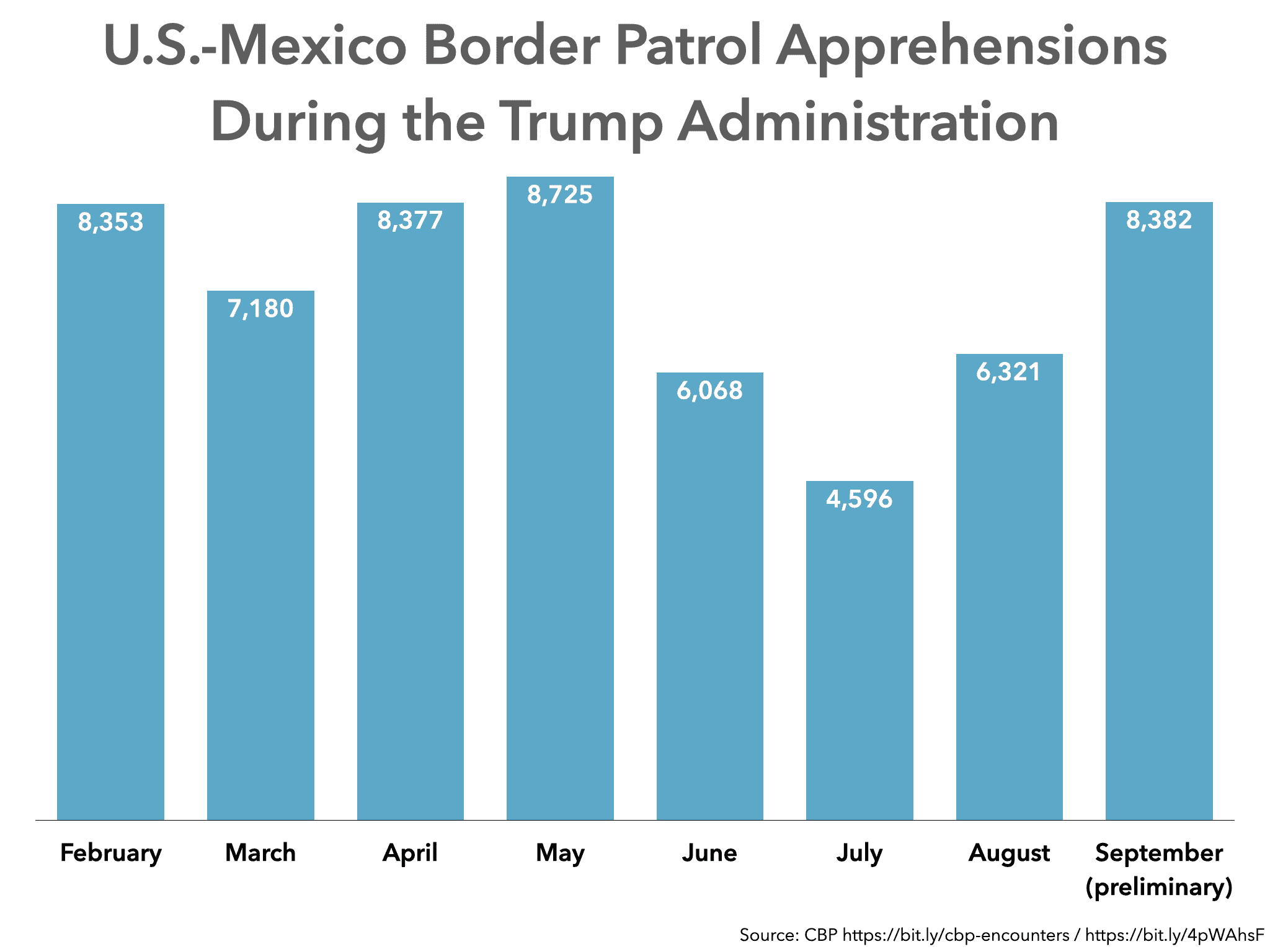
It’s not clear why monthly apprehensions are now increasing. The New York Post reported at the end of August, citing a DHS official, that an increasing number of those apprehended were individuals seeking to return to the United States after being recently deported by Immigration and Customs Enforcement (ICE) from the U.S. interior. The increase could also be seasonal: migration often peaks in the spring and fall, while declining in the summer and winter. This trend was less visible in recent years, when the migrant population included large numbers of asylum seekers, who did not appear to follow seasonal patterns as closely.
”Mass deportation” updates
Despite big budget, ICE’s detention capacity growth is “stalled”
The $45 billion in new funding for detention operations that ICE received from the so-called “One Big Beautiful Bill Act” in July has yet to result in an increase in the population in the agency’s network of detention centers, which has ranged between 56,397 and 61,226 since June 15.
This is partly explained, according to the Atlantic’s Nick Miroff, by DHS Secretary Kristi Noem’s policy of requiring personal approval for all contracts valued at over $100,000. That has prevented the rapid addition of new ICE detention beds, though it may be working to the advantage of state governments, like Florida, that are charging higher prices to hold detained migrants at their own facilities. Grumbling from eight current and foreign officials within the department pointed to the role of Corey Lewandowski, the former Trump campaign official now serving as a sort of de facto chief of staff to Noem, in slowing spending.
Chicago
Tensions continue escalating around the Trump administration’s “Operation Midway Blitz” mass deportation campaign in Chicago. ICE agents, backed by personnel from Customs and Border Protection (CBP), Border Patrol, and other agencies, are freely using force as they round up people they believe to be undocumented migrants and confront protesters.
Border Patrol agents shot and injured a woman in Chicago’s Brighton Park neighborhood on October 5. DHS claimed that Marimar Martinez, a U.S. citizen, rammed a Border Patrol vehicle while other cars “boxed” them in, and drove at an agent before one of them opened fire in self-defense, noting that Martinez was “armed with a semiautomatic weapon.” However, body-camera footage showed a Border Patrol agent pulling over, exiting his vehicle, saying “Do something, b—-,” and shooting her several times, the Chicago Sun-Times reported. Prosecutors’ documents, which came after the initial DHS statement, did not mention Martinez’s gun, which her attorney says she did not brandish and is covered by a concealed-carry license.
Martinez and Anthony Ian Santos Ruiz, also arrested during the incident, were in a convoy of citizens following Border Patrol vehicles for over 20 minutes, filming some of their pursuit on social media. They were charged with felony assault of a federal officer, but were released pending trial due to lack of criminal history and community ties.
This is the second time that DHS personnel participating in “Midway Blitz” have fired a weapon at a civilian and then had their initial account of the incident challenged. On September 12, an ICE agent shot at Mexican citizen Silverio Villegas-González, killing him while he was at the wheel of his car. The agency claimed that an agent was injured when Villegas-González’s car dragged him “a significant distance,” but security and local police body-camera footage have cast doubt on the official story (see WOLA’s September 26 Border Update).
Reports continued to emerge about a very aggressive and legally questionable DHS raid on a South Shore Drive apartment building in the middle of the night of September 29-30 (see WOLA’s October 3 Border Update). As some rappelled to the building from a Black Hawk helicopter, agents without apparent search warrants broke down most of the building’s apartments’ doors, pulling people out in the middle of the night and ransacking their homes.
DHS claimed that the apartment’s neighborhood was “a location known to be frequented by Tren de Aragua members and their associates,” referring to the Venezuelan criminal organization, but provided no evidence to back up that assertion. “The show of force highlighted President Donald Trump’s unprecedented use of Border Patrol agents as a surge force in major cities,” noted a Reuters report.
A DHS spokesperson contacted by Reuters “declined to say whether agents had warrants to forcibly enter homes, saying that because Tren de Aragua has been labeled a terrorist organization, ‘there are sensitivities on what we can provide without putting people at risk.’”
A Guardian article by Siri Chilukuri highlighted what strongly appears to be disproportionate force used by DHS forces in Chicago against protesters and journalists, including tear gas, pepper balls, and physical force. “What was unique on the first day is that it didn’t feel like ICE had planned to use their legal tools to remove us,” said a protester named A’keisha. “They have the right, right to say, ‘Y’all gotta leave, arrest them.’ But they didn’t. They chose instead to be violent and, like, push us and throw us to the ground and drag us.”
A lawsuit filed by journalists and demonstrators alleges, according to Mother Jones, that “federal officers are firing so much tear gas at protesters outside an ICE facility in Broadview, Illinois [a Chicago suburb], that some nearby community members who aren’t even protesting are struggling to breathe when they leave their homes to run errands.” (See WOLA’s October 3 Border Update for past coverage of the response to protests in Broadview, which has drawn sharp criticism from the town’s mayor and police chief.) “Snipers with guns loaded with pepper balls, paintballs, and rubber bullets are stationed on the roof of the Broadview ICE facility with their weapons trained on the press and civilians,” the lawsuit continues. “Federal agents have tackled and slammed people to the ground; they have lobbed flash grenades and tear gas canisters indiscriminately into the crowd.”
Video first posted on September 19, publicized by an October 7 Religion News Service article, showed a sniper on the roof of the ICE facility striking Presbyterian Minister David Black in the head with a chemical munition while he was praying outside the facility with his arms outstretched. “It was clear to me that the officers were aiming for my head, which they struck twice,” Black said. The video shows Black falling to his knees; “We could hear them laughing,” the Minister said.
Rev. Hannah Kardon, a United Methodist pastor, told Religion News Service that she, too, had been shot multiple times with pepper bullets, including while praying and wearing clerical clothing. “They are unhinged,” she said of the agents. Individuals clearly identified as “press” were also subjected to very rough treatment as they recorded video, Mother Jones noted.
Writer Emily Wheeler noted that, according to an October 6 court filing, the outspoken “at large” chief of operations in Chicago, Border Patrol Sector Chief Greg Bovino, visited Broadview police headquarters on September 27 and warned municipal cops there to “prepare for a s—show.” The document continues, “Specifically, federal agents, including Agent Bovino, told the Broadview police to expect increased use of chemical munitions and increased ICE activity in Broadview. That afternoon and evening, September 27, Agent Bovino and his colleagues followed through on their warning.”
Wheeler observed that of 11 people announced as arrested for being “violent rioters” at the Broadview ICE facility, only two are now facing charges.
The police chief of Broadview, Thomas Mills, said that ICE agents have been making false 911 emergency calls, like claims that someone was tampering with the facility’s gate, when only a CBS News crew was present, which has been draining his department’s resources. “It’s disturbing. It’s ridiculous,” Chief Mills said.
In a move with few modern precedents, the Trump administration has deployed National Guard personnel from one state to another over the objections of the receiving state’s governor. Approximately 200 Texas National Guard soldiers, along with 300 federalized Illinois National Guard personnel and some California National Guard personnel, were federalized and deployed in the greater Chicago area. “These soldiers are employed to protect U.S. Immigration and Customs Enforcement and other U.S. Government personnel who are performing federal functions, including the enforcement of federal law, and to protect federal property,” tweeted the Defense Department’s Northern Command.
As of October 7, some Texans were at an Army Reserve facility approximately 50 miles from Chicago. “I fully authorized the President to call up 400 members of the Texas National Guard to ensure safety for federal officials,” tweeted Texas Gov. Greg Abbott (R). “You can either fully enforce protection for federal employees or get out of the way and let Texas Guard do it.”
Illinois and Chicago filed a lawsuit on October 6 challenging the constitutionality of deploying another state’s National Guard against the governor’s wishes. Following a hearing late on October 9, U.S. District Judge April Perry issued a 14-day temporary restraining order blocking National Guard operations in the Chicago area.
The governor of Illinois, JB Pritzker (D), has vocally opposed the “Midway Blitz” and military deployments to his state. President Trump took to his social media platform to call for the jailing of Pritzker and Chicago Mayor Brandon Johnson. In response, Pritzker tweeted, “I will not back down. Trump is now calling for the arrest of elected representatives checking his power. What else is left on the path to full-blown authoritarianism?” Pritzker called the National Guard deployment “a show of force so he can militarize our cities because of the 2026 elections.”
Mayor Johnson signed an executive order designating all city-owned properties as “ICE-free zones.” The agency’s personnel, Pablo Manríquez of Migrant Insider reported, are now barred from municipal sites “including parking lots, libraries, parks, and municipal buildings.”
A federal judge in Chicago extended a 2022 nationwide consent decree requiring ICE to better document and report probable cause for immigration arrests, finding that the agency has been repeatedly violating the agreement by carrying out “warrantless arrests” in the city. In a 52-page ruling, U.S. District Judge Jeffrey Cummings criticized ICE for incorrectly telling officers that the consent decree had been canceled, questioned the massive South Shore apartment building raid, and took issue with the practice of carrying blank warrant forms to circumvent probable-cause requirements. The judge ordered ICE to release detainees subjected to warrantless arrests in Chicago and provide documentation for all arrests made without warrants in northern Illinois since June.
Mark Fleming, a lead attorney for the National Immigrant Justice Center and the American Civil Liberties Union, who are among the plaintiffs in the suit that led to Judge Cummings’s decision, told the Chicago Tribune that the number of warrantless arrests under “Midway Blitz” is likely to be well above 200 so far. The original consent decree resulted from a 2018 lawsuit originating from a Chicago-area ICE enforcement operation, during which agents were creating “post-hoc” arrest warrants for people already in custody.
Since the Trump administration launched a Washington, DC anti-crime and immigration enforcement operation in early August, nearly 40 percent of over 3,550 arrests have been immigration-related, CBS News reported. “The federal figures also suggest ICE agents have visited over 130 work sites in Washington.”
In Portland, Oregon, the Trump administration is also seeking to send National Guard personnel to confront protests occurring outside of an ICE facility. (So far, a federal judge has blocked this deployment, though a three-judge appeals court panel with two Trump-appointed judges might undo that.) Despite dire language from President Trump, the New York Times found that as recently as September 26, federal officers’ internal reports were portraying the protests as “low energy,” with the demonstrator count of September 25 peaking at 20.
Detention
Writing at #DetentionKills, Andrew Free noted that Huabing Xie, a Chinese national who died in ICE custody on September 29 at the Imperial Regional Detention Facility in California, became the 23rd person to die in ICE detention during fiscal year 2025, which ended on September 30. That is the second-highest annual total ever (28 deaths in 2004). It appears that seventeen of those cases happened after Donald Trump took office in January: on September 23, Rep. Pramila Jayapal (D-Washington) had announced two deaths, citing a total of 16.
At the American Prospect, Emma Janssen cited the case of Willian Giménez González, a man held at ICE’s Broadview facility outside Chicago, as an example of how ICE is making it very difficult for immigration attorneys to access their detained clients, often by transferring them to detention sites around the country. Giménez González’s attorney, Kevin Herrera, had to file a writ of habeas corpus to compel the court to reevaluate the detention.
Citing fired employees of the agencies, NPR’s Ximena Bustillo reported that the administration’s near-total dismantling of the DHS Office of Civil Rights and Civil Liberties (CRCL) and the Office of Immigration Detention Ombudsman (OIDO) has left detainees much more vulnerable to human rights abuse. Now that they cannot file complaints with those internal watchdogs, immigrant rights advocates are turning to Congress for help addressing the most severe cases. With ICE’s detention system now flush with funding, “If we were still there, we would be incredibly busy,” one former CRCL employee said.
Writing at Reason, C.J. Ciaramella found that the Florida state government built its Everglades detention facility under dubious emergency powers, bypassing legislative oversight and operating without clear legal authority. Its $450 million operational budget comes from a disaster preparedness fund with virtually no legislative accountability. The article summarizes allegations of inhumane conditions—possibly an inducement to convince detainees to give up on immigration cases and “self-deport”—and the environmental harm of expanding a facility located in the Big Cypress National Preserve.
Deportation flights are increasing
September’s ICE flights removing people from the United States reached their highest monthly total since the Human Rights First ICE Flight Monitor dataset began in 2020. The project’s latest report noted at least 223 flights to 48 countries last month. Guatemala and Honduras (55 flights each) were the top destinations by far, while flights to Mexico’s south dropped from a single-month record 72 in August to 9 in September.
Apple takes down apps designed for citizen oversight of ICE
Under pressure from the Homeland Security and Justice Departments, Apple has removed at least four apps from its App Store that were designed to improve oversight of ICE or to inform users about the agency’s mass deportation activities. The company removed ICEBlock, a popular app that enabled users to create location-based alerts about ICE agents operating in their area. Apple also took down a similar app called Red Dot, 404 Media reported. “We reached out to Apple today demanding they remove the ICEBlock app from their App Store—and Apple did so,” said Attorney General Pam Bondi. “It’s hard to see how crowdsourcing information on ICE operations is easily distinguishable from live reporting—an activity explicitly protected by the First Amendment,” observed Tech Policy Press.
Following complaints from the Trump administration, Apple also removed DeICER, an app that allowed users to log ICE activity. Apple cited a guideline prohibiting discriminatory content, but also stated that the app could be used to harm law enforcement officers, effectively treating federal immigration agents as a “protected class,” noted Manríquez of Migrant Insider. “A guideline written to protect minorities from hate speech is now being used to protect federal agents from public accountability,” Manríquez added.
Apple also banned from its App Store an iPhone app called Eyes Up, which archived videos of ICE abuses, 404 Media reported. Eyes Up did not carry out real-time tracking of ICE officials: it was “more of an aggregation service pooling together information to preserve evidence in case the material is needed in the future in court.” Eyes Up’s creator, “Mark,” told 404 Media that “the posts on this app are significantly delayed and subject to manual review, meaning the officers will be long gone from the location by the time the content is posted.” The app’s website, which does not rely on a corporate platform but is only viewable in web browsers, remains operational.
MIT Technology Review reported that the “People over Papers” crowdsourcing project, which maps sightings of immigration agents, was taken offline by the Padlet platform due to unspecified violations of their Content Policy. The takedown came days after “the right-wing influencer Laura Loomer had tweeted at Padlet’s CEO about the project.” People over Papers had been averaging between 200,000 and 300,000 users per day.
Wired reported that ICE is planning to hire nearly 30 contractors to perform constant, round-the-clock monitoring of social platforms like Facebook, TikTok, and Instagram for intelligence that can lead to deportation raids and arrests, with tight turnaround deadlines.
Immigration judges being purged, temporarily replaced with military JAGs
CNN’s Priscilla Álvarez reported on the Trump administration’s “unprecedented purge” of immigration judges, with 139 of what had been 735 judges fired, taking early-out offers, or involuntarily transferred since January. The immigration court backlog exceeds 3.7 million cases. At least 30 of the departed judges had asylum grant rates above 30 percent, indicating an effort to make the Justice Department’s immigration judge corps less friendly to asylum seekers.
Training began on October 6 for 50 National Guard and Army Reserve lawyers who the Trump administration expects to serve for six months in the Justice Department’s immigration court system as temporary judges, the Associated Press reported. Another 50 Judges Advocate General (JAGs) are to begin training in the spring as part of a plan “to bring in as many as 600 military-trained attorneys to help make decisions about which immigrants can stay in the country.” Previous immigration law experience is not required.
ICE prohibited from detaining unaccompanied minors who turn 18 with their cases unresolved
A federal judge in Washington, DC blocked a Trump administration policy that would have allowed migrant children who arrived in the United States unaccompanied to be transferred to adult detention facilities once they turn 18, the Associated Press and Politico reported. District Judge Rudolph Contreras found that the policy would have violated an order he issued in 2021.
ICE offers unaccompanied kids $2,500 to go home
Judge Contreras’s ruling came on October 4, a day after ICE “quietly rolled out a related policy to grant minors $2,500 if they agreed to leave the U.S. and withdraw their claims in immigration court once they turned 18,” as Politico described it. The so-called “Family Assistance Reintegration Program” would apparently be made only to 17-year-olds and would require approval from an immigration judge. However, Migrant Insider, the Associated Press, the Washington Post, and CBS News cited a Department of Health and Human Services notice to shelters stating that it could apply to kids as young as 14. “Dangling money before vulnerable children distorts this [asylum] process and could endanger their lives,” Melissa Adamson of the National Center for Youth Law told CBS.
Congressional letter on schoolchildren
Citing nearly 2,000 ICE arrests of children between January and July, a letter from much of the New York Democratic House delegation, led by Reps. Alexandria Ocasio-Cortez, Adriano Espaillat, and Dan Goldman, demanded answers from the Homeland Security and Education secretaries regarding the treatment of detained children in several local cases, Migrant Insider’s Manríquez reported.
“Mass deportation” essays and analyses
- A Reveal News and Mother Jones podcast told “stories about the people swept up in President Donald Trump’s mass deportations and the families that are left behind.” The report focuses on cases around the country of people with no criminal records being detained and deported.
- In an interview with the Intercept’s “Collateral Damage” podcast, journalist Radley Balko discussed how the administration is seeking to merge the “war on terror” with the “war on drugs.” Balko pointed to parallels between targeting immigrants, protestors, and marginalized communities with “mass deportation” operations at home and military strikes on civilian boats suspected of carrying drugs abroad. The article identified an erosion of constitutional protections, including limits on free speech and increasing surveillance, and a breakdown in civilian-military separation in domestic policing—but traced it back to presidents stoking fear about marginalized people since the 1960s.
- Nobel laureate economist and former New York Times columnist Paul Krugman wrote about the apartment building raid on Chicago’s South Shore. He voiced concern that the lack of profile the “wildly disproportionate and illegal” episode has received, noting that it “suggests that many people don’t realize how fast and aggressively the Trump administration is moving to end rule of law and convert America into a full-fledged autocracy.”
- Journalist Garrett Graff portrayed the South Shore operation as a “Kavanaugh raid,” a reference to a brief September 8 Supreme Court ruling in which the Trump-appointed Justice wrote that, when immigration forces detain U.S. citizens, the experience would be “typically brief” (see WOLA’s September 12 Border Update). Recalling that “agents approached or entered nearly every apartment in the five-story building, and U.S. citizens were among those detained for hours” despite Fourth Amendment guarantees against unreasonable search and seizure, Graff drew parallels to other past authoritarian moments in U.S. history, like the post-World War I “Red Scare.”
- After Cato Institute immigration expert David Bier tweeted about ICE’s misrepresentation of the criminal record of Silverio Villegas-Gonzalez, the Mexican man shot to death by ICE on September 12, the agency responded that “false accusations” like Bier’s “viral post… have led to DAILY assaults on the men and women of ICE and dangerous riots.” At MSBNC, Bier replied that in fact, ICE is endangering its own agents by demanding that they “conduct operations in ways they’ve rarely done before.”
- “Black people knew this would happen” is the title of a strong essay about the South Shore apartment raid by Alain Stephens at the Intercept. “Generational experience has taught us what happens when the state builds a weapon for someone else: Sooner or later, it finds a way back to us. The raid wasn’t an aberration; it was a continuation, the latest verse in a long American refrain where safety is promised, and Black lives become the proving grounds.”
- At the New York Times, Lulu Garcia-Navarro profiled Sen. Alex Padilla (D-California), who gained national renown in June, when video showed him being roughed up by security guards after he interrupted a press conference held by DHS Secretary Kristi Noem in the early days of the Los Angeles “mass deportation” operation. The son of immigrants from Mexico, Padilla discussed his opposition to proposals, like the 2024 Senate “border deal” legislation, that lack protections for asylum seekers and other vulnerable groups. Asked whether his removal from Noem’s press conference was deliberate, Padilla responded, “They knew who I was. Just like Vice President Vance knows my name, but he chose to call me Jose. We served together for two years in the Senate, for Christ’s sake. He knows who I am, but it’s the way they choose to go about things.”
- “There were a lot of pollsters and pundits who said, don’t go, you shouldn’t go because we don’t want to talk about immigration,” Sen. Chris Van Hollen (D-Maryland) told the New Republic’s Perry Bacon about his April 2025 visit to meet with imprisoned Kilmar Abrego García in El Salvador. “I just think it’s fundamentally wrong, and I think this is a moment where, as I said, all of us need to stand up.”
Law enforcement agencies continue diverting personnel to immigration duties
The Wall Street Journal reported on how federal law enforcement agencies that focus mainly on fighting organized and transnational crime, like the Drug Enforcement Administration (DEA), the Federal Bureau of Investigation (FBI), and ICE’s Homeland Security Investigations (HSI) division, have seen much of their workforce compelled to shift their focus to immigration enforcement since the Trump administration began.
The findings confirm data obtained by the Cato Institute’s David Bier in early September, who found that at least 25,000—and perhaps as many as 42,000—federal law enforcement personnel had been moved into immigration duties. Mother Jones summarized that data on October 2, noting, “Put another way: Only about 13 percent of the personnel carrying out Trump’s deportation agenda are employed by ICE’s primary deportation unit; the rest are pulled from other jobs, primarily crime-fighting jobs.”
The administration’s still-unmet goal of arresting 3,000 undocumented migrants per day has pulled federal agents from their traditional duties, worsening concerns about “fewer complex investigations, less time to build cases, and a decline in prosecutions,” as well as human rights impacts. “Many federal line agents say they now have to split their days, with some focusing on traditional criminal cases in the early morning and migrant-arrest operations during business hours,” found Journal reporters Steve Fisher and Vera Bergengruen. “It’s not a very good time to be an HSI special agent,” a former top official said.
The Washington Post reported, citing data obtained by Sen. Mark Warner (D-Virginia), that about 3,000 of the FBI’s approximately 13,000 agents are now assigned to immigration enforcement duties for at least 50 percent of their time, with the percentage approaching 40 in some of the largest field offices. “Agents have been pulled from duties related to cybercrimes, drug trafficking, terrorism, counterintelligence, and more.”
Other news
- A brief October 3 ruling on the Supreme Court’s “shadow docket” permitted the Trump administration to continue terminating Temporary Protected Status (TPS) for about 300,000 citizens of Venezuela in the United States while lower courts’ deliberations continue. That number could grow to about 600,000 as a separate TPS grant expires. The Court’s three Democratic-nominated justices opposed the lifting of lower courts’ stays on Secretary Noem’s action. “The Supreme Court’s majority has—in a total of five paragraphs over two orders—allowed Noem’s effort to proceed in opposition to seven rulings from seven judges, amounting to 227 pages of opinions,” wrote legal analyst Chris Geidner.
- With the October 1 ICE transfer of 18 people who had been awaiting deportation there, the U.S. naval base at Guantánamo Bay, Cuba, is currently holding no migrants for the first time since February, the New York Times’s Carol Rosenberg reported. More than 600 government personnel, including 120 civilians, remain temporarily assigned to the base’s migrant detention mission. Over the course of eight months, fewer than 700 people passed through the facility, a number that peaked at 178—all of them Venezuelans—on February 19.
- At Hard-G History, Gillian Brockell has compiled a comprehensive list of all of the Trump administration’s removals of migrants to third countries. She wrote, “I believe these removals are legally and morally wrong, and I hope the information gathered here will someday be useful in bringing justice to the people who committed them and the people subjected to them.”
- A Migration Policy Institute report on migration in the Americas notes “a volatile new era,” with “solidarity-driven” migration policies eroding and many nations taking a harder line toward non-citizens within their borders. It foresees a major challenge to fragile migrant-integration systems coming from a likely wave of mass deportations from the United States.
- The U.S. Army announced new requirements that individuals, like hikers and hunters, must meet if they wish to enter the fringe of New Mexico border territory that the Trump administration now considers to be a military installation or “National Defense Area.” According to the Santa Fe New Mexican, those who wish to be in the narrow strip of land must complete a background check with Fort Huachuca, the Arizona base that, for the next few years at least, has had the New Mexico borderland added to its territory. Some individuals with criminal records and non-citizens may not enter. Those who are not authorized in the area, usually within yards of the border, risk being charged with trespassing on a military installation. The Southern Terminus of the 3,000-mile Continental Divide Trail is now officially on military base land.
- The mayor of Laredo, Texas said that the area may soon see a further increase in military presence, following the Texas state government’s recent decision to deploy 300 Texas National Guard troops to Border Patrol’s Laredo Sector. The expanded presence, Mayor Victor Treviño said, responds to Mexican criminal organizations’ increased use of drones. The Laredo Sector typically sees fewer migrant apprehensions than most of Border Patrol’s nine U.S.-Mexico border sectors, but it rose to fourth place in August with 742 apprehensions, a 43 percent increase over July.
- An October 8 notice in the Federal Register revealed that DHS has ordered expedited construction of border barriers along more than 100 miles of the New Mexico border with Mexico, enabling it by waiving 27 federal laws, including environmental statutes.
- At Arizona Luminaria, John Washington wrote about environmental concerns resulting from renewed border wall construction in southeast Arizona’s ecologically fragile San Rafael Valley. The Tohono O’odham Nation, whose lands straddle a segment of borderland to the west, passed a resolution recognizing the jaguar as a sacred being and condemning the destruction of jaguar habitat as a violation of religious liberties.
- UN High Commissioner for Refugees Filippo Grandi warned against a U.S. government-led effort to reform the refugee convention and asylum system, calling proposals to narrow the right to asylum a “catastrophic error.” The Trump administration seeks to alter international standards to render asylum a temporary status that governments can revoke when they determine that conditions in a person’s country of origin have improved. Additionally, it aims to require individuals to apply for asylum in the first country they reach along their migration route. Reuters also noted that the administration’s severe foreign aid cuts have caused UNHCR to undergo “its most severe budget cuts in its history,” a 25 percent reduction that has forced the agency to eliminate 5,000 jobs.
- In a letter to a Justice Department official whom the Trump administration’s transition team had tasked with vetting candidates for positions, House Judiciary Committee Democrats demanded information about when transition officials knew that Tom Homan, the White House’s “Border Czar,” was under active FBI investigation. In September 2024, before the election, agents posing as businesspeople hoping for border and immigration enforcement contracts in a future Trump administration handed Homan a bag with $50,000 in cash, an act caught on video. After Donald Trump’s inauguration, the Justice Department’s new management halted the investigation.
- The Colombian government’s migration agency reported a sharp drop in the number of people—mainly Venezuelans giving up on seeking asylum in the United States—detected migrating southbound, almost entirely by boat, from Panama. Colombia counted 16,852 southbound migrants this year, but numbers fell from 94 per day in March, to 70 per day in June, to 57 per day in August, and to 44 per day during the first 15 days of September.
- In Mexico’s southern border-zone city of Tapachula, EFE spoke with migrants from Guatemala who are fleeing threats from gangs. With no hope of getting protection in the United States today, they are now seeking refuge in Mexico. “I can’t go back. If I return, I will surely be killed. I have nothing left there, and they would see me as an easy target. I had no choice but to stay in Mexico,“ one said.
- The Mexican daily Milenio reported that CBP caught three people trying to sneak through the San Ysidro port of entry between Tijuana and San Diego in June and July by posing as critically ill U.S. citizen patients in the backs of ambulances. Smugglers apparently charge $15,000 to carry out this ruse.
- As of October 6, the Mexican government’s “Operation Northern Border” security buildup, launched in February after President Trump first threatened to levy tariffs on Mexican goods, has resulted in 7,900 arrests and the seizure of over 1 million rounds of ammunition and 467 kilograms of fentanyl.
Newsletter
Subscribe to get the latest on analysis and policy