
Adam Isacson

Adam Isacson
Director for Defense Oversight
Adam Isacson has worked on defense, security, and peacebuilding in Latin America since 1994. He now directs WOLA’s Defense Oversight...With this series of updates, WOLA seeks to cover the most important developments at the U.S.-Mexico border. See past updates here.
Your donation to WOLA is crucial to keeping these paywall-free and ad-free Updates going. Please contribute now and support our work.
THIS WEEK IN BRIEF:
- The Reconciliation bill hits a snag: The U.S. Congress continues to consider legislation that would pour another $61.1 billion into ICE, Border Patrol, and CBP through 2029, using a mechanism that would allow it to pass without a single Democratic Party vote. Disagreements among the majority Republicans on other issues have delayed the timeline.
- Land-border deportations into Mexico pause; concerns about Cuban and other third-country citizens: Deportations of Mexican citizens across the land border into Mexico stopped in mid-April and have not resumed; all are occurring by air. Some third-country citizens continue to be deported across the land border, and alarming reports document the conditions that they, especially citizens of Cuba, are facing.
- Big Bend border wall uncertainty continues: CBP approved a big contract for border barrier construction inside Big Bend National Park, one of the quietest and emptiest parts of the border. The barriers would not be full-scale border walls, but would involve much construction. The community is angry, as are those near other environmentally and culturally sensitive construction sites.
- Protests mount over detention center conditions: Detained migrants have launched hunger strikes to protest intolerable conditions in ICE detention facilities in California and New Jersey; protests have gathered outside the New Jersey site. A report estimates that as many as 205,000 children, including 145,000 U.S. citizen kids, may have had a parent detained since the Trump administration began.
- April border numbers show spring increase, more people trying to evade capture: April saw more migrants encountered at the U.S.-Mexico border than any other month of the Trump administration so far. The increase is almost certainly seasonal. Reports from around the border indicate more people are crossing and trying to evade capture. Still, migration remains near 60-year lows amid the ongoing suspension of asylum access and “mass deportation” campaign.
THE FULL UPDATE:
The Reconciliation bill hits a snag
The U.S. Senate departed Washington for a week-long Memorial Day break without passing a bill, as planned, to fully fund Immigration and Customs Enforcement (ICE) and Border Patrol through 2029 with few conditions or reporting requirements. Members of the chamber’s Republican majority were unhappy about the Trump administration’s insistence on adding a provision to the bill that would fund the President’s $1.8 billion so-called “Anti-Weaponization Fund” to distribute to political allies. Republicans still appear determined to fund ICE and Border Patrol through this bill, but the path forward is murkier.
The story so far, laid out in previous WOLA Border Updates:
- In January and February, as Congress was belatedly finishing up much of the 2026 federal budget, Senate Democrats pulled support from the Department of Homeland Security (DHS) appropriations bill unless Republicans, in the wake of January DHS shootings of U.S. citizens in Minneapolis, agreed to mandate a series of human rights reforms. Under the Senate’s “filibuster” rule, 60 out of 100 senators must vote to end debate on a bill and proceed to a vote. As Democrats and allied independents hold 47 seats, they can block the appropriations bill’s passage.
- The parties could not agree, and DHS partially shut down on February 13. The shutdown was partial because ICE and Customs and Border Protection (CBP), two of the Department’s largest components, had already received $140 billion in funding in July 2025 through the so-called “Big Beautiful Bill Act,” which they could spend through 2029. That earlier bill had passed without a single Democratic vote, evading the filibuster by using a rarely invoked rule called Reconciliation, which (explained imprecisely here) allows a simple-majority vote on bills that affect only taxes and spending.
- The shutdown ended in late April after the House and Senate approved a DHS funding bill with money for all of the Department’s agencies except ICE and Border Patrol. Though this looked like a capitulation to Democrats, Republicans instead sought to fund ICE and Border Patrol separately, without demanded reforms, for the rest of Donald Trump’s term via a new Reconciliation bill.
That bill is now moving through Congress. Both houses’ Republican majorities, without a single Democratic vote, approved a budget resolution specifying overall amounts. The Senate is moving first on the subsequent bill specifying what those amounts would pay for. The Senate Homeland Security Committee has approved its part of the bill, and the Senate Judiciary Committee has published its draft , but has not yet approved it.
It would provide, through the end of fiscal 2029, $61.102 billion:
- $30.725 billion for a list of ICE items, including operations, personnel, and facilities (Judiciary Committee)
- $7.45 billion for ICE personnel (Homeland Security Committee)
- $13.02 billion for CBP and Border Patrol personnel ($9.55b Homeland Security Committee, $3.47b Judiciary Committee)
- $3.45 billion for CBP technology and screening (Homeland Security Committee)
- $5 billion for DHS to spend on personnel and technology in general ($2.5b Homeland Security Committee, $2.5b Judiciary Committee)
- $1.457 billion to the Department of Justice for a list of purposes, including counter-terrorism and support for the Drug Enforcement Administration (DEA)
- (Another $1 billion to the Secret Service for Donald Trump’s proposed White House ballroom was ruled by the Senate Parliamentarian to be an expenditure that would not qualify for Reconciliation and would have to pass through the 60-vote filibuster threshold.)
Democrats remain unanimously aligned against the bill. Sen. Jeff Merkley (D-Oregon), the ranking Democrat on the Senate Budget Committee, noted that, as of the end of April, ICE and CBP still had $103 billion in unspent funds from the “One Big Beautiful Bill Act.” Merkley’s statement, citing White House Office of Management and Budget data, reported:
As of the end of April 2026:
- Of the $75 billion provided to ICE in OBBBA, $63 billion remain.
- Of the $65 billion provided to CBP in OBBBA, $37 billion remain.
Fourteen U.S. Catholic bishops, most of them from the U.S.-Mexico border region, sent a May 20 letter to Congress voicing “grave concern” about the legislation. “As pastors, we remain troubled by how immigrants, the vast majority of whom have committed no crimes and have built equities in the country, have become targets for enforcement, with their God-given human dignity and human rights being violated on a daily basis,” the letter reads.
If Senate Republicans manage to pass a Reconciliation bill—which would be difficult if it were to have “Anti-Weaponization Fund” money added to it—the measure would then move to the House of Representatives, where Republicans also hold a slim and increasingly fractious majority.
Land-border deportations into Mexico pause; concerns about Cuban and other third-country citizens
Land-border deportations have stopped
Human Rights First’s ICE Flight Monitor project counted a stunning 71 deportation flights to Mexico during the first 20 days of May. Most have taken Mexican migrants to the country’s southern border-zone cities of Tapachula and Villahermosa. This follows 68 ICE flights to Mexico in April, a giant increase over 25 in March. Over the May 16-17 weekend alone, ICE deported 712 Mexican citizens to Tapachula.
“Beginning on April 13, removal flights to Mexico ramped up dramatically,” noted ICE Flight Monitor’s report for April. The increase coincided with a near-total halt in deportations across the common land border, which began in mid-April and continues as of late May.
That highly unusual stoppage is almost certainly happening at the Trump administration’s initiative, ICE Flight Monitor explained: “This spike appears to be linked to a pause in removals of Mexican nationals over the U.S.-Mexico land border, with an apparent intent to deport Mexicans via ICE Air to the south of the country, making it harder for them to re-cross into the United States.”
Cuban and other third-country deportations
“While land deportations have been paused for Mexican nationals, non-Mexican nationals have continued to be deported over the U.S.- Mexico land border,” the April report continued. Under a standing, unwritten agreement, such third-country deportations into Mexico have happened nearly 16,000 times since the Trump administration began, according to Human Rights First and Refugees International’s Third Country Deportation Watch project.
When that happens, Mexican authorities have been systematically boarding non-Mexican deportees onto buses and transporting them all the way across the country to Tapachula and Villahermosa, near the country’s border with Guatemala. Using data obtained from Mexico’s migration authority (National Migration Institute, INM), the independent Cuba-focused media outlet ElToque estimated that Mexico’s government spent 13.5 million pesos (about US$7.8 million) on these buses between January 2025 and March 2026.
The largest third-country nationality deported from the United States into Mexico has been citizens of Cuba, who have nowhere to go, since the government in Havana permits very few returns. The norm has been one removal flight per month, “typically taking place on the third Thursday of every month since they resumed in April 2023 following a pause during the pandemic,” according to ICE Flight Monitor. The last, on May 21, deported 66 Cuban men and 10 women to a nation that has run out of fuel amid intense U.S. economic pressure.
A May 27 report from Human Rights Watch documented the grim conditions faced by third-country migrants, especially Cuban citizens, whom the Trump administration has been deporting to Mexico. “The almost complete absence of government support means that many find themselves without access to shelter or food, and vulnerable to high levels of violence. Some described being unable to access healthcare,” the report reads.
Many of the 53 deported individuals whom Human Rights Watch interviewed described being compelled to board buses to Mexico’s south shortly after ICE left them at the U.S. border. After a two or three-day bus trip to the southern border zone, Mexican authorities gave most a permit to stay in the country for 10 days and informed them that they could seek asylum with the Mexican Refugee Commission (COMAR), the government’s already-overwhelmed refugee agency.
“Some of the people we interviewed were forced to live on the streets upon arrival and, at the time of the interview, were sleeping outside hospitals or in parks,” the report noted. ElToque concurred: “The National Migration Institute transfers people at night and abandons them in public spaces, often without documents or means of communication.” In April, Human Rights Watch reported, the only available shelter in Villahermosa shut its doors “due to increased violence in its surroundings.” Nearly all shelters and aid providers have endured sharp budget cuts as a result of the Trump administration’s deep early-2025 cuts in foreign assistance.
In Villahermosa, ElToque noted, “Little by little, a small Cuban community has gathered out of the public eye and amidst the severe local violence.” The outlet spoke to 54-year-old Cuban deportee Miguel Sánchez, who, after 25 years in the United States, now works six 14-hour days at a taco restaurant for the equivalent of US$115 per week.
If the U.S. intervenes
Trump administration officials, including the President, have been hinting at a possible U.S. intervention in Cuba. If that happens—or if the island’s deep economic collapse persists—there is some probability of a mass migration event. In a column, Gil Guerra of the Niskanen Center acknowledged that this is possible but predicted that the outflow would be less severe than generally expected: “The Cubans who remain on the island today are older, sicker, poorer, and likelier to stay.”
New INM “humanitarian access points”
While COMAR remains underfunded, Mexico’s migration enforcement agency (National Migration Institute, INM) plans to install 28 shelters and “humanitarian access points” for “temporary care, protection, humanitarian assistance, and dignified conditions to national and foreign migrant people in vulnerable situations,” the daily La Jornada reported. The tent-based facilities would operate from June through the end of the year. It is not clear whether migrants’ presence at the facilities would be voluntary or mandatory.
Confrontation in Chiapas
Outside Mexico’s southern border-zone city of Tapachula, the Fray Matías de Córdova Human Rights Center reported that INM agents forcibly intercepted a group of 80 Central American and Caribbean citizens, including six children, who had sought to walk north along the Chiapas coastal highway.
Undercounting crimes against migrants in Mexico
A Mexico City-based human rights group, the Foundation for Justice, noted that Mexican authorities are badly undercounting crime and other abuse committed against migrants in the country. The Interior Ministry’s Migration Policy Unit counted only 35 crimes against irregular migrants in all of 2025, while the Foundation counted 1,191 just from reviewing media reports.
Big Bend border wall uncertainty continues
A big contract, a quiet sector
CBP signed a $1.7 billioncontract on May 11 with Albuquerque-based Southwest Valley Constructors to build border barriers and infrastructure in Big Bend National Park, a protected area and major tourist destination along the Rio Grande in far west Texas. The agency explained to Marfa, Texas Public Radio that it does not plan to build 30-foot steel border wall inside the park, but will install about 17 miles of vehicle barrier (lower-profile steel posts and beams), along with “about 205 miles of what the agency described as ‘system attributes’ that will ‘include a mix of patrol roads and/or technology, depending upon the location.’” In at least some areas, this might include bright stadium-style lighting.
A provision in the 2005 REAL ID Act allows CBP to waive other laws, including environmental laws that protect national parkland, to build border wall segments. It also complicates communities’ ability to get reliable information about CBP’s construction plans, using $46.55 billion appropriated nationwide in last July’s “One Big Beautiful Bill Act.” The Big Bend Sentinel, Texas Tribune, and ProPublica explained, “For residents of border communities, the waivers have meant that DHS has released very little information detailing the massive infrastructure projects coming to their communities.” CBP’s written response to Marfa Public Radio is one of the most solid pieces of information available.
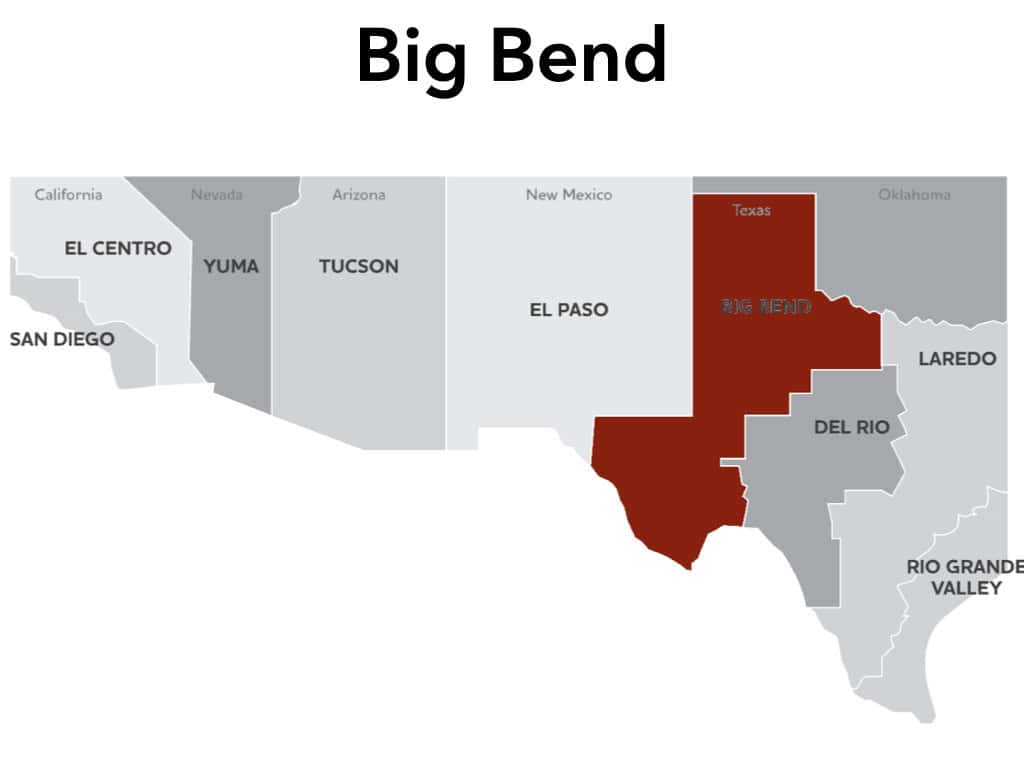
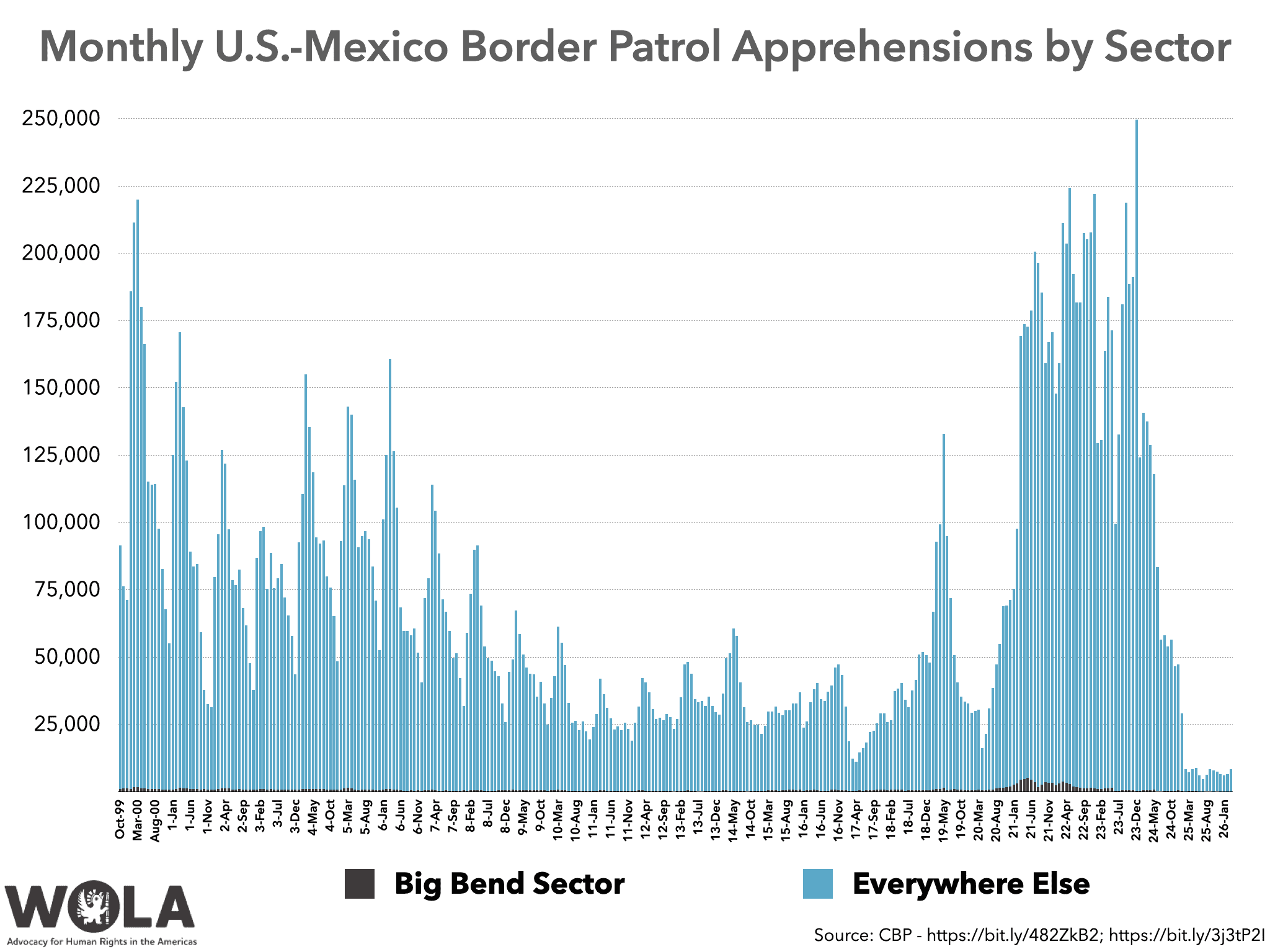
The national park and an adjacent Texas state park make up part of the Big Bend Sector, one of nine geographic zones into which Border Patrol divides the U.S.-Mexico border. Though it is the sector with the largest share of the border—517 miles out of a coast-to-coast total of 1,954—it is one of the emptiest zones in the continental United States and sees very little migration. Since the 21st century began, Border Patrol has made only 1.1 percent of its migrant apprehensions in the Big Bend Sector, averaging just 176 per month so far in fiscal year 2026.
If one looks very closely at this chart of Border Patrol apprehensions by sector since fiscal year 2000, one can barely discern the Big Bend Sector, depicted in dark brown:
CBP plans to build 30-foot border wall in much of the Big Bend region beyond the national park. “Two federal contractors—Barnard Construction Company and Fisher Sand and Gravel—have together received more than $3 billion in contract awards for that project,” Marfa Public Radio reported. Some of the Fisher contract includes borderland in Big Bend Ranch State Park, where “it hasn’t publicly released any plans for what alternate border barriers might look like,” the Big Bend Sentinel noted.
In the Big Bend region, where much of the economy depends on tourism and much of the population professes to value close relations to Mexico and unspoiled natural beauty, opposition to the project is widespread and bipartisan. The barrier and infrastructure projects, Rachel Monroe wrote at the New Yorker,
would intrude on the land of alfalfa farmers, cattle ranchers, river guides, and wealthy landowners. It would block the views along what National Geographic has called one of the most scenic drives in the country, and it would brighten some of the darkest night skies in the continental United States. It would impede the movement of wild animals and prevent livestock from accessing the Rio Grande, a crucial water source. It may disturb historic evidence of “the edge of the Puebloan world,” according to an archeologist who works in the region. It could disrupt tourism in a regional economy that is reliant on it. In places prone to flooding, a wall could make the problem worse. It would sever people from their neighbors in a region that’s long considered itself binational and interdependent.
In a May 21 letter to DHS Secretary Markwayne Mullin, six former superintendents and one former deputy superintendent of Big Bend National Park voiced strong objections to the project and the lack of public input, the Houston Chronicle reported.
The former park leaders warned that constructing “a border wall—or other unnecessary and highly destructive border infrastructure” inside the park “would be the most egregious assault on the integrity of the entire National Park System” since the damming of Yosemite’s Hetch Hetchy Valley more than a century ago.
Residents told the Austin American-Statesman that concertina wire and other barrier debris could worsen flooding during heavy rains. Private landowners told NPR of their intention to go to court to challenge federal eminent-domain proceedings to purchase their property or build barriers through it.
Recent reporting about other environmentally and culturally sensitive projects
Elsewhere along the border, wall-building plans fueled by waivers are inflaming controversies in several areas of ecological and cultural importance.
- On the iconic Mount Cristo Rey, along the border in New Mexico on El Paso’s western outskirts, CBP is seeking to enable 1.32 miles of border wall-building by compelling the Las Cruces, New Mexico Catholic Diocese to sell 14 acres on the mountain’s south face for $183,000. The Diocese has refused; the mountain, topped by a cross, is the site of a large annual pilgrimage. The federal government has filed a lawsuit against the Diocese.
- In south-central California, detonations and bulldozing have been taking place on Kuuchamaa Mountain (Tecate Peak), a sacred landmark for the Kumeyaay Nation, whose members consider the mountain to be a healer and spiritual guardian.
- In Arizona, a 1,000-year-old fish-shaped drawing resembling Peru’s famous Nazca Lines, “Las Playas Intaglio,” was defaced by construction in April. The Tohono O’odham Nation, whose lands straddle the border in south-central Arizona, had warned contractors about the site, which sits on ancestral land, but it was carved through without permission.
- One terminus of the Continental Divide Trail, a popular 3,100-mile hiking route that goes from the Mexico border to the Canada border, lies in New Mexico’s remote Bootheel region, in the Chihuahuan Desert. There, the declaration of a “National Defense Area”—denoting a fringe of territory along the border as part of a military installation—and border wall construction preparations have cut off hikers’ access to the trail’s final southern marker, High Country News reported.
- In South Texas’s Rio Grande Valley region, Border Report reported, residents are voicing alarm at plans to build 30-foot border wall segments through the Salineño Wildlife Preserve, a popular birdwatching destination.
Protests mount over detention center conditions
In-custody deaths and suicides
So far in 2026, 18 people have died while in custody in ICE’s network of mostly contractor-run detention centers around the United States. Of these, five have been suicides.
Since the Trump administration began in January 2025, in-custody deaths have totaled 51, 10 of which have been reported as suicides. Of those 10 people, seven “had no record of violent crimes in the United States,” the Associated Press reported.
Hunger strike
Conditions in detention have led detained immigrants to launch hunger strikes, which are ongoing in at least two ICE facilities.
At least 20 people have been refusing food for nearly a week at the Desert View Annex facility in Adelanto, California, a detention center run by the GEO Group, a big detention contractor, in the Mojave Desert. They are seeking “to bring attention to conditions at the facility, including mold, unsafe drinking water, and a lack of medical care,” according to the Los Angeles Times.
Four people have died at Adelanto since the current Trump administration began, and medical staffing levels have declined there since 2021 despite a fourfold increase in detainees, CNN revealed.
“The observations and interviews at Adelanto and Desert View paint a picture of an understaffed facility overwhelmed with detainees and unprepared to provide basic necessities,” observed a new report from California’s state Department of Justice. The agency visited seven facilities throughout the state and “found overcrowding, poor medical care, inadequate food and excessive force from guards,” noted journalist Kate Morrissey.
At Delaney Hall, a recently reopened facility in Newark, New Jersey also run by GEO Group, about 300 people are reportedly refusing food to protest conditions and an inability to pursue their immigration cases with due process. A letter from the detainees, smuggled out of the facility in mid-May, issued a poignant plea for help, the Jersey Vindicator reported.
“We see with deep helplessness and frustration that our due process, rights, and defense have been violated, disregarding benefits granted under the 4th, 5th, and 6th Amendments of the United States Constitution,” the detainees wrote. “We feel vulnerable and, in a way, kidnapped, detained without justification, not to mention that we are being tortured physically and psychologically due to the poor food resources provided in these detention centers.”
Thomas Homan, the White House “border czar,” said that ICE is prepared to force-feed hunger strikers if the agency deems it necessary.
The New Jersey protest has drawn growing attention. Top state political leaders—including Gov. Mikie Sherrill (D), who was denied entry to Delaney Hall—have been a regular presence outside the facility.
With the U.S. Congress out of session this week, much of the state’s Democratic congressional delegation, including both senators (Cory Booker and Andy Kim), has used its legal right to conduct unscheduled visits to the facility, and have been present alongside protesters outside. Sen. Kim posted a thread on Twitter detailing alarming stories and conditions he witnessed inside Delaney Hall. Outside the detention center on May 26, Sen. Kim, a member of the Senate Homeland Security Committee, was pepper-sprayed as he sought to de-escalate confrontations between ICE agents and protesters.
DHS Secretary Mullin accused Sherill, Kim, and other political leaders who showed up at Delaney Hall of participating in “a political stunt by New Jersey sanctuary politicians for fundraising clicks.”
The cost of running Dilley
The highly controversial ICE “family detention” facility in Dilley, Texas, costs “at least $13.1 million per month, plus another $2.5 million for medical care,” to manage, with most of the money going to contractor CoreCivic, the Houston Chronicle reported. The detention site has a capacity of 2,400 people, which would be about $217 per person (not per family) per day. In early May, Rep. Joaquín Castro (D-Texas) reported that Dilley was holding 396 people, including 93 children. That number, if sustained, would be $1,313 per person per day, or $4,000 per day for a family of three.
Hundreds of thousands of children have had a parent detained
A data analysis by a group of Brookings Institution economists estimated that about 205,000 children in the United States have had a parent detained by ICE since the Trump administration began. Of these children, about 145,000 have been U.S. citizens, and 22,000 experienced “detention of all their co-resident parents.”
“The findings point to a scale of family separations that far eclipses that of the first Trump administration’s ‘zero tolerance’ policy in 2018, when about 5,500 children were removed from their parents immediately after crossing the southern border,” noted New York Times coverage of the Brookings report.
“Even a short separation from a parent is likely traumatic for a child, but a majority of detentions are not short-lived separations,” the study added.
ProPublica, which used a more conservative methodology to estimate parental detentions in March, observed that “it’s nearly impossible to know how many family separations that has caused, since the administration does not track it. Families are also now being split up in ways that are more dispersed, more hidden, and harder to track.”
Family separations among those deported to Honduras
At the Atlantic, reporter Caitlin Dickerson visited the site where dozens of U.S. deportation flights arrive each month, and found many parents deported without a chance to avoid separation from their children in the United States. (See a similar but more preliminary report from Women’s Refugee Commission and WOLA last year, and further work from WRC earlier this year.) “Of the 40 people I interviewed outside the reception center in La Lima, 24 said they had to leave children behind in the United States,” Dickerson reported. “Most said they were never asked about being a parent.”
Health contractor at El Paso tent camp
The Project on Government Oversight reported that Loyal Source Government Services, a medical service provider with a lackluster record, continues to be the medical contractor at Camp East Montana, the giant tent encampment holding thousands of migrants at Fort Bliss in El Paso, despite “deaths, a measles outbreak, and allegations of substandard medical care.” Charles Tiefer, a University of Baltimore law professor who specializes in federal contracting, told POGO, “You are combining a contractor with a very dubious record and a facility that is in shambles.”
Use of force in Florida and access to ICE information
At Reason, C.J. Ciaramella reported on ICE’s Krome North Service Processing Center on the outskirts of Miami, which, according to data obtained by the Washington Post, recorded “more uses of physical force against immigrant detainees than any other detention center over a two-year period.” Information about uses of force in ICE detention has deteriorated during the Trump administration, however, part of what Ciaramella called “a nationwide documentation collapse” that makes it impossible to get a complete picture today.
Woman denied surgery in Texas
Texas Tribune investigative reporter Lomi Kriel reported on the case of Andrea Pedro Francisco, a 23-year-old Guatemalan woman detained in El Paso after a January ICE arrest in Minnesota, days before she was scheduled to undergo surgery. Though she suffers from an ovarian cyst the size of a lime and could face infertility, sepsis, or even death if it is not treated, ICE has refused to provide necessary care.
April border numbers show spring increase, more people trying to evade capture
The most migration measured during a low-migration administration
CBP published data about the agency’s encounters with migrants at the U.S.-Mexico border in April. It reported the highest number of any month during the Trump administration, although encounters were still very few compared with most of the past 60 years. Arrivals at the border remain near lows not measured since the mid-1960s, due to the White House’s suspension (facing legal challenges) of the statutory right to petition for asylum at the border, and amid a larger climate of fear that pervades immigrant communities in the U.S. interior.
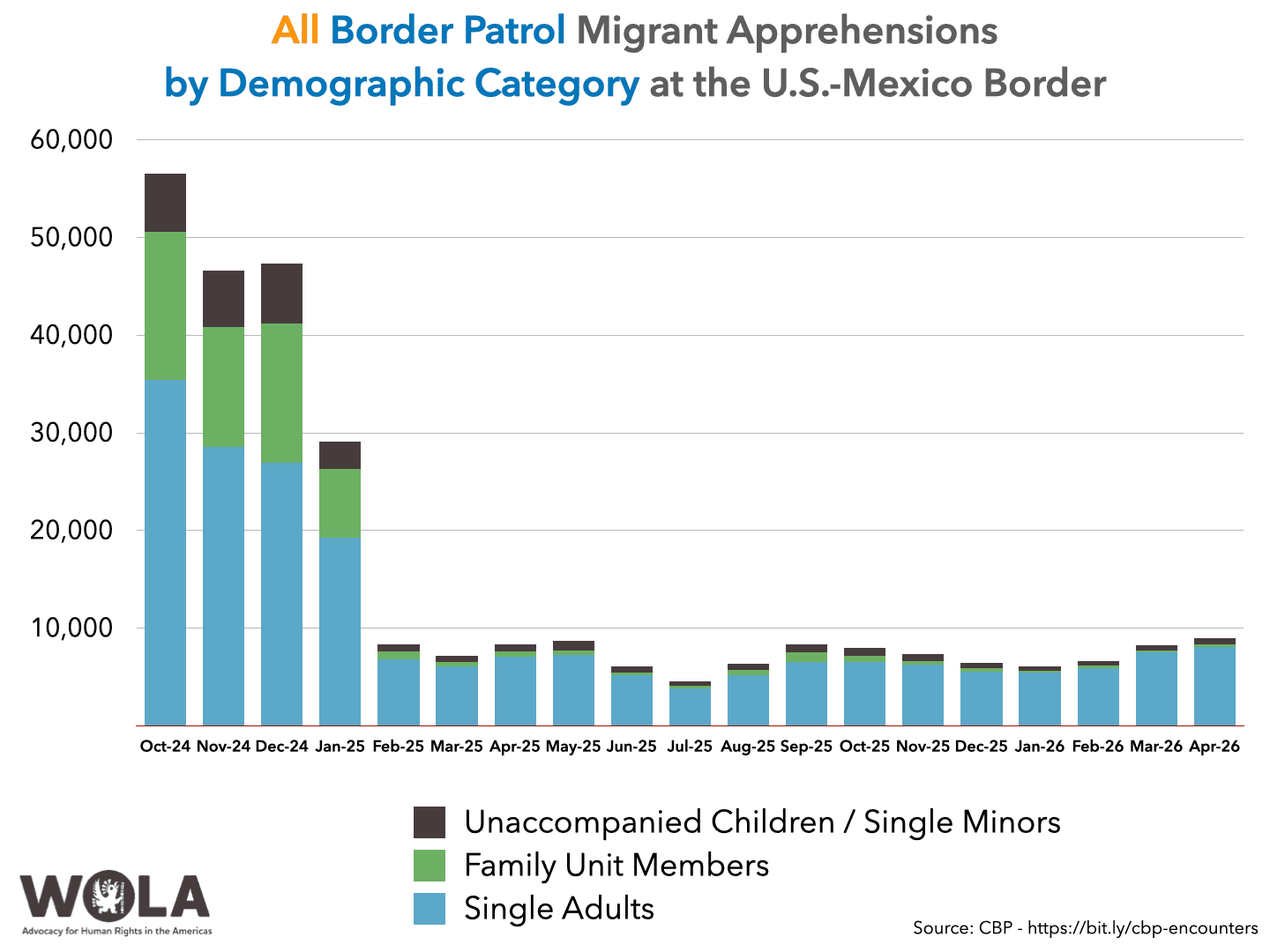
In zones between the official border crossings (ports of entry), Border Patrol reported apprehending 8,943 undocumented migrants in April, an 8 percent increase over March and a 36 percent increase over February. The second-most monthly Border Patrol apprehensions during the Trump administration was 8,724 in May 2025.
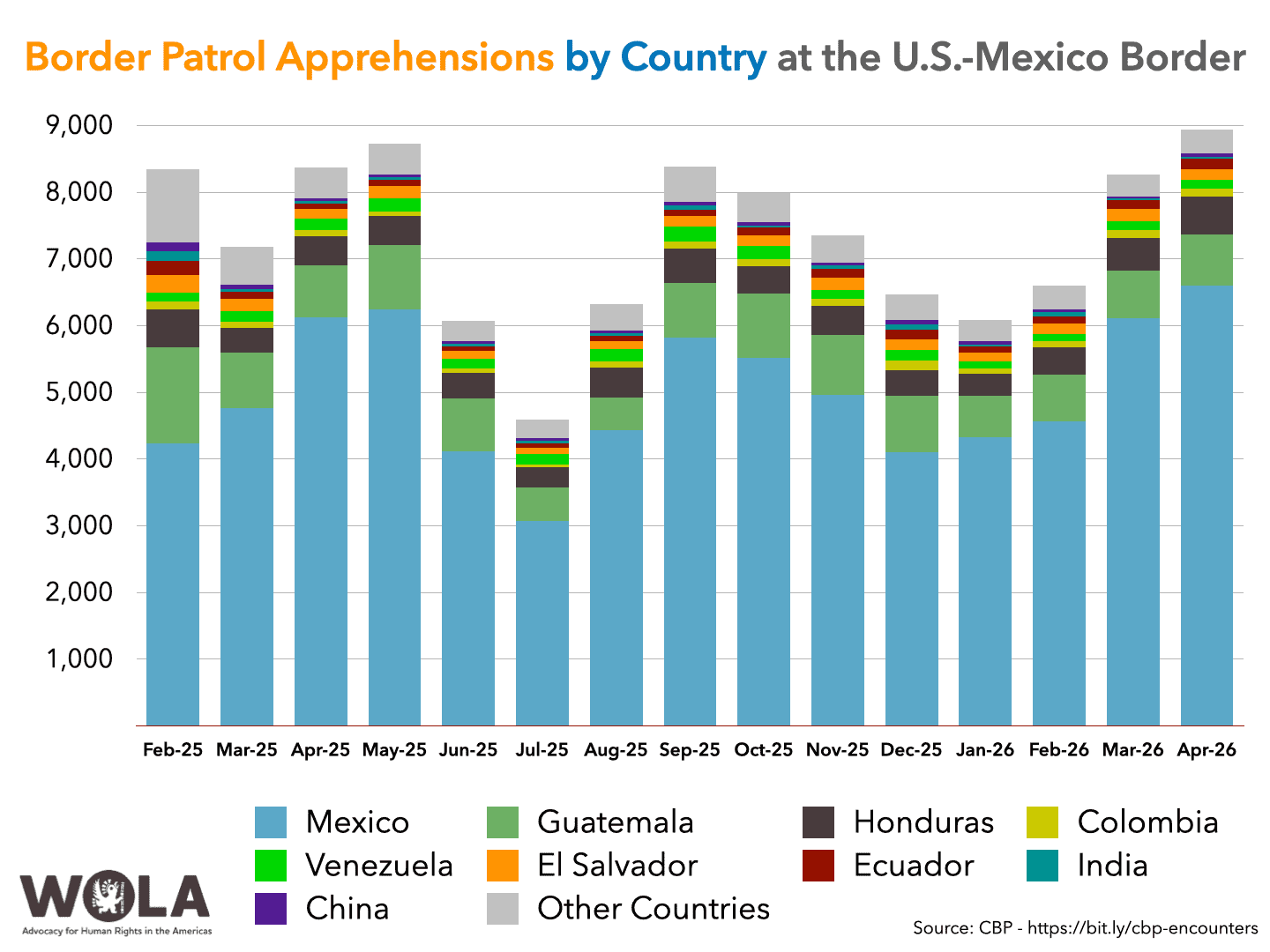
The increase is almost certainly seasonal: the population of migrants seeking to evade capture tends to rise in spring and fall, when weather conditions are less severe. If past trends are an indicator, encounters could increase still further in May, remain high in June, then drop—perhaps sharply—as the summer heat intensifies.
Of Border Patrol’s April apprehensions, 74 percent were citizens of Mexico, and 91 percent were from either Mexico or Central America. Except for the early months of the COVID-19 pandemic, both figures are near 15-year highs: people from farther-away countries have stopped attempting the journey to the U.S. border. At times during the Biden administration, migrants from Mexico or Central America made up less than half of total border encounters.
Adding migrants encountered at the ports of entry increases April’s number to 12,836, also the most of Trump’s second term. Thirty percent of April’s migrant encounters took place at the official crossings. During much of the latter part of the Biden administration, when protection-seeking migrants could use the CBP One app to schedule appointments at ports of entry, more than half of migrant encounters occurred at the ports rather than in the vast river or desert regions between them.
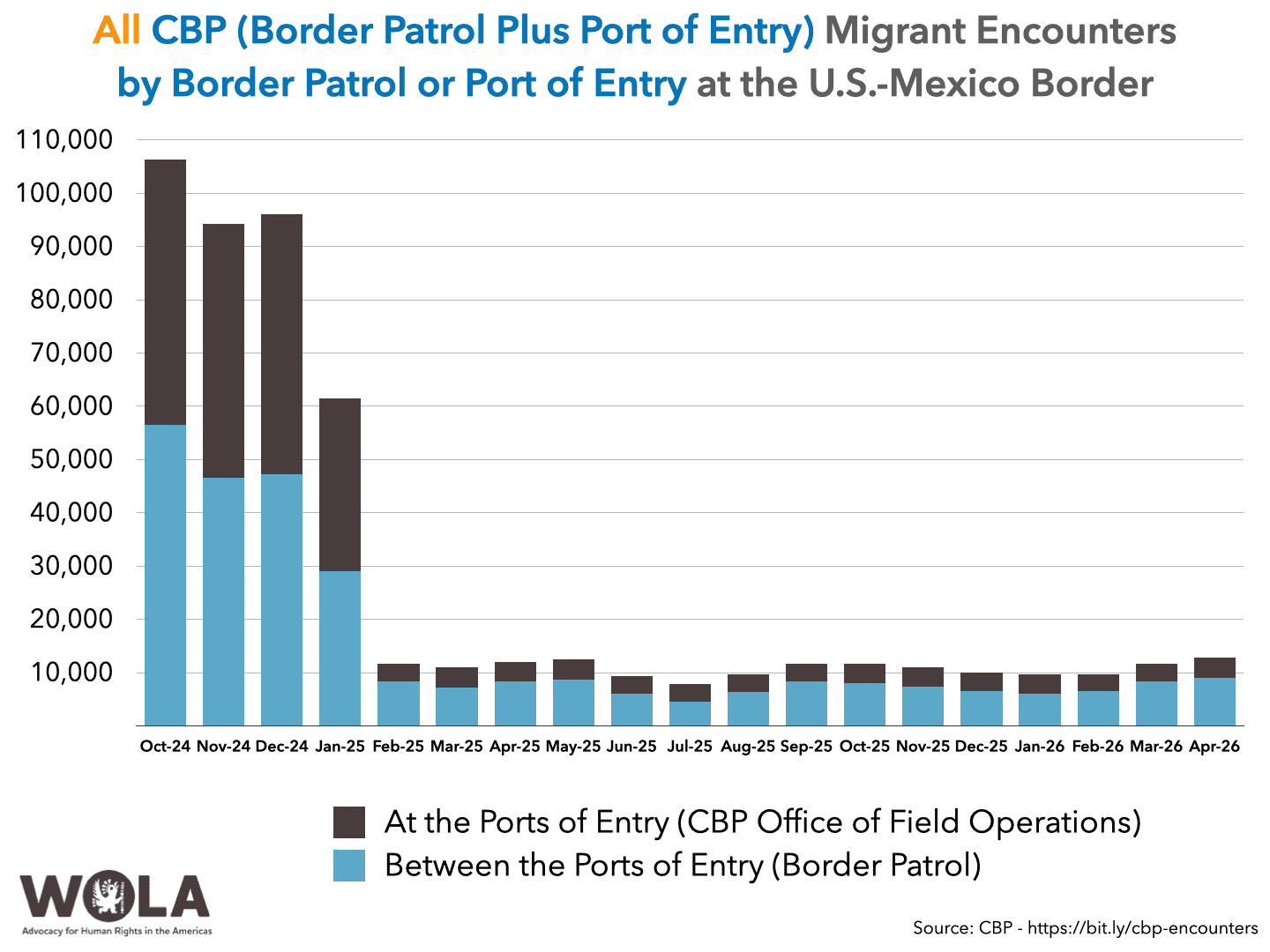
The Trump administration canceled CBP One and has endeavored to bar asylum or protection-seeking migrants from approaching the ports of entry to turn themselves in. In all of April, CBP classified just 32 people at the ports of entry as “credible fear inadmissibles” who were permitted to petition for protection. In December 2024, the Biden administration’s last full month, the ports processed 39,613.
As has been approximately the case during every month since January, only 10 percent of Border Patrol’s apprehended migrants (including ports of entry) have been children or parents traveling with children. In December 2024, when asylum seekers accounted for a larger share of apprehended migrants, the proportion was 43 percent.
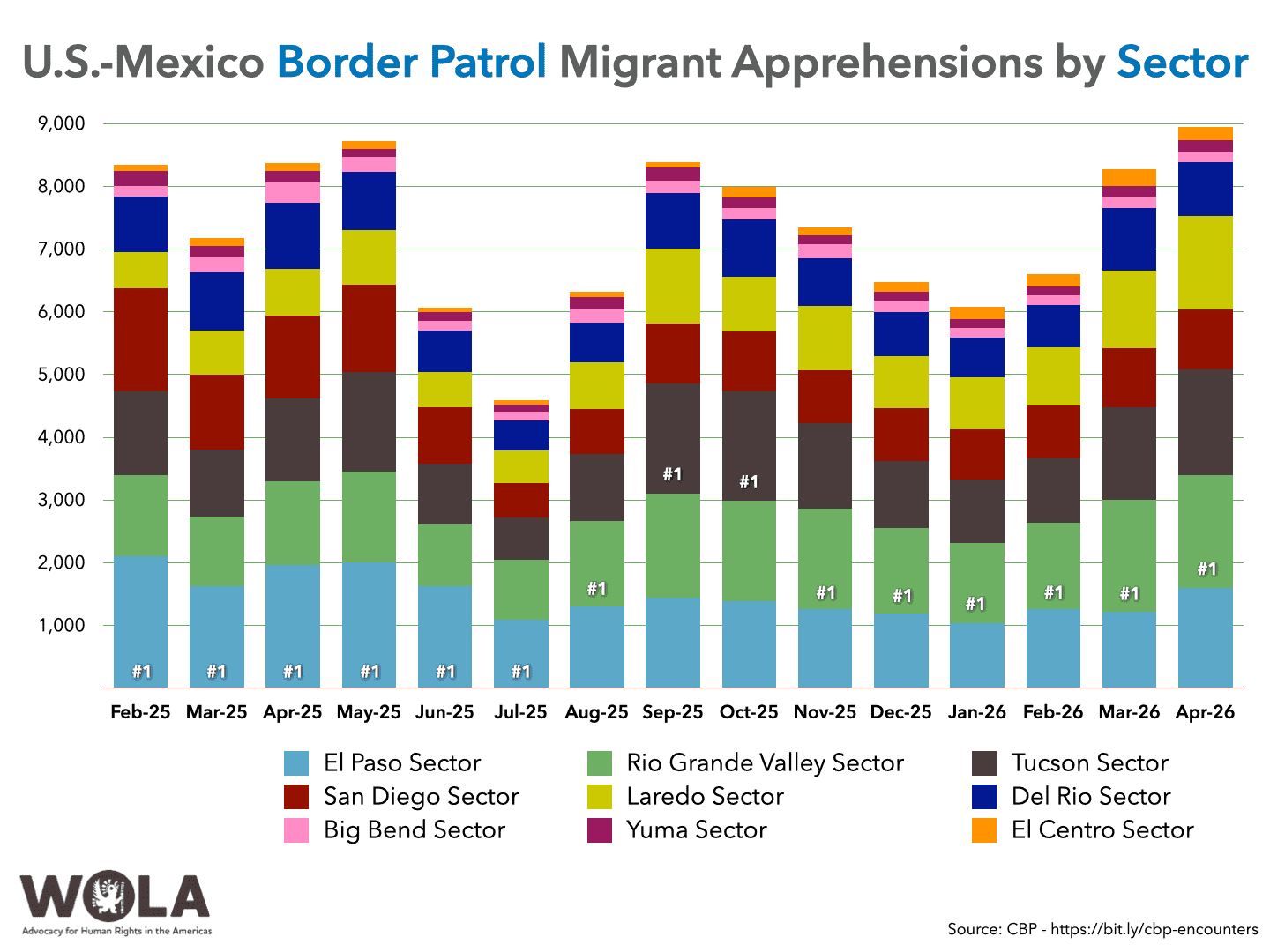
For the sixth straight month, South Texas’s Rio Grande Valley measured more Border Patrol apprehensions than any other of the nine geographic sectors into which Border Patrol divides the U.S.-Mexico border. The Tucson Sector in Arizona was second for the second straight month, and the El Paso Sector (far west Texas and New Mexico) was third, registering the largest increase over March (31 percent).
Attempts to evade U.S. authorities
With the spring increase in migration have come signs that more people are coming to the border and attempting to evade capture. By far the most tragic of those signs was the grim May 10 discovery of six people from Mexico or Honduras, ranging in age from 14 to 56, found dead in a railroad boxcar near Laredo, Texas.
The most likely cause of death was hyperthermia—extreme heat—suffered inside the stifling cargo enclosure. That risk will worsen as summer arrives.
Also in Laredo, NewsNation reported, authorities captured 40 migrants “packed into the sleeping area” of two different cargo trucks—20 in each—along Interstate 35, and found 41 people held in a stash house in the city.
In San Diego, the U.S. Coast Guard reported apprehending 36 suspected migrants, all believed to be citizens of Mexico, aboard a boat about 20 miles off the California coast. South of the city, Border Patrol reported arresting 19 people hiding in a drainage system near the border on May 4.
Other News
- Border Patrol Chief Mike Banks abruptly resigned amid allegations from subordinates that he had bragged about hiring sex workers during official overseas trips. His interim replacement is the agency’s deputy chief, Walter Slosar, a former chief of its El Paso Sector.
- In an interview with the Washington Examiner, White House “Border Czar” Thomas Homan said that so far in the Trump administration, migrant “arrests are around 600,000, 641,000, something like that. Deportations over 800,000 if you know, you’re counting the Border Patrol, too.” Homan said “I’m working on a plan” to surge ICE agents into New York City, and cast strong doubt on questionable claims, advanced recently by former “at large” Border Patrol commander Greg Bovino, that there are 100 million deportable individuals in the United States.
- A federal judge has dismissed the Justice Department’s effort to prosecute Kilmar Ábrego García for human trafficking, ruling that the prosecution of the Salvadoran migrant, mistakenly sent to the notorious CECOT prison in his home country last year, was vindictive. The Washington Post called it “an extraordinary defeat for the administration, which marshaled the resources of multiple federal agencies to publicly malign Abrego.” He still faces possible deportation, though he is barred from being sent to El Salvador, where he faces threats. ICE has stated its intention to send him to Liberia, but Costa Rica has indicated its willingness to accept him.
- The Guardian reported that Andry Hernández is now seeking asylum in Spain. Hernández, a gay Venezuelan makeup artist, became well-known after ICE arrested him in the United States in March 2025, then rendered him and 251 other Venezuelan men to El Salvador’s CECOT prison. (The Trump administration also sent a few dozen Salvadoran men, including Ábrego García, to CECOT at the same time; most remain there.) After gaining release to Venezuela in July 2025, Hernández and others reported being tortured in El Salvador.
- In Guatemala, the government’s migration authority (Guatemalan Migration Institute, IGM) registered 19,301 deportations of Guatemalan citizens from the United States, which is 46 percent more than the same period in 2025. This reflects not recent border apprehensions, but increased arrests of people in the U.S. interior who had been living in the United States for years or even decades.
- An unmanned, 66-foot, helium-filled military surveillance blimp, normally tethered to the earth near Laredo, Texas, broke free on May 18 and eventually landed in northern Mexico.
- U.S. military personnel whom the Trump administration has deployed to the border are using their rather quiet mission as “a literal and figurative sandbox” to test out counter-drone technology, Business Insider reported. Mexican organized crime groups appear to be using small drones frequently to surveil the border zone.
- Last July’s “Big Beautiful Bill Act,” the enormous spending package that provided about $170 billion for border and migration enforcement, included a $13.5 billion payout to states that have spent their own money on those priorities. This includes Texas, where Gov. Greg Abbott (R) spent about $11 billion in state taxpayers’ funds on a border crackdown he called “Operation Lone Star” and expects to be reimbursed by the federal government. According to the Houston Chronicle, this reimbursement has not been made: DHS is still “finalizing the process” for disbursing the funds.
- A May 19 White House executive order called for the imposition of new measures on financial institutions to limit not just money laundering, but “low-dollar cross-border funds transfers.” This spurred concern in Mexico, Guatemala, and other states where financial remittances from U.S.-based migrants, some of them undocumented, comprise a significant share of economic output.
- After firing well over 100 immigration judges, mostly those more inclined to grant asylum or other immigration statuses, the Trump administration onboarded more than 80 new judges, the Department of Justice announced. “The Trump administration has publicly referred to them as ‘deportation judges’ in official job listings,” CBS News noted.
- A court in Mexico handed down an 18-year prison sentence to “Isaac ’N,’” a Guatemalan smuggler involved in the December 2021 death of 56 migrants who were aboard a truck that drove off a road in Chiapas.
- The administration’s ongoing ban on asylum access at the U.S.-Mexico border has dramatically decreased U.S.-bound migration through Panama’s Darién Gap, a once-impassable and ecologically fragile jungle region. The U.S. Embassy in Panama announced a $3 million effort with Panama’s Environment Ministry, in the embassy’s words, “to restore the Darién region and repair the devastation caused by the previous administration’s failed open borders policies.”
- A few dozen participants in the 23rd annual Migrant Trail Walk are spending this week walking 75 miles from the Arizona-Sonora border to Tucson, retracing the route many migrants take through the desert, to commemorate the more than 10,000 people who have died on U.S. soil this century after crossing the border.
Links: “mass deportation” and human rights in the U.S. interior
- Harsha Walia, How Not to Abolish Ice (Boston Review, Wednesday, May 27, 2026) <https://www.bostonreview.net/articles/how-not-to-abolish-ice/>.
What have we learned from the past two decades of struggle?
- Gwynne Hogan, Haidee Chu, Rosalind Adams, Ice Targeted Ny Metro Latinos With 93% of Known Street Arrests (The City, Wednesday, May 27, 2026) <https://projects.thecity.nyc/ice-street-arrests-investigation-racial-profiling>.
An investigation by THE CITY, based on a database of more than 1,200 lawsuits, shows that ICE agents in the field have seized Latinos in numbers that far exceed their share of the undocumented population
- Erika de los Reyes, Xavier Alvarez, Arrests Under Texas’ Controversial sb4 Law Begin in Rio Grande Valley (The Brownsville Herald, Wednesday, May 27, 2026) <https://myrgv.com/featured/2026/05/27/arrests-under-texas-controversial-sb4-law-begin-in-rio-grande-valley/>.
Two men were arrested by the Texas Department of Public Safety in Hidalgo County on Sunday under the state’s controversial immigration law, Senate Bill 4, or SB4
- David Gilbert, The State Department Really Doesn’t Want to Talk About the Office of Remigration (Wired, Wednesday, May 27, 2026) <https://www.wired.com/story/the-state-department-really-doesnt-want-to-talk-about-the-office-of-remigration/>.
The office was created a year ago and seemingly named for a far right European plan to expel minorities and immigrants from Western nations. It now works, a source says, with little to no oversight
- Lisa Song, Maya Miller, U.S. Lawmakers Demand Reforms to Immigration Officers’ Use of Tear Gas and Pepper Spray (ProPublica, Wednesday, May 27, 2026) <https://www.propublica.org/article/lawmakers-demand-reforms-tear-gas-children>.
A ProPublica investigation found that scores of children were hurt by these chemicals during President Donald Trump’s immigration crackdown. Lawmakers say the findings show more restrictions are needed
- Laura Sanchez Ley, Deportados Victimas de Delitos Podran Regresar a Eu por Orden Judicial (Milenio (Mexico), Wednesday, May 27, 2026) <https://www.milenio.com/internacional/deportados-victimas-de-delitos-podran-regresar-a-eu-por-orden-judicial>.
Sobrevivientes de violencia doméstica, de trata de personas y crímenes graves que fueron arrestadas y deportadas por el gobierno de Donald Trump, obtuvieron un fallo judicial que podría cambiar su situación
- Schuyler Mitchell, Dhs Is Getting Sued for the Truth About Its “Domestic Terrorism Watchlist” (Mother Jones, Tuesday, May 26, 2026) <https://www.motherjones.com/politics/2026/05/ice-dhs-domestic-terror-protest-biometric-database-civil-rights/>.
The agency denies keeping ICE protesters in a database of terror threats—which makes certain incidents very hard to explain
- Angelica Franganillo Diaz, Trump Targets Immigration Attorneys Over False Asylum Claims (1) (Bloomberg Law, Tuesday, May 26, 2026) <https://news.bloomberglaw.com/us-law-week/trump-targets-immigration-attorneys-for-fraudulent-asylum-claims>.
The Trump administration is directing Immigration and Customs Enforcement attorneys to combat fraudulent asylum claims by targeting lawyers accused of filing false applications in immigration court, according to a Department of Homeland Security directive
- Nicole Sganga, Dhs Memo Directs Ice to Ramp Up Asylum-Related Fraud Cases (CBS News, Tuesday, May 26, 2026) <https://www.cbsnews.com/news/dhs-memo-ice-asylum-fraud/>.
A top DHS official directed ICE attorneys to aggressively pursue administrative fraud cases against immigration lawyers accused of filing false asylum claims
- Ximena Bustillo, Immigration Courts Are Using a New Tactic to Speed Up Deportations (National Public Radio, Tuesday, May 26, 2026) <https://www.npr.org/2026/05/26/nx-s1-5830474/trump-immigration-courts-mega-masters>.
The Justice Department is moving up the court hearings for hundreds of immigrants and scheduling them for mass hearings. If they don’t show up, they could be ordered deported
- Jessie Blaeser, Kyle Cheney, Heavy Caseloads, Regrets and Surprises: 5 Judges Who Embody the Courts’ Rebuke of Trump’s Ice Detentions (Politico, Sunday, May 24, 2026) <https://www.politico.com/news/2026/05/24/ice-detention-rulings-judges-00934539>.
Judges have overwhelmingly rejected the administration’s new policy
- Delaney Nolan, U.S. Citizen Stopped in Lafayette, Shackled, and Detained in Louisiana Ice Facility (The Lens, Saturday, May 23, 2026) <https://thelensnola.org/2026/05/23/u-s-citizen-stopped-in-lafayette-shackled-and-detained-in-louisiana-ice-facility/>.
The U.S.-born young mother presented ICE and sheriff’s deputies with her ID and Social Security card. Agents took her anyway
- David Nakamura, New Rule Requires Most Green-Card Applicants to Apply From Outside U.S. (The Washington Post, Friday, May 22, 2026) <https://www.washingtonpost.com/immigration/2026/05/22/new-rule-requires-most-green-card-applicants-apply-outside-us/>.
Immigration lawyers say the change could affect a wide swath of people and marks an escalation in the administration’s efforts to curtail legal migration
- Olga R. Rodriguez, San Francisco Immigration Court Shuts Down After Purge of Judges, Leaving Asylum Cases in Chaos (Associated Press, Associated Press, Friday, May 22, 2026) <https://apnews.com/article/san-francisco-immigration-court-closed-asylum-8a0946a7cd4bcc9bd925d075cabef44a>.
San Francisco’s main immigration court has closed, leaving chaos and dysfunction in a region long known for its friendliness to asylum seekers
- Matt Sledge, Sam Biddle, Ice Recruitment Tweets Are So Racist That Cops Feared They Could Incite Neo-Nazi Violence (The Intercept, Thursday, May 21, 2026) <https://theintercept.com/2026/05/21/ice-dhs-social-media-white-supremacist-violence/>.
Social media posts by the Department of Homeland Security recruiting for ICE contained so many white supremacist themes that they could endanger the public, Colorado law enforcement officials warned, according to internal records obtained by The Intercept
- Lisa Needham, How Hennepin County Unwound an Ice Agent’s Web of Lies (Public Notice, Thursday, May 21, 2026) <https://www.publicnotice.co/p/christian-castro-ice-shooting-north-minneapolis>.
Christian Castro is now the subject of a nationwide arrest warrant
- Nick Miroff, Homeland Security’s Plan to Squeeze International Flights (The Atlantic, Thursday, May 21, 2026) <https://www.theatlantic.com/politics/2026/05/dhs-ice-sanctuary-cities-airports/687245/>.
DHS Secretary Markwayne Mullin told travel executives he may target airports in cities that don’t help ICE
- Jacob Sullum, A State Assault Case Against an Ice Agent Could Illustrate the Limits of Supremacy Clause Immunity (Reason, Wednesday, May 20, 2026) <https://reason.com/2026/05/20/a-state-assault-case-against-an-ice-agent-could-illustrate-the-limits-of-supremacy-clause-immunity/>.
An ICE shooting case in Minnesota is testing whether federal officers can face state criminal charges for misconduct
- David Gilbert, Election Officials Are Getting Ready for Ice to Show Up at the Polls (Wired, Wednesday, May 20, 2026) <https://www.wired.com/story/election-officials-are-getting-ready-for-ice-to-show-up-midterms/>.
The Trump administration keeps threatening to send federal agents to oversee elections. State and local officials are preparing, and even gaming out what happens if they’re arrested
- Benjamin Weiser, Jonah E. Bromwich, Judge Bars Ice From Making Immigration Arrests at Courts in New York (The New York Times, Tuesday, May 19, 2026) <https://www.nytimes.com/2026/05/18/nyregion/ice-immigrant-arrests-nyc-courts.html?smid=tw-nytimes&smtyp=cur>.
The Trump administration’s practice of detaining migrants at federal courthouses had stirred outrage
- Ernesto Londono, Mitch Smith, Ice Agent Charged in Shooting of a Venezuelan Immigrant in Minnesota (The New York Times, Monday, May 18, 2026) <https://www.nytimes.com/2026/05/18/us/ice-agent-charges-venezuelan-immigrant.html>.
The agent is the second federal officer to face felony charges in Minnesota stemming from Operation Metro Surge, the Trump administration’s immigration crackdown
- Hannah Fingerhut, Tim Sullivan, Minnesota County Charges an Ice Officer in a Nonfatal Shooting During Trump’s Immigration Crackdown (Associated Press, Associated Press, Monday, May 18, 2026) <https://apnews.com/article/minneapolis-immigration-crackdown-charges-sosacelis-bd78efd7f341a9bd9c1acc2c0037a958>.
A Minnesota county prosecutor has charged an Immigration and Customs Enforcement officer in the nonfatal shooting of a Venezuelan man during the Trump administration’s immigration crackdown in the state
- Andrew Kreighbaum, Eric Heisig, Trump Is Taking Immigrants to Court, Seeking Millions in Fines (Bloomberg Law, Monday, May 18, 2026) <https://news.bloomberglaw.com/daily-labor-report/trump-is-taking-immigrants-to-court-seeking-millions-in-fines>.
The Trump administration has issued thousands of fines against immigrants and has started taking people to court, seizing their tax refunds, and demanding payments for being in the US illegally, according to a Bloomberg Law analysis
- Samantha Michaels, Memphis Is “Under Full-Blown Occupation” by Ice. Here’s Why You May Not Know That. (Mother Jones, Monday, May 18, 2026) <https://www.motherjones.com/politics/2026/05/memphis-safe-task-force-still-operating-aclu-lawsuit-cameras-filming-ice-harassment-homeland-security-tennessee-highway-patrol/>.
Community members face retaliation for trying to spread the word out, a lawsuit alleges
Newsletter
Subscribe to get the latest on analysis and policy