
Adam Isacson

Adam Isacson
Director for Defense Oversight
Adam Isacson has worked on defense, security, and peacebuilding in Latin America since 1994. He now directs WOLA’s Defense Oversight...With this series of updates, WOLA seeks to cover the most important developments at the U.S.-Mexico border. See past updates here.
Your donation to WOLA is crucial to keeping these paywall-free and ad-free Updates going. Please contribute now and support our work.
THIS WEEK IN BRIEF:
- Border wall updates: Construction equipment has appeared in Big Bend National Park as businesses and members of Congress demand more information. Drought-hit New Mexico ranchers stopped wall-builders from pumping water, while protesters in Arizona are trying to save a 200-year-old cottonwood tree.
- Administration revokes legal aid contracts for unaccompanied children: A contract to provide non-profit legal representation to unaccompanied children expired on July 31; the new, smaller legal service provider is a Trump administration-connected Texas law firm. Many children, of all ages, will now have to face immigration judges alone to defend their asylum claims and avoid deportation.
- More deaths in ICE custody as “mass deportation” ratchets up: The 23rd person to die in ICE custody perished on August 1. Other deaths are not being reported, as ICE is releasing them while they are in medical distress. Some detained people are being force-fed when they go on hunger strikes to protest conditions. ICE has detained over 600,000 people since the Trump administration began, and arrested at least 46,000 in July, a monthly record. CBP is hiring contractors to chase down deported migrants in their home countries, in an attempt to collect fines from them.
- Impacts around the Americas: Temporary Protected Status for about 350,000 Haitian citizens is now terminated, following a June Supreme Court ruling. The first deportation plane since devastating June earthquakes—which included freshly deported people among the victims—landed in Venezuela. Reports inform about how “safe third country” agreements are being used to end asylum cases; deportation flights; and impacts of U.S. migration policies in Guatemala, Brazil, Uruguay, Mexico, Belize, and Nicaragua.
THE FULL UPDATE:
Border wall updates
Construction equipment arrives in Big Bend National Park
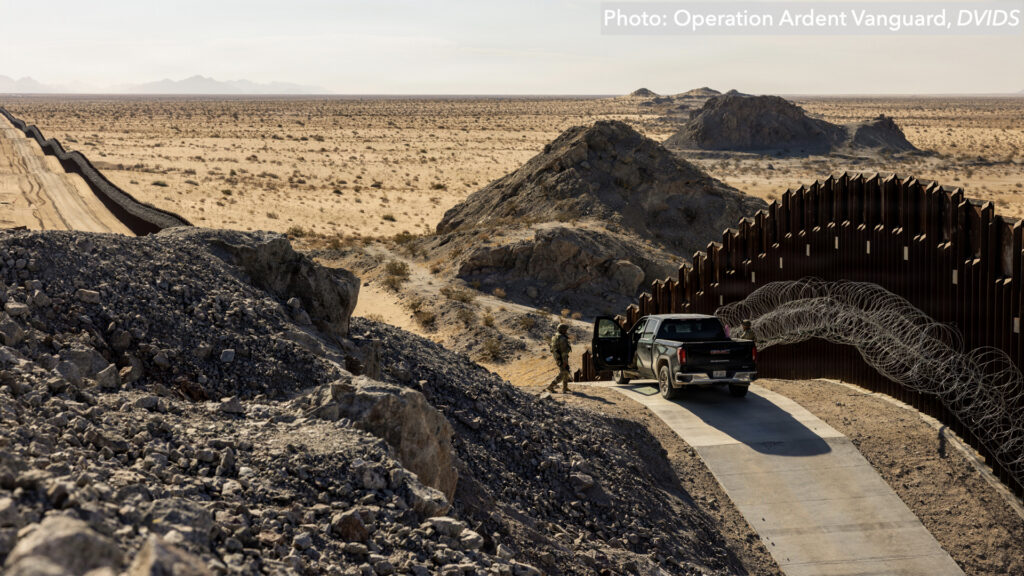
Video recorded on August 6 showed bulldozers clearing native vegetation in Big Bend National Park, a jewel of the U.S. National Park system along the Rio Grande in remote west Texas. Contractors are apparently clearing an access road as part of a border barrier-building project in the park, enabled by the Department of Homeland Security’s (DHS) waivers of environmental laws. Southwest Valley Constructors, a subsidiary of the Kiewit Corporation, appears to have moved from planning to construction under a $1.7 billion contract to build access roads, 17 miles of vehicle barriers (not tall bollard border walls), lighting, and other infrastructure in the park.
- Sam Karas, “More Questions Than Answers as Contractors Descend Upon Big Bend National Park” (Big Bend Sentinel, August 4, 2026).
Over the past few weeks, observers on the ground have spotted survey crews on roads along the river and staging areas popping up north of the park — but officials still don’t have straight answers for many of the questions anxious locals have
- Travis Bubenik, Zoe Kurland, “Border Project Contractors Arrive in Big Bend National Park as Texas Lawmakers Call for a Pause” (Marfa Public Radio, August 4, 2026).
On Tuesday, Marfa Public Radio witnessed a bulldozer and multiple trucks bearing the contractor’s name – Southwest Valley Constructors – stationed inside the park near the entrance to Cottonwood Campground, which is situated right next to the U.S.-Mexico border.
A coalition of more than 140 tourism outfitters and other businesses active in and near the park sent a letter to Texas’s Republican governor and two senators urging them to block physical barriers in favor of technology-only solutions. “Big Bend has been called ‘Texas’ Gift to the Nation’ and generations of Texans have built their lives on this river,” they wrote. “We are asking you, our elected representatives, to protect our livelihoods, our river, and one of our state’s most treasured landscapes from needless and permanent destruction.”
The letter offers a new data point about how rare border crossings are in this region. Border Patrol’s migrant apprehensions inside the park’s 118 miles (about 6 percent of the entire U.S.-Mexico border) made up just 0.045 percent of border-wide apprehensions in fiscal 2025: 200 people out of a total of 443,671.
The ability to waive environmental, public health, and historic preservation laws to build border walls, granted by a provision in the REAL ID Act of 2005, specifies that the waivers are for “areas of high illegal entry into the United States.” WOLA’s Adam Isacson submitted an “Expert Report,” documenting the very low and infrequent nature of illegal entries in the Big Bend Sector, to the court considering a local challenge to the Big Bend construction project.
- Dan Gooding, “Texas Businesses Issue Warning to Republicans About Trump’s Border Barriers” (Newsweek, August 4, 2026).
The business leaders are warning that much of Big Bend’s tourism could be lost if access to the Rio Grande is cut off
Twelve House Democrats, most from Texas, wrote to senior Trump administration officials requesting detailed plans about the project in the national park. The letter raises concerns about potential damage from building a road on Mariscal Mountain, where the river makes its “big bend.” Not among the signers was Rep. Henry Cuellar (D-Texas), who represents a border district and is the ranking Democrat on the House Appropriations Homeland Security Subcommittee.
- Rep. Lloyd Doggett (D-Texas), “Texas Democratic Congressional Delegation & Natural Resources Committee Ranking Member Urge Answers Before Action Jeopardizing Big Bend” (U.S. House of Representatives, July 31, 2026).
Delay work on a proposed road across and over Big Bend National Park’s Mariscal Mountain until specific details of the project are made fully available and questions answered about the potentially irreparable destruction the project poses
A development board in the nearby border town of Presidio had gone to federal court to block construction there, contending that border wall building would harm the municipal levee system in an area where floods are common. Citing the federal government’s authority to waive other laws to build walls, Washington, DC District Court Judge Reggie Walton declined, on August 2, to block construction while deliberations proceed.
DHS attorneys argued that the border wall will increase security in Border Patrol’s Big Bend Sector, and that the Department’s goal is zero illegal border crossings. Walton replied, “You’re never going to get that.”
- Rebecca Santana, “A Federal Judge Lets DHS Proceed With a Border Wall Through a Small Texas Town’s Levee System” (Associated Press, Associated Press, August 3, 2026).
A federal judge has ruled that the Department of Homeland Security can proceed with building a border wall through a levee system in a small Texas town
- Mary Cantrell, “Judge Declines to Block Big Bend Area Border Wall” (Marfa Public Radio, August 2, 2026).
A federal judge on Sunday rejected a Presidio, Texas entity’s request to block construction over claims that the Trump administration violated the Rivers and Harbors Act in pursuing the border wall build near the city’s levee system
On July 31, the Texas state government’s General Land Office (GLO) formally reprimanded Montana-based Barnard Construction for illegally clearing more than a mile of state land in Presidio County without authorization. GLO Commissioner Dawn Buckingham ordered both Barnard and Customs and Border Protection (CBP) to halt work and restore the land, a rare rebuke of the Trump administration on a border issue from Texas’s deeply pro-Trump state government.
- Sam Karas, “Border Wall Contractors Ordered to Stop Unauthorized Work on State Land” (Big Bend Sentinel, July 31, 2026).
Montana-based firm Barnard Construction was formally reprimanded by the Texas General Land Office (GLO) on Friday morning after the company illegally cleared more than a mile-long swath of land for border wall construction. The agency’s cease-and-desist marks the first time a State of Texas entity has made any statement on the border
More waivers
DHS Secretary Markwayne Mullin signed a waiver, which took effect on July 27, suspending dozens of laws in Border Patrol’s Big Bend and Del Rio sectors, stretching several hundred miles from the Big Bend region to Lake Amistad east of Laredo.
- “DHS Waives Environmental Laws for Border Barriers and Roads From Big Bend to Lake Amistad” (Houston Public Media, July 29, 2026).
The waiver clears the way for barriers, roads and surveillance infrastructure, though federal officials have not specified what will be built throughout the project area
Flood risks
On the other side of Texas, in Starr County, residents of the border town of San Ygnacio say that plans to build border wall and border buoys could increase hazards in a historic floodplain that experienced destructively high waters in mid-July. That flooding damaged a pump that supplies San Ygnacio’s drinking water.
- Sandra Sanchez, “Border Residents Say the Wall Is Being Built on Long-Established Flood Plains” (Border Report, August 3, 2026).
- Sandra Sanchez, “Texas Floodwaters Inundate Areas Cleared for Border Wall Construction” (Border Report, July 23, 2026).
Mt. Cristo Rey
Rep. Veronica Escobar (D-Texas), who represents El Paso, introduced legislation that would prohibit construction on Mt. Cristo Rey, the mountain (technically in New Mexico) that straddles the border and dominates views on El Paso’s western edge. Escobar’s bill, which is unlikely to move in a Republican-majority House of Representatives, prohibits the federal government from using eminent domain to seize land on the mountain, much of which is owned by the Catholic Diocese of Las Cruces, New Mexico.
- Camillo Barone, “Texas Lawmaker Introduces Bill to Protect Mount Cristo Rey From Border Wall Construction” (National Catholic Reporter, July 29, 2026).
Religious men and women in the borderland region accompany migrants on a daily basis in the federal courthouses and in immigration detention centers, seeking to provide solace, comfort and support
New Mexico well-drilling stopped
In drought-stricken southern New Mexico, CBP ordered border wall construction crews to stop drilling unpermitted wells, used primarily to mix cement and tamp down dust, after ranchers protested that the pumping—up to 300 gallons per minute—was threatening livestock water supplies.
- Mikella Schuettler, “Contractors Building Border Wall Ordered to Stop Drilling Wells in Drought-Stricken New Mexico” (Associated Press, Associated Press, August 5, 2026).
Customs and Border Protection has ordered construction crews building Trump’s second border wall to stop drilling wells in drought-stricken New Mexico after ranchers said pumping the groundwater needed to mix cement could threaten their livestock
- Peter O’dowd, “As Anger Mounts, Feds Tell Border Wall Contractors to Stop Drilling for Water in New Mexico” (WBUR (NPR Boston), August 5, 2026).
Ranchers along the U.S.-Mexico border are outraged that the federal government is drilling unpermitted wells to pump water from the region’s drought-stricken aquifers
- Mikella Schuettler, “Ranchers Win Fight as Trump Halts Border Wall Water Drilling in Drought-Hit New Mexico” (The Independent (UK), Yahoo!, August 4, 2026).
Customs and Border Protection has ordered construction crews building Trump’s second border wall to stop drilling wells in drought-stricken New Mexico
- Coral Murphy Marcos, “Crews Building Trump Border Wall in Drought-Hit New Mexico Ordered to Stop Drilling Wells” (The Guardian (Uk), August 3, 2026).
Residents and farmers say contractors have tapped border aquifers that threaten water supply for those nearby
Cottonwood trees in Arizona
In Lochiel, in southeastern Arizona’s remote San Rafael Valley, protesters are staging a sustained “tree sit” in the path of a planned secondary wall being built by contractor Fisher Sand and Gravel. On July 27, contractors crushed three ancient cottonwood trees—some locals call them “grandmothers”—with excavators. Protesters are now defending a single 200-year-old cottonwood estimated to be the last of its kind on the border.
- Douglas Main, “Protesters Occupy 200-Year-Old Tree at US-Mexico Border to Stop Its Destruction: ‘She’s Our Statue of Liberty’” (The Guardian (Uk), August 4, 2026).
Demonstrators stage ‘tree sit’ in Arizona town to stop felling of ancient cottonwood grove to make way for border wall
- Michael Loria, “Activists Defend Century-Old Tree Standing in Way of Trump’s Border Wall” (USA Today, July 28, 2026).
The tree is the last remaining of four cottonwoods that have stood along the U.S.-Mexico border in Lochiel, Arizona, for between an estimated 100 to 200 years. Border Patrol says the trees must be removed for the wall
- Michael Loria, “Sierra Club Says Century-Old Trees Felled to Make Way for Border Wall” (USA Today, July 27, 2026).
Locals say the trees have served as a community gathering place for generations and are ecologically rare
Tohono O’Odham nation faces wall-building it has long opposed
CBP began planning construction on 62 miles of Tohono O’odham reservation land, which straddles south-central Arizona and Mexico’s state of Sonora, without seeking the Nation’s authorization. Nation attorneys argued at a July 22 hearing in Washington that DHS lacks authority to unilaterally diminish reservation boundaries, a power that belongs to Congress. DHS is citing its REAL ID Act waiver authority.
- Cheyenne Mcneill, “DHS Wants to Build a Border Wall Through Tohono O’odham Land. It’s Another Instance of the US Undermining Tribal Sovereignty.” (Mother Jones, August 3, 2026).
The nation says the wall would be “devastating” to its lands and people
- Arlyssa D. Becenti, “Trump Border Wall Would Illegally Reduce Tribal Lands, Leaders Argue” (Arizona Republic, The Arizona Daily Star, July 26, 2026).
The Tohono O’odham Nation asks a federal court to halt border wall construction across tribal lands, citing sovereignty, sacred sites and environmental harm
Administration revokes legal aid contracts for unaccompanied children
On July 31, the Trump administration allowed the Acacia Center for Justice’s federal contract to provide legal representation to migrant children who arrived unaccompanied—covering nearly 100 legal providers representing approximately 20,000 children—to expire, while owing providers more than $65 million in unpaid invoices dating to November 2025. Acacia declined a bridge contract that would have required providers to turn over confidential client information, calling it an ethics violation that could have enabled deportations.
In El Paso, Estrella del Paso shut down its Unaccompanied Children’s Program on July 31, laying off 13 employees and leaving 243 children without representation in far west Texas and New Mexico. Estrella is owed nearly $1 million for services already rendered. ProBar in south Texas laid off 20 percent of its staff. At least 40 law firms and service providers have been forced to lay off staff or suspend services across the network.
The administration’s replacement, announced August 4, is a $150 million contract awarded to Burke Law Group—a 26-employee Houston boutique firm that bills itself as specializing in “high-stakes litigation, environmental, regulatory, and corporate matters.” Only two of its lawyers list any immigration law experience in their backgrounds. The firm’s founder served in the first Trump administration.
“We know what happens to children that go to court without an attorney. In one word, it is deportation,” said Estrella del Paso’s executive director, Melissa Lopez. Research confirms that without legal representation, children brought before judges—often too young to understand the proceedings—win immigration relief less than 1 percent of the time. Immigration judges removing unaccompanied minors issued over 18,000 removal orders in June alone, a 73 percent increase from January.
“We’re going to see a lot of kids railroaded into taking voluntary departure, aka self-deport, even where their protection needs are acute and where they would be facing real danger to their lives in their countries of origin,” said Acacia Center Executive Director Shaina Aber.
The Acacia Center’s public statement documented the human costs through anonymized case profiles: a deaf, non-verbal, autistic child kidnapped during his journey; trafficking survivors; a 2-year-old whose attorney has continued representing her despite receiving no government funding because it would be “unconscionable for a 2-year-old to be alone in court.” The International Rescue Committee announced it would continue representing unaccompanied children despite the loss of funding.
- Cybele Mayes-Osterman, Rebecca Santana, Ryan J. Foley, Valerie Gonzalez, “A $150m Contract for Migrant Kids’ Lawyers Goes to a Trump-Linked Texas Firm, Raising Concerns” (Associated Press, Associated Press, August 5, 2026).
Legal aid groups are raising concerns after the Trump administration awarded a $150 million contract to a small Texas law firm with limited experience in immigration law
- Gina Christian, “Diocese of El Paso Ends Unaccompanied Child Ministry as Trump Admin Withholds Almost $1m Owed” (National Catholic Reporter, August 4, 2026).
- Eric Bazail-Eimil, “26-Employee Texas Law Firm Gets $150m to Represent 24,000 Children in Immigration Court” (Politico, August 4, 2026).
None of the Burke Law Group’s lawyers list immigration law as an area of expertise, per the firm’s website
- Mary Ellen Klas, “Immigrant Kids Deserve to Keep Their Lawyers” (Bloomberg, August 4, 2026).
The Department of Health and Human Services ended the contract with the Acacia Center for Justice, leaving more than 20,000 unaccompanied kids in legal limbo
- “Statement From Acacia Center for Justice in Response to Trump Administration’s False Claims” (Acacia Center for Justice, August 4, 2026).
The administration doesn’t get to manufacture a crisis, offer an unacceptable “fix”, and then claim it’s solved. More than 20,000 unaccompanied children are waiting for a real solution
- Cindy Ramirez, “Estrella del Paso Shuts Down Unaccompanied Children’s Program as Trump Ends Funding” (El Paso Matters, July 31, 2026).
The nonprofit, a ministry of the Catholic Diocese of El Paso, provided free and reduced legal services to unaccompanied migrant children. Without federal funding, the organization shut down its children’s program and laid off 13 employees Friday
- Rebecca Santana, Valerie Gonzalez, “Thousands of Migrant Children in the US Could Face New Deportation Risks as Legal Aid Deal Expires” (Associated Press, Associated Press, July 31, 2026).
Migrant children who came to the U.S. alone could soon face immigration court without legal representation
- Gwynne Hogan, “Inside the NYC Courtroom Where Detained Children Face Deportation Without Attorneys” (The City Reporter, July 31, 2026).
Around 20,000 unaccompanied minors nationwide are set to lose legal services when the federal government ends a contract Friday. One NYC immigration court shows us what that will look like
- Arelis R. Hernandez, “Thousands of Immigrant Children May Soon Face a Judge Alone” (The Washington Post, July 30, 2026).
A federal contract that provides attorneys for vulnerable undocumented minors is set to expire Friday. Advocates fear children will be left to defend themselves in court alone
- Jackie Llanos, “More Migrant Kids Are Getting Removal Orders. Some Could Lose Their Attorneys Too.” (NOTUS, July 29, 2026).
A contract for nonprofits representing thousands of children is set to expire Friday
More deaths in ICE custody as “mass deportation” ratchets up
23rd death this year
At least 53 people have died in Immigration and Customs Enforcement’s (ICE) system of mostly contractor-run detention centers since the Trump administration began. The 23rd in-custody death of the 2026 calendar year happened on August 1: Edwin Jeovanny Lopez Cornejo, a 39-year-old citizen of El Salvador, died at New Jersey’s Delaney Hall Detention Facility in Newark. Delaney Hall, run by the private contractor GEO Group, has been the site of frequent protests as detainees have recounted inhumane conditions and medical neglect. Lopez Cornejo, a landscaper and father of a 12-year-old U.S. citizen daughter, was detained on June 18 after 20 years in the United States and filed a habeas petition on July 24 challenging his detention on medical grounds.
ICE did not publicly report another recent Delaney Hall death, Rep. Robert Menendez (D-New Jersey) revealed, because the agency had technically “released” the deceased person while in the middle of a medical emergency. Under a June ICE change to a 2021 policy, it is no longer reporting to Congress the deaths of people within 30 days of their release, as it was compelled to do before.
29-year-old Mexican citizen Priciliano Trejo died in a Georgia hospital on July 24 after being released from ICE’s Stewart Detention Center. He suffered from leukemia, and advocates allege that he was denied necessary medical care while in custody. His death was not reported as occurring “in custody” because ICE released him to the hospital while he was still alive. The agency’s policy change will complicate efforts to keep an accurate count of in-custody deaths.
- Matt Shuham, “Congressman Makes Stunning Allegation After Visiting ICE’s Delaney Hall” (The Huffington Post, August 4, 2026).
Rep. Rob Menendez made a stunning allegation while addressing the recent death of another man who had been detained at Delaney Hall
- Gwynne Hogan, “Salvadoran Man Held at Delaney Hall Dies in ICE Custody” (The City Reporter, August 3, 2026).
The detainee had an extensive medical history, including epilepsy, according to a lawsuit. He had complained about his face and hand going numb just before his death, his mother said
- Ana Ley, Mark Bonamo, Tracey Tully, “Immigrant Held at Delaney Detention Center Has Died, Officials Say” (The New York Times, August 3, 2026).
The mayor of Newark identified the dead man as Edwin Lopez-Cornejo. The New Jersey center has been the focus of intense scrutiny for its treatment of detainees
- Austin Kocher, “Edwin Lopez-Cornejo Is the 23rd Person to Die in ICE Custody in 2026” (Austin Kocher, August 3, 2026).
Edwin Lopez-Cornejo died at Delaney Hall in Newark, six weeks into ICE custody. He is the 23rd person to die in ICE detention this year and the second at Delaney Hall since it reopened under Trump
- “Otro Mexicano Murio Tras Arresto del ICE” (La Jornada (Mexico), July 31, 2026).
- Patricia Ortiz, “A Young Mexican Man Living in Durham Died in ICE Custody.” (Enlace Latino NC, July 28, 2026).
Prisciliano Trejo Ricano began feeling ill while detained at a Georgia detention center, where he had been for three weeks. He reported that he had not received medical attention after experiencing severe symptoms. The young man died on Friday, July 24
Hunger strikers force fed
A Guardian investigation found the Trump administration has sought court orders to force-feed at least 10 people in ICE custody who have gone on hunger strikes to protest the conditions of their confinement. At least three have been subjected to nasogastric tube feeding—widely classified as torture by human rights organizations—for periods ranging from nearly three to nearly eight months.
“The process to engage in force-feeding is quick and secretive,” wrote Guardian reporter José Olivares. “After a detainee has spent a certain amount of time on a hunger strike, which varies, ICE will request emergency court orders from federal judges allowing them to quickly force-feed them. In six of the cases reviewed by the Guardian, detained immigrants did not have any legal representation during the court proceedings. Most records are sealed, giving the public only a glimpse at the process.”
- Jose Olivares, “‘What They’re Doing Qualifies as Torture’: New Details of ICE Force-Feeding Revealed” (The Guardian (Uk), August 5, 2026).
Exclusive: cases of Afghan man, Ukrainian man and Saudi woman show repeated nasogastric tube insertions and lack of legal representation
- Jose Olivares, “‘Stark Example of Brutality’: Trump’s ICE Used Court Orders in Plan to Force-Feed at Least 10 Hunger Strikers in Detention” (The Guardian (Uk), August 3, 2026).
Exclusive: court records reviewed by the Guardian show that procedures included force-feeding, intravenous forced hydration and involuntary blood draws
Conditions at Adelanto, California City
At ICE’s Adelanto detention facility in southern California, where four people have died since 2025, video footage showed worm-like creatures in a bottle of drinking water. DHS denied any problems, noting that the center uses water from the Adelanto municipal system. At California City, a site in the Mojave Desert operated by private contractor CoreCivic for $130 million per year, a federal court-appointed monitor found the facility out of compliance with all eight court-ordered healthcare mandates.
- Ruben Vives, “Video Shows Worm-Like Creatures in Drinking Water at ICE Detention Center” (The Los Angeles Times, August 1, 2026).
A federal court judge ordered sweeping changes at the Adelanto ICE Processing Center in Southern California two weeks ago. But some detainees say issues persist
- Donny Evans, “California’s Largest ICE Detention Center Fails Every Court-Ordered Medical Standard, Monitor Reports” (Developer, July 28, 2026).
The court’s independent monitor found California City out of compliance with all eight healthcare mandates in a federal injunction, warning of “serious risk of both immediate and long-term harm”
Numbers
Data analyst Austin Kocher reported that ICE has booked over 600,000 people into detention since the beginning of the Trump administration. (About 68,000 are currently in custody, approaching a peak reached in January.) At this rate, “1.75 million people could be detained by the end of the second Trump administration.” That is more than 1 in every 200 people currently living in the United States.
ICE has deported more than 66,000 family-unit members (parents with children) since January 2025, Kocher reported in another post. That is more than 10 percent of deportations so far.
ICE set a new monthly arrest record in July, booking 46,000 (CBS News) or 51,000 (Julia Ainsley of NBC News) people into detention, averaging over 1,500 per day. ICE has broadened enforcement to airports, with Transportation Security Administration (TSA) collaboration, and has shifted from large-scale urban operations toward quieter, sustained enforcement through check-ins, traffic stops, and 287(g) partnerships with state and local police forces.
- Austin Kocher, “Over 600,000 People Booked Into ICE Detention Centers Since Start of Trump Ii Administration” (Austin Kocher, July 28, 2026).
65,000 people are currently in ICE detention, but the full impact is much larger and most detained people are deported. 1.75M people could be detained by the end of the second Trump administration
- Austin Kocher, “ICE Has Deported More Than 66,000 Family Members Under Trump Administration, Family Detention Is Back at Dilley and Karnes” (Austin Kocher, July 29, 2026).
New ICE data show more than 66,000 family-unit deportations since January 20, 2025, about one in ten removals, with an August spike above 20 percent, as family detention reopens at Dilley and Karnes
- Camilo Montoya-Galvez, “ICE Detentions Set Trump-Era High in July, as Immigration Crackdown Widens” (CBS News, August 3, 2026).
Detentions by Immigration and Customs Enforcement set a monthly record high for the second Trump administration in July, internal agency data obtained by CBS News shows, as ICE widened its crackdown
- “Julia E. Ainsley (@Juliaeainsley) on X” (NBC News, Twitter, August 3, 2026).
ICE set a new record in July, arresting over 51,000 people, a record monthly high, including 20-40 per day in airports, according to DHS officials.
ACLU action against detention
The American Civil Liberties Union (ACLU) filed a tort claim on behalf of a 55-year-old legal permanent resident from Trinidad and Tobago who was deported in 2025. Elton Purvis seeks $10 million in damages after experiencing medical neglect and mistreatment while detained at the South Texas Detention Complex in Pearsall and elsewhere. “While in detention, Mr. Purvis filed over 100 grievances to ICE and followed every channel available to ask for medical help—nothing worked,” said ACLU attorney Caro Rivera Nelson. Guards found him unresponsive in his cell at least three times.
- Alex Nguyen, Uriel J. Garcia, “ACLU Launches National Legal Action Against Immigrant Detention” (The Texas Tribune, July 30, 2026).
A $10 million claim by Elton Purvis, who was held in Texas for seven months before his deportation, is part of the group’s allegations that immigrants’ medical and other needs were neglected
John Washington: “Call Them Camps”
“We don’t have concentration camps today in the United States, but we have something close,” wrote John Washington, author of the new book How To Close a Camp, wrote at the Guardian. “The word camp best captures the political function they serve: concentrating, immobilizing and excluding populations deemed unwanted.”
- John Washington, “Don’t Call Them ICE Detention Centers. Call Them Camps” (The Guardian (Uk), July 30, 2026).
I’ve spent a decade reporting on immigration enforcement. The word ‘camp’ best captures the political function of these facilities
Outrage at quotas, misuse of force, and unprofessionalism
Jason Houser, ICE’s chief of staff from 2021–2023, published a pointed op-ed at the Houston Chronicle, noting that the agency’s arrest quotas “do not distinguish between a threat and a target… Americans should not mistake activity for security.” Houser noted that ICE’s recruitment drive, which has come with sharply reduced training of new agents, is creating conditions for tragic and sometimes fatal misuse of force incidents on U.S. streets.
The New York Times noted a trend of people creating AI-generated corrido folk ballads to memorialize victims of alleged ICE misuse of force, like Lorenzo Salgado Araujo, fatally shot in Houston in July.
- Jason Houser, “I Helped Lead ICE. Trump’s Dragnet Enforcement Doesn’t Make Us Safer.” (The Houston Chronicle, August 3, 2026).
What is happening now is not a public-safety strategy. It is a quota, and quotas do not distinguish between a threat and a target.
- Antranik Tavitian, Sasha Von Oldershausen, “ICE Killed Him. A.I. Helped Turn Him Into a Folk Ballad, Fast.” (The New York Times, August 3, 2026).
Artificial Intelligence is helping people write corridos within hours, accelerating a century-old tradition of memorializing tragedy through song
- David Myers, “I’m a Former Cop. ICE Isn’t Law Enforcement, It’s a Militia.” (USA Today, Yahoo!, July 27, 2026).
ICE shootings in Houston and in Biddeford, Maine, are the predictable output of a federal agency that lacks training, oversight and a settled mission
ICE “dress code”
The Washington Examiner reported that ICE has banned deportation officers from wearing casual clothing such as jeans, hoodies, and T-shirts while working in public spaces, to ensure “a more professional look.” Agents who spoke to reporter Anna Giaritelli said that, though they may continue to wear masks and won’t be uniformed, they fear being “targeted” if they are more identifiable, even though nearly all U.S. police personnel dress in identifiable ways.
- Anna Giaritelli, “ICE Quietly Gives Officers a Makeover, but It May Risk Their Safety” (The Washington Examiner, July 30, 2026).
New guidelines issued internally will give federal law enforcement a more professional appearance while making arrests on the street
Protesters, including social media-posters, being followed and harassed
The Wall Street Journal, NPR, and Mother Jones reported on increased surveillance, investigation, prosecution, and intimidation of online critics of immigration enforcement, raising major free speech issues. The Journal found that ICE’s surveillance spending reached $258 million in Trump’s first full year—a 57 percent increase over the prior year. Contracts include services like social media scanning, geolocation of labeled “extremists,” and AI-driven “anticipatory threat intelligence.” ICE’s Office of Professional Responsibility (OPR), which is meant to focus on agents’ misconduct, is leading this initiative. The ICE Privacy Office, meanwhile, is down to two full-time staffers.
Records obtained by Mother Jones showed that ICE Homeland Security Investigations (HSI) task force officers, including deputized local police, are systematically collecting license plate and social media data from ICE protesters, including bystanders with no protest connection. On July 24, the Electronic Privacy Information Center (EPIC) and legal observers filed a First Amendment lawsuit against DHS alleging a “secret Protester Surveillance Policy.” The Justice Department has charged more than three dozen people in at least 10 cases with conspiracy to impede federal officers, using a Civil War-era statute, for protesting immigration enforcement.
- Hannah Critchfield, Shane Shifflett, “How ICE Is Weaponizing Social Media Against Its Critics” (The Wall Street Journal, August 3, 2026).
Agency says its surveillance program searches for threats to agents, but critics see free-speech infringements
- Meg Anderson, “She Protested ICE Raids. Then Agents Showed Up at Her Door” (National Public Radio, August 3, 2026).
The Justice Department is using federal conspiracy charges to sweep up ICE protesters. Some legal experts worry the agency is casting too wide a net to prosecute political activists
- Schuyler Mitchell, “Records Reveal How Homeland Security Agents Surveilled ICE Protesters” (Mother Jones, July 27, 2026).
Spokane police documents show a DHS task force officer tracing protesters’ cars, identities, and whereabouts without alleging any wrongdoing
More federal circuits ban mandatory detention
The 9th and 7th Circuits issued simultaneous 2-1 rulings on July 30, bringing the appellate score to 6-2 against the administration’s position, laid out in a July 2025 ICE memo, that all immigrants who entered the United States improperly—regardless of how long ago—are subject to mandatory detention without bond hearings. The 9th Circuit ruling, authored by Trump appointee Daniel Bress, held that the 1996 immigration law framework requires detention without bond only for those apprehended at or near the border; those who have resided in the U.S. for years “could only be detained after being afforded a bond hearing.” The two circuits that have sided with the administration are the 5th (Texas) and 8th (Midwest). The issue is virtually certain to reach the Supreme Court.
- Sonja Sharp, “Judges Nix Trump’s Mandatory Immigrant Detention Policy, Teeing Up Supreme Court Fight” (The Los Angeles Times, July 31, 2026).
The 9th Circuit was one of two appellate courts to issue rulings this week against the Trump administration, finding that immigrants who are detained away from the border are entitled to a bond hearing to decide whether they should be freed or remain in detention while their case proceeds
- Kyle Cheney, “Two More Federal Appeals Courts Reject ICE Mass Detention Policy” (Politico, July 30, 2026).
The 9th and 7th circuits ruled on the same day that the Trump administration misconstrued immigration law
Impacts around the Americas
End of Haiti TPS
The termination of Temporary Protected Status (TPS) for about 350,000 people from Haiti is now official, following the Supreme Court’s 6-3 ruling in June upholding the administration’s termination. Haitians formerly protected by TPS have lost work authorizations and are subject at any time to detention or even deportation to their Caribbean homeland, which remains in a state of extreme, violent turmoil.
ICE has moved swiftly. In Springfield, Ohio, approximately 50 Haitians who had TPS and who have active asylum cases were summoned to ICE check-in offices on August 1, fitted with ankle monitors, and conditionally released with travel restricted to a 75-mile radius.
Deportation flights to the northern Haitian city of Cap-Haïtien have continued, limited to that destination due to the security situation in the capital, Port-au-Prince. Rep. Ami Bera (D-California) led a congressional delegation to Haiti and reported that conditions directly contradict DHS’s November 2025 determination that “no extraordinary and temporary conditions” prevented safe return: gangs control approximately 70 percent of Port-au-Prince, internal displacement matches post-2010 earthquake levels, and hospitals and schools have been attacked or closed. In April, the House of Representatives passed legislation extending Haiti TPS through January 2029; the Senate has not acted.
With El Salvador’s TPS designation set to expire in early September, DHS has yet to announce a decision that could strip an additional 170,000 individuals of their status.
- Arelis R. Hernandez, David Nakamura, Maria Sacchetti, “TPS for Haitians Officially Ends, Putting Thousands Out of Work and in Limbo” (The Washington Post, August 5, 2026).
A federal judge took the final step in allowing the Trump administration to terminate humanitarian protections for 350,000 Haitians in the United States
- Devan Cole, Priscilla Alvarez, Tami Luhby, “Court Confirms That Temporary Deportation Protections for Haitians Are No Longer in Place” (CNN, August 5, 2026).
A federal judge on Wednesday officially allowed the Trump administration to end temporary deportation protection for hundreds of thousands of Haitians, marking the final step, for now, in a months-long case that made its way to the Supreme Court
- Arelis R. Hernandez, Lauren Kaori Gurley, Ted Hesson, “ICE Begins Outfitting Haitian Immigrants With Ankle Monitors, Attorneys Say” (The Washington Post, August 3, 2026).
Haitian immigrants in Ohio with temporary protected status are being called to ICE offices for check-ins after federal officials said their protections had ended
- Rep. Ami Bera (D-California), “Ending TPS Now Undermines Haiti’s Fragile Recovery. US Senate Must Act” (The Miami Herald, August 1, 2026).
- Jacqueline Charles, “‘I’m Just So Lost:’ Haitians Face Impossible Choices as TPS Nears the End” (The Miami Herald, July 28, 2026).
As the federal humanitarian program nears its end, hundreds of thousands of Haitians who had been shielded from deportations because of their homeland’s turmoil are confronting impossible choices
- Reshma Kirpalani, “Haitians Face an Uncertain Future as TPS Ends” (National Public Radio, July 27, 2026).
More than 300,000 Haitians living in the United States are losing Temporary Protected Status. Many now face an uncertain legal future and possible deportation
- Spencer Ackerman, “The End of TPS for Haitians Is a Moment of Truth for Zohran Mamdani” (Forever Wars, July 27, 2026).
Will ‘municipal socialism’ stand by as ICE snatches, cages and deports tens of thousands of New Yorkers? Or will it resist?
- Camilo Montoya-Galvez, Joe Walsh, “Ohio’s GOP Governor Calls Trump’s Plans to Deport Haitians A “Mistake”: “You’d Be Sending People … Back to Hell”” (CBS News, July 27, 2026).
Republican Ohio Gov. Mike DeWine told CBS News the Trump administration’s plan to ramp up deportations of Haitian migrants is a “mistake,” arguing the move could bruise Ohio’s economy
- Royce Bernstein Murray, “TPS Is the Glue Holding Together a Broken Immigration System” (Securing America’s Promise, July 27, 2026).
The Supreme Court will soon send its recent ruling on Temporary Protected Status back to the lower courts, formally clearing the way for the Trump administration to terminate the TPS designations for Haiti and Syria
- Camilo Montoya-Galvez, “ICE Plans to Target Haitians as Temporary Protected Status Is Set to End, Sources Say” (CBS News, July 26, 2026).
The plans include arresting migrants in Ohio and quickly putting them on deportation flights to crisis-stricken Haiti, the internal documents indicate
- Michael Sainato, “‘We’re Human Beings’: Haitians in the US Fear Family Separation and Deportation to Violence” (The Guardian (Uk), July 26, 2026).
More than 330,000 Haitian immigrants in limbo as Trump administration seeks to end temporary protected status
- Laura C. Morel, “Trump Ended TPS Overnight. Deporting 350,000 Haitians Is a Different Story.” (Mother Jones, July 24, 2026).
“The lowest public safety threats are the most vulnerable”
- Russel L. Honore, “Haiti Is a War Zone. Why Are We Banishing Our Neighbors There?” (The New York Times, July 23, 2026).
Deporting Haitian migrants will further destabilize a country in crisis
Venezuela deportations restart
The Trump administration resumed deportation flights to Venezuela on August 3, for the first time since June 24 earthquakes 24 devastated parts of the country. ICE sent 147 Venezuelan citizens (132 men, 15 women) to Barcelona, Anzoátegui state, rather than to the main Caracas airport, which remains closed.
- “Llegan a Venezuela los Primeros Migrantes Deportados de EEUU Desde los Terremotos” (Tal Cual (Venezuela), August 4, 2026).
- Genevieve Glatsky, “U.S. Sends Flight With Deportees to Venezuela for First Time Since Quakes” (The New York Times, August 3, 2026).
A plane with 147 Venezuelans landed on Monday in the South American country amid criticism over the deaths of deportees housed in a collapsed building during June’s quakes
Flight 164
A Washington Post published an investigation into “Flight 164,” the June 24 deportation plane, carrying 146 Venezuelans, which arrived at the Caracas airport eight hours before the earthquakes struck. The hotel in which most were placed upon arrival collapsed, and most of the recent deportees are believed to be among the dead. The Post found that of identified passengers, most had pending asylum claims, roughly half had previously held TPS, and many were coerced into signing voluntary departure under miserable, prolonged detention conditions.
Neither the U.S. nor the Venezuelan government has released a complete passenger manifest or official death toll. “The resumption of deportation flights to Venezuela is premature and hard to reconcile with what happened to the passengers” on Flight 164, WOLA President Carolina Jiménez Sandoval told the New York Times.
- Arelis R. Hernandez, Maria Luisa Paul, “Deported by the U.S., Detained in Venezuela — Then Lost in the Earthquakes” (The Washington Post, August 2, 2026).
The immigrants aboard Flight 164 were pursuing lives in the U.S. when ICE detained them. In Venezuela, they were held in a building that collapsed hours later
Venezuelan men who were sent to CECOT are suing ICE charter-flight contractors
Human rights attorneys filed a lawsuit, on behalf of some of the Venezuelan men whom the Trump administration deported to El Salvador’s notorious CECOT prison in March 2025, against the companies CSI Aviation and GlobalX, which operated the ICE flights that delivered them. Their complaint alleges that the companies “went to great lengths” to carry out the flights in apparent defiance of a federal judge’s order. The men were released to Venezuela in July 2025, after which many told of experiencing torture and abuse in El Salvador.
- Jose Olivares, “Venezuelan Men Sue Aviation Firms Who Flew Them to Notorious Salvadorian Jail” (The Guardian (Uk), July 26, 2026).
Exclusive: CSI Aviation and GlobalX accused of violating civil rights as part of Trump immigration crackdown
CBP hiring skip tracers to track down deported people with unpaid, inflated fines
Wired and Project Salt Box reported that CBP is seeking a private contractor to track down people already deported to Mexico, Honduras, and Guatemala and collect unpaid immigration fines from them. The Trump administration has imposed steep fines—$998 per day—on people who remain in the United States after receiving removal orders, among other penalties. CBP estimates $423 million in unpaid penalties across DHS as of July 2026, involving 66,387 people who have since been removed. The agency gave prospective bidders for the $9 million, two-year solicitation three business days to respond.
Advocates note that many deportees had phones and identification confiscated before removal, leaving them unable to access U.S.-based bank accounts through which payment would be required, and that sending debt collectors into countries where extortion is rampant creates risks for already vulnerable people.
- Dell Cameron, Maddy Varner, “DHS Is Hiring Bounty Hunters to Find and Photograph Deported People’s Homes Abroad” (Wired, August 5, 2026).
Homeland Security told immigrants that leaving the US would wipe out fines it claims they owe. Now it wants private investigators to find them in their home countries and collect
- Michael Wriston, “U.S. Border Patrol Wants a Contractor to Track Down Deported People Abroad and Collect Their Immigration Fines” (Project Salt Box, August 4, 2026).
The agency gave bidders three business days to compete for a first-of-its-kind contract to collect fines from people it has deported to Mexico, Honduras and Guatemala
Human Rights First report on “safe third country” deals and pretermissions
“Slammed Doors,” a July 30 report from Human Rights First, explains how the Trump administration is using the existence of so-called “Safe Third Country” agreements—in which foreign governments accept third-country U.S. deportees who presumably then seek asylum there—as a pretext to terminate a far larger number of asylum cases in U.S. immigration courts.
Immigration judges have been encouraged to “pretermit” asylum cases, instantly dismissing them without a hearing, 30,679 times between August 2025 and June 2026, with instructions to send the asylum seekers to countries that have “Safe Third Country” agreements in place. However, the agreements in place call on those countries—Belize, Cabo Verde, Ecuador, Guatemala, Honduras, Liberia, Paraguay, and Uganda—to take far fewer asylum seekers than that.
The report documents LGBTQI+ asylum seekers ordered to Uganda, an Indigenous Mexican woman cut off mid-testimony and ordered to Ecuador, and a gay Cameroonian man previously deported and tortured whose case was pretermitted days before his final hearing.
- “Trump Administration Using Secretive “Safe Third Country” Deals to Slam the Door on Asylum Seekers Without a Hearing” (Human Rights First, July 30, 2026).
U.S. removal flights reach a record 288 flights to 38 countries, largely driven by a continued surge in removal flights to Mexico
Deportation flights are “ratcheting up”
A burst of flight activity in late July revealed deportation infrastructure operating at unprecedented pace, wrote journalist Gillian Brockell.
- Gillian Brockell, “Frenzy of Cruel and Unusual ICE Flights Shows Trump’s Ethnic Cleansing Campaign Is Escalating – Again” (Gillian Brockell, July 30, 2026).
Seven apparent ICE removal flights in the last few days – including third-country removals, prolonged shackling, and failed deportations – reveal an agency ratcheting up
Guatemalan couple killed after deportation
Nixon Giovanni Pérez Paz, deported from Missouri, and his wife Glendy Marisol González de la Cruz, who self-deported from Guatemala with their children, were found bound and shot to death in a sugarcane field in Retalhuleu, Guatemala on July 21, with their 14-month-old daughter alive beside them. A DHS spokesperson replied, “When an individual is no longer in ICE custody, ICE is no longer responsible for them,” read a DHS statement to the Washington Post reporters investigating the Flight 164 case in Venezuela cited above.
- Leire Ventas, “El trágico caso de la pareja que temía ser deportada de EE.UU. y acabó asesinada en Guatemala – BBC News Mundo” (BBC (UK), August 3, 2026).
Nixon Pérez Paz fue deportado de EE.UU. en mayo de 2025. Al año, su mujer, Glendy González de la Cruz, decidió volver a su Guatemala natal para reunificar a la familia. La semana pasada fueron hallados en un cañaveral con sendas heridas de bala
- Brian Munoz, “Overland Couple Shot Dead in Guatemala After Local ICE Stop Led to Deportations” (St. Louis Public Radio, July 27, 2026).
The couple’s 14-month-old daughter was found crying beside her mother’s body in a sugarcane field last week, according to Guatemalan authorities and media
Aid to Guatemala’s migration agency
The U.S. Embassy in Guatemala formalized a $3.5 million contribution to Guatemala’s Migration Institute on July 30 to modernize immigration control at land, sea, and highway checkpoints. Guatemala has received 38,720 deportees so far in 2026, a 47 percent increase over the same period last year, noted a BBC report on the murdered Guatemalan couple.
- “Us Embassy Guatemala (@Usembassyguate) on X” (U.S. Embassy Guatemala, Twitter, August 3, 2026).
- “Estados Unidos Apoya la Modernizacion de Controles Migratorios de Guatemala para Fortalecer la Seguridad Fronteriza Regional” (U.S. Embassy Guatemala, July 30, 2026).
Cuban asylum seekers increasingly going to Brazil
With U.S. pathways largely closed, NPR reported, more than 41,000 Cubans applied for asylum in Brazil in 2025, a record. Many flew to Guyana, which does not require visas for arriving Cubans, before crossing via the Amazon.
- Catherine Osborn, “With U.S. Doors Shutting, Cubans Turn to Brazil for Asylum” (National Public Radio, August 3, 2026).
For years, many Cubans hoping to leave the island looked to the United States. Now, with legal pathways largely closed, a growing number are heading to Brazil instead
U.S. sending Cubans to Uruguay
The State Department is finalizing a deportation arrangement with Uruguay for arrivals of deported Cuban nationals. The small South American country had already hosted about 24,000 Cuban asylum seekers as of last year.
- Edward Wong, Emma Bubola, “As Trump Squeezes Cuba, He Plans to Send Cuban Deportees to Uruguay” (The New York Times, July 29, 2026).
The State Department under Secretary of State Marco Rubio has deported Cubans to Africa. Now it’s negotiating with a South American country
Children stranded in Mexico
In Mexico, a Plan International research report based on participatory research with 136 children and adolescents identified three territorial situations shaped by the Trump administration’s closure of the U.S. border to protection-seeking migrants. Tapachula, in the far south near the Guatemala border, is a “containment site without exit” trapping primarily Venezuelan, Cuban, Honduran, and Haitian children in prolonged limbo, with documented anti-Black racism targeting Haitians. Over 50,000 people are estimated to be stranded there. Mexico City has shifted from a transit hub to a site of “prolonged permanence.” Ciudad Juárez is a zone of “forced immobility” with depopulated shelters and children facing interrupted schooling and child-labor risks.
The Hope Border Institute and El Paso Diocese Bishop Mark Seitz announced expanded funding for humanitarian services to people stranded across the border in Ciudad Juárez, noting that international funding cuts have strained local organizations precisely as the population’s need has grown.
- “Vivencias de la Ninez en Situacion de Movilidad en Mexico” (Plan International, July 28, 2026).
La investigación busca visibilizar las condiciones en las que niñas, niños y adolescentes viven la movilidad humana en México
- Jared Laureles, Jessica Xantomila, “Mexico, Territorio de Espera Forzada para Ninos y Adolescentes Migrantes” (La Jornada (Mexico), July 29, 2026).
La contención impuesta por EU los pone en riesgo, documenta estudio
- “Hope Border Institute and Bishop Mark Seitz Announce Expanded Humanitarian Response for Migrants at Us-Mexico Border” (Hope Border Institute, July 30, 2026).
Protests at Tapachula detention center
People detained in Tapachula’s Siglo XXI migrant detention center—the largest such facility in the Americas—held a protest on August 1-2, citing prolonged detention without case, isolation, extortion, and denial of access to counsel. Those protesting—including setting fire to mattresses—were largely citizens of Cuba and Venezuela, many deported into Mexico by the United States then bused to Mexico’s southern border. Many, if not most, are unable to return to their home countries due to protection concerns or lack of travel documents.
- Edgar H. Clemente, “Migrantes se Amotinan en la Estacion Siglo 21 en Tapachula, Chiapas” (La Jornada (Mexico), August 2, 2026).
Hasta la mañana de este domingo el INM no había emitido información oficial sobre los hechos registrados anoche en la estación migratoria Siglo 21
- Jose Torres, “Un Grupo de Migrantes se Amotina en la Estacion Migratoria de Tapachula” (El Pais (Spain), August 2, 2026).
Dos ciudadanos venezolanos han sido arrestados por los disturbios que resultaron sin heridos
Tapachula protest/caravan
Migrants may be organizing a “caravan” protest in Tapachula for approximately August 20. As with nearly all such mass events over the past seven years, the goal is not to reach the United States—caravans disintegrate in Mexico’s far south—but to pressure the Mexican government to move faster to resolve people’s migratory situations and work permits.
- Edgar H. Clemente, “Pretenden Armar Cuarta Caravana Migrante del Ano en la Frontera Sur” (La Jornada (Mexico), August 1, 2026).
Desde mediados de julio los extranjeros han comenzado a organizarse a través de redes sociales y grupos de mensajería para salir de Tapachula, la principal ciudad de la región fronteriza con Guatemala, que según estimaciones extra oficiales concentra a más de 50 mil migrantes varados
Belize “Safe Third Country” agreement
A second group of third-country nationals arrived in Belize under the U.S.-Belize Safe Third Country Agreement on July 30. The 18 passengers included five Haitians, one Honduran, one Salvadoran, and one Nicaraguan. The first transfer took place on July 10.
- “Eight More Foreigners to Arrive Under the Belize–US Safe Third Country Agreement” (Love FM (Belize), July 29, 2026).
Belize has officially received its first migrant under the country’s Safe Third Country Agreement with the United States
Poll in Nicaragua
A poll of people living under Nicaragua’s authoritarian regime, conducted by “Let’s Do Democracy NIC-CR,” found that 54 percent of respondents would leave Nicaragua if they had the opportunity. 86.4 percent of people between the ages of 18 and 25 said they would leave. The United States is the destination of choice for 57 percent of those who would leave, followed by Costa Rica (20%) and Spain (19%).
- “Crisis Total en Nicaragua: 54% Quiere Emigrar y los Jovenes Lideran Con 86%” (Nicaragua Investiga, August 5, 2026).
Las remesas que entran al país siguen siendo un pilar para muchos hogares. El 40,7% de las familias recibe dinero del exterior
Other news
Border Patrol use of “tonk” slur
ACLU court filings document that Border Patrol agents, including those whom the Trump administration has assigned to the U.S. interior, continue to refer to suspected migrants with slurs like “wet” and “tonk,” the latter derived from the sound that a human head makes when hit by a large flashlight. Agents are heard using it on camera footage during Los Angeles-area raids in June 2025, directed at two detained U.S. citizens.
The Los Angeles Times’s Gustavo Arellano traced the slur to 1976 and documented its normalization as workplace culture. CBP’s own 2019 guidance had called it “derogatory” and discouraged its use. Now, DHS responded to the Times: “agents are focused on protecting the American people—not entertaining performative outrage.” ACLU attorney Mayra Joachin alleged racial profiling, calling the footage “clear evidence that these stops were always about individuals’ appearance of being Latino working class.”
- Gustavo Arellano, “The Banality of Evil in the Border Patrol’s Secret Anti-Immigrant Slur” (The Los Angeles Times, July 31, 2026).
For at least half a century, Border Patrol workers have used the onomatopoeic word “tonk,” referring to the sound of someone getting hit, as slang for undocumented immigrants
- Brittny Mejia, Clara Harter, Ruben Vives, “Racial Slurs and a Google Search for Car Washes: What Court Records Reveal About L.A. Immigration Raids” (The Los Angeles Times, July 29, 2026).
The court records were made public this week by the ACLU, which is part of a coalition seeking to bar an “ongoing campaign of suspicionless and discriminatory detentive stops” in the Central District of California
- Brittny Mejia, “Immigration Agents Used Slurs When Referring to Latinos in Text Messages, Video Obtained by ACLU” (The Los Angeles Times, July 27, 2026).
Body camera footage and forensically recovered texts, which provide a window into the mindset of agents who conducted raids throughout the L.A. area, were detailed in a 37-page motion for a preliminary injunction filed Monday
Top DHS statistician departs
Marc Rosenblum, DHS’s first and longtime executive director of homeland security statistics, resigned in late July after serving under Democratic and Republican administrations. In a frankly worded LinkedIn post, Rosenblum cited “the war on immigrants, the war on feds, and the war on facts” as reasons why “I just need a change.” The Office of Homeland Security Statistics has not updated public monthly data on Immigration Enforcement and Legal Processes since January 16, 2025.
- Noah Shachtman, “DHS Official Resigns, Citing ‘War on Immigrants’” (Wired, July 27, 2026).
The outgoing executive director of the Office of Homeland Security Statistics is one of very few federal officials to speak out against the Trump administration’s immigration crackdown
San Diego checkpoints
San Diego Sector Border Patrol Chief Justin De La Torre told the San Diego Union-Tribune that, with the administration’s asylum ban slowing border crossings, agents there are staffing highway checkpoints that had been left unmanned at times during peak asylum-processing years. Funds from the 2025 “Big Beautiful Bill Act” are enabling the agency to install additional checkpoints.
- Alexandra Mendoza, “As Illegal Crossings Plummet, Border Patrol Turns Focus to Bolstering Checkpoints in San Diego” (San Diego Union-Tribune, August 2, 2026).
Checkpoint operations that used to be “very limited” have resumed with higher staffing, and one local checkpoint could soon get an infusion of money
ICE vehicle pursuits in Rio Grande Valley
In Laguna Vista, Texas, ICE agents conducted a high-speed chase through residential streets and drew a gun on a U.S.-citizen roofer, something that ICE denied but eyewitness footage depicted. The Texas Observer confirmed that ICE never stopped vehicle pursuits, even as CBP had limited them, in south Texas’s Rio Grande Valley region.
- Gaige Davila, “ICE Never Stopped Chasing People in Cars in the Rio Grande Valley” (The Texas Observer, July 30, 2026).
Immigration agents sped after a vehicle through a residential neighborhood on the same day of the agency’s traffic stop pause, reportedly endangering a mother and son—before pulling a gun on and briefly handcuffing a U.S. citizen
New asylum rule enables quick case dismissals
A rule introduced July 28, effective immediately with the comment period still pending, transfers 444,724 pending USCIS asylum cases directly to immigration courts for removal proceedings, skipping the asylum officer review stage. The stated rationale is to reduce the case backlog, but the effect is that many more asylum seekers will face deportation without substantive adjudication of their claims.
- Maria Sacchetti, “Asylum Seekers Could Be Sent Directly to Deportation Court Under New Rule” (The Washington Post, July 28, 2026).
The Trump administration rule, which took effect immediately, could transfer nearly 450,000 cases to immigration judges, who could dismiss the asylum petitions
- Ximena Bustillo, “The Trump Administration Has Undercut the U.S. Asylum Program. These 3 Charts Show How” (National Public Radio, July 30, 2026).
A new rule for asylum applications adds to the bevy of changes under the Trump administration to the core program for those fleeing persecution in their home countries
Expanding family separation
A Migration Policy Institute analysis documented the second Trump administration’s ongoing wave of family separations, which is larger but far less visible than the 2018 “zero-tolerance” crisis. Approximately 205,000 children, 71 percent of them U.S. citizens, had a parent detained by immigration officials as of May 2026, per Brookings Institution estimates. Of 320,000 fiscal year 2026 ICE book-ins, nearly 17,900 (6%) involved people who self-reported as parents of U.S.-citizen children. That is almost twice fiscal 2024 levels, and likely a significant undercount.
ICE has reportedly used the threat of separation as leverage to induce voluntary departure, MPI reported, offering parents the choice to leave with their children or contest removal and see their children transferred to the Office of Refugee Resettlement (ORR) as unaccompanied minors.
Because they are happening in a more decentralized, opaque, and often indirect way, “the public response has been more muted” as family separations continue to mount.
- Greg Garcia, Muzaffar Chishti, “In Its Second Term, Trump Administration Quietly Expands Family Separation” (Migration Policy Institute, July 30, 2026).
Immigration enforcement during the second Trump term is driving a quieter, more diffuse wave of family separations inside the United States, often through detention, deportation, and pressures to depart the country voluntarily
- Cindy Ramirez, “Children Being Separated From Parents as ICE Arrests in El Paso Surge” (El Paso Matters, July 26, 2026).
“Nos hecho la migración,” recalls an 11-year-old who was separated from his father when they were detained by ICE in El Paso in April. Now the boy is voluntarily deporting to Venezuela as an unaccompanied minor. His story is not uncommon
ORR tips to ICE causing thousands of arrests
Relatives or sponsors seeking to claim unaccompanied children in ORR shelters now face a strong likelihood of ICE enforcement. Data obtained by Reuters showed ORR sharing more than 460,000 “leads” with ICE, resulting in over 12,000 arrests of people affiliated with unaccompanied children. As a result, fewer relatives or sponsors are claiming custody, and children who arrive at the border unaccompanied are now spending an average of 194 days in custody, up from 30 days in 2024. “They are weaponizing a child welfare program for the purposes of more deportations,” said Jen Smyers, who served as ORR’s deputy director during the Biden administration.
- Kristina Cooke, “Thousands of Children, Sponsors Arrested by ICE After Tips From Us Child Migrant Agency” (Reuters, Reuters, July 28, 2026).
ORR shared more than 460,000 leads with ICE since January 2025, internal data showed
MPI estimates the U.S. unauthorized population
Another Migration Policy Institute analysis estimated the U.S. unauthorized immigrant population, finding that it reached 15.8 million as of mid-2024, a historic peak after holding stable near 11 million throughout the 2010s. (The U.S. population was estimated at 342 million a year ago.)
Mexico’s share has fallen from 62% in 2010 to 35% in 2024, while Central American (up 2.3 million) and South American (up 1.3 million, led by Venezuela and Colombia) populations rose sharply.
MPI noted that up to 40% of the 2024 unauthorized population—approximately 6.3 million people—held some form of “twilight” legal status (TPS, DACA, humanitarian parole, pending asylum). The Trump administration has since been systematically stripping those statuses to enable detention and deportation at scale.
- Ariel G. Ruiz Soto, Jennifer Van Hook, Julia Gelatt, “Following Years of High Border Arrivals, the U.S. Unauthorized Immigrant Population Hits New Peak” (Migration Policy Institute, July 29, 2026).
MPI estimates the U.S. unauthorized immigrant population reached a new peak of 15.8 million as of mid-2024, after holding steady at around 11 million throughout the 2010s
Firearms trafficking charges
The Justice Department reported a 158-count indictment returned July 21 in Phoenix against 22 individuals for conspiring to purchase firearms and traffic them south across the border into Mexico for sale to criminal groups.
- “28 Charged With Firearms Offenses in HSTF Takedown” (U.S. Attorney’s Office District of Arizona, Department of Justice, August 4, 2026).
3D-printed barracks
Soldiers from the Kentucky-based 101st Airborne Division, part of the Trump administration’s deployment of about 10,000 troops to the U.S.-Mexico border, will be among the first to live in barracks at Fort Bliss, near El Paso, constructed by 3D printers. Task and Purpose reported that “the service signed a $62.8 million contract with construction company ICON to build 10 barracks that can hold 560 troops.”
- Patty Nieberg, “101st Airborne Troops Will Stay in 3D-Printed Barracks on Border Deployment” (Task & Purpose, July 29, 2026).
Officials at Ft. Bliss, Texas, opened two of 10 new barracks created with 3D-printers ahead of the 101st Airborne deployment
“The New Ellis Island”
At the New York Review of Books, journalist Julia Preston reviewed Jazmine Ulloa’s book El Paso: Five Families and One Hundred Years of Blood, Migration, Race, and Memory, which tells the story of El Paso, Texas, and its complex history of migration, violence, and “how resilient immigrants and Mexican Americans have contributed to the economic progress of the borderlands and their continuously evolving multiethnic mix, despite the United States’ efforts, generation after generation, to build walls and jails to thwart the flow of people.”
- Julia Preston, “The New Ellis Island” (The New York Review of Books, July 23, 2026).
A history of five families in El Paso reveals the city’s significance as a bellwether of America’s immigration policy
Links: “mass deportation” and human rights in the U.S. interior
- Justin Papp, “Trump’s Deportation Agenda Raised Prices, Contracted Local Economies, Immigration Group Says” (CNBC, August 5, 2026).
A report released Wednesday by the immigration advocacy group America’s Voice argues President Trump’s immigration policies are hurting the economy
- Philip Wang, “Why Ice Is Quietly Buying Up Private Detention Centers” (Time, August 4, 2026).
The Trump Administration’s efforts to quickly expand how many migrants it can hold at once has cost billions of dollars
- Dhruv Mehrotra, “Ice Collected Nearly 1 Million People’s Dna Last Year—Including Young Children” (Wired, August 3, 2026).
Internal documents show ICE’s DNA collection has skyrocketed in the second Trump administration. Now hundreds of thousands of people never convicted of a crime are in an FBI criminal database forever
- Dan Friedman, Nick Schwellenbach, Will Sytsma, “As for-Profit Companies Battle Over Ice Contracts, Immigrants Are Caught in the Middle” (Mother Jones, August 3, 2026).
“There is so much money right now in detaining people”
- Gwynne Hogan, “Inside the Nyc Courtroom Where Detained Children Face Deportation Without Attorneys” (The City Reporter, July 31, 2026).
Around 20,000 unaccompanied minors nationwide are set to lose legal services when the federal government ends a contract Friday. One NYC immigration court shows us what that will look like
- Zachery Schmidt, “Judge Rejects Bid to Block Arizona Border Measure” (The Center Square, Yahoo!, July 29, 2026).
An Arizona federal judge denied a temporary restraining order to block part of a state law that allows Arizona to protect its border with Mexico
- Dell Cameron, “Ice’s New Detention Center Contracts Declare State Laws ‘Shall Not Apply’” (Wired, July 29, 2026).
One day after a federal judge ordered an ICE detention center opened to state health inspectors, the agency posted new contract terms that would void state oversight at four facilities
- David Gilbert, “It Looks Like Nothing Can Dent Maga’s Support for Ice” (Wired, July 29, 2026).
Despite weeks of renewed press coverage and controversy around ICE, Donald Trumpâs supporters appear to be standing by the agency no matter what
- Brittany Gibson, “How Trump’s “Self-Deportation” Machine Has Ramped Up” (Axios, July 28, 2026).
It’s virtually the only carrot in an aggressive immigration crackdown that has been long on sticks.
- Nick Miroff, “The Problem With Shutting Down Ice in Blue States” (The Atlantic, July 26, 2026).
Trump officials are happy to ship immigrants elsewhere
Newsletter
Subscribe to get the latest on analysis and policy