
Adam Isacson

Adam Isacson
Director for Defense Oversight
Adam Isacson has worked on defense, security, and peacebuilding in Latin America since 1994. He now directs WOLA’s Defense Oversight...With this series of updates, WOLA seeks to cover the most important developments at the U.S.-Mexico border. See past updates here.
Your donation to WOLA is crucial to keeping these paywall-free and ad-free Updates going. Please contribute now and support our work.
THIS WEEK IN BRIEF:
- Supreme Court decisions deal severe blows to the ability to seek protection in the United States: With two 6-3 decisions issued on June 25, the Supreme Court overruled two lower-court rulings. The Court has declared legal the practice of “metering”: placing CBP agents on the borderline outside ports of entry to exclude asylum seekers. It also allowed DHS to terminate Temporary Protected Status for citizens of Haiti.
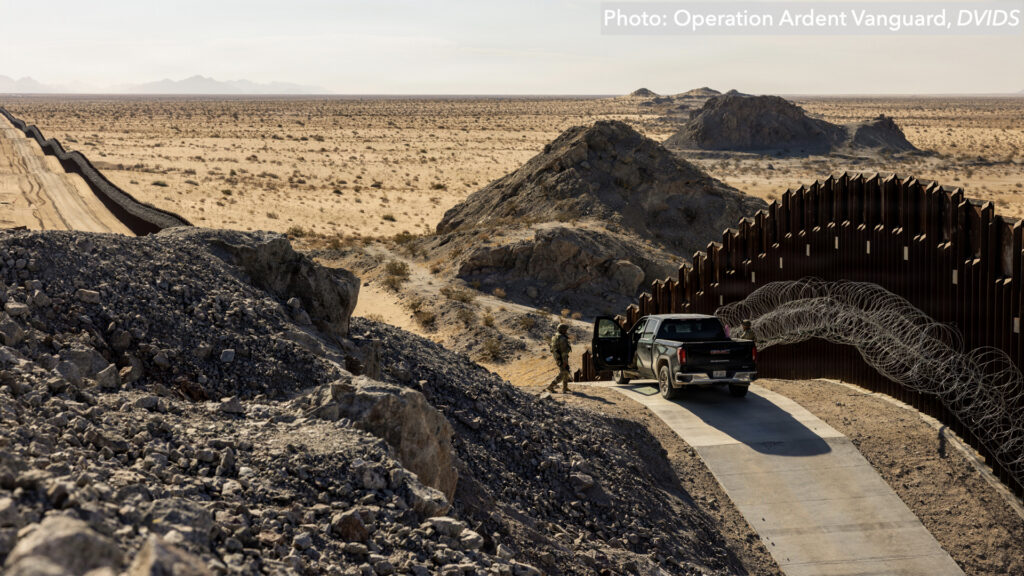
- Border wall updates: As the Trump administration races to build 700 miles of border barriers by the end of 2027, waiving environmental and other laws along the way, the plan is generating turbulence and legal actions in Arizona, Mt. Cristo Rey outside El Paso, Texas’s Big Bend, and elsewhere.
- ICE “Warehouse” plan is being rolled back: The New York Times revealed that ICE plans to sell seven of 11 “mega-warehouses” purchased earlier in the year, for more than a billion dollars, to convert into giant migrant detention centers. It appears that the plan is being downgraded. In ICE’s existing detention system, meanwhile, a Mexican man became the 20th person to die in custody so far this year.
- Seasonal increase brings May migration to highest point of Trump administration: Border Patrol apprehended 9,998 people at the U.S.-Mexico border in May, the largest monthly total of the Trump administration, though still a historically low number. Increases since January probably owe to spring weather. The Trump administration ceased most land-border deportations into Mexico in mid-April, meanwhile, and instead deported Mexican citizens aboard 108 flights last month.
- Links: border and migration policies elsewhere in the Americas: Updates on border and migration policies and developments in Mexico, Guatemala, Honduras, Panama, Ecuador, Colombia, Argentina, the Dominican Republic, and Jamaica.
THE FULL UPDATE:
Supreme Court decisions deal severe blows to the ability to seek protection in the United States
On Thursday June 25, as this Border Update edition was nearing completion, the Supreme Court issued two decisions reinterpreting immigration laws in ways that will make it much harder for people to seek protection in the United States. Both decisions were 6-3, with the Republican-nominated and Democratic-nominated justices voting together, and both overturned contrary rulings from district and appellate courts.
For more context about what led to these decisions, see these discussions in past WOLA Border Updates:
- On “metering” of asylum seekers at the border: WOLA’s November 21, 2025 and April 3, 2026 Border Updates
- On TPS for Haitian citizens: WOLA’s February 6, 2026 and May 1, 2026 Border Updates
Upholding “metering” of asylum seekers at the border
The Court’s decision in Mullin v. Al Otro Lado upheld “metering,” a practice dating back to the last year of the Obama administration, intensified during the Trump era. It refers to placing Customs and Border Protection (CBP) agents on the borderline outside ports of entry (official border crossings)—including in the middle of bridges over the Rio Grande—to prevent anyone without proper documentation from setting foot on U.S. soil.
U.S. law guarantees the right to seek asylum for people who arrive in the United States, regardless of how they got there. Presenting oneself at a port of entry is considered the “correct” way to do so at the border. The Trump administration sought to dispute whether people in need of protection in the United States could be physically prevented from presenting themselves on the U.S. side of the borderline outside the ports of entry. Courts in the U.S. judiciary’s Ninth Circuit had defined “arriving in” the United States as being in contact with U.S. personnel even if not physically present on the U.S. side of the line, but the Supreme Court’s majority did not agree. Even if the Government actively blocks entry, the blocked person still has not “arrived.”
The decision changes little right now, as the Trump administration continues to suspend asylum access at the border, a policy that faces legal challenges. Still, as a dissent from Justice Sonia Sotomayor pointed out, the decision “blesses the Executive Branch’s decision to slam the door shut on all who are fleeing persecution, despite the detailed inspection and asylum system that Congress enacted and commands.” Melissa Crow of the Center for Gender and Refugee Studies, one of the organizations arguing the case, warned, “This ruling should sound the alarm for anyone who cares about human rights and the rule of law.”
“The right to seek asylum—a fundamental freedom and a critical element of the postwar system,” is at risk of becoming “an artifact of a bygone era, one of many casualties of the emerging anti-liberal global order,” author Linda Kinstler wrote at Foreign Policy on June 15, before the Al Otro Lado decision.
Cancellation of Temporary Protected Status (TPS) for citizens of Haiti and Syria
The Court’s decision in Mullin v. Doe allows the Department of Homeland Security (DHS) to terminate Temporary Protected Status (TPS) for citizens of Haiti and Syria without judicial review, regardless of whether the Department’s leadership followed the legal process required to weigh the danger to those who would lose this status. As a result, 350,000 citizens of Haiti in the United States are losing their jobs and their ability to work legally, and are now at high risk of deportation back to a country that, amid out-of-control gang violence, is one of the most dangerous places in the hemisphere.
The Court’s majority relied on language in the Immigration and Nationality Act stating that “there is no judicial review of any” TPS designation or termination. The dissenting opinion pointed out that the law would not have required the Department to follow a legal process at all if the courts had no means to enforce it. This is especially salient when terminating TPS for Haiti, a country about whose citizens President Trump had made public statements indicating “racial animus.”
The Court’s decision came just days after documents revealed that the DHS secretary at the time of the Haiti TPS cancellation, Kristi Noem, had not followed the legal process required to weigh the danger to Haitians before canceling the designation. It appears that DHS terminated TPS for Haitians in June 2025 without obtaining input from the Department of State, although Noem claimed that she had consulted with State.
Ultimately, the Supreme Court effectively held that this point did not matter because the TPS termination process is not “reviewable.” Some immigration experts noted on social media that this interpretation could allow a future, pro-immigration president to grant TPS to all undocumented migrants living in the United States: while that would be illegal, courts would not be able to weigh in.
While this may leave one wondering why laws exist if courts cannot determine when they are broken, the decision still leaves the door open for reviews of the constitutionality of the TPS termination process. “The fight is far from over. Constitutional and equal-protection claims will continue in the lower courts,” recalled a statement from Communities United for Status and Protection and the Haitian Bridge Alliance.
Mullin v. Doe brings new urgency to legislation, which passed the Republican-majority House of Representatives in April, that would keep TPS for Haitians in place through the January 2029 end of Donald Trump’s term. Sen. Ed Markey (D-Massachusetts) and Sen. Lisa Blunt Rochester (D-Delaware) have introduced a companion bill to the House bill, which passed with 10 Republicans joining Democrats. The new bill, however, faces long odds in the Senate, where President Trump’s Republican Party holds a 53-47 majority and 60 votes are needed to end debate and bring the measure to a vote.
Other notable decisions during the past two weeks
- In a 6-3 decision issued June 23, the Supreme Court ruled that CBP officers at ports of entry do not need “clear and convincing evidence” that a green card holder entering the United States has committed “a crime of moral turpitude” in order to strip them of their residency status. “The court has now handed the government a massive blank check” to undo “the benefits and security that come with having a green card,” read a dissenting opinion from Justice Ketanji Brown Jackson.
- A three-judge panel of the U.S. Circuit Court for the District of Columbia decided, by a 2-1 vote, that the Trump administration could go ahead with its policy of applying “expedited removal” to asylum seekers and other immigrants anywhere in the United States. Expedited removal, a “fast track” proceeding that allows some cases to skip immigration court, had previously been implemented only for recent border arrivals. The two judges who upheld the government’s position are Trump appointees.
- Determining that the practice is “arbitrary and capricious,” a federal judge in California called a nationwide halt to Immigration and Customs Enforcement’s (ICE) arrests of migrants at immigration courts. For now, at least, those who show up for their court hearings need not fear being arrested in courthouse hallways by masked ICE agents.
Border wall updates
Building plans
By the time the Trump administration ends in January 2029, DHS expects to have about 1,400 of the border’s 1,954 miles blocked by barriers, mainly border wall segments or riverine buoys. “It’s an enormous task that will require the administration to build around 775 miles of new wall by the end of 2027, and several hundred more miles of secondary and waterborne barrier by the end of 2028,” CNN explained.
Axios reported that about 698 miles of planned primary border wall remain unbuilt. Finishing that “by this time next year,” a goal that DHS Secretary Markwayne Mullin has voiced in congressional testimony, would require building 13 miles of wall per week; so far this year, the pace has been 2.6 miles per week.
The construction is made possible by $46.5 billion that Congress appropriated in July 2025 through the so-called “One Big Beautiful Bill Act,” giving the second Trump administration more than three times the amount the first Trump administration was able to wrest from Congress and from “emergency” budget transfers.
The main hurdle CBP’s wall-building effort faces, CNN noted, is the acquisition of border-front land from private landowners, especially in Texas. “Over recent months, the Department of Justice has been hiring attorneys whose primary job includes invoking eminent domain to seize private land for the administration to build barriers.” The Justice Department has filed 39 land condemnation cases, and CNN reviewed a federal document predicting that all land would be acquired or available for construction by the end of 2027. “While eminent domain cases can be lengthy, they generally don’t keep the agency from being able to proceed with construction,” CNN reporter Priscilla Alvarez explained.
At the Atlantic, Nick Miroff compared President Trump’s desire to paint the Lincoln Memorial Reflecting Pool with his plan to have the border wall painted a heat-absorbing, burn-inflicting black. “The president seemed to enjoy discussing the various ways that migrants could be injured or killed by the wall, according to his aides, who said often that he talked about grisly scenarios as the best way to prevent illegal crossings.”
Arizona
Along Arizona’s border with Sonora, the Tohono O’odham nation is bitterly opposing the Trump administration’s plans to build a wall across its sovereign territory, which straddles the United States and Mexico. The U.S. federal government “hasn’t unilaterally tried to take Indian lands like this in a very long time,” nation chairman Verlon José told the Atlantic’s Geraldo Cadava.
The nation is taking DHS, CBP, and Border Patrol to court, asking the Washington, DC district court for an injunction to stop wall-building on its land. The complaint argues that the Tohono O’odham land is private, not public, and that the wall would disrupt indigenous spiritual and cultural practices. The nation’s lawyers are seeking a hearing as quickly as possible, since CBP expects to begin awarding construction contracts imminently.
“The nation has long worked cooperatively with the Department of Homeland Security to help secure the U.S. border with multiple levels of vehicle barriers, technology, and personnel,” read a quote from Jose in a statement from the Tohono O’Odham Nation. “We have tried to work with the department on the border wall issue, but it insists on rushing forward with construction. We have been left with no other choice but to file suit to protect our land, our culture, and our rights.”
Elsewhere in Arizona, planned construction of a second layer of border wall in a remote area of Organ Pipe Cactus National Monument threatens a rare desert freshwater ecosystem, Quitobaquito Springs, which is home to fish and snail species that don’t exist elsewhere in the world, and the last U.S. home of a turtle species. When the first layer of the border wall near the spring went up during the first Trump administration, builders’ use of groundwater for tasks such as mixing concrete caused an alarming drop in water levels at Quitobaquito.
Mt. Cristo Rey
Controversy is mounting over the administration’s effort to use eminent domain to acquire 14 acres of land on the southern slope of Mt. Cristo Rey, currently owned by the Catholic Diocese of Las Cruces, New Mexico. CBP wants to build border wall segments across the iconic peak, topped with a 29-foot limestone sculpture of Jesus Christ, that looms over El Paso’s western edge.
Because of its rugged terrain, the mountain is the only part of the border in greater El Paso that lacks a wall, which has funneled many border crossers onto its slopes. During the Biden administration, a growing number of migrants died of dehydration and exposure in the vicinity.
The Diocese turned down the agency’s offer of $183,000 for the property. The Justice Department has taken the Diocese to court, and a hearing is scheduled for July 23. Construction on the mountain already began in January, with controlled blasting to level land for wall construction. “Attorneys for the diocese argue the government’s desire to take the property without judicial review infringes on the right to ‘the free exercise of religion,” Border Report noted.
“This is not a battle between the church and the government; it’s a battle between symbols,” said Deacon Jim Winder, chancellor of the Las Cruces Diocese, told the New York Times. “One is a 29-foot statue of Christ the King, which is meant to symbolize unity and hope, and the other is a 30-foot iron monstrosity that symbolizes exclusion and division. Our symbol was there first. The wall is an in-your-face insult.”
Big Bend
All 13 of Texas’s Democratic House representatives joined five other Democrats in sending a June 16 letter to DHS Secretary Markwayne Mullin. The legislators objected to the Department’s June 9 waiver of environmental and historic preservation laws to enable construction of border barriers in the ecologically fragile Big Bend National Park, which straddles the Rio Grande in far west Texas.
Six former superintendents of the park, along with one deputy superintendent, sent Mullin a June 15 letter outlining alternatives for securing the park’s border without a large, disruptive construction project. “The goal here is to respectfully and logically pull them back from what we consider the brink,” Bob Krumenaker, the park’s superintendent from 2018 to 2023, told the Austin American-Statesman.
DHS and CBP leadership say that they do not plan to build a 30-foot-high steel bollard wall through the park. Instead, the plan involves shorter vehicle barriers, access roads, lights, construction platforms, and other infrastructure that could disfigure the landscape of a park that, over the past 10 years, “has accounted for just 0.023% of all documented illegal crossings along the southern border—about 23 for every 100,000 crossings,” the Statesman reported.
The park makes up more than 100 of the 517 miles of Border Patrol’s Big Bend Sector. Even though it makes up more than a quarter of all U.S.-Mexico border miles, this sector sees fewer border crossings than any of the nine geographic zones into which Border Patrol divides the border. So far this century, only 1.1 percent of Border Patrol’s migrant apprehensions have occurred in the Big Bend Sector.
The Big Bend plan still lacks detail; CBP told the Statesman that it is “still in the planning stages.” However, as noted in WOLA’s June 12 Border Update, the agency has already signed contracts with construction companies worth at least $5.8 billion.
The opposition to construction here is bipartisan. The libertarian publication Reason reported about landowners facing the likelihood of “forfeiting their property rights, some for land their families have held for generations.” The Texas Tribune estimated that about 400 landowners in the Big Bend sector are “targeted” for construction projects on their land. Popular podcaster Joe Rogan, whose influence with some demographics likely built electoral support for Donald Trump in 2024, said of the Big Bend plan, “It’s B.S. And they’re just going to do it because they got a nice contract… No bueno.”
In Presidio, Texas, the largest border city in the Big Bend sector, the Presidio Municipal Development District, a board appointed by the city government, filed a lawsuit on June 24 seeking to block construction. The city, which lies outside the national park, is concerned that barriers along its riverfront could exacerbate the risk of flooding. Levees built by the International Boundary and Water Commission and the Army Corps of Engineers mostly protected the city from flooding in 1978 and 2008, but 30-foot walls could overwhelm their capacity.
This is the second lawsuit filed against barrier construction in Border Patrol’s Big Bend Sector. The Center for Biological Diversity, Friends of the Ruidosa Church, and a Big Bend-area landowner filed a complaint in April, amended after DHS officially waived all laws to enable construction. It argues that the waiver authority in U.S. law is worded to specify an intent “to deter illegal crossings in areas of high illegal entry,” but the Big Bend Sector is the least-traveled area along the entire border.
In Presidio, an ICE Homeland Security Investigations (HSI) agent and former city council member is under fire for purchasing a plot of land near the city, only to lease it back to the border wall contractor Fisher Sand and Gravel for use as a staging area. “I’m done with him. I don’t want to have anything to do with him,” the town’s mayor said of the agent.
Laredo
Laredo, Texas, is probably the largest city along the border that remains unwalled, due to opposition from city leaders and organized residents. Now, though, local officials are taking a more conciliatory approach, wrote Jason Buch at the Texas Observer. They appear to recognize the inevitability of the wall after the passage of the “One Big Beautiful Bill Act” and are now negotiating with CBP to minimize its impact on the city’s parks, water treatment plants, and other infrastructure.
Rio Grande Valley
CBP is planning to start building “a reinforced concrete levee wall with 30-foot steel bollard panels adjacent to the current levee” in the Santa Ana National Wildlife Refuge, in south Texas’s Rio Grande Valley region, Border Report reported.
The Refuge was on a list of Rio Grande Valley sites where wall construction was prohibited by language in Homeland Security appropriations bills. The “One Big Beautiful Bill Act” wall-building money, however, came with no such prohibition, and the Trump administration is determined to build there. Other now-unprotected sites left vulnerable to wall construction include the Bentsen-Rio Grande Valley State Park, La Lomita Historical Park, the National Butterfly Center, and part of the Lower Rio Grande Valley National Wildlife Refuge.
“A string of giant orange cylindrical buoys now line the Rio Grande for miles in South Texas,” Border Report reported from near the mouth of the Rio Grande south of Brownsville. CBP has now installed 15 miles of plastic cylinders down the middle of the river, and plans to install 536 miles total. “We’re concerned that this will create a flooding crisis because debris can back up in the buoys and make the river waters increase,” Bekah Hinojosa of the South Texas Environmental Justice League told Border Report’s Sandra Sanchez.
ICE “Warehouse” plan is being rolled back
At least seven warehouses are being unloaded
NBC News had reported on May 29 that the Trump administration was considering selling some of the giant warehouses that ICE had been purchasing “to serve as mega-detention centers for immigrants.” On June 18, the New York Times’s Hamed Aleaziz confirmed the story with more detail.
“In a major turnabout, the agency is planning to offload seven warehouses purchased for more than $700 million by either giving them to other federal agencies or selling them outright,” Aleaziz informed, citing government documents that the Times had obtained.
WOLA’s February 6 and February 20 Border Updates described ICE’s plan, as did some subsequent updates. The idea, hatched during the tenure of former DHS Secretary Kristi Noem, was to purchase 24 shipping warehouses around the country to create a network, along with 10 existing detention facilities, capable of detaining about 100,000 people at a time. ICE would outfit the largest of the “mega-warehouses” to hold up to 10,000 people. The agency would pay for the plan with $38 billion from a $45 billion outlay for detention in the “One Big Beautiful Bill Act” that Congress passed in July 2025 on a party-line vote.
By the time Noem’s tenure at DHS ended in March, ICE had purchased 11 warehouses for a total of $1.074 billion. Now, seven of those are to be sold off as Noem’s successor, Markwayne Mullin, pursues a detention expansion plan that, while likely to be less ostentatious, will be large-scale and remains under development.
The warehouse scheme encountered bipartisan opposition in many of the communities where ICE, often without consulting local officials, made its purchases. Seven jurisdictions filed lawsuits or sought to apply environmental regulations to slow the plan. (Unlike border wall-building, DHS has no authority to waive environmental or other laws to build detention sites.) “The biggest challenge has been the proliferation of environmental lawsuits across the country,” Haleaziz reported. “The lawsuits have set the agency back significantly.”
The plan was also set back by what Michael Wriston, whose organization Project Salt Box has most closely tracked the warehouse purchases, called “just the total infeasibility of the project.” He told Marisa Kabas of the Handbasket, “I think that’s something that people within ICE have known for a while—that converting warehouses into detention centers or concentration camps is logistically just not feasible.” Claire Trickler-McNulty, a former senior ICE official, told the Associated Press, “Facilities over 2,000 people just break down. It’s very hard to run a very big facility, to keep it staffed, to keep all of it moving.”
The warehouses being put back up for sale, the Times reported, are in Romulus, Michigan, Social Circle and Flowery Branch, Georgia; Hamburg and Tremont, Pennsylvania; Salt Lake City, Utah; and Roxbury, New Jersey. In most of these areas, opposition from local officials and residents was stiff.
In a filing for a lawsuit brought by state and city government officials, ICE stated that it planned to sell the Romulus, Michigan facility, which it had bought in February for about $34.7 million. “The ICE warehouse proposal was every bit as ill-conceived as it was cruel and unnecessary, and I am relieved that this chapter is coming to a close,” Michigan’s attorney general said. The city of Social Circle, Georgia put out a statement thanking its Democratic senators and Republican House representative for their “assistance throughout this process.” In Pennsylvania, the Philadelphia Inquirer reported, state government agencies had “issued five administrative orders in March that would have prevented the warehouses from using local water and sewage systems unless DHS complied with state and federal regulations.”
ICE also appears to be scaling back “mega-warehouse” plans in Socorro, Texas, east of El Paso, where three warehouses had been slated to hold 8,500 people. Rep. Veronica Escobar (D-Texas) said that the Socorro site will instead “be a training facility. It will be a campus, essentially, for ICE, with offices and conference rooms, but yes, there will be privately run detention.”
No changes have been announced for warehouses purchased in San Antonio, Texas; Surprise, Arizona; or Hagerstown, Maryland. In Hagerstown, a federal judge has put construction on hold.
Wriston, of Project Salt Box, warned opponents of the warehouse plan to be alert to the possibility of ICE choosing to build large detention centers through “greenfield construction” projects, “essentially using undeveloped land and building brand new detention centers from the ground up.”
More deaths in ICE custody
On June 19, a 63-year-old citizen of Mexico, Felix Alcorta Rodríguez, died of apparent “natural causes” shortly after being taken to a nearby hospital from the Webb County Detention Center, operated by the contractor CoreCivic, in Laredo, Texas. Alcorta Rodríguez is the 20th person to die in ICE custody this calendar year.
A total of 50 people have died in ICE custody since the Trump administration began in January 2025, noted a Reuters analysis using data obtained by the Deportation Data Project. The outlet’s journalists calculated that there has been about one Trump-era death for every 1,630 people in custody, more than double the 2009-2024 rate of one for every 3,848 detained people. Experts interviewed “said the rising rate and other data points raised concerns about the quality of supervision and medical care in detention centers that have seen their populations balloon under Trump.”
The Intercept covered the disturbing case of a 35-year-old immigrant from Belarus who has been detained at the Farmville Detention Center in Virginia, run by the contractor CoreCivic, for nearly a year. Aliaksei Shcharbachenia has been unable to get medical attention for a tumor growing on his arm. “‘Dogs’ live better than detainees there, Shcharbachenia told the Intercept. ‘I want people to know what really happens inside here.’”
GEO and detainee protections
The Washington Post revealed that one of ICE’s principal detention contractors, GEO Group, privately weighed in with the agency when it was reviewing federal immigration detention standards. “Geo asked that ICE remove lines saying contractors needed to follow state and local laws around the treatment of detainees and that ICE amend language to support its legal position” in lawsuits brought by state governments objecting to the company’s practice of paying some detainees as little as $1 per day for their labor.
On June 15, ICE posted revised detention standards, including a specification that detainees “are not entitled to wages or benefits under applicable wage laws or labor regulations.” The Post noted, “Two of the Trump administration’s top immigration officials — border czar Tom Homan and ICE’s acting director, David Venturella — previously worked for Geo Group.”
Overdoses at Fort Bliss
The El Paso Times and El Paso Rep. Veronica Escobar (D-Texas) revealed that two people held at the increasingly notorious “Camp East Montana” tent detention facility, at the Fort Bliss army base, appear to have suffered non-fatal overdoses on May 23 and 24. A third incident occurred in February. DHS told the El Paso Times that they were “related to an overdose of psychiatric medication and a ‘self-harm’ incident.” The Fort Bliss camp is the largest detention facility in ICE’s system.
“These recent suspected overdoses are yet another example of a contractor unable to meet federal standards,” read a letter from Rep. Escobar. “At a minimum, the public deserves answers as to how three individuals were able to potentially overdose inside a federal detention facility.”
Florida
Crews have begun dismantling the Florida state government-run migrant detention facility in the Everglades that state officials called “Alligator Alcatraz.” All detainees have been moved out of the nearly year-old detention camp, which cost the state more than $1 million per day to operate.
Seasonal increase brings May migration to highest point of Trump administration
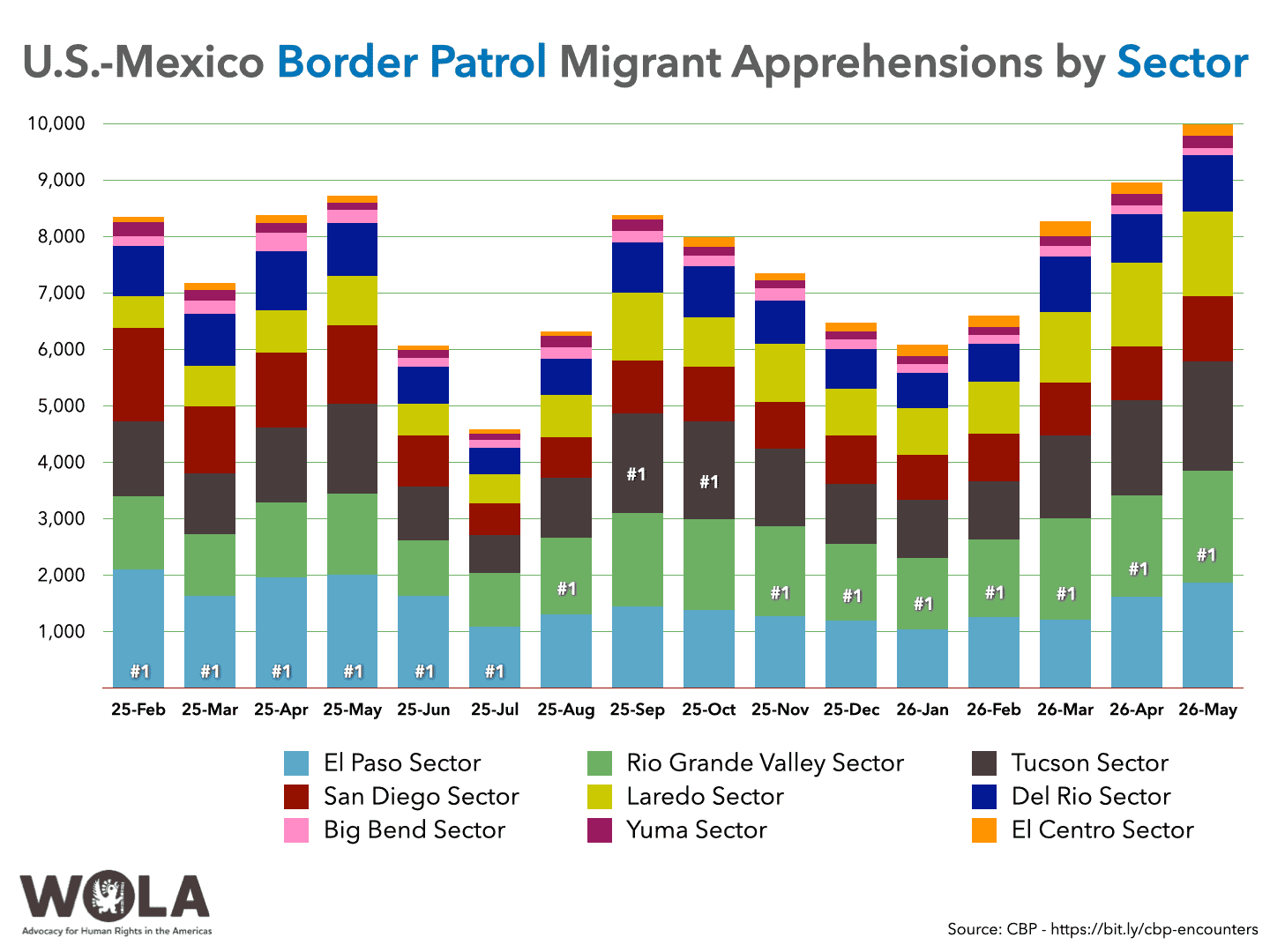
CBP published data about the agency’s encounters with migrants at the U.S.-Mexico border in May. For the second straight month, the agency reported the highest number of migrant encounters of any month during the Trump administration: 9,998 apprehended by CBP’s Border Patrol component between the ports of entry (official border crossings), and another 3,532 encountered by CBP’s Office of Field Operations at the ports of entry, for a total of 13,530.
While the port-of-entry number is similar to prior months (CBP posts officers on the borderline to prevent most undocumented people from reaching U.S. soil), the Border Patrol apprehension total increased 12 percent from April to May, and—following four straight months of increases—64 percent from January to May.
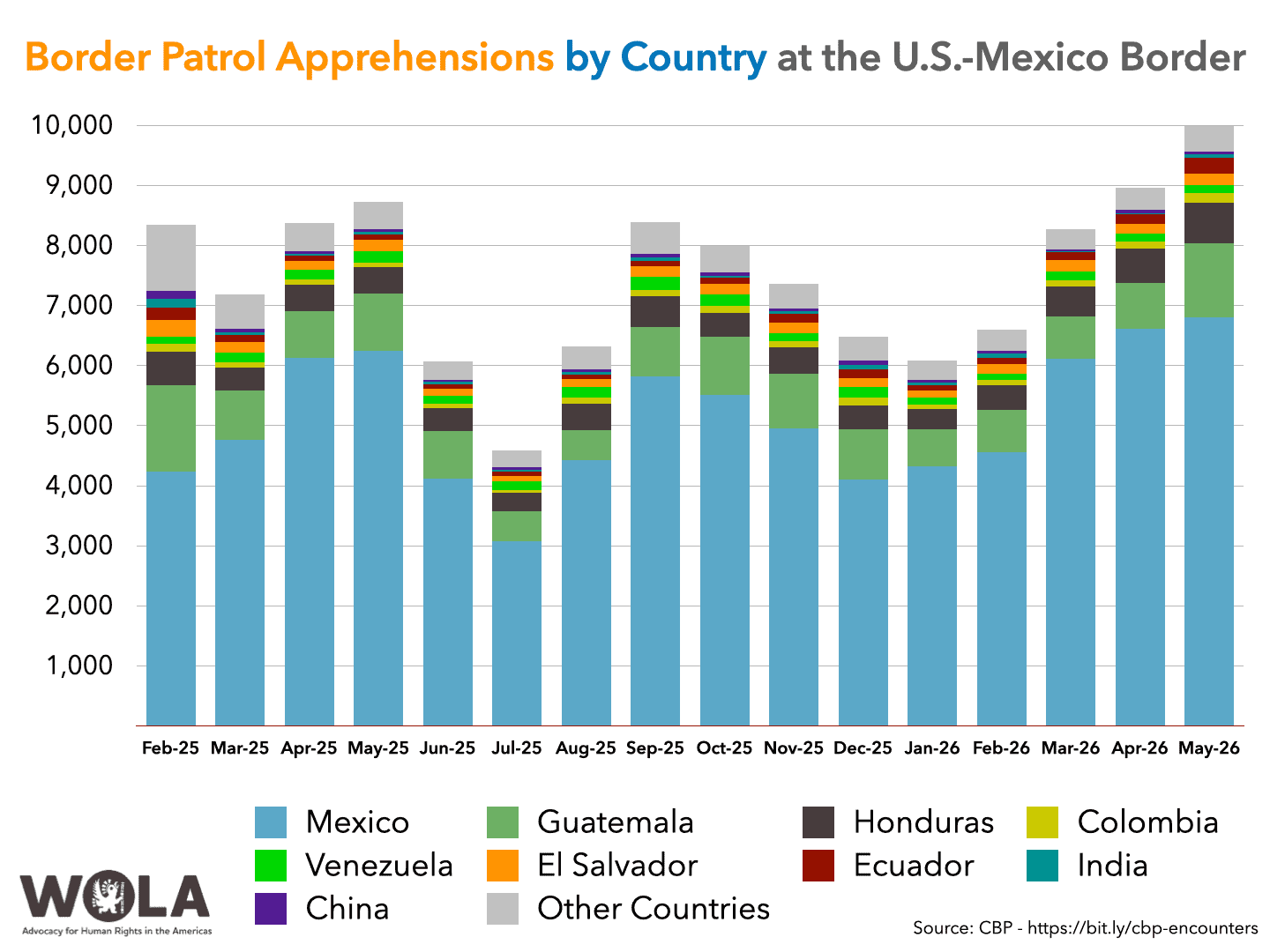
The increase is almost certainly seasonal: migrants who are trying to evade U.S. authorities—a journey that can involve days in hazardous desert conditions—tend to cross more often in the spring and fall when the weather is milder. If that remains the case, a decline from May to June is likely as the summer heat intensifies.
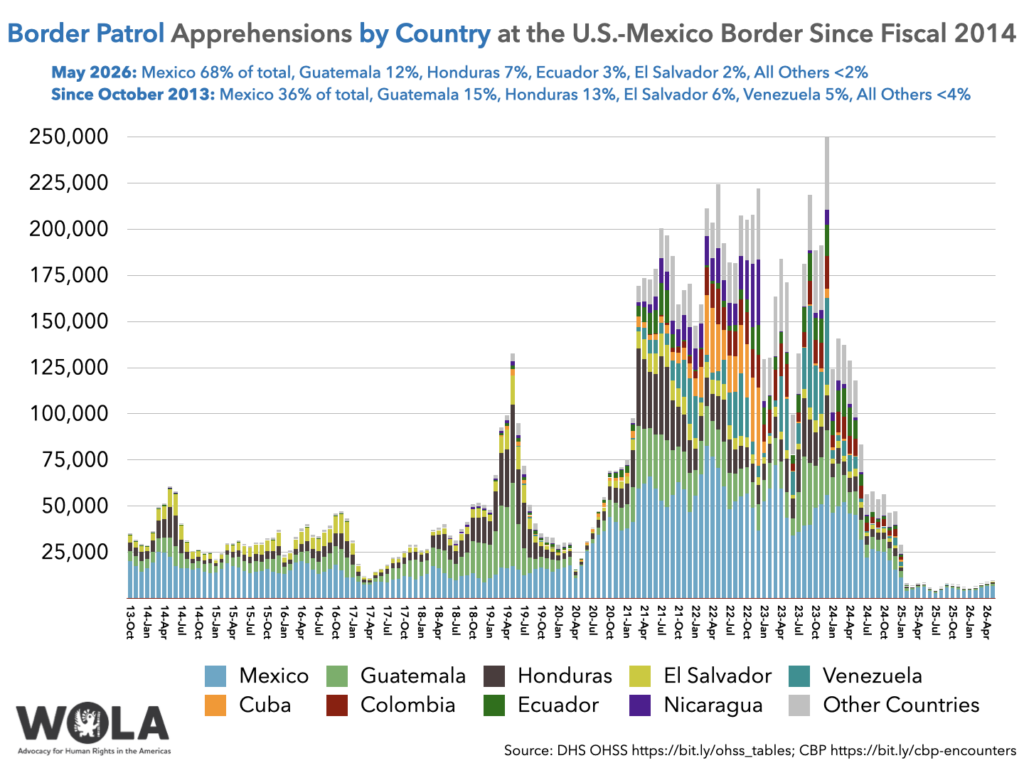
In general, migrants who are not traveling through the desert to evade authorities are asylum seekers, who would wait on U.S. soil to turn themselves in to U.S. agents. Since January 2025, however, the Trump administration has suspended the statutory right to petition for asylum at the border, so the asylum-seeking population is virtually zero. With asylum unavailable, and amid constant reports of the climate of fear pervading immigrant communities in the U.S. interior, arrivals at the border remain near lows not measured since the mid-1960s.
With the spring increase in migration have come signs that people are going to great lengths to evade capture. In one example, the U.S. Coast Guard stopped a boat carrying 19 Mexican citizens, including an adolescent, off the coast of San Diego, in the predawn hours of June 14.
Of Border Patrol’s May apprehensions, 68 percent were citizens of Mexico, and 90 percent were from either Mexico or Central America. 1,243 (12%) were citizens of Guatemala, making May 2026 the first month in which Border Patrol apprehended more than 1,000 migrants from a country other than Mexico since February 2025.
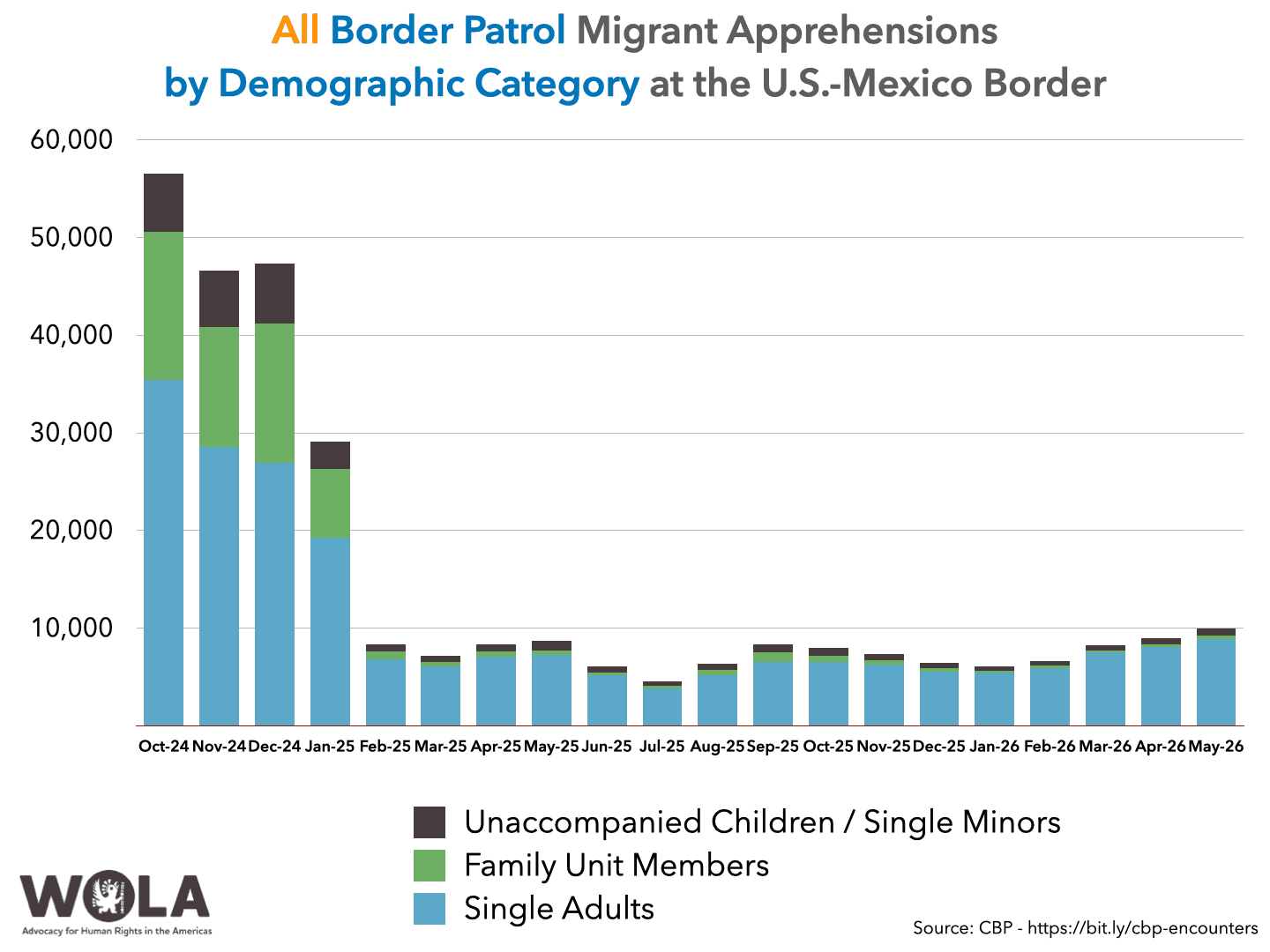
As has been approximately the case during every month since January, only 11 percent of Border Patrol’s apprehended migrants (including ports of entry) have been children or parents traveling with children. In December 2024—the last full month of the Biden administration, when asylum seekers accounted for a larger share of apprehended migrants—the proportion was 43 percent.
For the seventh straight month, South Texas’s Rio Grande Valley measured more Border Patrol apprehensions than any other of the nine geographic sectors into which Border Patrol divides the U.S.-Mexico border. The Tucson Sector in Arizona was second for the third straight month, only 40 apprehensions behind Rio Grande Valley (1,978 and 1,938 apprehensions). The El Paso Sector (far west Texas and New Mexico) was third. All sectors except Big Bend (far west Texas) measured increases in apprehensions from April to May, with the San Diego Sector (California, 20%), gaining the most.
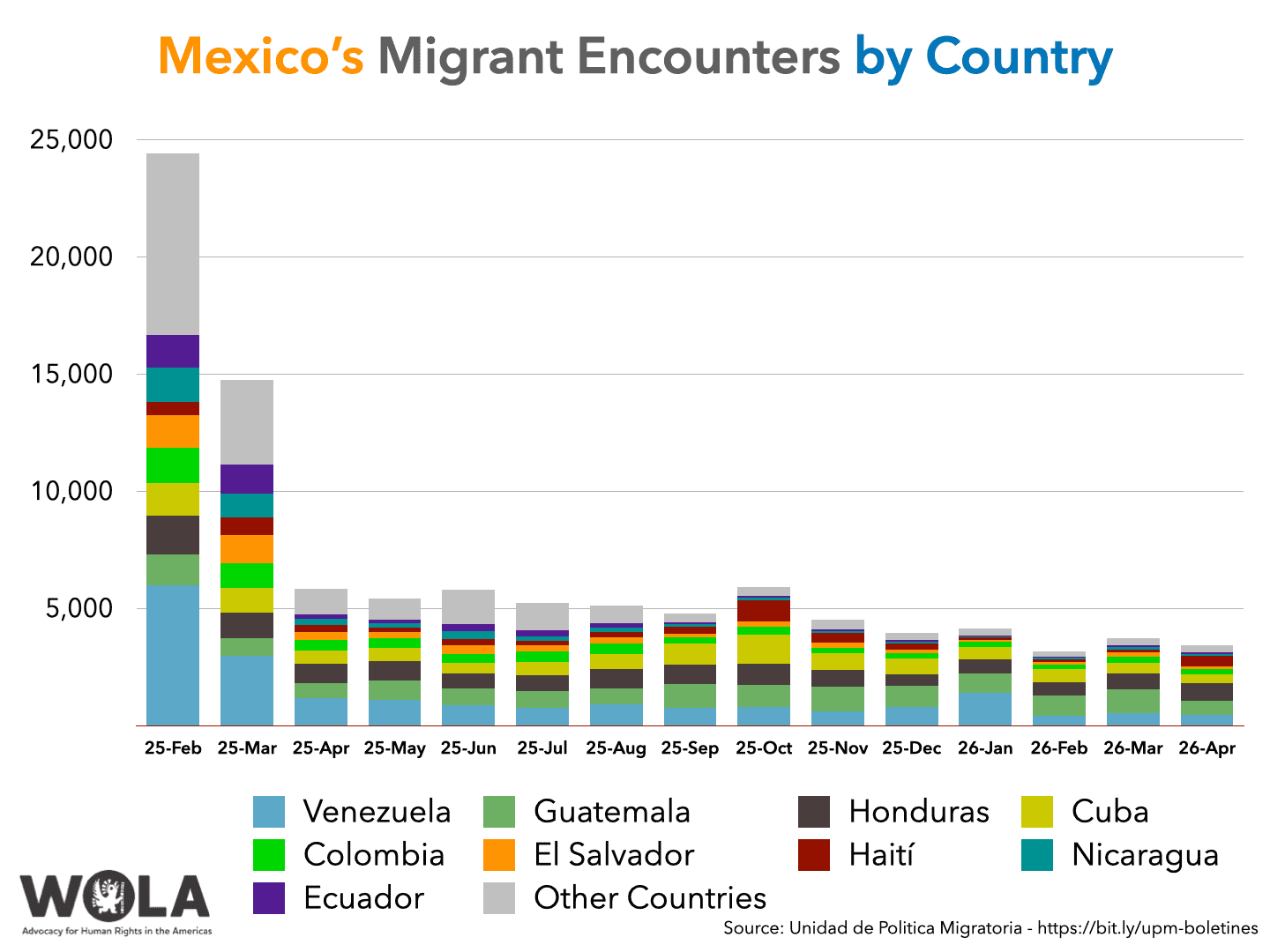
The Mexican Interior Department’s Migration Policy Unit has reported data about Mexican authorities’ migrant encounters through April. With fewer non-Mexican migrants seeking to transit the country en route to the U.S. border, the Mexican government is encountering fewer migrants than at any time this century, except for the first months of the COVID-19 pandemic. The 3,440 encounters in April were in fact a decline from March (3,724), with the largest number coming from Honduras (22%), Guatemala (18%), Venezuela (13%), Haiti (13%), and Cuba (11%).
Mexican government data about U.S. deportations of Mexican citizens are also current through April. The numbers begin to show the Trump administration’s move, starting in mid-April, to drastically cut back deportations along the common land border, and instead to fly nearly all deported people to cities deep in Mexico’s interior, especially Tapachula, Chiapas and Villahermosa, Tabasco near the Guatemalan border. In the chart below, Villahermosa is shown in red, and Tapachula in gray. When Mexico reports May deportations, that month’s column is likely to be almost completely red and gray.
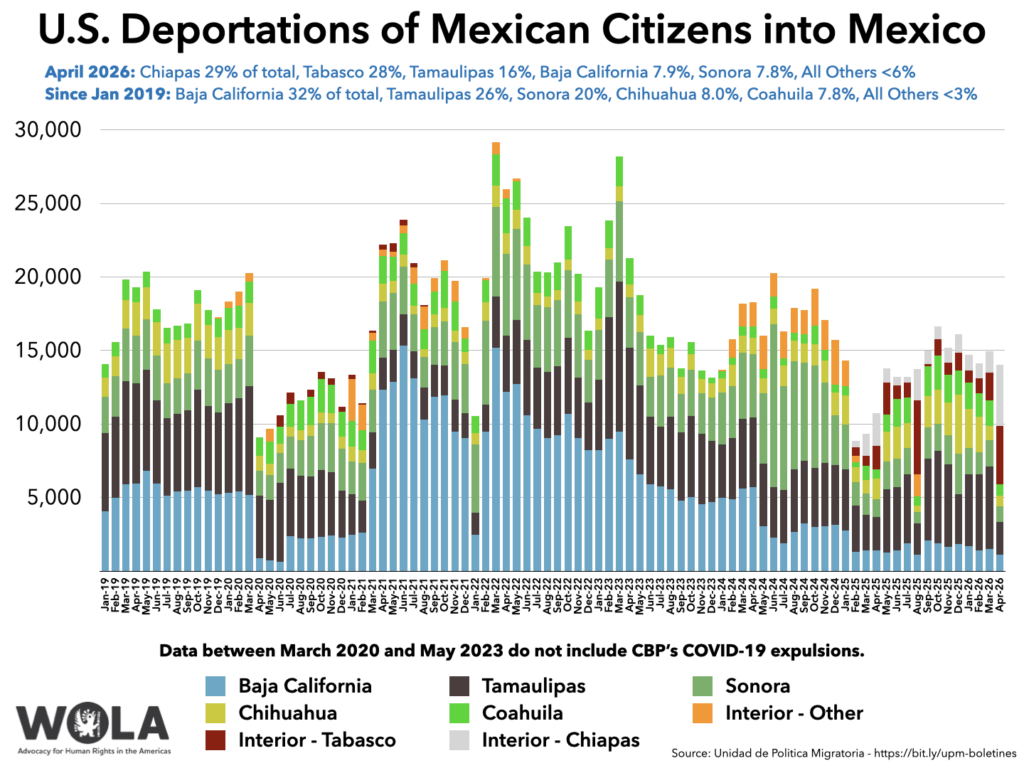
Strong evidence of that shift from land-border to aerial deportations comes from the latest monthly report from Human Rights First’s ICE Flight Monitor project, which showed that the agency ran a record 288 deportation flights worldwide in May, with an unprecedented 108 going to Mexico. That far exceeds 48 flights to Guatemala and 39 to Honduras last month. The array of Mexican cities receiving ICE flights has expanded beyond Tapachula and Villahermosa to include Mexico City; Tulum, Quintana Roo; Mérida, Yucatán; Huatulco, Oaxaca; Campeche, Campeche; and Morelia, Michoacán.
The U.S. ambassador to Mexico, Ronald Johnson, met with Mexican cabinet officials “to discuss topics on the bilateral agenda in migration matters,” the country’s Foreign Affairs Department stated. The diplomats offered no further details on the discussions, so it is unclear whether the Trump administration’s land-border deportation stoppage was a major topic.
Links: border and migration policies elsewhere in the Americas
Mexico
- A new “caravan” protest of about 200 migrants in Mexico’s southern state of Chiapas “does not seek to reach the United States due to President Donald Trump’s policies,” the daily La Jornada reported, but instead “aims to reach other regions of Mexico where they can find work and continue their migration processes.” At least 19 caravans have departed Mexico’s southern border-zone city of Tapachula since October 2024, “but all have been disbanded between Chiapas and Oaxaca.”
- Since 2019, about 175,000 migrants have been granted asylum in Mexico’s system, the daily La Jornada reported, citing a new UNHCR report with data placing Mexico in eighth place globally and first in Latin America.
- The Ciudad Juárez-based head of the Chihuahua, Mexico State Coordination of Social Protection (Coespo), which handles much of the state’s migration policy, told reporters that the population of non-Mexican migrants in the border city has dropped 90 to 95 percent since Donald Trump took power. Enrique Serrano Escobar estimated that 1,200 to 1,400 migrants lacking firm documentation remain in Ciudad Juárez, noting that they are especially vulnerable to ransom kidnappings. Escobar also called out the Mexican government’s migration agency (National Institute for Migration, INM) for slow, rigid processing of residency documents and work permits for migrants: “There is a procedure before the National Institute of Migration, but it is difficult to comply with. This procedure has not adapted to these new circumstances we are living. We need an agile, expeditious procedure.”
- Mexican authorities have been demolishing at least 15 “irregularly settled” houses near the border wall in the Anapra area on the western end of Ciudad Juárez, near Mt. Cristo Rey. Mexico’s army set up a new checkpoint nearby. “The work is part of a strategy initiated weeks ago at the request of military authorities to improve visibility and control over an area that has historically been used for irregular crossings of people into the United States,” reported the Juárez daily Norte. This will allow more joint, “mirrored” patrols between Ciudad Juárez municipal police and Border Patrol, the city’s top security official said.
- Dana Graber Ladek has finished nearly six years at the head of the International Organization for Migration (IOM) office in Mexico. She told the daily La Jornada that when the Trump administration cut off asylum access and ended the CBP One program in January 2025, about 65 percent of migrants stranded “in limbo” had no intention of returning to their home countries, and many now “see Mexico as a destination.”
Central America
- Remittance payments to Latin America and the Caribbean, sent from migrants in the United States and elsewhere, surged 7.3 percent from 2024 to 2025, to a record $173.7 billion, the Inter-American Development Bank reported. This “reflected migrants’ exceptional response to policy uncertainty: extra transfers funded by savings, longer hours, and heightened concern for households back home.” The Bank expects the growth rate to slow in 2026. An analysis by the Guatemalan daily La Hora notes a “silent decline” in remittances to the country, as fewer Guatemalan citizens in the United States are able to maintain steady incomes amid the Trump administration crackdown.
- A report from the Migration Policy Institute (MPI), supported by the UN International Organization for Migration (IOM), found a big Trump-era shift in the population of Guatemalan migrants being returned to the country. Survey data showed that a much larger portion of people being deported had “a longer residence history in the United States,” defined as five to nine years. Half of those surveyed, upon returning to Guatemala, said they did not wish to emigrate again. As of June 14, the United States had deported 29,153 Guatemalan citizens back to their home country so far this year.
- In Honduras, the news site Criterio reported, U.S.-bound migration has been proceeding “at a snail’s pace” due to the Trump administration’s crackdown on asylum and pursuit of mass deportation. Inside Honduras, however, people continue to flee their communities: “The latest figure on internal forced displacement is 400,000 people, a result of poverty and violence.”
- With funding from the U.S. Department of State, Panama deported 67 Colombians and Ecuadorians back to their home countries aboard a June 18 fight.
South America
- The U.S. and Ecuador governments signed a “Safe Border Implementation Charter” committing the U.S. government to increased U.S. assistance to the South American country “to combat transnational crime, drug trafficking, illegal immigration, and other threats affecting border areas.” As with most U.S. border security assistance and training to other nations, it is funded by the U.S. Department of State (usually through its Bureau of International Narcotics and Law Enforcement Affairs). CBP often conducts training and provides advice.
- Secretary of State Marco Rubio used a rarely invoked authority to order the arrest, with intent to deport, of an asylum seeker and social-media influencer from Colombia who supports his home country’s left-wing government. Beto Coral was placed in ICE custody shortly after going to Florida to protest the right-wing, Trump-favored candidate who just won Colombia’s June 21 presidential election. It “appears to be the first time Mr. Rubio has used this authority to recommend the deportation of an activist related to a foreign election,” the New York Times reported.
- In Argentina, a far-right, pro-Trump government has created a new “Immigration Security Program” within its Ministry of National Security, which is creating Immigration Security Units “to reinforce controls, prevent crime, and combat criminal organizations,” Infobae reported. The leftist newspaper Página 12 ran the headline, “[President Javier] Milei created his own version of ICE.” Milei’s government has tightened access to work permits and undocumented migrants’ access to health care, while claiming to have deported 14,000 migrants over the past six months.
Caribbean
- Amid a draconian crackdown on undocumented (and de-documented) Haitians living in the Dominican Republic, the Haitian community there is “witnessing a campaign of serious human rights violations that appeals to the anti-Haitian sentiment entrenched in much of society, normalizing violence and dehumanization against our community,” Roudy Joseph of the human rights group Colectivo HaitianosRD told Spain’s El País.
- Jamaica could become the latest of several Latin American and Caribbean countries to sign a deal with the Trump administration to accept deportations of third-country nationals, with the expectation that they would then be repatriated or sent to fourth countries. Jamaica would receive up to 25 migrants every two weeks, the New York Times reported. This resembles an ongoing arrangement with Costa Rica, which is accepting 25 people per week. Jamaican officials said that migrants sent there would not be detained, but it is unclear what might happen to those who fear returning to their home countries.
Other news
- The seven people found dead aboard a train cargo container in Laredo, Texas, in May attempted the journey despite the Trump administration’s attempts to deter migrants from crossing, Jason Buch wrote at the Texas Observer, because it is not possible to “outdo the horrors of immigrating here.”
- A CBP release commemorated the “historic milestone” of Border Patrol’s workforce reaching a new record of 21,471 agents, with a goal of hitting 25,000. The release did not mention how many are deployed specifically at the U.S.-Mexico border; the agency has largely stopped releasing that information, citing operational security. The latest figure WOLA has seen for Border Patrol agents at the U.S.-Mexico border was 16,654 as of May 2022. (See a chart and data table of 1992-2022 Border Patrol staffing.)
- A report from Mijente, Surveillance Resistance Lab, and Just Futures Law, summarized at the Guardian, found that ICE and CBP roughly tripled their spending, from 2024 to 2026, on contracts to companies providing surveillance technology.
- 9,000 active-duty U.S. military personnel remain deployed at the U.S.-Mexico border, “at a cost of tens of millions of dollars each week,” the New York Times reported. The Times report revealed that “the military has flown more than 800 surveillance and reconnaissance flights since the mission started in early 2025, up from about 160 a year earlier.” However, they face challenges from organized crime surveillance, particularly using drones. After Mexican forces, with U.S. support, killed Jalisco New Generation Cartel leader Nemesio Oseguera Cervantes in February, some troops at the border “discovered that their phones had been hacked, and they began receiving threatening messages.”
- Texas Gov. Greg Abbott (R) indicated that he will seek billions of dollars in federal money from a “State Border Security Reinforcement Fund” that became available on June 4. This $10 billion fund, created by the “One Big Beautiful Bill Act” that Congress passed in July 2025, reimburses states, such as Texas, that spent their own budgets on border security measures. During the Biden administration, Abbott spent over $10 billion of Texas funds on border fence-building, busing of migrants to Democratic-led cities, National Guard deployments, and arrests and jailing of asylum seekers on state “trespassing” charges, among other measures, calling it “Operation Lone Star.” He now expects to get much of this money back from U.S. taxpayers.
- Speaking to immigration data expert Austin Kocher, Heidi Altman of the National Immigration Law Center (NILC) walked listeners through the details of the new $70 billion, four-year appropriation for ICE and CBP that passed Congress on a party-line vote in early June (see WOLA’s June 12 Border Update). The bill, Kocher noted, “also strips the transparency rules, including the requirement that ICE publish basic data on who it is detaining, which is the foundation of the work I have written about for years.” Altman’s organization also published an overview of the new budget law; now, NILC warns, “we may see DHS attempt to degrade the basic rights of people in its custody even further.” ICE and CBP now have a quarter of a trillion dollars to spend between 2025 and 2029, a two-thirds increase over what they would have received under previous appropriated levels.
- It is the time of year when water levels rise in fast-flowing irrigation canals near the border in El Paso, raising the risk of drowning for migrants seeking to cross them. “Border Patrol says the canals, which belong to the International Boundary and Water Commission, are deeper than they appear and often carry strong currents and undercurrents,” Border Report reported.
- The Department of Justice is still seeking to prosecute Kilmar Abrego Garcia for allegedly smuggling migrants, appealing a Tennessee federal judge’s dismissal, on grounds of “vindictiveness,” of the Trump administration’s case against the Salvadoran migrant.
- Border Patrol agent Raymundo Ramos was arrested on June 8 and indicted on June 10 on charges of aggravated assault for hitting a Mexican migrant whom he was chasing with his vehicle in Harlingen, Texas, in January. “Surveillance footage from a nearby home obtained by the Department of Homeland Security Office of the Inspector General showed that the victim was ‘walking calmly in a non-threatening manner’ at the time of the crash,” local media reported.
- Writing at LA TACO, Chelsea Vega found that economic opportunity, upward mobility, and a sense of “belonging” are key reasons why significant numbers of U.S. Latinos join CBP and Border Patrol (about 50%) and ICE (about 20%). “How much must someone do before they are fully accepted as American?” Vega asked.
- House of Representatives Republicans hope to keep their narrow majority by flipping two Democratic-held border districts in south Texas’ Rio Grande Valley (Reps. Henry Cuellar and Vicente Gonzalez) and New Mexico’s lone border district (Rep. Gabe Vasquez), according to a CNN political analysis.
- In an upcoming memoir, former Colorado senator and Biden-era ambassador to Mexico Ken Salazar, a centrist, wrote about his frustration with the Biden administration’s “political failure to understand the reality of the crisis at the border, and the political consequence it would have on Democrats in the 2024 election.”
- “What will happen [in Latin American nations] when there is an increase in the unemployed population and dissidents who can no longer emigrate, while at the same time remittances decrease? It’s a pressure cooker,” WOLA’s Adam Isacson said in an interview with Expediente Publico.
Links: “mass deportation” and human rights in the U.S. interior
- Priscilla Alvarez, “Federal Judge Blocks Trump Policy of Making Arrests at Immigration Courts Nationwide” (CNN, June 24, 2026).
A federal judge in California on Tuesday issued a nationwide block against the Trump administration’s policy of making arrests at immigration courts, putting an end to a practice that garnered national attention
- Laura Romero, “Judge Orders Return of Deported Honduran Man Whose Removal ‘Boggles the Mind’” (ABC News, June 23, 2026).
A judge has ordered the DHS to facilitate the return of a 20-year-old Honduran man with no criminal history after she found he was likely removed without due process
- Luzdelia Caballero, “Father and Daughter Visit Through the Us-Mexico Border Fence After the Elder Self-Deports” (CBS News, June 23, 2026).
Aracely Duarte Perez is a US citizen and recently came to Imperial Beach, where San Diego meets Playas de Tijuana, for a brief, emotional moment with her father
- Jessica Washington, “Ice Tried to Deport an Asylum-Seeker. Now He’s Being Denied Care for a Growing Tumor in a Private Prison.” (The Intercept, June 23, 2026).
A Belarusian asylum-seeker describes medical neglect at Farmville Detention Center, which was recently bought by CoreCivic
- Sophie Hurwitz, “Dhs Still Has a Civil Rights Team. Aliya Rahman Is Testing It.” (Mother Jones, June 23, 2026).
The disabled US citizen was violently jailed by ICE agents—so she’s going to their “internal adversaries”
- Mark Joseph Stern, “Clarence Thomas Just Gave Border Agents a Terrifying New Power” (Slate, June 23, 2026).
On Tuesday, the Supreme Court blessed a Kafkaesque nightmare by a 6–3 vote along the usual partisan lines
- Priscilla Alvarez, Tierney Sneed, “Trump Effort to Expand Speedy Deportations of Migrants Can Proceed, Appeals Court Rules” (CNN, June 23, 2026).
A federal judge in California on Tuesday issued a nationwide block against the Trump administration’s policy of making arrests at immigration courts, putting an end to a practice that garnered national attention
- Luis Ferre-Sadurni, “Trump Administration Sues New York State Over Ice Mask Ban” (The New York Times, June 23, 2026).
A Department of Justice lawsuit said that a measure prohibiting law enforcement officers from covering their faces would endanger agents
- Hamed Aleaziz, Zolan Kanno-Youngs, “How Trump Turned America’s Refugee Program Into a Pathway for White People” (The New York Times, June 23, 2026).
President Trump has created an exception to his refugee ban for white South Africans, reshaping a program intended for people fleeing persecution and disaster
- Camilo Montoya-Galvez, Joe Walsh, “Federal Court Allows Ice to Expand Expedited Deportations Nationwide” (CBS News, June 23, 2026).
A federal appeals court has allowed the Trump administration to move forward with an effort to expand fast-track deportations throughout the U.S.
- Pablo Manriquez, “Five Immigration Policy Scoops Everyone Else Missed” (Migrant Insider, June 22, 2026).
From courts pricing out asylum seekers to a federal hiring blitz, here’s what the government did while no one was watching
- Ximena Bustillo, “A California Man’s Case Highlights Gaps in Care and Oversight at Dhs Detention Centers” (National Public Radio, June 20, 2026).
Federal officers shot Ricardo Parias eight months ago during an ICE operation to detain him. His lawyer says he is still in pain, highlighting gaps in oversight and care in DHS facilities
- E. Tammy Kim, “How the Trump Administration Pushed Judges to Deport Children” (The New Yorker, June 20, 2026).
The D.O.J. has fast-tracked immigration cases for unaccompanied minors and fired judges who appear not to comply
- Emily Bregel, “Venezuelan Asylum Seeker Still Detained, Despite Dhs Admitting She Has Legal Status” (The Arizona Daily Star, June 20, 2026).
A Venezuelan asylum seeker with active Temporary Protected Status remains detained at Arizona’s Eloy Detention Center nearly nine months after her arrest. Court filings show a federal government attorney acknowledged
- Alan Feuer, “Ice Protester Says He Was Shackled in Hospital for Days After Agents’ Attack” (The New York Times, June 18, 2026).
The story of one progressive activist arrested in Minnesota in January shows what critics say is the aggressive nature of the Trump administration’s response to those who have protested its immigration crackdown
- “Us: Federal Government Terrorized Minnesota Communities” (Human Rights Watch, June 18, 2026).
Accountability, Sweeping Reforms Needed to Prevent Future Violations
- Aaron Torres, “Dallas Immigration Dockets Swell Under New Trump Administration Policy” (The Dallas Morning News, June 18, 2026).
The Trump administration in recent weeks began scheduling 100 or more migrants to appear in front of a single judge on the same day, a dramatic change that worries immigration attorneys
- Claudia Boyd-Barrett, “Arrests of Immigrant Parents Create Mental Health Crisis for Children” (CBS News, June 18, 2026).
An estimated hundreds of thousands of children, many of them U.S. citizens, have been separated from a parent in the Trump administration’s immigration crackdown
- Michael Gonzalez, “A Traffic Stop, Three Months in Ice Detention, and a Deportation Order: How Texas’s Immigration Crackdown Is Sweeping Up Daca Recipients” (The Border Chronicle, June 18, 2026).
With interior Border Patrol checkpoints to the north, and the border to the south, DACA recipients in border communities feel under threat by multiple layers of law enforcement, from ICE to local police. Nowhere more so than in Texas
- Dara Lind, “Is the Trump Administration Slow-Walking Daca to Death?” (American Immigration Council, The Bulwark, June 18, 2026).
USCIS doesn’t have to deny applications to derail lives—it can just stop deciding in a timely manner
- Megan Crepeau, “Ice Protesters Push for Special Counsel to Investigate Doj” (Bloomberg Law, June 17, 2026).
A group of anti-ICE protesters wants a special counsel appointed to investigate federal prosecutors’ handling of their case, which imploded last month after revelations of misconduct and sparked a crisis of credibility in the Chicago US attorney’s office
- Suzanne Monyak, “Immigration Detention Cases Weigh on Courts, Months After Spike” (Bloomberg Law, June 17, 2026).
A flood of challenges by immigrants seeking to be freed from detention facilities are delaying civil cases, forcing courts to hire more employees, and prompting some judges to share concerns directly with Chief Justice John Roberts
- Josh Gerstein, “Taxpayers May Pay Legal Bills of Activists in Dropped Case Over Ice Protests Near Chicago” (Politico, June 17, 2026).
Trump’s Justice Department makes an unusual move to quell controversy following admission of misconduct
- Arelis R. Hernandez, “Death of Woman Released by Ice on a Winter Day Is Now Ruled a Homicide” (The Washington Post, June 16, 2026).
Security footage shows Daphy Michel, a 31-year-old asylum seeker from Haiti, sitting on a bus stop bench for days in cold temperatures
- Linda Kinstler, “The End of Asylum” (Foreign Policy, June 15, 2026).
States across the global north are shutting their doors permanently
- Jonathan Swan, Maggie Haberman, “Frustrated by Courts, Trump Weighed Suspending a Constitutional Right” (The New York Times, June 15, 2026).
Secret memos show that the White House debated last year, to a greater degree than previously known, whether to limit habeas corpus rights for undocumented immigrants
- Ian Frazier, “On the Front Lines of Delaney Hall, Ice’s Newark Prison” (The New Yorker, June 15, 2026).
The detention center was the first new facility to open under the second Trump Administration. Protesters won’t stop until it is shut down
- John Fritze, “Supreme Court to Decide if Migrants Detained for Months Must Receive Bond Hearings” (CNN, June 15, 2026).
The Supreme Court on Monday agreed to decide if the government may hold noncitizens in detention for prolonged periods without a bond hearing, a case that could have significant implications for the Trump administration’s crackdown on immigration
- Marty Lederman, “Chief Judge Boasberg’s Contempt of Court Inquiry Involving Blanche and Bove” (Georgetown Law School, Just Security, June 15, 2026).
How the DC Circuit Court of Appeals can address Judge Boasberg’s contempt of court proceedings involving senior DOJ officials
- Samantha Michaels, “Ice Took Mom and Dad. Now the Perez Kids Are Home Alone.” (Mother Jones, June 15, 2026).
Four American siblings left to fend for themselves—and they’re not the only ones
- Joseph Contreras, “Living in Fear of a Knock at the Door: The Cubans Being Deported Under Trump” (The Guardian (Uk), June 14, 2026).
The US president has deported far more Cuban nationals during his second term than the entirety of his first
- Maanvi Singh, “A Year After Ice Raids Terrorized los Angeles, a Rattled City Counts Its Scars: ‘the Arrests Never Really Stopped’” (The Guardian (Uk), June 14, 2026).
Thousand of arrests last summer led to mass protests and some deaths – across the city, communities still bear the scars
- “Explore the Data: More Than 13,300 Rulings Against Trump in Ice Cases” (Politico, June 13, 2026).
Here’s POLITICO’s database of how the courts have ruled on Trump’s mass detention policy
- Samantha Michaels, “The Department of Homeland Security Is “Kidnapping People’s Kids”” (Mother Jones, June 13, 2026).
Trump officials claim, falsely, that they are splitting up families for the children’s benefit
- Kate Morrissey, “50 People Ordered Deported in First Day of San Diego ‘Mega’ Master Immigration Hearings” (Daylight San Diego, June 13, 2026).
San Diego became the latest city where immigration judges are seeing a dramatic increase in the number of cases scheduled per day
- Matt Sledge, Sam Biddle, “Ice Should Show It Hasn’t Been “Infiltrated by Violent Extremists,” Senator Urges” (The Intercept, June 12, 2026).
Spurred by The Intercept’s reporting, Sen. Sheldon Whitehouse calls out DHS for ICE recruiting materials celebrated by white nationalists
- Kalea Gunderson, “Death by Hypothermia of Haitian Asylum Seeker Found at Pittsburgh Bus Stop After Release From Ice Ruled Homicide” (ABC 4 Pittsburgh, June 12, 2026).
The death of Haitian asylum-seeker Daphy Michel, who was found unresponsive at a Pittsburgh bus stop days after being released from ICE custody, has been ruled a homicide
- Allison Mccann, “Ice Wants Local Police to Enforce Immigration Law. These Officers Signed Up.” (The New York Times, June 12, 2026).
The Trump administration has enlisted hundreds of state and local law enforcement agencies to support its mass deportation campaign
- Laura Romero, Maggie Green, Matt Rivers, “Just 3% of Recent Ice Detainees Had a Violent Felony Conviction, Government Data Shows” (ABC News, June 12, 2026).
Only 3% of individuals detained by ICE during the first 14 months of the second Trump administration had a violent felony conviction, according to an ABC News analysis
- Campbell Robertson, “Sheriffs in Maryland Challenge State Limits on Cooperation With Ice” (The New York Times, June 12, 2026).
A lawsuit by a group of 17 county law enforcement officers is another front in the Trump-era fight over local police’s role in immigration enforcement
- Gisela Salomon, “Florida Immigration Arrests Have Quietly Surged, With State and Local Agencies at the Forefront” (Associated Press, Associated Press, June 11, 2026).
Trump’s immigration crackdown has met with fierce resistance in Democratic-led sanctuary cities, where police are forbidden from assisting and many locals view the masked federal agents as an invading force
- Elena Betti, “Trump’s Border Crackdown Is Wreaking Havoc on the World Cup” (Wired, June 11, 2026).
Travel bans and other visa issues are creating problems for World Cup participants even before the whistle blows
- Fola Akinnibi, “Can Anyone Say No to Ice?” (Bloomberg, June 11, 2026).
This rural community is unprepared, underequipped and largely unwilling. The same is true for many of the other places tapped for similar warehouse jails. So far, none of that matters
Newsletter
Subscribe to get the latest on analysis and policy