
Adam Isacson

Adam Isacson
Director for Defense Oversight
Adam Isacson has worked on defense, security, and peacebuilding in Latin America since 1994. He now directs WOLA’s Defense Oversight...With this series of updates, WOLA seeks to cover the most important developments at the U.S.-Mexico border. See past updates here.
Your donation to WOLA is crucial to keeping these paywall-free and ad-free Updates going. Please contribute now and support our work.
Due to upcoming staff travel, WOLA’s May 15 Border Update will be reduced to a curated list of links to stories. The next full edition of the Update will appear on May 29.
THIS WEEK IN BRIEF:
- Big cases in the federal courts: Appeals courts struck down the Trump administration’s day-one ban on asylum access at the U.S.-Mexico border and its requirement for mandatory detention of improper border crossers. An appeals court upheld Texas’s controversial S.B. 4 law. All cases are likely headed to the Supreme Court, which heard arguments on the administration’s termination of TPS for citizens of Haiti.
- Bill with $70 billion more ICE and Border Patrol funding moves forward: The House approved, and President Trump signed, a bill funding all of DHS except for ICE and Border Patrol in 2026. Both chambers’ Republican majorities are now working on a bill that would fund ICE and Border Patrol unconditionally through 2029; they hope to pass it using a rarely invoked procedure that would avoid the filibuster and allow it to pass without Democratic votes.
- Third-country deportations intensify: The administration sent its first planes carrying citizens of other nations to the Democratic Republic of the Congo and Paraguay, and its second and third planes to Costa Rica.
- Border wall updates: Texans are confused about the status of possible plans to build border wall segments in and near Big Bend National Park. The top authorities in all 14 of the state’s border counties wrote to DHS demanding more transparency and consultation. Environmentally sensitive areas in the Rio Grande Valley have lost the protection from wall construction that earlier legislation had provided. The Tohono O’odham Nation is facing plans to build a double border wall through its land in Arizona and Sonora.
- Notes from Mexico: Links to recent reporting on migrants stranded in Mexico by the Trump administration’s crackdown and, in many cases, seeking to settle there. Also, stories about recent organized crime violence impacting migrants in Mexico and border security.
THE FULL UPDATE:
Big cases in the federal courts
D.C. Circuit strikes down administration’s day-one asylum ban
On April 24 the Washington, D.C. Circuit Court of Appeals ruled that the Trump administration’s Inauguration Day proclamation suspending the right to apply for asylum at the southern border is unlawful. The 2-1 decision, which the administration is certain to appeal, brings the restoration of asylum access at the border somewhat closer.
On January 20, 2025 the new administration, claiming an “invasion” of migrants, proclaimed that protection-seeking migrants could not invoke Sec. 208 of the Immigration and Nationality Act (INA), which has enshrined the right to seek asylum since 1980, until President Donald Trump determines that the “invasion” is over. Since then, U.S. border authorities have turned away most protection-seeking migrants apprehended at the border, though there are small carve-outs for harder-to-attain statuses like Convention Against Torture protection.
The unavailability of protection has almost certainly resulted in people being forced to return to situations where they faced imminent threats of death or persecution. It is a central reason why arrivals at the U.S.-Mexico border, measured in Border Patrol apprehensions and Customs and Border Protection (CBP) encounters, have plummeted since Donald Trump took office.
The challenge to asylum suspension is now nearly 15 months old:
- On February 3, 2025, three border-region organizations that represent asylum seekers (RAICES, Las Américas, and the Florence Immigrant and Refugee Rights Project), assisted by national groups that carry out human rights litigation, filed suit in Washington DC district court to block the suspension. They argued that no legal authority exists to suspend asylum access, and that the Trump administration improperly sought to do so with Section 212(f) of the INA, which allows the president to suspend the entry of a class of aliens.
- In July 2025, Washington DC district court Judge Randolph Moss struck the suspension down, but largely stayed the ruling while the government appealed.
- The Appeals Court panel, with judges originally nominated by presidents Obama, Trump, and Biden, heard arguments in November.
- The Court’s April 24 decision stated that the INA does not authorize the President to remove migrants “under procedures of his own making” or to suspend their right to apply for asylum. “If the Government wishes to modify this carefully structured and intricate system, it must present those arguments to the only branch of government able to amend the INA: Congress,” wrote Judge J. Michelle Childs, a Biden appointee. Trump appointee Judge Justin Walker dissented in part, agreeing the executive branch cannot deport migrants to countries where they face persecution but arguing the president retains broad discretion to deny access to the asylum system.
“The court’s opinion does not mean there are now open borders, but only that the United States will no longer be one of the few countries in the world who, after World War II, does not provide a hearing for those fleeing persecution,” said ACLU attorney Lee Gelernt, who argued the appeal. “The court properly made clear that the president cannot simply waive away the laws enacted by Congress.”
The decision does not mean that the asylum system is being “switched back on” at the U.S.-Mexico border. White House spokesperson Abigail Jackson said the Trump administration would “seek further review of this badly flawed decision,” which means appeal either to an “en banc” panel of all of the D.C. Circuit judges or to the Supreme Court. “The order doesn’t formally take effect until after the court considers any request to reconsider,” the Associated Press explained.
TPS in the Supreme Court
The Supreme Court heard arguments on April 29 about the Trump administration’s termination of Temporary Protected Status (TPS) for about 350,000 citizens of Haiti and 6,000 citizens of Syria living in the United States. The Court consolidated two separate cases to consider the TPS terminations together.
Established by a 1990 law, TPS allows the President to grant temporary, documented status to nationals of countries experiencing armed conflict, natural disasters, or other “extraordinary and temporary conditions” that would threaten their safety if deported. TPS is temporary and requires periodic review, during which the Secretary of Homeland Security must consult relevant agencies to assess whether conditions in the protected citizens’ country have improved. If the Secretary does not act to terminate TPS, the status automatically renews.
During the Trump administration’s first year, Homeland Security Secretary Kristi Noem sought to terminate TPS for all 13 nationalities that came up for review, out of 17 that had some form of the status when the Biden administration ended. Noem’s terminations placed over 1 million people at risk of returning to potentially dangerous conditions, including approximately 600,000 Venezuelans, 350,000 Haitians, 51,000 Hondurans, 11,700 Afghans, and people from Burma, Cameroon, Ethiopia, Haiti, Nepal, Nicaragua, Somalia, South Sudan, Syria, and Yemen. Four countries (El Salvador, Lebanon, Sudan, Ukraine) have not yet come up for review.
Federal courts have stayed TPS terminations in several of these cases; a major exception is Venezuela: in March and October “shadow docket” decisions, the Supreme Court allowed the administration’s TPS termination for Venezuelans to take effect while lower courts considered the case.
The Supreme Court’s ruling on the Haiti and Syria cases is expected in late June or early July. “After nearly two hours of arguments, it seemed that the court’s decision could come down to the votes of Chief Justice John G. Roberts Jr. and Justice Amy Coney Barrett,” both Republican nominees, the New York Times reported. Justice Barrett has two adopted children from Haiti.
Three key points are at issue. First, whether the law enables judges to review the Homeland Security Secretary’s decisions to terminate TPS. Second, whether Noem followed proper procedures in the Haiti and Syria cases. And third, whether “racial animus,” given Donald Trump’s and J.D. Vance’s strongly pejorative comments about Haitian populations in communities like Springfield, Ohio, motivated the termination for Haiti.
Whether Noem properly considered security conditions in Haiti before her decision, as the law requires, is strongly in doubt. The original 2010 TPS designation occurred after an earthquake that killed over 100,000 people, and security conditions are worse now than they were then, as violent gangs now control much of the country, especially the capital, Port-au-Prince. The State Department’s own travel advisory for Haiti is set at Level 4, “Do Not Travel,” the highest category. It advises U.S. citizens who must go to “prepare a will and any last instructions” and “consider hiring a professional security organization.”
Despite that, when the case was before District Judge Ana Reyes, the main evidence of Noem’s required “consultation with appropriate agencies” was a single email exchange with the State Department conducted on a Friday afternoon after litigation had commenced, to which State responded in 53 minutes saying it had “no foreign policy concerns.” Ashley Holland, a researcher at U.S. Citizenship and Immigration Services, wrote in an email of receiving a “command” to claim, without “any empirical evidence,” that the issuance of TPS had caused more Haitians to migrate to the United States. (TPS is offered to people who arrived in the United States before a certain date, not new arrivals.)
In a column, longtime New York Times Supreme Court reporter Linda Greenhouse departed from her usual caution to predict that the Trump administration will lose the Haiti-Syria TPS case. She cited the Court’s decision to block the TPS termination while deliberations proceeded, the opposite of what it had done in the Venezuela case. Even if the Court keeps TPS in place, however, the Trump administration could try to terminate it again, this time producing evidence that it consulted more fully with relevant government agencies.
The arguments came 13 days after the House of Representatives passed a bill to extend TPS for Haitians through 2029, with 10 Republicans and one Republican-caucusing independent joining Democrats in a 224-204 vote. It was the first time a chamber of Congress had successfully challenged an aspect of the Trump administration’s immigration policies. It resulted from a “discharge petition”—a measure to force House leadership to consider a bill by gaining the signatures of more than half of House members—sponsored by Rep. Ayanna Pressley (D-Massachusetts). The bill moved to the Senate, where the Republican majority has no intention of taking it up. Sen. Katie Britt (R-Alabama), who chairs the Senate Appropriations Homeland Security Subcommittee, said the Haiti TPS bill was “dead on arrival.”
Circuits are split on the administration’s mandatory detention policy
On April 28 in New York, a unanimous three-judge panel of the 2nd Circuit Court of Appeals rejected the Trump administration’s policy of subjecting migrants with active immigration cases to mandatory detention without bond hearings if they had ever crossed the border improperly.
The policy, instituted in a July 2025 ICE memo, has resulted in abrupt detentions of people who have lived in the United States for years or decades without a criminal record. Before then, mandatory detention was usually applied only to very recent border crossers and immigrants convicted of certain crimes. The Justice Department’s Board of Immigration Appeals, which the Trump administration has packed with its own appointees, upheld the policy in September.
Now, because it is the only way for attorneys to get their clients out of detention, the July 2025 “no bond” policy has brought a flood of habeas corpus petitions: ProPublica counts 40,840 habeas petitions filed since January 2025, up from an average of 934 per year between 2008 and 2024.
Judge Joseph Bianco, a Trump appointee writing for the panel (joined by Clinton appointee Jose Cabranes and Biden appointee Alison Nathan), called it “the broadest mass-detention-without-bond mandate in our Nation’s history for millions of noncitizens” and found it based on a “flawed, implausible and unprecedented interpretation” of a 1996 immigration law. “The government’s interpretation” of that law, Bianco wrote, “would send a seismic shock through our immigration detention system and society, straining our already overcrowded detention infrastructure, incarcerating millions, separating families, and disrupting communities.”
The 2nd Circuit is the first appellate court to reject the mandatory detention policy: appeals courts in two conservative circuits, the 5th and 8th, have sided with the administration with 2-1 rulings. At the district court level nationwide, however, a running list maintained by Politico finds that of 467 judges known to have ruled on habeas corpus petitions, only 47 have sided with the administration.
With different circuits coming to different conclusions, the split “could put the long-simmering dispute on a trajectory to the Supreme Court,” wrote Kyle Cheney, Politico’s senior legal affairs reporter who closely monitors immigration litigation.
Texas’s S.B. 4
With an April 24 en banc decision, a 10-7 vote, the full 5th Circuit’s justices cleared the way for Texas’s Senate Bill 4 to take effect. Passed by Texas’s Republican state legislature in 2023, S.B. 4 empowers state and local police to arrest migrants who cross illegally from Mexico, to deport them if they agree to be sent there, and to jail them if they do not. (Mexico’s government has stated that it will not receive individuals deported by non-federal agencies like Texas authorities.)
Critics of S.B. 4 have pointed out that because the statute is in effect statewide—not just in border zones where police might witness someone in the act of crossing from Mexico—it could empower police anywhere in Texas to stop and possibly arrest anyone whom they suspect of having, at one time, crossed the border illegally. That is a high-probability scenario for racial profiling.
The Biden administration’s Justice Department had sued to challenge the law, as had Texas civil rights groups. In March 2025, after the Trump administration took office, the federal government withdrew from the lawsuit.
The appeals court’s decision does not address the merits of the case, like whether Texas state officials can carry out federal immigration enforcement, whether Texas’s argument that it is defending from a migration “invasion” makes sense, or whether the law risks enabling widespread profiling. The judges instead decided, narrowly, that the remaining plaintiffs lacked standing to sue.
The ruling does not take effect until May 15, and challengers have indicated they will appeal. Legal experts broadly expect the case to reach the Supreme Court, where it could allow the conservative majority to revisit the landmark 2012 Arizona v. United States decision that undid a similar “show me your papers” law.
Other important cases
- A Maryland district court ruled that the Department of Homeland Security (DHS) cannot move ahead with a plan to convert a warehouse into a giant detention facility—part of a $38 billion administration plan to expand immigration detention—without first conducting an environmental review under the National Environmental Policy Act (NEPA). That step could slow the administration’s controversial “warehouse” plan for months.
- In Florida on April 22, the 11th Circuit court of appeals ruled, 2-1, that the state government’s Everglades detention facility, which it calls “Alligator Alcatraz,” is not subject to NEPA environmental reviews. In August, a district judge considering environmental groups’ litigation against the facility ruled that although it is formally a state government property, it “exists for the sole purpose of detaining and deporting those subject to federal immigration enforcement” and should be subject to NEPA. The appeals panel disagreed, and “Alligator Alcatraz” remains open.
- In California, a 9th Circuit panel ruled unanimously that a recently passed California state law could not require federal immigration agents to wear identification. The judges argued that under the Constitution’s Supremacy Clause, states cannot regulate the federal government’s performance of its duties. Immigration and Customs Enforcement (ICE) and other agents may continue to operate in the state with masks covering their faces.
Bill with $70 billion more ICE and Border Patrol funding moves forward
On April 30, the 80th day of DHS’s partial shutdown, the Republican-majority House of Representatives passed a bill that the Republican-majority Senate had approved weeks earlier to fund all of DHS except for ICE and Border Patrol. President Trump quickly signed it into law. As a result, employees of the rest of the Department’s agencies, such as the Coast Guard, FEMA, the Transportation Security Administration, and the Secret Service, are assured to receive their paychecks.
The House finally moved because Republican congressional leadership appears on track to pass another measure by the end of May: a bill that would give ICE and Border Patrol their regular budget in full, without reforms or conditions, through at least the end of Donald Trump’s term. This bill could pass without a single Democratic vote.
Nearly all ICE and Border Patrol personnel were unaffected by the 80-day shutdown, since a giant special spending bill that Congress passed last July, H.R. 1 or the “One Big Beautiful Bill Act” (OBBBA), already provided ICE and Border Patrol’s parent agency, CBP, with over $150 billion in separate funding through 2029. However, for the moment, ICE and Border Patrol still lack “regular” budget funding for 2026.
The reason, as detailed in the last several WOLA Border Updates, is Democratic senators’ insistence on human rights reforms to ICE and Border Patrol as a condition for their votes. Congressional Democrats issued these demands after DHS personnel killed two U.S. citizen protesters in separate incidents amid a mass deportation surge in Minnesota in January. Most legislation cannot pass the Senate without 60 of 100 senators voting to allow it to proceed to a vote (the “filibuster” rule), and the Democrats, who hold 47 seats, had managed to block the bill to demand reforms.
When it passed the “all-but-ICE-and-Border-Patrol” funding measure for DHS on March 27, Senate Republican leaders sought to keep DHS employees paid while negotiations continued over reforms to those two component agencies. House Republican leaders, though, refused to consider the bill without guarantees that the Senate would use a special, seldom-invoked rule called “reconciliation” to fund ICE and Border Patrol for years, without reforms.
“Reconciliation,” which can only be used for tax and spending bills, allows legislation to skirt the Senate’s filibuster rule and pass by a simple majority. This was the vehicle used to pass the “One Big” bill in July 2025. It has never been used before as a substitute for a regular annual appropriations bill.
WOLA’s April 17 Border Update noted that a reconciliation bill was imminent, and the Senate introduced a budget resolution, the first step to get the process started, on April 21. By 3:22 AM on April 23, this resolution passed the Senate by a vote of 50-48, with zero Democrats voting “yes” and two Republicans (Senate Homeland Security Committee Chairman Rand Paul (R-Kentucky) and Lisa Murkowski (R-Alaska)) voting “no” with the Democrats.
On April 29, the House passed the same resolution—after Speaker Mike Johnson (R-Louisiana) held a vote open for several hours while he strong-armed Republican dissenters—by a vote of 215-211, with 1 Republican-caucusing independent voting “present.” No House Democrats voted “yes,” and no House Republicans voted “no.”
The resolution, like the OBBBA before it, sets the stage for lavishing enormous sums of money on ICE and Border Patrol. It instructs both houses’ Homeland Security and Judiciary committees to draw up plans to spend an additional $70 billion each, “for the period of fiscal years 2026 through 2035.”
Though the resolution’s text says “2035,” Senate Budget Committee Chairman Lindsey Graham (R-South Carolina) had announced on April 21, “This resolution will instruct the Judiciary and Homeland Security Committees to create a reconciliation bill that fully funds Border Patrol and ICE for 3.5 years, which will carry us through the Trump presidency.”
This resolution includes no details about how the money would be spent. That should happen in the next phase, when Republican leadership draws up the actual “reconciliation” spending bill. However, the 2025 OBBBA included very few important details. Its section on border wall construction, for example, used 123 words to describe a $46.55 billion appropriation.
Regular, annual appropriations bills, by contrast, include specific earmarks, restrictions on how money can be spent, and requirements that agencies report to Congress and the public about how money is used. If the upcoming reconciliation bill is as vaguely worded as the OBBBA, it will undo all of that and will complicate legislative and public oversight over ICE and Border Patrol for years.
“It will cloak ICE from congressional reform for three years—not one, but three, explicitly for Trump’s whole term—armoring officers against any future attempts, by, say, a Democratic House after January, to deal with its abuses,” wrote Charles Tiefer at Talking Points Memo. “Trust, but verify,” American Governance Institute Executive Director Daniel Schuman told Bloomberg Government. “You don’t give people unfettered power. This is incredibly dangerous.”
“There were lessons learned from the last reconciliation bill where oversight was not a robust thing,” Rep. Mark Amodei (R-Nevada), chairman of the House Appropriations Homeland Security Subcommittee, told Bloomberg Government. However, Sen. James Lankford (R-Oklahoma), who sits on the Senate Homeland Security Committee, told Bloomberg he “trusts” DHS Secretary Markwayne Mullin—who until March was Oklahoma’s other senator—to manage the funds appropriately.
The relevant Senate committees will produce this bill during the week of May 11, and debate and vote on it shortly afterward. That, according to “reconciliation” rules, requires a 20-hour, usually overnight, debate session with rapid votes on amendments.
If all 50 Republican senators who voted “yes” on the budget resolution vote “yes” on the reconciliation bill, it will pass, and move to the House, where Speaker Johnson would once again have to strong-arm his caucus into voting “yes” as they have ultimately done on past bills.
Third-country deportations intensify
The administration’s program of deporting migrants to countries with which they have no connection—part of a larger effort to spread fear and encourage people to abandon their asylum or other immigration cases—keeps expanding.
In March, the Migration Policy Institute counted about 15,000 third-country deportations since the Trump administration began, 13,000 of them to Mexico, while Human Rights First and Refugees International have created a resource to track them. The past two weeks included three prominent examples involving migrants from Latin America.
Democratic Republic of Congo
An ICE contractor plane landed in Kinshasa, Democratic Republic of Congo, on April 17 following a 27-hour flight from Alexandria, Louisiana, with stops in Dakar, Senegal and Accra, Ghana. The flight was the first under an agreement between Washington and Kinshasa that allows the deportation of some third-country citizens whom the Congolese government does not expect to remain there.
Aboard were fifteen people—seven from Peru, three from Ecuador, five from Colombia; eight men and seven women—who spent the entire trip in shackles. All held U.S. court protection orders preventing return to their home countries. Those who had passports were deported by ICE without them.
For days, they remained confined to a hotel compound near the Kinshasa airport, with Congolese police and personnel from an unidentified private military firm present. The Democratic Republic of Congo is one of the world’s 15 poorest countries, fighting a bitter civil war in its eastern regions.
Of the Colombians deported, at least one held Convention Against Torture protection, and another had withholding of removal status preventing his return to his home country. Colombian President Gustavo Petro ordered his foreign minister to bring the deportees back to their country “immediately and without chains,” but it is unclear whether they would all be safe there.
By April 26, Peru’s government, through its embassy in Kenya, was managing travel permits for four of its seven nationals who requested repatriation. Two others, though, fear returning to Peru.
Costa Rica
On April 24 Costa Rica received a third weekly flight of 25 third-country migrants, under an agreement signed with former DHS Secretary Noem on March 23. That brings to 72 the number of people, from 18 countries, whom the Trump administration has sent to San Jose aboard flights on April 11, 17, and 24:
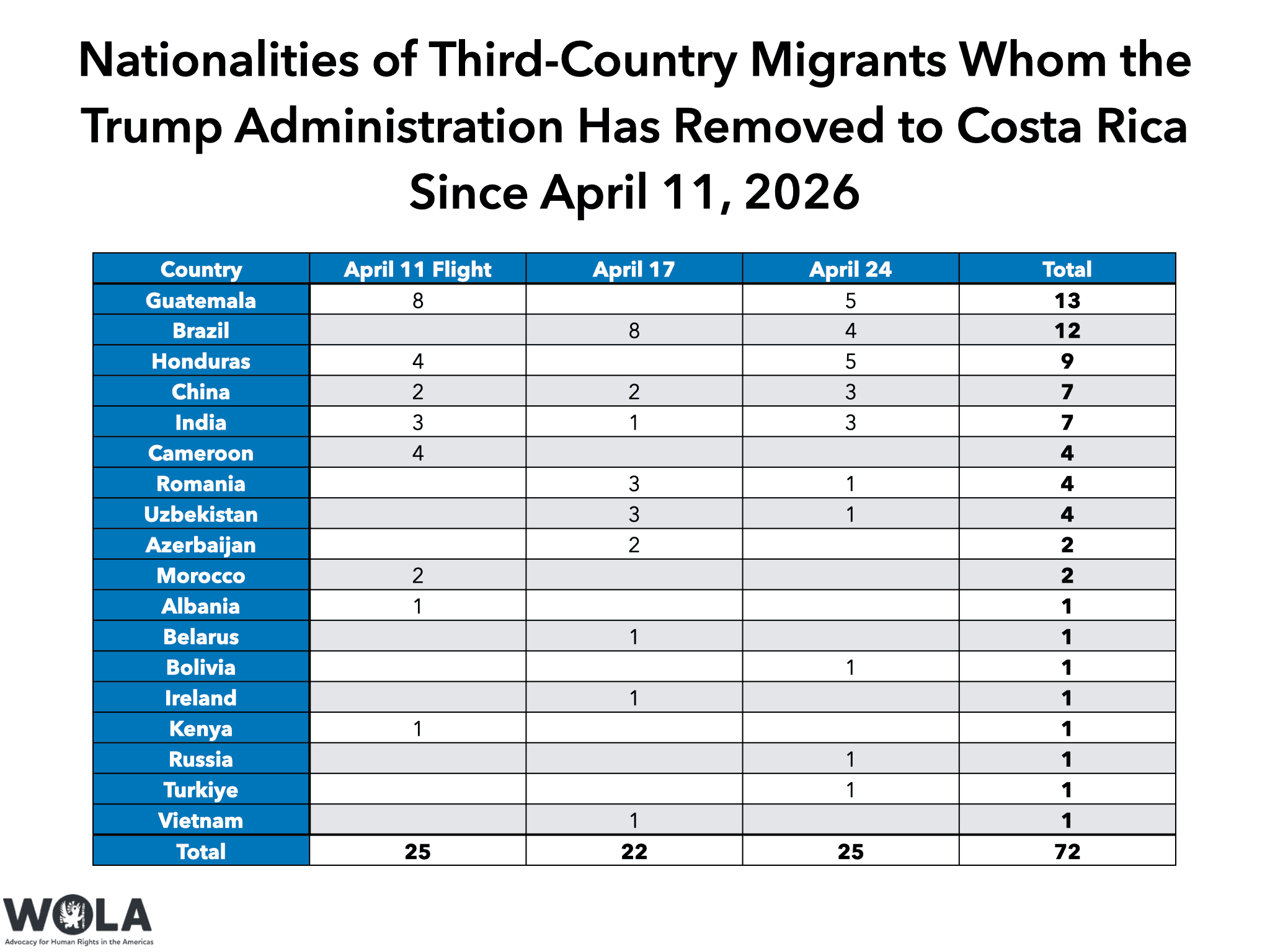
Costa Rica’s agreement with the Trump administration calls for ICE to send 25 third-country citizens to the Central American nation each week. Those who wish to return to their countries of origin can do so using the International Organization for Migration’s (IOM) U.S.-backed Assisted Voluntary Return program. Unlike in the DRC, these individuals have freedom of movement during their time in Costa Rica, and may apply for humanitarian status if they fear return to their home countries.
Of the 47 aboard the first two flights, EFE reported on April 25, “18 are in the assisted voluntary return program, 12 have expressed that they do not want to return to their country of origin, and 2 have abandoned one of the options. The others have requested more information or have not yet communicated their decision.”
This treatment contrasts positively with that received by 200 third-country citizens whom the Trump administration sent to Costa Rica in February 2025. Until the judicial system acted to allow humanitarian options, the San Jose government confined those who feared return to their home countries to a compound near the Panama border for months.
A small number who underwent that ordeal have remained in Costa Rica; the New York Times reported on the hospitality shown them by the Quaker community in Monteverde, near a popular cloud forest reserve in the country’s northwest.
Paraguay
A Safe Third Country Agreement signed with Paraguay in August produced its first flight on April 23, carrying 16 citizens of Bolivia, Colombia, Ecuador, El Salvador, and the Dominican Republic. The agreement caps arrivals at 25 per month and requires Spanish-speaking migrants with Paraguayan government approval; 9 of the original 25 expected were rejected. As this is a Safe Third Country Agreement—unlike the DRC and Costa Rica arrangements—those aboard the flight were people pursuing asylum cases; the Trump administration now expects them to seek protection in Paraguay’s asylum system.
Border wall updates
The administration’s border wall construction effort, funded by $46.55 billion in 2025 OBBBA money, continues to generate controversy.
Texas
It remains unclear whether CBP has fully abandoned plans to build pedestrian border barriers in Big Bend National Park and the adjacent Big Bend Ranch State Park in far west Texas. This remote, ecologically sensitive, and tourism-dependent area usually sees the fewest migrants among Border Patrol’s nine U.S.-Mexico border sectors.
On February 11, CBP added planned wall segments in those parks to an online “smart wall” map; at about the same time, then-DHS Secretary Kristi Noem signed waivers of environmental and other laws (a power granted by the 2005 REAL ID Act) to allow construction to proceed in the Big Bend Sector, which includes the parks but covers more border than they do. “However, in early March, the physical border suddenly disappeared from the map, only to reappear on Tuesday, April 21,” The Travel explained.
During the time the wall disappeared from the map, DHS made no announcements, though the Border Patrol sector chief indicated in a meeting that the agency did not plan to build wall segments in the parks. As of April 21, what reappeared on the online map was “a slew of new patrol roads and ‘vehicle barriers,’” according to Laiken Jordahl of the Center for Biological Diversity.
Then, on or around April 23, that interactive, border-wide map disappeared entirely from CBP’s “smart wall” web page. The confusion has intensified.
“First a hiker stumbled on surveying stakes in Big Bend Ranch State Park in late March. Then a construction crew began work on a remote mountain road without notifying local officials in neighboring Presidio and Jeff Davis Counties,” the Houston Chronicle reported. “These (federal officials) are too damn lazy to give us a call or too scared to catch us up on what’s going on,” the judge of Jeff Davis County, Curtis Evans (R), told the Chronicle. (“Judges” are the highest elected officials in Texas counties.)
The Center for Biological Diversity, Texas Civil Rights Project, Friends of the Ruidosa Church, and a local river guide filed a lawsuit challenging as “unconstitutional” the administration’s waivers of other laws to build wall segments in the Big Bend Sector. A water resources engineer, Matt Stahl, published a simulation of what the wall would do to Big Bend National Park: of 83 points of interest in the park, such as “campsites, viewpoints, and other popular spots,” three-quarters would have views marred by border-barrier structures.
Beyond the parks’ boundaries, landowners along the border are being notified that the federal government wants part of their property. (Texas is the only border state where most land along the border—the Rio Grande—is privately owned.) “We never thought anyone would be so stupid to build a wall out here,” Rancher Yolanda Alvarado told the Guardian; her family got a letter from CBP in February about the agency’s intention to build on their property.
Several hundred miles to the east in Laredo, the administration plans a 30-foot wall along more than 100 miles of Webb County riverfront, along with sensor-enabled orange buoys in the middle of the river. Writing at the Border Chronicle, Michael Gonzalez noted that “no publicly available study has explored the hazards of placing buoys in the Rio Grande or constructing a border wall in Webb and Zapata counties.” An unofficial study commissioned by the Rio Grande International Study Center (RGISC) and landowners found that “the planned border wall and buoy sections could affect the flow of the Rio Grande, accelerate erosion, and risk structural damage to infrastructure built in and around the river during floods.”
Still further east in South Texas’s Rio Grande Valley region, waivers of environmental laws are enabling barrier construction through the Lower Rio Grande Valley National Wildlife Refuge and other areas that earlier border wall legislation—but not the 2025 OBBBA—had specifically excluded. The National Butterfly Center, a private reserve that had energetically fought past wall-building efforts, has been notified that nearly 70 of its 100 acres will be cut off. Also vulnerable, Texas Monthly reported, are the nearby Santa Ana National Wildlife Refuge and Bentsen–Rio Grande Valley State Park.
In Rio Grande City, Border Report’s Sandra Sánchez spoke with homeowners who, over the course of a week, saw segments of the wall built extremely close to their residences. In the Rio Grande Valley, a floodplain, wall segments are usually built far from the riverbank.
All 14 Texas border counties’ judges, including Democrats and Republicans, sent a letter to DHS Secretary Mullin on April 21 requesting early coordination and consistent communication before infrastructure decisions are finalized. The judges cite concerns about water supplies, agricultural access, and environmental resources, and ask for “flexibility in approach.”
The Texas Observer reported that property owners along the Rio Grande are receiving letters from CBP offering signing bonuses of $1,000 to $5,000 to allow wall construction to start before the federal government officially purchases or condemns their land. Attorneys warn that landowners who sign may be giving contractors permission to build a wall with no enforceable guarantee that the government will ever pay fair market value. ”Landowners are quite scared when they receive these letters,” said RGISC’s Martin Castro.
New Mexico
New Mexico’s State Land Office reported that CBP filed condemnation paperwork on April 18 to take back and build barriers on seven acres of land, near Santa Teresa west of El Paso, that the federal government had ceded to the state government in 1898. CBP had offered the state’s Democratic government about $800,000 for the parcel in March, but the Land Office did not respond by the deadline set by the federal agency. “Doing business with these thugs was simply not an option,” said Commissioner of Public Lands Stephanie Garcia Richard, referring to the Trump administration.
Arizona
CBP appears to be moving forward with plans to build a double steel-bollard wall through the 62 border miles running through the lands of the Tohono O’odham Nation in southern Arizona. The Nation has resisted wall construction on its land for decades, instead permitting a vehicle barrier and using much tribal law enforcement resources to secure the border in coordination with CBP.
Nation leaders are actively considering legal action to oppose the wall, which “does not work,” Tribal Chairman Verlon Jose told the Arizona Daily Star. “There are so many other things we can work on together to address the issue.” The Daily Star article notes that while DHS may seek to employ REAL ID Act waivers to enable construction on sovereign tribal land, “this kind of case could be different,” David Beeksma, director of the University of Arizona’s Native Nations Institute, explained. “Tribal sovereignty is ‘settled law in the United States.’”
“This wall is going to be a further division,” Jose told the Daily Star’s Emily Bregel. “An elder said to me, ‘I don’t know if I can go on living. It would break my heart’” if it gets built.
Notes from Mexico
- A New Humanitarian/Guardian investigation tracking the impact of CBP One’s January 2025 closure on hundreds of thousands of stranded migrants finds the situation “very much still in flux.” Those who sought to migrate “in reverse” were overwhelmingly Venezuelan (85 percent), with 54 percent returning somewhere other than their home country. Smugglers in Panama have turned return migration into a lucrative business, with boat fares from Panama’s Caribbean coast to Colombia rising from approximately $100 to $300. For those still wishing to migrate north into Mexico, smugglers offer a cheap route through Mexico’s southern border town of Tapachula, from where it is difficult for migrants to move on, or a more expensive route into the southern state of Tabasco; “from there, many people—especially Cubans and Venezuelans—head to cities on the Yucatán peninsula, such as Cancún, to join established communities.”
- In Chiapas, southern Mexico, a caravan of hundreds, most from Haiti, left Tapachula in late April. Many participants explicitly stated that the U.S. is “no longer an option,” and that they are seeking to encourage Mexican authorities to speed asylum or work permits, and allow them to settle in parts of the country that offer more employment. Of 18 caravans during the administration of President Claudia Sheinbaum, none has passed southern Oaxaca, the Associated Press noted.
- Spain’s El País investigated the disappearance of 83 migrants off the coast of Chiapas between September and December 2024. Families of the missing have received suspicious signals suggesting that some may have been abducted and could still be alive.
- In Ciudad Juárez, Chihuahua, Mexico, across from El Paso, Texas, Norte reported that the city had 19 known cases of migrant kidnappings in March. The Chihuahua state Specialized Prosecutor’s Office for Strategic Operations (FEOE) reported dismantling a suspected criminal cell dedicated to migrant kidnapping; its members allegedly kidnapped two young Mexican people and charged their families $28,000 ransom.
- Reynosa, Tamaulipas, Mexico, across from McAllen and Hidalgo, Texas, saw two nights of organized crime violence, including numerous road blockades, after authorities captured a top Los Metros/Gulf Cartel figure. The U.S. Embassy in Mexico, through its Matamoros consulate, issued a security alert reiterating the State Department’s Level 4 “Do Not Travel” designation for Tamaulipas. During the first two months of 2026, Mexican government records show that the U.S. government deported 10,034 Mexican citizens into Tamaulipas, 554 of them into Reynosa specifically.
- The Cuba-focused independent news outlet El Toque published advice for Cubans considering applying for asylum in Mexico. The process, it noted, “is a legal route that requires a high dose of patience and meticulousness in procedures” in order to avoid becoming “a victim of scams in the process.”
Other news
- WOLA’s April 17 Border Update noted how unusual it was for Border Patrol’s Laredo Sector, in south Texas, to be in third place for migrant apprehensions in March: “the sector, across from what may be the most violent part of Mexico’s northern border, is often quiet, in seventh place so far this century” out of the agency’s nine U.S.-Mexico border sectors. Now, the conservative DailyWire is reporting that at least 200 Border Patrol agents from across the country, including the Canada border, are being called to serve 30-day volunteer stints in Laredo amid an increase in what the agency calls “gotaways”: migrants who evade capture.
- As required by law, CBP’s 2027 budget request to Congress, released in early April, includes some past-year performance data. This includes the agency’s estimate that 70,454 migrants “got away” from Border Patrol in fiscal 2025, out of a total of 394,009 detected migrants. That would mean 82 percent of detected migrants were either apprehended or turned back last year, down from 86 percent in fiscal 2024, when the migrant population included many more asylum seekers willingly turning themselves in to agents. “The got-away rate has fallen 83 percent over the first half of FY2026, but CBP acknowledges migrants are becoming ‘more evasive,’ choosing to run rather than surrender,” the Washington Times reported.
- Aled Damien Carbonell-Betancourt, a 27-year-old Cuban citizen, became the 17th person to die in ICE custody this year on April 12. Carbonell-Betancourt was being held at the Federal Detention Center in Miami, “a federal prison in downtown Miami that began quietly doubling as an immigration detention center early last year” according to the Miami New Times. ICE claims that the death was an apparent suicide; the Miami Herald found the original felony charge leading to his detention was downgraded to a misdemeanor that prosecutors declined to pursue. Twenty-nine people have died in ICE custody since fiscal 2026 began in October, just six and a half months before Carbonell-Betancourt’s death. That already breaks the full-year record of 28 deaths set in 2004; there have been 48 in-custody deaths since the Trump administration began.
- Dozens of El Paso residents marched to the entrance of ICE’s Camp East Montana detention camp, on the grounds of Fort Bliss, as part of a day of protests on April 25. The protesters included Army Sgt. José Serrano Arosio, a Fort Bliss-based non-commissioned officer who became nationally known after ICE detained his Salvadoran wife, who is being held at another El Paso facility. The El Paso Times, citing the office of Rep. Veronica Escobar (D-Texas), reported that the East Montana facility, with an eventual planned capacity of 5,000, was holding 715 people as of April 17. On April 18, hundreds of protesters drove to the family detention facility in Dilley, Texas. The organizers call themselves the “Blue Bunny Brigade” in honor of the hat that 5-year-old Liam Ramos, whom ICE sent to the facility in January, was wearing when the agency arrested his father in Minneapolis.
- The Central American outlet Expediente Público documented a pattern of Salvadoran deportees being imprisoned upon arrival in El Salvador under President Nayib Bukele’s state of exception, despite having no criminal record, no judicial hearing, and no family contact for months or years. Of the more than 9,000 Salvadorans deported by the United States since the beginning of 2025, only 10.5 percent had convictions for violent crimes in the U.S. The Salvadoran government’s Comprehensive Care Center for Migrants (CAIM), originally designed as a temporary reception facility, was repurposed under the state of exception to hold deportees for repeated evaluations, often without a clear reason.
- “ICE Flight Monitor has seen a spike in removal flights to Mexico in April, totaling 40 flights as of the 22nd,” reported the Monitor, a project of Human Rights First. “Deportations by land appear to be paused again, following previous pauses in August and December 2025. ICE appears to be attempting to remove nearly all Mexican nationals by ICE Air to Tapachula and Villahermosa” in southern Mexico.
- A report from Guatemala’s National Council for Attention to Migrants (Conamigua) found that smugglers, or “coyotes,” continue to seek to recruit migrants in the country’s interior with traditional methods like “word of mouth,” public announcements, and even roving vehicles announcing offers through megaphones. However, “Social networks have become the main channel for recruitment. Platforms such as WhatsApp, Telegram, Signal, or Facebook allow traffickers to establish direct contact, create groups, share routes, and coordinate payments,” according to La Hora.
- CBP’s Air and Marine Operations division reported stopping three smuggling boats off Southern California on April 17, 18, and 21, apprehending a total of 60 people.
- 404 Media reported that CBP is using OBBBA money to purchase more MQ-9 Reaper drones to add to an existing fleet of “around 10 drones.”
- An Associated Press investigation reviewed more than 40 recently hired ICE personnel identified via their LinkedIn updates. They are part of an OBBBA-funded recruitment drive that added 12,000 new officers and special agents, roughly doubling the agency’s personnel strength. The AP found new hires with histories of bankruptcies, multiple law enforcement jobs in rapid succession, settled lawsuits alleging false arrests and evidence falsification, and would-be cops who failed to complete police academy training.
- Governor Greg Abbott (R) renewed Texas’s border security emergency declaration, now in its fifth year, for nearly 70 counties, including several more than 250 miles from the border, even as Border Patrol apprehensions hit 60-year lows. The San Antonio Express-News editorial board called it “gaslighting Texans”: “Abbott is showing it’s less about border security than about perpetuating border politics and emulating Trump’s authoritarianism. And he’s making a mockery of the Texas law that authorizes a governor to take the extraordinary step of declaring a state of disaster.”
- A March 2026 survey by Third Way and UnidosUS documented a sharp collapse in support for the administration’s immigration enforcement policies. Trump’s job approval on immigration has fallen to 44 percent (55 percent unfavorable), though a majority (56 percent) still viewed him favorably on border security specifically. “This is a dramatic collapse for Trump on his signature issue, with approval especially low among Independents at just 38 percent.” Among Latino voters, Trump’s immigration approval fell to 32 percent. Gallup found the share of Americans who want immigration reduced dropped from 55 percent in 2024 to 30 percent today, with a record-high 79 percent saying immigration is good for the country. In a policy memo, the two organizations argue that the opinion data show Democrats facing a “two-sided trust challenge”: voters want to rein in and professionalize ICE, but still trust Republicans more on enforcement (43 to 37 percent).
Links: “mass deportation” and human rights in the U.S. interior
- C. Frances, Jessica Washington, “ICE Watchers Worry Democrats Are Trying to Co-Opt Their Movements for Votes” (The Intercept, April 29, 2026).
Activists accuse Minnesota House candidate Matt Little of “cosplaying” as a protester, blurring the line between solidarity and opportunism
- Tom Latchem, “ICE Agent Who Shot Dead Unarmed Mom Quietly Reassigned as FBI Probe Stalls” (The Daily Beast, April 28, 2026).
DHS officials tell PunchUp the FBI needs to “s–t or get off the pot”
- Sandra Sanchez, “Congresswoman Tours Migrant Facility Holding Pregnant Teens: ‘What Are They Hiding?’” (Border Report, April 28, 2026).
U.S. Rep. Maxine Dexter, a physician, said she was not allowed to speak with detainees
- Priscilla Alvarez, “Exclusive: Trump Moves to Accelerate Deportations of Migrant Children in US Custody” (CNN, April 28, 2026).
The Trump administration is taking steps to accelerate the deportations of migrant children in US custody amid White House pressure to quickly move kids through the system, according to administration officials and lawyers for the children
- Adam Taylor, “New State Department Rules Would Deny Visas to Those Who Fear Returning Home” (The Washington Post, April 28, 2026).
A directive orders diplomatic missions to ask nonimmigrant visa applicants if they fear going back to their country and refuse U.S. travel documents for those who say yes
- Maria Sacchetti, “Trump Officials Hire ‘Deportation Judges’ With Less Training, Experience” (The Washington Post, April 27, 2026).
The president is remaking courts to clear a backlog of asylum cases. Hires include an attorney for Jan. 6 rioters and a lawyer who championed Minneapolis ICE raids
- “You Won’t Read This Because It’s About a Concentration Camp” (L O L G O P, The Cause, April 26, 2026).
We built the cages for people we’d decided didn’t count. Trump just stopped pretending they’re only for them
- Alex Woodward, “ICE Is Cutting Back on Cuffing Immigrants in Court and Warrantless Arrests: Report” (The Independent (UK), April 24, 2026).
Trump administration appears to be backing off two major tactics that led to chaotic and violent scenes in his mass deportation campaign
- Alejandro Serrano, Uriel J. Garcia, “ICE Deported Man to Mexico Who Says He’s a U.S. Citizen” (The Texas Tribune, April 23, 2026).
Brian José Morales García has a birth certificate showing he was born in Denver. ICE agents accused him of lying and says he entered the country illegally
- Angelica Franganillo Diaz, “Immigration Agents Told to Use Judicial Warrants for Home Entry” (Bloomberg Law, April 23, 2026).
US Immigration and Customs Enforcement officers were told verbally weeks ago to stop entering homes without judicial warrants, marking a shift away from some of the agency’s most aggressive enforcement tactics, according to a person familiar with the matter
- Adam Kinzinger, “ICE’s Terror Campaign Now Takes Place Out of View” (Adam Kinzinger, April 23, 2026).
New DHS Head Markwayne Mullin tries to keep ICE out of the headlines, but the deportations continue
- “Republicans Refuse to Hear Stories of Their Fellow Citizens Attacked by ICE & CBP, Reject Subpoenaing Tom Homan & Stephen Miller” (Committee on Homeland Security Democrats, U.S. House of Representatives, April 22, 2026).
- Uriel J. Garcia, “Trump Administration Targets DACA Recipients for Deportation” (The Texas Tribune, April 22, 2026).
Immigrants with DACA were protected from deportation, but since Trump’s return, the government has arrested nearly 300 DACA recipients, including 75 in Texas
- Colleen Slevin, Morgan Lee, “Immigration Officer Is Charged With Assault After Protest Outside Colorado ICE Facility, DA Says” (Associated Press, Associated Press, April 22, 2026).
A Colorado district attorney has charged an immigration agent after a protester said she was held in a chokehold during demonstrations against the detention of an immigrant father and two children
- Em Knepp, M., Michael Wriston, “ICE Is Planning New Fast-Track Construction Contracts” (Project Salt Box, April 21, 2026).
An RFI released this morning details plans for a nationwide network of flexible construction contracts
- Kate Morrissey, “Border Report: Deaths Prompt Detention Center Inspections” (Voice of San Diego, April 21, 2026).
Mexican consul general in San Diego estimated that staff conduct between 40 and 50 interviews at the Border Patrol stations, and six to 10 interviews in ICE detention every day
- Becky Z. Dernbach, Cynthia Tu, “ICE Detained More Than 70 Minnesota Children, Data Reveals” (Sahan Journal, April 21, 2026).
Immigration officials detained more than 70 Minnesota children between Dec. 1 and March 10, a Sahan analysis of court records and federal deportation data shows
- Ken Klippenstein, “Exclusive: ICE Glasses” (Ken Klippenstein, April 20, 2026).
Homeland Security is making “smart glasses” to collect intelligence on Americans
- Sonja Sharp, “Ordered Free, Still Locked Up: Judges Fume as Trump Administration Holds ICE Detainees” (The Los Angeles Times, April 19, 2026).
A legal maneuver once reserved for death row inmates and suspected terrorists has become the only recourse for immigrant detainees, who have flooded federal courts in California with thousands of petitions for freedom
- Sophie Hurwitz, “Homeland Security’s New Task Force Website Sanitizes Trump’s Deportation Agenda” (Mother Jones, April 18, 2026).
With help from Edward “Big Balls” Coristine and other usual suspects
- Sandra Sanchez, “Advocates Caravan to Protest Conditions at Dilley Detention Center” (Border Report, April 18, 2026).
- Lauren Villagran, “Fired by Trump, This Immigration Judge Set Off on the Migrant Trail” (USA Today, April 18, 2026).
This U.S. immigration court judge began an adventure south of the border after Trump fired him
- Astead Herndon, “How Americans Really Feel About Immigration” (Vox, April 18, 2026).
The messy politics of immigration reform, explained
- Patrice Taddonio, “A Protester Threw a Snowball. Federal Agents Responded With Tear Gas and Pepper Balls.” (Frontline, Propublica, ProPublica, April 17, 2026).
A new investigation from ProPublica and FRONTLINE examines federal agents’ response to protesters and bystanders at the Trump administration’s immigration sweeps. “We see, just, use of excessive force after use of excess force,” one expert said
- Jeff Abbott, “Camp East Montana Under New Management, ICE Director Tells US Rep. Escobar” (The El Paso Times, April 17, 2026).
Acting ICE Director Todd Lyons told U.S. Rep. Veronica Escobar and the House Appropriation Committee that Camp East Montana is under new management
- Aaron Reichlin-Melnick, “New ICE Arrest Statistics Shed Light on Who the Agency Is Targeting in American Communities” (American Immigration Council, April 17, 2026).
Statistics reveal the full extent of ICE’s operations under Trump, including who the agency is arresting and how many have criminal records
- “Expanding Visa Restriction Policy to Protect U.S. Interests in the Western Hemisphere” (U.S. Department of State, April 16, 2026).
- Ernesto Londono, Julie Bosman, Sheila M. Eldred, “ICE Agent Charged With Assault After Motorists Say He Brandished Gun” (The New York Times, April 16, 2026).
Minnesota prosecutors have spent weeks investigating the conduct of immigration agents who took part in an immigration crackdown in the Twin Cities. This is the first case they have brought
- Priscilla Alvarez, “Exclusive: Beatings, Restraints and Isolation: Allegations of Abuse at a Migrant Children’s Shelter Trigger Federal Review” (CNN, April 16, 2026).
A facility in New York that housed migrant children faces allegations of physical abuse, including placing some children in isolation in a so-called “red room,” according to multiple sources who spoke with CNN about what’s unfolded at the shelter
- Tanvi Misra, “The Death of Asylum” (Jewish Currents, April 16, 2026).
How centuries of efforts to deny refuge to persecuted people paved way for authoritarianism
- Anna Giaritelli, “ICE Nears Half a Million Arrests Under Trump” (The Washington Examiner, April 16, 2026).
Acting ICE Director Todd Lyons said the agency had taken into custody almost 457,000 people between Jan. 20, 2025, and mid-April
- Camilo Montoya-Galvez, “ICE Head Todd Lyons Planning to Leave Agency This Spring” (CBS News, April 16, 2026).
Todd Lyons, the acting head of U.S. Immigration and Customs Enforcement, is planning to leave the federal government later this spring
Newsletter
Subscribe to get the latest on analysis and policy