
Adam Isacson

Adam Isacson
Director for Defense Oversight
Adam Isacson has worked on defense, security, and peacebuilding in Latin America since 1994. He now directs WOLA’s Defense Oversight...With this series of updates, WOLA seeks to cover the most important developments at the U.S.-Mexico border. See past updates here.
Your donation to WOLA is crucial to keeping these paywall-free and ad-free Updates going. Please contribute now and support our work.
THIS WEEK IN BRIEF:
- Border data, halfway into fiscal year 2026: An ongoing asylum shutdown and “mass deportation” crackdown have slowed migrant apprehensions at the border to a pace not seen since 1967. However, apprehensions increased by 25 percent from February to March, likely due to seasonal factors. Drug seizures at U.S. borders remain at 2025’s pace, despite a campaign of lethal boat strikes.
- Congress may try to fund ICE and Border Patrol for years on a simple-majority vote: Part of DHS has been “shut down” since February 13 as Senate Democrats demand human rights reforms to ICE and CBP. But Republicans have a plan: to pass a bill funding all but those agencies for 2026, and to fund an unreformed ICE and CBP separately for at least three years, using a complicated parliamentary maneuver that allows a party-line, simple-majority vote.
- The leadership transition at DHS: Investigations, based on numerous interviews, portray a Department of Homeland Security with remarkably low morale as Markwayne Mullin takes over as secretary. As the Trump administration backpedals on its most visibly aggressive “mass deportation” policies, which have proved unpopular, it is pursuing quieter but perhaps even more effective efforts—bureaucratic hurdles, long stays in miserable detention conditions—to encourage migrants to abandon the United States.
- Conditions at ICE detention centers remain dire: Amid that backpedaling, ICE’s arrests and detained population have declined. However, reports are proliferating about abusive and inhumane conditions in the agency’s network of detention facilities, where a remarkable 16 people have now died in custody since the start of the year.
- Border wall construction updates: An east-to-west survey of controversies surrounding border wall construction projects along the border, as CBP and its contractors spend out a $46.5 billion appropriation that could leave nearly the entire border blocked by barriers from coast to coast.
- Updates from further south along the migration route: Links to articles about the situation of migrants, and about security challenges, in Mexico, Central America, Panama, Ecuador, and Venezuela. Several cover the Trump administration’s increasing deportations of citizens from third countries.
THE FULL UPDATE:
Border data, halfway into fiscal year 2026
An April 9 monthly release from Customs and Border Protection (CBP) covers migration, drug seizures, and other border enforcement data through March. As the 2026 fiscal year began on October 1, we now have statistics for the first half of the year.
Migration
During that half-year, Border Patrol apprehended 42,757 migrants at the U.S.-Mexico border, and CBP’s Office of Field Operations encountered another 20,975 migrants at ports of entry (official border crossings).

The Border Patrol figure is on track to make 2026 the lowest year for migrant apprehensions since 1967 (73,973). The ports-of-entry figure is on track to be the fewest since at least 2012, the earliest year for which we have data.
The reasons for the continued drop include the impossibility of accessing asylum at the border, as the Trump administration’s January 2025 proclamation suspending asylum remains in effect while legal challenges continue. This, together with a climate of fear in the U.S. interior amid the administration’s “mass deportation” campaign, has suppressed new arrivals.
Notably, Border Patrol apprehensions increased 25 percent from February to March, from 6,598 to 8,268 people. As noted in WOLA’s April 3 Border Update, which reported a smaller January-to-February increase, this appears to reflect a seasonal pattern: non-asylum-seeking migration tends to increase in the spring and often in the fall, when the weather is milder, only to drop in the summer and winter. It is reasonable to expect further increases in Border Patrol apprehensions in April and May, followed by a drop.
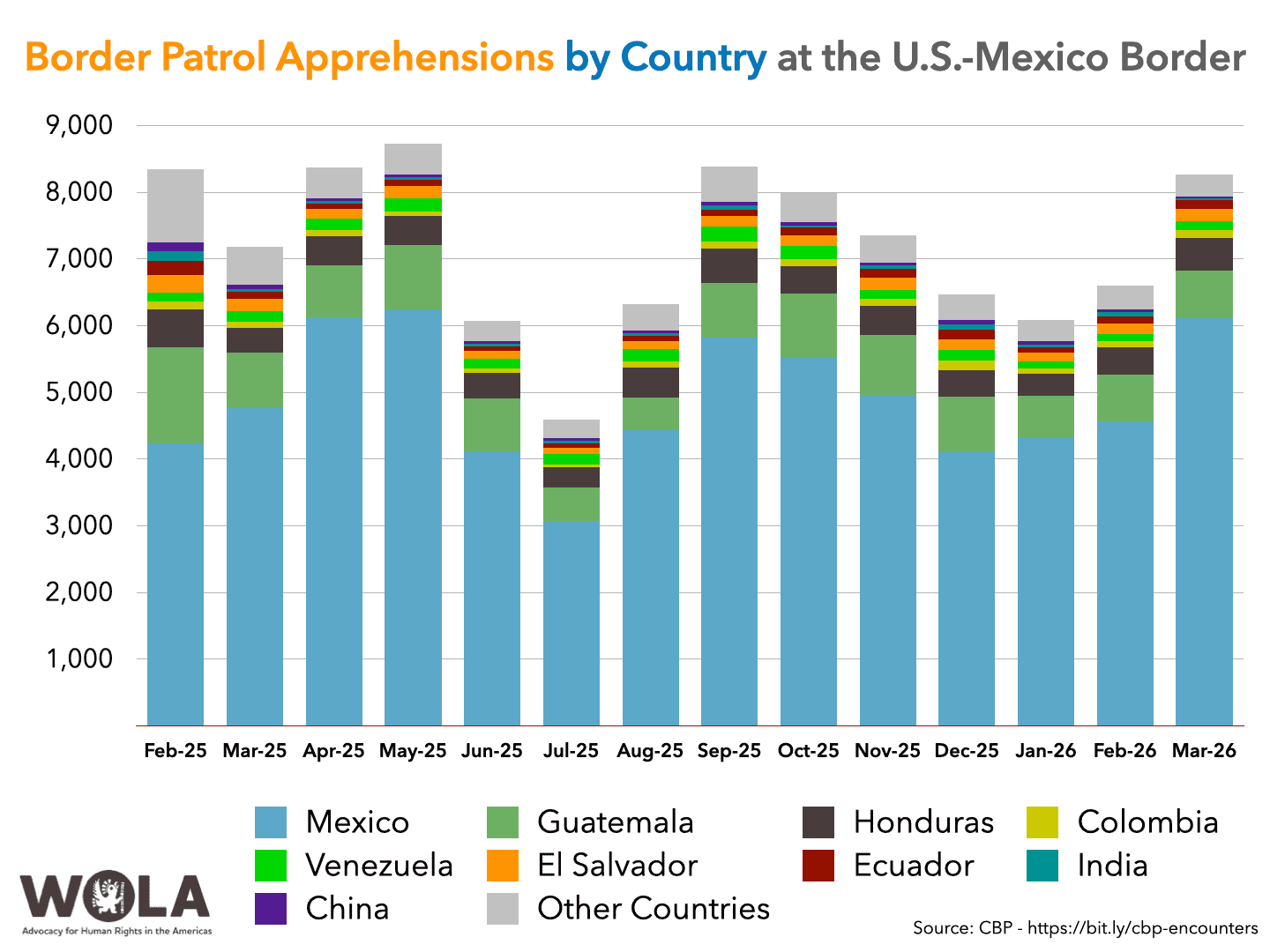
The diversity of nationalities coming to the border continues to decline. Of the March Border Patrol apprehensions, 74 percent were of citizens of Mexico, and 92 percent were citizens of Mexico plus four Central American nations (Guatemala, El Salvador, Honduras, and Nicaragua). During the 2020s, those proportions were higher only in the first months of the COVID-19 pandemic.
Of nationalities with more than 50 apprehensions in February or March, three exceeded the 25 percent border-wide threshold: Mexico (34%), Venezuela (33%), and Ecuador (28%). Apprehensions of citizens of India declined by 60 percent, and those of individuals from countries CBP lists as “Other” declined by 11 percent.
So far in fiscal 2026, 13 percent of Border Patrol’s apprehensions have been of children or family unit members. That is the smallest proportion since 2012. Child and family migration, at first mainly from Central America, began to increase in 2013, and especially in the spring of 2014. Now, though, with the possibility of seeking asylum at the border all but eliminated, few children or families are coming: Border Patrol’s apprehended population in March was just 10 percent kids and parents.

For the fifth month in a row, the Rio Grande Valley Sector in South Texas recorded the most apprehensions among the nine sectors into which Border Patrol divides the U.S.-Mexico border.
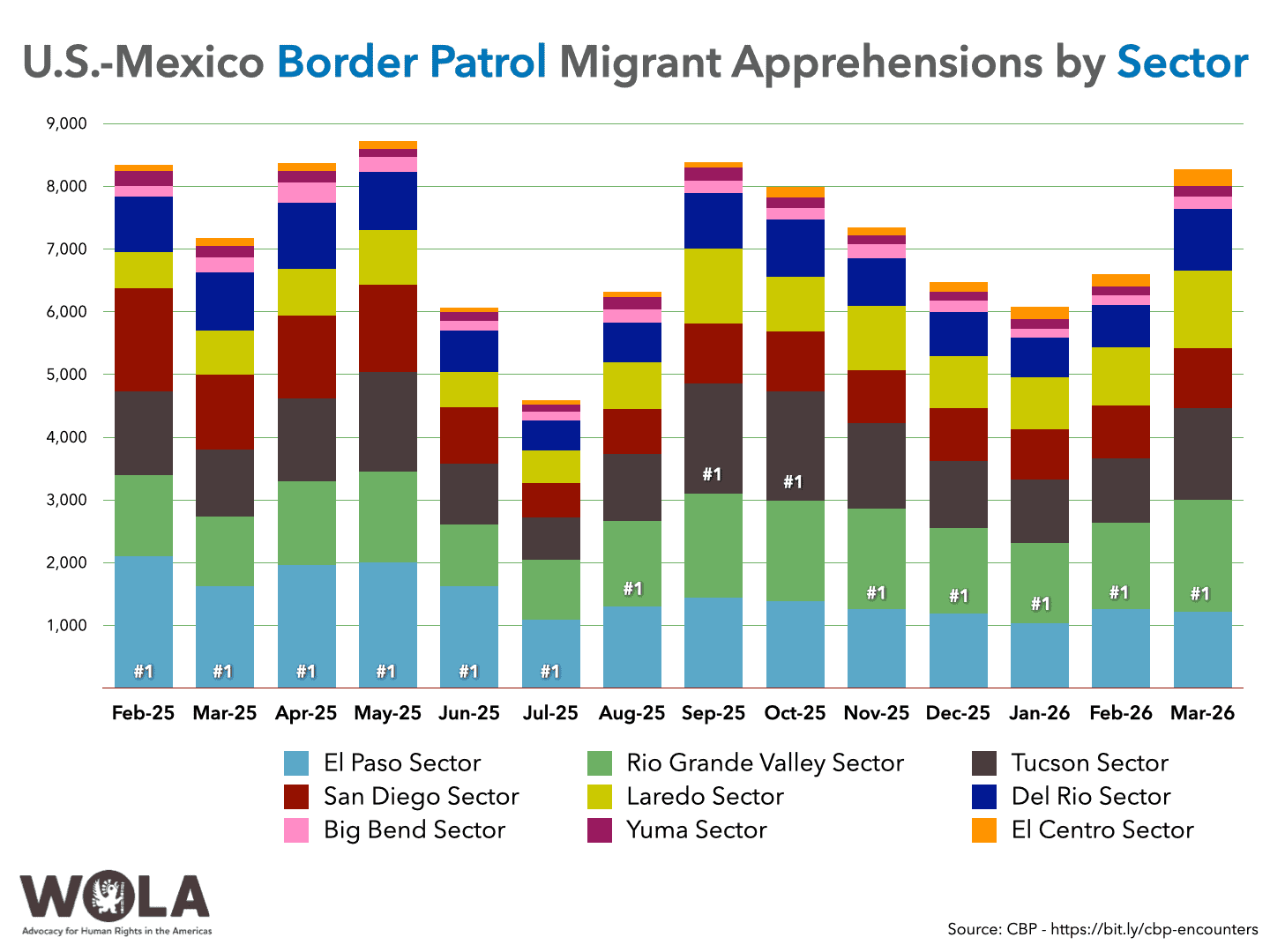
Five sectors saw February-to-March increases greater than the 25 percent border-wide amount:
- Del Rio (mid-Texas, 5th place) 47 percent
- Tucson (Arizona, 2nd place) 44 percent
- Laredo (south Texas, 3rd place) 35 percent
- El Centro (7th place) 35 percent
- Rio Grande Valley (1st place) 29 percent
It is unusual to see Laredo in third place: the sector, across from what may be the most violent part of Mexico’s northern border, is often quiet, in seventh place so far this century. The only sector to see a decline in apprehensions from February to March was El Paso (far west Texas and New Mexico, -3%), which had been the fastest-growing from January to February.
CBP’s release noted that March was the 11th consecutive month in which Border Patrol did not release any protection-seeking migrants into the U.S. interior: all were detained or removed from the United States.
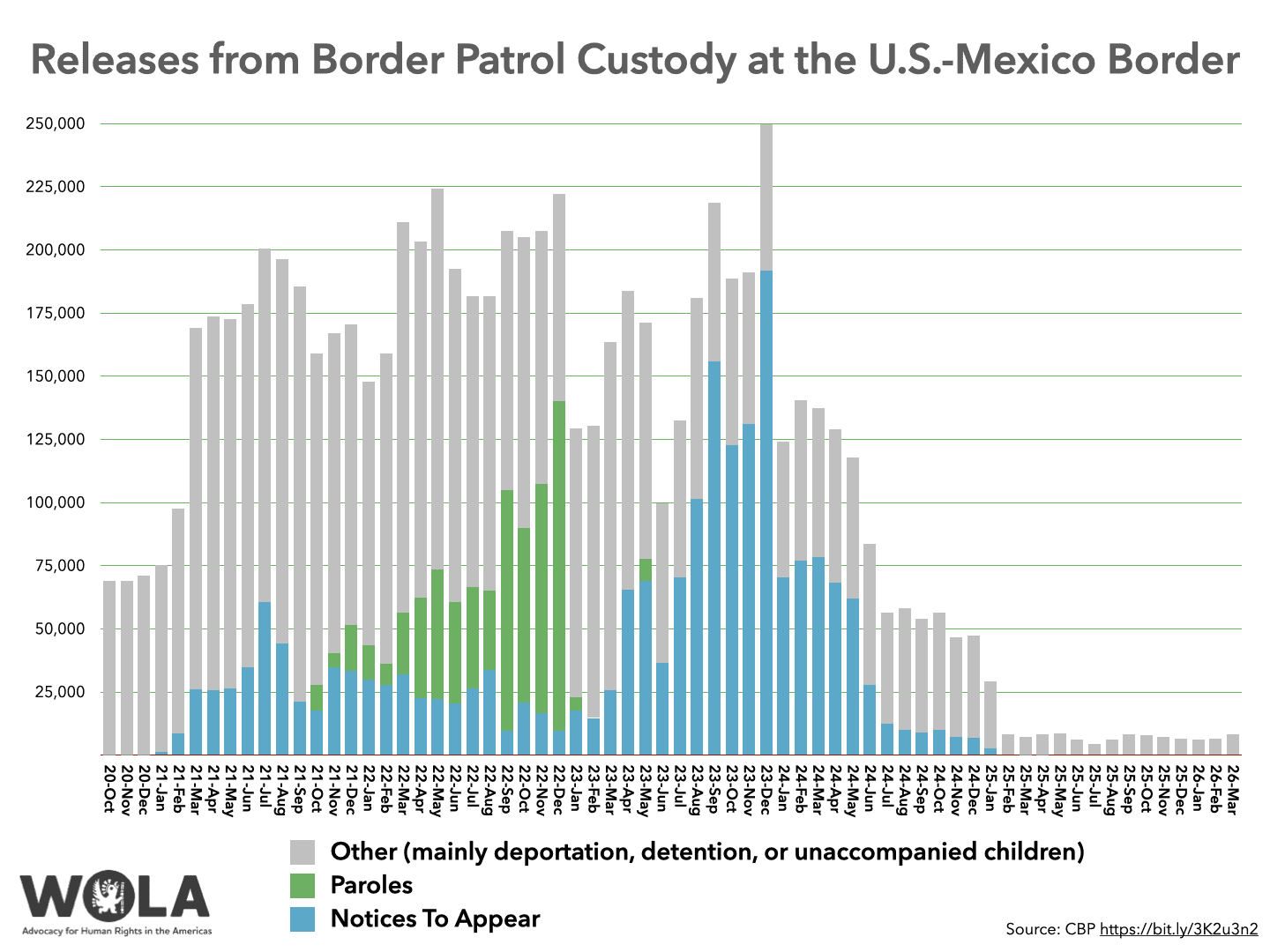
At the ports of entry, only 12 of 3,464 people who entered CBP custody were reported as “credible fear inadmissibles”—people seeking protection. That is the fewest since the Trump administration began and indicates that almost nobody who arrived at the U.S.-Mexico border was able to seek protection from threats to their life or freedom.

Charting port-of-entry encounters clearly shows the impact of the Trump administration’s abrupt January 20, 2025, cancellation of the CBP One program, which the Biden administration had used to allow protection-seeking migrants to approach ports of entry via smartphone app appointments.
Drug seizures
The release also includes data about CBP’s seizures of illicit drugs at the U.S.-Mexico border and other land, air, and coastal borders. For all major drugs, seizures appear to be almost exactly continuing their 2025 pace: no significant increases or decreases.
CBP’s seizures of fentanyl at the border declined, often sharply, between mid-2023 and early 2025, a likely indicator of reduced supply. Since then, though, the declines stopped, and seizures have been flat. Halfway into fiscal 2026, fentanyl seizures (5,797 pounds) are almost exactly half of 2025’s full-year total (11,486 pounds).

Similar to past years, 95 percent of 2026 fentanyl seizures have taken place in California (62%) or Arizona (33%). Since fiscal 2020, 96 percent of fentanyl seizures took place in California (49%) or Arizona (47%). For unclear reasons likely having to do with Mexican organized crime patterns, few seizures take place in Texas or New Mexico.
Halfway through fiscal 2026, CBP’s cocaine seizures at all U.S. borders are just over half of 2025’s full-year total (36,700 pounds in the past six months versus 70,100 pounds all of last year). At the U.S.-Mexico border specifically, cocaine seizures are running at 97 percent of their 2025 pace (19,771 pounds versus 40,949 pounds all of last year).
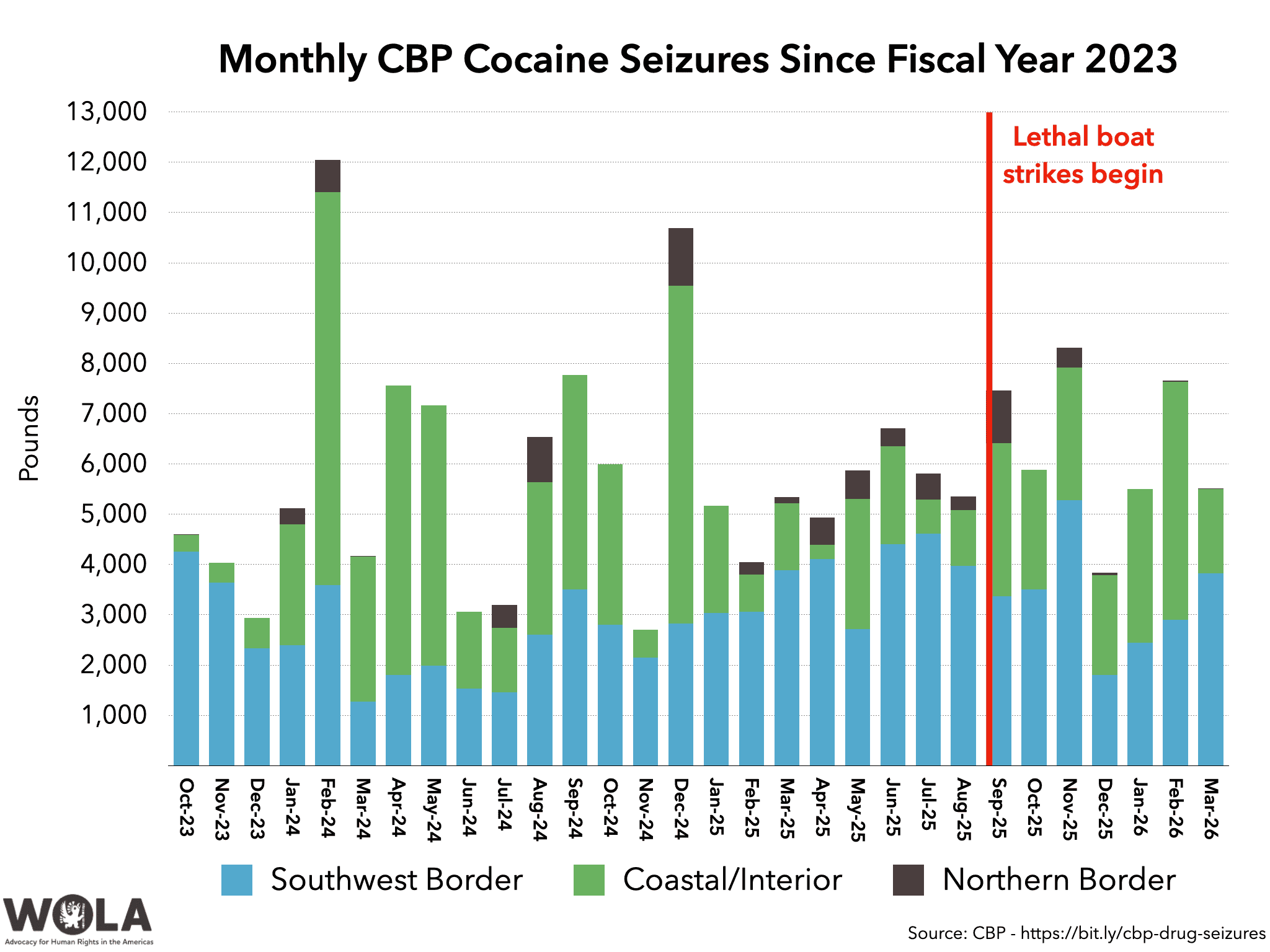
This is significant because it shows no apparent impact on cocaine supply after at least 49 lethal strikes on civilian vessels that the U.S. Defense Department alleges were carrying drugs—probably cocaine—from South America. Those strikes, which began on September 2, 2025, have killed at least 178 people as of April 15, 2026.
Data similarly show no significant movement since 2025 on seizures of methamphetamine or marijuana.

Border marijuana seizures have plummeted to about one-twentieth of what they were in 2018, a result of many U.S. states—including three out of four U.S.-Mexico border states—legalizing and regulating recreational cannabis.

Texas is the only border state that prohibits recreational cannabis, and 94 percent of 2026 seizures took place there (technically, “Texas and New Mexico,” as New Mexico is considered part of Border Patrol’s El Paso Sector and CBP’s El Paso Field Office). As recently as 2020, Texas had accounted for a much smaller share (60%) of marijuana seizures.
Congress may try to fund ICE and Border Patrol for years on a simple-majority vote
Much of the Department of Homeland Security (DHS)—but, for the most part, not Immigration and Customs Enforcement (ICE) and CBP—remains officially shut down, as it has been since February 13. By moving funds around, the Department managed to pay employees who were working without a paycheck, but it may not be able to do so again.
As noted in WOLA’s April 3 and earlier Border Updates, Senate Democrats have refused to support a 2026 appropriations bill that fails to include key human rights reforms to ICE and Border Patrol. These are “common sense” safeguards that are “what every police department uses and when you ask the American people, they’re on our side,” said Senate Minority Leader Chuck Schumer (D-New York). Negotiations, however, have stalled.
The Republican-majority Senate had passed a bill to fund all of DHS except ICE and Border Patrol, which have separate money from last year’s “One Big Beautiful Bill Act.” The Republican-majority House, however, has not taken it up, and House leadership will not do so unless the Senate—using a complicated, infrequently invoked budget maneuver called “reconciliation”—moves ahead with a bill that would keep ICE and Border Patrol funded for at least the next three years.
“Reconciliation,” which can only be used for tax and spending bills, allows legislation to skirt the Senate’s filibuster rule and pass by a simple majority. This was the vehicle used to pass the “One Big” bill in July 2025. It has never been used before as a substitute for a regular annual appropriations bill.
The reconciliation process starts with the Senate passing a budget resolution that assigns overall amounts. In a subsequent bill, committees would then decide what those amounts pay for. The process is moving fast: Senate Republican leadership could bring the budget resolution—the first step—before the full Senate next week, bypassing the Budget Committee to go straight to the Senate floor.
Because the Republicans’ majority in both houses is narrow and they cannot afford to lose many dissenters’ votes, Senate Majority Leader John Thune (R-South Dakota) is indicating that the bill will be “skinny”: it may include only the funding for ICE and Border Patrol, and no other Republican priorities. It is unclear how many years of funding the bill would seek to provide. “Some Republicans want to fund immigration enforcement for the rest of Trump’s term, and others have floated funding for up to 10 years,” Politico reported.
The Republican majority is hoping for a quick replay of the process that provided more than $170 billion in additional border and migration funding through 2029 through the “One Big Beautiful Bill Act.” That bill passed by a very narrow margin, and it remains unclear whether Republicans in both chambers will be as united this time. “Pots of money for ICE and Border Patrol ‘aren’t really popular things’ with Americans” right now, House Ways and Means Committee Chair Jason Smith (R-Missouri) told Punchbowl News.
If the budget resolution goes to the Senate floor next week, the arcane “reconciliation” rules call for an hours-long, often overnight, session of votes on amendments. Schumer said that Democrats would use the so-called “vote-a-rama” procedure to hold Republicans’ “feet to the fire on DHS, on the war, on so many other issues.”
The leadership transition at DHS
Sworn in on March 24, DHS Secretary Markwayne Mullin is assuming command of a 260,000-person cabinet department where, by most accounts, morale is remarkably low.
“Low morale has plagued agencies across the federal government amid downsizing and policy shifts over the past year, but DHS conditions worsened sharply under former Secretary Kristi Noem,” current and former officials told Bloomberg Government. Noem and her special advisor, former Trump campaign official Corey Lewandowski, had bruised the agency with “heightened monitoring of employees, strict controls on spending, and rhetoric about eliminating parts of the department and firing ‘people who don’t like us,’” the Bloomberg report continued, with one DHS official speaking of “a real sense of paranoia” among the workforce. “You have to watch what you say and who you say it to—you don’t know who you can trust.”
A Washington Post investigation detailed allegations of contracting misconduct, political interference, and governance failures during Noem and Lewandowski’s tenure at DHS. These include giant contracts for private jets and advertising campaigns featuring Noem.
Exhaustion with the Department’s “chaotic, dangerous, and ineffective” management was a frequent theme of a deeply reported New York Times Magazine feature drawing on interviews with more than 80 current and former employees of DHS, its component agencies, and the Justice Department’s immigration court system.
Even agents ideologically sympathetic to strong enforcement expressed exhaustion, moral distress, and skepticism about sustainability. One former DHS executive gave the piece its title: “I don’t know if we can come back from this.”
Many career officers described being repurposed into mass immigration enforcement with little preparation or coordination. Border Patrol agents unfamiliar with interior enforcement norms were deployed into cities. Many described resulting profiling, reckless stops, and warrantless home entries. “The joke in the hallways became, We all work for ICE now.”
Among many remarkable statements cited in the Times piece:
- What personnel at ICE Homeland Security Investigations (HSI), who are basically detectives, were forced to do: “HSI used to investigate companies that were violating labor laws. Now, instead of going after the business owners, they would be going after the employees. They had to hit five workplaces every single day. It started with anything that sounded even vaguely Hispanic and then became completely indiscriminate.”
- An encounter with White House Deputy Chief of Staff Stephen Miller about indiscriminate arrests: “Stephen Miller goes up next, and he chastises our director [acting ICE director Todd Lyons]. He dresses him down in front of us. And I’m like, This is so unprofessional. A field office director says: We’re working through the list, but we’re having some challenges with the list. We’re going to get it done. We’re trying our hardest. And Miller looks at Todd and says: What are you telling your people? I told you—there is no list. Everyone is fair game.” (Late on April 16, DHS announced Lyons’ resignation.)
- A DHS attorney, on the extremely controversial ICE “warehouse” plan for immigration detention, discussed below: “One of the most disappointing experiences I’ve had here is watching career staff who believe this warehouse plan is a disaster—one that will cause suffering and increased death—work their hardest to make the plan happen. I’ve really struggled with how to deal with that.”
- An HSI agent: “We don’t like working with the Border Patrol agents because they cut corners. They’re reckless and unnecessarily aggressive. And you saw the direct result of that in Minneapolis. The agents who shot Mr. Pretti were CBP.”
- A former DHS executive, on an ICE memo authorizing entry into private residences without judicial warrants: “That memo is going to reach the Supreme Court and get struck down. They took 40 or 50 years of policy and just disregarded it. Quite frankly, the people who signed that have legal exposure. They better get good lawyers. They need to have discussions about getting a pardon before they leave. There’s a few unfortunate folks out there who have gone in with administrative warrants, but I’ve heard that it’s hardly ever done because people at ICE understand that it’s incredibly dangerous. People who do it are going to be personally, civilly, and criminally liable.”
Two other New York Times articles explored how, following the aggressive, high-profile operations that killed two U.S. citizen protesters in Minneapolis in January, Miller—the White House’s main immigration policy architect—and the rest of the administration have backpedaled and shifted to a quieter, less visible, but no less aggressive approach to arrests, detentions, and deportations. Now, through a host of bureaucratic initiatives ranging from detention mandates to work permit limitations to blocking access to housing and education, the administration is seeking “to take apart immigrants’ lives, piece by piece, until they decide to leave the country altogether.”
“The most important tool for encouraging self-deportation today is the same as it was more than a century ago: fear,” the Times noted. Spreading word about miserable conditions in ICE’s detention centers, the analysis argued, heightens this fear and becomes an incentive for self-deportation.
The Times profile of Miller’s new approach notes that the White House advisor intervened personally to reinstate an ICE officer who was suspended after a much-shared video showed him violently pushing an Ecuadorian mother to the floor of a New York courthouse hallway in September.
As the public face of DHS, Mullin is planning to “communicate directly” with Americans and emphasize “humanizing” the Department, Politico reported. That may not square with some of Mullin’s first remarks as secretary, in which he mused about pulling CBP officers from the airports of Democratic-run cities, like New York and Los Angeles, that do not cooperate fully with ICE. “The move could effectively halt international air travel and commerce at major airports in Democratic states, and have major ramifications for the FIFA World Cup that is set to start in early June,” Reuters noted.
Conditions at ICE detention centers remain dire
Detained population
For the first time in nearly two months, ICE published data about the population held in its detention centers. The agency must furnish this information publicly every two weeks; it cites the partial DHS shutdown as the reason for the delay.
As of April 4, the agency was holding 60,311 people in 203 facilities around the country. That is “a significant decline of nearly 10,000 people over the past two months,” read an analysis by immigration data expert Austin Kocher, though still far greater than at any time during the Biden administration, when the population never exceeded 40,000.
In an apparent result of the reevaluation and backpedaling at DHS discussed above, ICE’s daily arrests in the U.S. interior dropped to 955 in March: a multiple of Biden-era averages, but the fewest since August 2025 (913 per day).
ICE reports its detained population according to three categories: those with prior criminal convictions, those facing criminal charges, and those with no criminal history. Kocher observed, “For the first time I can recall, for as long as I’ve been looking at detention data, the total number of people with criminal convictions is now the smallest of the three groups. It’s not by much, but if you’re looking for another data point that contradicts the administration’s wild claims about “the worst of the worst,” there you have it.”
Deaths
On April 11 in the Winn Correctional Center in Louisiana, Alejandro Cabrera Clemente, a 49-year-old man from Mexico, “was found unresponsive” and became the 16th person to die in ICE custody during the 2026 calendar year. That marks an unheard-of pace of one death every six days. Cabrera was the 47th person to die in ICE custody during the Trump administration. In 2024, during the Biden administration, ICE deaths totaled 11 for the year.
NBC News noted that ICE’s legally required reporting about detainee deaths has declined in quality. “Until late last year, when an immigrant died in a U.S. detention center, Immigration and Customs Enforcement would release a detailed three-page report on the circumstances. As the number of detainee deaths swelled, those reports have been cut to four-paragraph summaries.”
The 15th detainee death of 2026 was Tuan Van Bui, a 55-year-old man originally from Vietnam, the second person to die since February at the Miami Correctional Center in Indiana. That facility is new: “the first group of ICE detainees arrived at Miami Correctional in early October 2025,” Kocher noted.
In rural Chiapas, Mexico, Miami New Times reported on the funeral of the 13th person to die in ICE custody this year, Royer Pérez-Jiménez, a 19-year-old speaker of the Tzotzil Maya language. His relatives rejected ICE’s claim that Pérez-Jiménez took his own life in the Glades County Detention Center in Florida.
Including Cabrera and Pérez-Jiménez, 15 citizens of Mexico have died in ICE’s detention facilities since the Trump administration began. On April 14 Mexico’s president, Claudia Sheinbaum—who usually avoids confrontation with the Trump administration—called the deaths “unacceptable” and “incompatible with human rights standards and the protection of life,” requesting investigations into the deaths and instructing Mexican consulates to visit detention centers every day.
Abuse allegations
Allegations of abuse in U.S. detention facilities continue to surface in press reporting around the country.
- NOTUS reproduced accounts of being “denied clean clothing, showers, adequate food and medicine” from “dozens of men from several immigration detention camps across the Southwest.”
- Three Democratic House members emerged horrified after paying an unannounced visit to ICE’s holding cells at the airport in Mesa, Arizona, which the Arizona Mirror reported “has been operating far over its 157-person capacity for most of this year.” Arizona Reps. Greg Stanton, Yassamin Ansari, and Adelina Grijalva saw “concrete rooms with no bedding or blankets, packed with people mostly laying on the floor” like “sardines.”
- Attorneys representing people held at the Everglades detention center that Florida’s state government calls “Alligator Alcatraz” told the Miami Herald that on April 2, when detainees protested a cutoff of phone access—an apparent punishment that hindered contact with attorneys—guards entered their cells, beating and pepper-spraying them. One was seen with a black eye, and another’s wrist was broken.
- ICE’s Office of Detention Oversight (ODO) performed a congressionally mandated inspection of ICE’s massive “Camp East Montana” tent facility at Fort Bliss in El Paso, Texas, where three detainees died in December and January. Inspectors found 49 “deficiencies,” as described by Jeff Abbott at the El Paso Times:
22 deficiencies related to “use of force and restraints,” 11 issues related to “facility security and control,” and five related to “medical care.” The report also lists two deficiencies in “sexual abuse and assault prevention and intervention,” four deficiencies related to the “grievance system” and one related to telephone access.
Contractor at East Montana
While the Fort Bliss facility, which opened in August 2025, has a planned capacity of 5,000, the April 4 ICE report listed its population as 2,505. Camp East Montana was the subject of an April 13 report by Public Citizen, which examined the contractors the Trump administration has hired to run the facility for at least $1.3 billion.
The first contractor, Virginia-based Acquisition Logistics, had no experience managing a facility of this size. DHS has terminated that contract and awarded a no-bid, sole-sourced $453 million contract to Amentum Services, a more established government contractor. Public Citizen’s report warned that “Amentum and its affiliated companies have been cited and fined for 112 regulatory violations over the years including fraud, employment discrimination, and one dozen health and safety violations over the past six years.”
Family detention
An in-depth analysis by Sarah Stillman at the New Yorker investigated “how the suffering of children, including infants and toddlers, has become central to the Trump Administration’s immigration-enforcement strategy.” Stillman’s piece drew on the work of Human Rights First and RAICES, which published a report on April 1 about the administration’s revival of family detention at the Dilley Immigration Processing Center in South Texas.
The administration has held more than 5,000 children and parents at Dilley over the past year; several recent WOLA Border Updates have referenced alarming reports of cruel treatment of parents and children detained there. Stillman noted that the population at Dilley has begun to rise again after falling from over 900 in January to about 100 in March.
The Marshall Project, analyzing data obtained through the Freedom of Information Act by the Deportation Data Project, reported that ICE has detained over 6,200 children during the Trump administration so far. The daily average of children in ICE custody has jumped tenfold from 24 during the Biden administration to 226 now.
The Texas Tribune profiled a Venezuelan family who had arrived in the United States via CBP One during the Biden administration but was detained and held at Dilley after showing up for a court date. The family was released after passing a credible fear interview, but has decided to return to Venezuela anyway because of the treatment and climate of fear they are experiencing in the United States.
Opposition to ICE’s “warehouse” detention center plan
A few media reports documented opposition to ICE’s troubling plan to buy warehouses around the United States and turn them into giant detention centers holding as many as 10,000 people each.
- In west Texas, the El Paso County Commissioners Court approved a request to file suit to demand that ICE provide more information about plans to convert three warehouses into a “mega-center” in Socorro and Tornillo, east of El Paso. The facility, purchased for $123 million, would hold 8,500 people.
- The New York Times reported on widespread opposition to a project to turn a warehouse into a 7,500-person detention facility in Tremont, Pennsylvania, in a county that Donald Trump won with 70 percent of the vote in 2024.
- “Officials at DHS and ICE told me that the administration has been taken aback by opposition from Republicans, whom they expected to be more supportive of the president’s deportation push,” reported the Atlantic’s Nick Miroff, in a piece about a facility, in Salt Lake City, Utah, for which ICE apparently overpaid substantially.
- Miroff noted that DHS Secretary Mullin has ordered a temporary pause on warehouse conversion plans, though there is no indication that the plan is being abandoned.
Border wall construction updates
The administration is spending out the $46.5 billion that the 2025 “Big Beautiful Bill” allocated for border barrier construction: in today’s dollars, “about five times what it cost the U.S. to build the Panama Canal,” Myles Traphagen of the Arizona-based Wildlands Network told the Arizona Daily Star.
Here is a survey of wall-building issues across the border, from east to west.
- In Texas’s Webb and Zapata counties, which include Laredo and the upper Rio Grande Valley, a plan to build over 107 miles of border wall and 152 miles of “buoy wall” in the Rio Grande “threatens to turn the only source of drinking water for some 15 million people into an area of irreversible risk,” Spain’s El País reported. Experts warn about the structures concentrating and obstructing floodwaters, making them much more destructive—although the risks remain hard to analyze because “there is no publicly available record documenting the design of the proposed system.”
- In Laredo, Texas, San Antonio’s NBC affiliate reported, “concerns are mounting over how construction could impact parks, nature trails, and areas near international bridges,” and even Rep. Henry Cuellar—the ranking Democrat on the House Appropriations Homeland Security Subcommittee, who represents the area—complained of a lack of transparency about the administration’s plans to wall off the city’s riverfront.
- A bipartisan crowd of more than 2,000 people gathered in Austin, Texas, to reject plans to build border wall segments in Big Bend National Park and Big Bend Ranch State Park, in west Texas. The administration has apparently changed its plans to build walls in one of the United States’ oldest and most beloved parks, removing barriers from a map of planned construction. But neither CBP nor DHS nor any other agency has confirmed, in writing, that plans to build barriers in the parks have decisively changed. Laiken Jordahl of the Center for Biological Diversity reported seeing surveyor’s markings and hearing about contractors’ trucks during a visit to the area. Jordahl’s group and the Texas Civil Rights Project filed a Freedom of Information Act lawsuit seeking records about CBP’s construction plans in the area.
- In the Trump administration’s 14 full months, Border Patrol’s migrant apprehensions in its Big Bend Sector account for less than 3 percent of the border-wide total. So far this century, Big Bend has been in last place among the nine sectors into which Border Patrol divides the U.S.-Mexico border, and has been in seventh place since February 2025.
- The Arizona Daily Star and the San Francisco Chronicle reported on wall-building plans in Arizona, including a double barrier that “could eventually run almost the entire length of Arizona’s 373-mile southern boundary, cutting through three national wildlife refuges, two National Park Service sites and the entire length of the Tohono O’odham Nation’s 62-mile border with Mexico.” The plans, enabled as elsewhere by waivers of environmental and other laws, could harm numerous natural and indigenous sites, among them the Quitobaquito spring at Organ Pipe National Monument, which “offers the only surface water for hundreds of miles.” Harm done to the spring during 2019-20 construction of the first layer of wall received significant media attention.
- In the central part of California’s border lies Kuuchamaa Mountain (Tecate Peak), a sacred site for the Kumeyaay Nation that straddles the borderline. There, CBP contractors have been detonating explosives to clear a path for new wall segments. “We’re taught to respect the mountain because for us there are no churches, so we used to go there to sing and concentrate,” Indigenous activist Norma Meza Calles told EFE. “For you, it’s just a mountain; for us, it’s our church.”
- The San Diego Union-Tribune reported that CBP is deploying “a new generation of AI surveillance towers from General Dynamics” along San Diego’s side of the border. “Using a combination of cameras and radar, the towers can distinguish a human from a cow, and a passerby from a potential case of smuggling.”
- At the Border Chronicle, Pedro Ríos of the American Friends Service Committee wrote about what has become of Friendship Park, the binational park established in the early 1970s at the border’s westernmost edge. The park now “overlooks a 30-foot wall that extends into the Pacific Ocean. It has truly become a dystopian landscape—one that, for me, signifies decades of bloated government budgets for border enforcement and a lack of significant immigration law reform since 1986.”
Updates from further south along the migration route
Mexico
- NACLA Report on the Americas featured an interview with Mavi Cruz, director of the Center of Human Rights Fray Matías de Córdova in Tapachula, near Mexico’s southern border with Guatemala. With so many migrants stranded there by U.S. and Mexican migration policies, “In recent years, Tapachula has become a ‘prison city,’” Cruz said. “Immigration processes do not move forward, and leaving often means paying some kind of criminal network.” The Fray Matías Center suffered two break-ins in late March, including the theft of computer equipment containing thousands of case files.
- Despite lower apprehension numbers, “Tijuana continues to receive migrant and displaced people who face an increasingly adverse situation,” reads a reported article at Mexico’s Nómadas. Claudia Portela of the Salesian Project Tijuana said that smaller migrant shelter populations do not mean fewer migrants in the city. “They are becoming invisible to protect their lives and also to avoid being returned to their places and countries of origin. They continue to arrive, but they are not necessarily registered in traditional spaces.”
- In Tijuana and elsewhere in Mexico’s Baja California state, criminal groups like the Sinaloa and Jalisco New Generation cartels have installed thousands of surveillance cameras, reviewed at clandestine monitoring centers, to monitor security forces’ activities, Revista Zeta reported.
- Large nationwide organized criminal groups’ takeover of migrant smuggling routes means that “the coyote system is dead” in Mexico, with “mom and pop” smugglers now beholden to cartels, reported investigative journalist Dawn Marie Paley, who compares the change to the consolidation of drug trafficking groups in response to prohibitionist drug policies.
- In Nogales, authorities discovered a rustic, unfinished 259-foot-long, 15-foot-deep underground tunnel leading north from the Centro neighborhood on the Mexican side of the border.
- Mexico’s government sent 250 more soldiers to Ciudad Juárez in response to reports of rising crime; “there are now a total of 2,500 military personnel distributed in different parts of the city, who are joining surveillance and crime prevention efforts,” Somos Juárez reported.
- Ciudad Juárez is the largest city in Mexico’s state of Chihuahua. At Type Investigations, José Olivares covered the Chihuahua state government’s installation of an AI-powered surveillance system called Plataforma Centinela, whose most visible component is a 20-story tower being built in the city’s old downtown. It is managed by a Mexican conglomerate, Grupo Seguritech, which has faced questions about past improprieties, and it shares data with U.S. agencies including CBP, the FBI, and the DEA.
- Reynosa, the city in Tamaulipas state across from McAllen and Hidalgo, Texas, suffered a day of violence on April 8, with road blockades and running shootouts between rival criminal groups.
Central America
- Belize’s Ministry of Foreign Affairs denied reports that the U.S. government is about to send a group of third-country citizens to seek asylum there, under a “Safe Third Country Agreement” signed last October. “Sources within government have indicated that the United Nations High Commission for Refugees has reportedly secured funding from the United States to support the accommodation of a first round of transferees,” reported Love FM, but the Ministry stated that this stage has not yet been reached.
- Under an agreement that will send 25 non-asylum-seeking migrants there each week, Costa Rica received, aboard an April 11 flight from San Diego, 25 people from Albania, Cameroon, China, Guatemala, Honduras, India, Kenya, and Morocco. The Costa Rican government stated that these individuals will receive seven days of lodging, food, and humanitarian assistance from the International Organization for Migration (IOM) and may apply for asylum, although it expects most to agree to return to their home countries.
- The Trump administration’s growing third-country deportations, monitored at a website maintained by Human Rights First and Refugees International, was the subject of:
- A letter from 10 senators and 20 House members, all Democrats, DHS and State Department inspectors general calling for an investigation. The letter notes “serious doubt on DoS’s [Department of State’s] process, if one exists, of verifying the reliability of countries’ assertions that they will not torture or persecute deportees, or transport them onward to other countries where they’re likely to face torture or persecution.”
- An El País article about the “opaque limbo” in which more than 1,000 third-country citizens find themselves in Mexico—unable to regularize their status, or attain safe housing or food—after being deported there under an unwritten agreement.
- A New York Times piece noting that some of the governments most receptive to these third-country deportation deals are authoritarian regimes, many in Africa, seeking to curry favor with the Trump administration.
- The University of California at Berkeley’s Human Rights Clinic and the Mexico City-based Institute for Women in Migration (IMUMI) published a report, based on dozens of surveys, on the impact of climate change on migration from Central America. Climate impacts like hurricanes, heatwaves, droughts, floods, landslides, and forest fires “interact with and exacerbate violence, exclusion, discrimination, and weak state protection” to drive migration, the report found.
- 39 people migrated northbound through the Darién Gap in March, the most since December (59) but still immeasurably fewer than an August 2023 high of nearly 82,000.
- NACLA reported on southbound migration, most of it via costly maritime routes, from Panama to Colombia. Authors Soledad Álvarez Velasco, Jonathan Echeverri Zuluaga, and Henry Esquivel Babilonia spoke to migrants, mostly Venezuelans—some of whom had made it to the United States only to be deported to Mexico, and some of whom arrived in Mexico only to be stranded there by the Trump administration’s suspension of asylum access “or because their journey was thwarted by violence and extortion as they tried to travel north.”
- Panama and Colombia authorities held a regular binational “COMBIFRON” meeting to discuss border security coordination on April 14-15, nearly two weeks after Panama, with U.S. government backing, deported 56 Colombian citizens aboard a plane to Medellín.
South America
- NACLA also reported on the Safe Third Country Agreement between the Trump administration and Ecuador, which is sending up to 300 third-country citizens to seek asylum in the nation with mainland Latin America’s highest homicide rate by far.
- Three months after the U.S. operation that removed authoritarian leader Nicolás Maduro, a UNHCR survey of Venezuelans living elsewhere in Latin America found just 35 percent of them expressing some inclination to return to Venezuela: 9 percent intending to return within 12 months, 10 percent “considering the move,” and 16 percent “expressing a general preference for repatriation.”
- Especially for Venezuelans in the United States, return is complicated by difficulty in obtaining a valid passport, which Venezuela’s government requires for re-entry but is barely able to issue from its embassies, the New York Times reported.
Other news
- An episode of WOLA’s podcast, recorded with attorney-advocates from the American Immigration Lawyers Association and the Center for Gender and Refugee Studies, explains the Trump administration’s multi-pronged assault on asylum in the United States, which has rapidly reduced grant rates in immigration courts to single-digit percentages.
- Part of that asylum assault has been summary firings of Justice Department immigration judges who, in the administration’s view, allow too many immigrants to remain in the United States. More than 100 of approximately 750 immigration judges have been fired over the past 14 months, and the New York Times spoke to several of them. The article revealed: “In a previously unreported whistle-blower letter to Congress, one fired judge quoted an official remarking on the standard for asylum: ‘Maybe if you were Jewish and escaping Nazi Germany in 1943, you should get it.’”
- With 10 Republican members joining Democrats, the House of Representatives passed a bill to extend Temporary Protected Status (TPS) for citizens of Haiti for three more years. The bill, forced to a vote by Rep. Ayanna Pressley’s (D-Massachusetts) “discharge petition”—a procedure requiring a majority of House members to compel the chamber’s leadership to bring a bill to the floor—defies the Trump administration’s effort, arguing that Haiti is somehow safe for return, to cancel TPS for Haitians. The TPS cancellation is currently held up in the courts and will go to argument before the Supreme Court in late April.
- A report about TPS from Fwd.us found that nearly 1.3 million people currently hold the protected status, and that as of early 2025, “TPS holders live with 390,000 U.S. citizen children, and more than 410,000 U.S. citizen adults” while contributing $29 billion to the U.S. economy and $7.8 billion in taxes each year.
- The latest monthly report from Human Rights First’s ICE Flight Monitor project found that the Trump administration removed people aboard 225 flights in March, up from 183 flights in February and 135 in March 2025. Similar to previous months, the top destinations were Guatemala (49), Honduras (43), Mexico (25), El Salvador (15), Venezuela (11), and Colombia (9).
- The most recent deportation flight to Venezuela, on April 15, had 316 people aboard. Since the Trump administration began, it has sent over 20,000 people to Caracas.
- A woman from Mexico died on April 14 after falling from the very tall border wall built during the first Trump administration near Otay Mesa, southeast of San Diego.
- Talking Points Memo and Wired reported on the lurid imagery on semi-official “challenge coins” that Border Patrol and other DHS employees have made and shared to commemorate operations inside the United States over the past year. A coin for the Minneapolis “Metro Surge” operation “features a skull, which has glowing eyes, a helmet, and mask. That grim visage, which is flanked by a pair of assault rifles, appears above the words: ‘OPERATION METRO SURGE MINNESOTA’ and ‘ONE NATION UNDER GOD.’ Trump and a figure who appears to be Homan are depicted below the text along with an American flag, flames, a police dog, and a row of masked agents in tactical gear.” A “North American Tour 2025” coin “depicts a gas mask, a riot control smoke grenade, and a pepper ball launcher. On the other side, the coin appears to have a portrait of Border Patrol’s now retired commander-at-large, Gregory Bovino, with his arm raised in a salute, along with the text ‘COMING TO A CITY NEAR YOU!’”
- The Arizona Daily Star reported that in Border Patrol’s Yuma Sector, in Arizona, agents have issued more than 100 tickets, with fines of at least $80, to legal immigrants—permanent residents, visa holders, international students—who were not carrying their papers when stopped.
- Reporters from ProPublica documented Border Patrol agents’ and soldiers’ inability to explain the exact locations of “National Defense Areas” that the Trump administration has established in a fringe of territory along the border, even though setting foot in these ambiguous areas could result in prosecution for trespassing on a military installation. “Another soldier told us he was ‘not at liberty to discuss’ the national defense area’s exact location. The response bewildered us. We asked him how we were supposed to know whether we were trespassing. He shrugged.”
- CBP is purchasing up to $50 million of “less lethal” weapons, according to procurement materials reviewed by The Intercept.
- The Federal Aviation Administration (FAA) has approved the Defense Department’s use of high-energy lasers to shoot down drones near the border. The Department’s prior use of the lasers, in coordination with CBP but not with the FAA, caused the latter agency to shut down airspace over El Paso for hours on February 18.
- NPR reported that ICE Homeland Security Investigations (HSI) is using Graphite, a spyware tool created by an Israeli company, that “can gain access to encrypted messages on a targeted device even if the user never clicks on a link.” The report notes, “The encrypted messaging app WhatsApp disclosed in early 2025 that it discovered some 90 journalists and members of civil society in various countries were targeted with Graphite.”
- Border security was the focus of a visit to San Diego by Sen. Maggie Hassan (D-New Hampshire), a member of the Senate Homeland Security and Governmental Affairs Committee. The Senator met with officials from the DEA, FBI, and ATF, but her release does not mention CBP or ICE officials. She also visited ICE’s Otay Mesa Detention Facility, a frequent subject of abuse complaints.
Links: “mass deportation” and human rights in the U.S. interior
- Laura C. Morel, “The Scammers Profiting Off Trump’s Immigration Crackdown” (Mother Jones, April 15, 2026).
Fake judges. Fake lawyers. Real deportations
- Jacob Sullum, “ICE Is Determined to Unmask a Reddit User Whose Only Crime Seems to Be Criticizing ICE” (Reason, April 15, 2026).
After withdrawing a summons in the face of a legal challenge, the government is seeking a grand jury subpoena
- “In Overloaded Immigration Courts, Detainees Fight Long Odds” (Bloomberg Law, April 15, 2026).
Bloomberg Law reporters attended 55 bond hearings in five states in February and March to chronicle proceedings before immigration judges. They offered a window into an uneven system beleaguered by an avalanche of cases and whipsawed by changing legal decisions
- Christopher Rowland, “Immigrants Who Care for Seniors Under Threat in Trump Court Fight, Nursing Homes Say” (The Washington Post, April 14, 2026).
Lower courts blocked the effort to send home Haitian immigrants, part of an already shrinking workforce in nursing homes. The Supreme Court will hear the case this month
- A.c. Thompson, Gabrielle Schonder, “Caught in the Crackdown: As Arrests at Anti-ICE Protests Piled Up, Prosecutions Crumbled” (Frontline, Propublica, ProPublica, April 14, 2026).
ProPublica and FRONTLINE found more than 300 protesters and bystanders who were arrested on charges like assaulting an immigration agent or interfering with law enforcement. Over and over, the accusations fell apart under scrutiny
- Andrew Duehren, Miriam Jordan, “Immigrants Are Scared to File Taxes. It Could Cost the U.S. Billions.” (The New York Times, April 14, 2026).
Fears that the I.R.S. could share their data with ICE have turned tax season into a gamble for people who are in the country illegally
- Chistopher Weber, “Man Shot by ICE in California Has Been Arrested by the FBI, Attorney Says” (Associated Press, April 13, 2026).
The attorney for a man shot by Immigration and Customs Enforcement agents during an enforcement stop in California says his client was arrested by the FBI after being discharged from a hospital
- David J. Bier, “Trump Has Cut Legal Immigration More Than Illegal Immigration” (The Cato Institute, April 13, 2026).
- Andrea Castillo, “DHS Advised Immigrant Children to Self-Deport Until a California Judge Stepped In” (The Los Angeles Times, April 11, 2026).
A federal judge in California ordered the government to stop using “blatantly coercive” language to persuade immigrant children to self-deport
- Hollie Silverman, “Who Is Brian Morales? Man Deported After Traffic Stop Says He’s US Citizen” (Newsweek, April 11, 2026).
Morales told the agents he could retrieve his birth certificate, Social Security number and other documents
- Miriam Jordan, “Second Venezuelan Doctor Detained in South Texas by Immigration Agents” (The New York Times, April 11, 2026).
An E.R. doctor was detained Saturday, just days after a family physician had been detained. Both were traveling when immigration agents took them into custody
- Jacey Fortin, John Yoon, “Trump Shares Video of Graphic Attack and Rails Against Haitians” (The New York Times, April 10, 2026).
The man seen beating a woman is from Haiti and faces a murder charge in Florida, officials said. President Trump has fought to end protections for Haitian immigrants
- Jose Olivares, “Human Rights Groups Decry US Plan for Guantanamo Camp for Cuban Migrants” (The Guardian (Uk), April 10, 2026).
Dozens of organizations write to Congress after general announced plan to ‘deal with’ those fleeing any humanitarian crisis on the island
- Sandra Sanchez, “Detained Migrants Allege Due Process Violations in Class Action Lawsuit” (Border Report, April 10, 2026).
- Angelica Franganillo Diaz, “Republican Feud Over Immigration Bill Highlights Party Split” (Bloomberg Government, April 10, 2026).
A rare bipartisan immigration bill triggered a Republican feud this week, highlighting a widening divide between GOP hardliners and moderates amid backlash to President Donald Trump’s deportation policies
- Jordan Rynning, “Federal Judge Orders Trump Administration to Stop Coercing Immigrant Children to Self-Deport” (LAist, April 8, 2026).
Government ruled to have threatened children, violating court order
- Geraldo L. Cadava, “Why Latinos Join ICE” (The Atlantic, April 7, 2026).
One reason: They’re aiming to protect, not betray, their communities
- David Nakamura, “Man in Critical Condition After ICE Shooting Incident in California” (The Washington Post, April 7, 2026).
The shooting comes amid mounting scrutiny over federal immigration enforcement
- Jordan Fischer, “Sotomayor Faults Kavanaugh Over Immigration Stops Concurrence” (Bloomberg Law, April 7, 2026).
Justice Sonia Sotomayor criticized a fellow member of the US Supreme Court for failing to grasp the real-world effects of an unsigned order last year that allowed immigration enforcement sweeps in Los Angeles to resume
- Marie-Rose Sheinerman, “She Testified About Being Raped. Then ICE Showed Up.” (The Atlantic, April 6, 2026).
Immigration officers are making arrests in sensitive locations, including family court
- Ernesto Londono, Haley Willis, Mitch Smith, Robin Stein, “Newly Obtained Video of Minneapolis Shooting Undermines ICE Account” (The New York Times, April 6, 2026).
Prosecutors did not watch video of the shooting until weeks after charging the wounded man, an official said
- Camilo Montoya-Galvez, “Liam Conejo Ramos Constantly Worries About Being Detained by ICE Again, His Parents Say: “My Boy Is Very Different”” (CBS News, April 6, 2026).
Liam Conejo Ramos, the 5-year-old whose detention by ICE sparked global outrage, constantly worries about being detained again, his parents told CBS News in an exclusive interview
- James Queally, “He Was Willing to Testify Against the Cartel — but ICE Got to Him First” (The Los Angeles Times, April 5, 2026).
Javier Hernandez was ready to testify against two other men involved in a Southern California meth trafficking operation. But six months before trial, ICE deported him without notifying federal prosecutors.
- Edgar Sandoval, Gabriel v. Cardenas, “Their Parents Were Taken by ICE. The Children Had to Raise One Another.” (The New York Times, April 5, 2026).
Andrea García and her siblings are carrying on in a home reshaped by fear, loss and new responsibility
- Ken Syring, “DHS- ICE: The Making of a Paramilitary Force Plain Sight” (The Steady State, April 2, 2026).
If you wanted to design a hiring and training system that would produce the most psychologically volatile, constitutionally illiterate federal law enforcement officers possible, it would look almost exactly like what the Department of Homeland Security is building today
- Ali Winston, Maddy Varner, “Unmasking the Paramilitary Agents Behind Trump’s Violent Immigration Crackdown” (Wired, April 2, 2026).
A WIRED analysis of DHS records identified dozens of specialized federal agents who used force against US civilians during the largest known deployment of its kind in US history
Newsletter
Subscribe to get the latest on analysis and policy