

Adam Isacson

Adam Isacson
Director for Defense Oversight
Adam Isacson has worked on defense, security, and peacebuilding in Latin America since 1994. He now directs WOLA’s Defense Oversight...With this series of updates, WOLA seeks to cover the most important developments at the U.S.-Mexico border. See past updates here.
Your donation to WOLA is crucial to keeping these paywall-free and ad-free Updates going. Please contribute now and support our work.
THIS WEEK IN BRIEF:
- Reconciliation bill provides another $69.5 billion to ICE and CBP: Employing a rule allowing them to avoid the Senate filibuster and clear a bill through the Senate on a party-line vote, congressional Republicans approved $69.5 billion in additional funding for ICE and CBP through 2029. The new funding allows those agencies to operate regardless of those years’ DHS appropriations bills and may relieve them of conditions and reporting requirements that typically appear in those bills. The current Congress has now granted ICE and CBP a quarter of a trillion dollars for their operations between 2025 and 2029.
- Alarms about detention conditions continue to sound: ICE reported the 19th in-custody death so far this year. Hunger strikes and protests continue over reportedly grim and hazardous detention conditions, particularly at the Delaney Hall facility in Newark, New Jersey. Federal watchdogs issued alarming reports about a facility in Louisiana, Guantánamo Bay, and the giant “Camp East Montana” at Fort Bliss in El Paso. Families separated during the first Trump administration are being re-separated now. ICE has detained over 500 babies and toddlers since the Trump administration began.
- Environmental concerns at the forefront as wall construction intensifies: DHS issued a waiver of environmental laws to enable border barrier construction in the pristine, ecologically fragile Big Bend National Park. In the larger Big Bend Border Patrol Sector, the least-transited of all U.S.-Mexico border sectors, CBP has already signed contracts with construction companies worth at least $5.8 billion. In Texas’s upper Rio Grande Valley, residents and local officials are alarmed by the rapid appearance of bulldozers to build barriers on what some claim is private property.
- Impacts in Latin America: Reports on the Western Hemisphere-wide impact of U.S. border and migration policy include a plan to boost Panama’s deportation capacity, the plight of migrants who remain stranded in Mexico’s border region, changes in remittances, and the future of Temporary Protected Status.
THE FULL UPDATE:
Reconciliation bill provides another $69.5 billion to ICE and CBP
The Senate and House of Representatives passed, and President Donald Trump signed into law, a bill that would provide Customs and Border Protection (CBP) and Immigration and Customs Enforcement (ICE) with an additional $69.5 billion in funding through 2029, with few guidelines or reporting requirements.
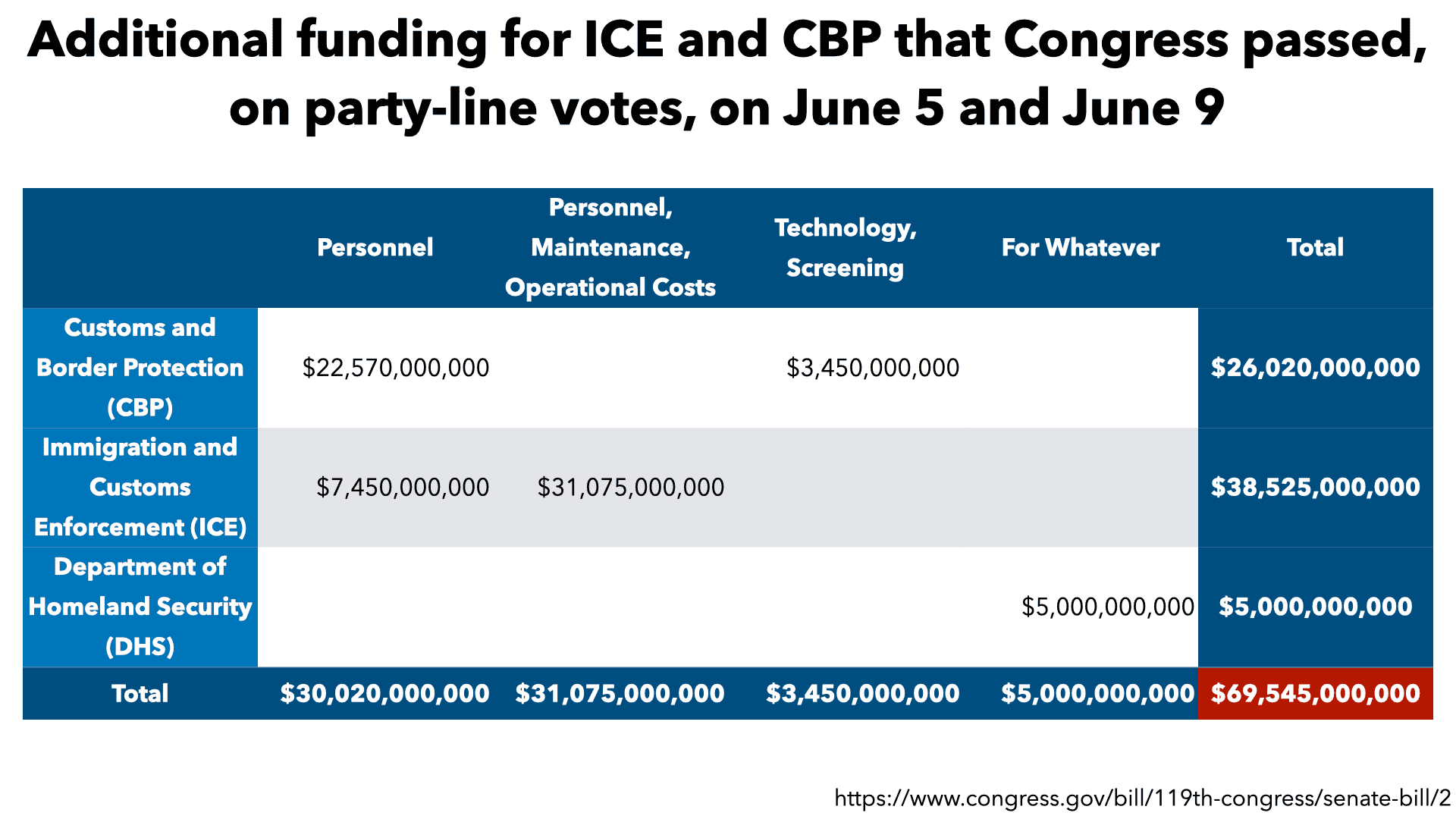
The “Secure America Act” (S.2) ensures that those two agencies, which have faced frequent and serious allegations of human rights abuse, will not need to get their funding approved in the next three annual Department of Homeland Security (DHS) appropriations bills (CBP and ICE are two of DHS’s largest components). The Republican majority leadership of both houses of Congress has effectively “front-loaded” ICE and CBP funding, making it nearly impossible for Democrats to limit or hold up, even if they win a majority of one or both chambers in the November midterm elections.
A quarter-trillion dollars in five years
In 2024 and 2025, CBP’s budget was $19.6 billion; ICE’s budget was $9.6 billion in 2024 and $10 billion in 2025, so the two agencies combined for about $30 billion per year. In July 2025, Congress passed the “One Big Beautiful Bill Act,” which provided those agencies approximately $150 billion more through 2029. (This is often reported as “$170 billion,” a figure that includes roughly $20 billion in funding for states and other agencies.)
With the new funding in S.2, CBP and ICE are receiving about a quarter of a trillion dollars over the five years between 2025 and 2029—approximately $50 billion per year. That is about two-thirds more per year than their original 2025 appropriation, and it comes with fewer conditions or transparency requirements than normal appropriations bills.
Reporting requirements that don’t appear in the legislation, Heidi Altman of the National Immigration Law Center told National Public Radio, include reporting on who ICE is detaining and on the treatment of pregnant women in custody. “It’s almost like a blank check for those agencies, because there’s no guidance,” William Hoagland, senior vice president for the Bipartisan Policy Center, told Talking Points Memo.
Using the “reconciliation” process to avoid ICE and Border Patrol reform
As laid out in previous WOLA Border Updates, the path to this outcome began with the violent ICE and Border Patrol operation in Minneapolis at the beginning of the year.
- In January and February, as Congress was belatedly finishing up much of the 2026 federal budget, Senate Democrats pulled support from the DHS appropriations bill unless Republicans, in the wake of January DHS shootings of U.S. citizens in Minneapolis, agreed to mandate a series of human rights reforms. Under the Senate’s “filibuster” rule, 60 out of 100 senators normally must vote to end debate on a bill and proceed to a vote. As Democrats and allied independents hold 47 seats, they could block the regular appropriations bill’s passage.
- The parties could not agree, and DHS partially shut down on February 13. The shutdown was partial because ICE and CBP had already received $150 billion in funding in July 2025 through the “Big Beautiful Bill,” which they could spend through 2029. That earlier bill had passed without a single Democratic vote, evading the filibuster by using a rarely invoked rule called reconciliation, which (explained imprecisely here) allows a simple-majority vote on bills that affect only taxes, debt, or spending.
- The shutdown ended in late April after the House and Senate approved a DHS funding bill with money for all of the Department’s agencies except ICE and Border Patrol.
- Though this looked like a capitulation to Democrats, Republicans instead moved to fund ICE and Border Patrol separately, without the Democrats’ demanded reforms, for the rest of Donald Trump’s term via a new reconciliation bill.
- The Senate, using reconciliation to avoid the filibuster, passed the bill after a night of debate and rapid-fire votes on amendments—all of which were rejected—at 4:42 AM on the morning of June 5. The vote was 52-47, with just one senator crossing party lines: Sen. Lisa Murkowski (R-Alaska), who voted “no” with the Democrats. One of the failed amendments, introduced by Sen. Cory Booker (D-New Jersey) and rejected on a party-line vote, sought to compel the Trump administration to reopen the DHS Office of the Detention Ombudsman, which has been shuttered despite being required by statute.
- The House passed the bill on June 9, with a party-line vote of 214-212: no representative crossed party lines, although Rep. Kevin Kiley (California), a Republican who went independent earlier this year, voted with the Democrats.
- President Trump had called on congressional Republicans to send him a completed bill by June 1. This was delayed by Senate Republican leaders’ concerns that the White House would seek to add funding for the President’s $1.8 billion so-called “Anti-Weaponization Fund” to distribute to political allies; once that idea was withdrawn, the bill moved ahead and became law on June 10.
On June 10 and 11, meanwhile, the House of Representatives’ Appropriations Committee met to mark up (debate, amend, and approve) its draft of the 2027 DHS appropriations bill. The committee passed it on a party-line vote of 34-27; like most or all of the federal budget, it is unlikely to pass Congress before the November midterm elections.
Alarms about detention conditions continue to sound
Another death in ICE custody
Mamuka Artmeladze, a 43-year-old man from Georgia, died on June 4 at the Winn Correctional Center in Louisiana. He was the 19th person to die so far this calendar year in ICE’s network of detention centers, and the 49th person to die in ICE custody since the Trump administration began. ICE’s announcement did not identify a cause of death.
Artmeladze had no criminal record; he was the second person to die at the Winn facility since April 11, according to immigration data expert Austin Kocher. He had been in detention for 119 days. His passing ended what, for the Trump administration, was an unusually long period of 37 days without an in-custody death.
DHS OIG reports on Louisiana facility
The Winn Correctional Center, operated by the private contractor LaSalle Corrections, was the subject of a June 2 report by the DHS Office of the Inspector-General, based on an unannounced March 2025 inspection that uncovered numerous accounts of guards’ misuse of force against detainees. Episodes included chokeholds and a stabbing with a pen, while facility staff refused to share some video footage of the incidents with investigators. “The investigators also discovered unsanitary food storage and badly leaking ceilings, found that medical staff members were not properly documenting treatment, and concluded that detainees were not receiving adequate access to legal materials,” the New York Times explained.
Reporting deaths of recently released people
ICE is meanwhile ending a policy, begun during the Biden administration, of reporting the deaths of people who had been in detention up to 30 days before their passing. “This creates a situation where ICE can basically release people on their deathbed and then not have to worry about having to do any investigations,” Khaled Alrabe of the National Immigration Project told CNN. The Biden administration had put the policy in place “to make clear that ICE should not release people simply to avoid deaths in custody,” Deborah Fleischaker, who was acting ICE chief of staff at the time, told the Washington Post, which first reported the change.
Hunger strikes and Delaney Hall
Grim and hazardous conditions at detention centers, along with due process violations and poor access to health care, have led detained migrants to stage hunger strikes in California, Michigan, Pennsylvania, and New Jersey, reported Gabe Ortiz at America’s Voice.
The alarm and the controversy have been greatest at Delaney Hall, a detention center that the Trump administration reopened in Newark, New Jersey last year. At least 300 people detained there have been on a hunger and labor strike since May, protesting conditions in a facility widely described as shoddily built and poorly maintained.
- “The conditions in this prison are not fit for human beings over such a long period of time: medical neglect, water unfit for consumption, food that is past its expiration date and in poor condition, bathrooms that are unusable, and ventilation systems that have never been maintained and because of this, we are constantly sick,” read a May 31 letter from people detained at Delaney Hall.
- An individual held at Delaney Hall told Newsweek that “officers entered a May 28 meeting of detainees during the strike, used force and pepper spray, and injured at least one person.” Another said that guards summoned migrants participating in the protest to a meeting, then attacked them, breaking one person’s nose and deploying pepper spray in an enclosed room. Relatives of people detained at Delaney Hall described the alleged May 28 beatings to the Intercept.
- In a recent court filing, GEO Group, the private detention company that operates Delaney Hall on a 15-year, $1 billion contract, claimed that it has “qualified immunity” because it is subject to government oversight, and thus cannot be sued by individuals claiming harm, the American Prospect reported.
- At Balls and Strikes, Madiba K. Dennie documented how people detained at Delaney Hall are required to do work for GEO Group—shoveling snow, cleaning dormitories and bathrooms, serving food—for pay of as little as one dollar per day, if they are paid at all.
- Members of Congress have been exercising their legal right to carry out oversight visits of the New Jersey facility. Rep. Analilia Mejia (D-New Jersey), Rep. Rob Menendez (D-New Jersey), Rep. LaMonica McIver (D-New Jersey), Rep. Dan Goldman (D-New York), Rep. Jerry Nadler (D-New York), and Sen. Andy Kim (D-New Jersey) came away with horrifying accounts of detainees having suffered beatings and suffering apparent medical neglect.
- Internal documents obtained by the New York Times show that of 591 people detained at Delaney Hall in early June, about 13 percent had past criminal convictions and 21 percent had pending criminal charges. The remaining 66 percent had no criminal history, throwing into doubt Trump administration claims that detainees are “the worst of the worst.” The average detainee at Delaney Hall had been there for 80 days.
- White House “Border Czar” Tom Homan paid a visit to Delaney Hall and told CBS News that the facility was “well-run” and that in the dining hall, “the spaghetti was good.”
Otay Mesa, California
A 2024 law—which legislators have gone to court to uphold—states that members of Congress cannot be denied access to ICE facilities, which is why several have been able to enter Delaney Hall. However, ICE has denied New Jersey officials, including Gov. Mikie Sherrill, permission to enter, and the state’s attorney general has sued to allow state health inspections. In San Diego, California, a federal judge ruled on June 3 that ICE must allow county health officials to conduct a full health inspection of its Otay Mesa detention facility, which is run by the contractor CoreCivic.
Camp East Montana
The Government Accountability Office (GAO), a legislative-branch agency that conducts audits and investigations, issued a troubling report on “Camp East Montana,” the tent facility at Fort Bliss, an Army base in El Paso, Texas, which opened last August and is currently ICE’s largest detention center. Troubling findings, some of which have been reported before, include:
- Three deaths of detained people in December and January, including one ruled a homicide. In the homicide case, “the contractor did not provide use of force and death reports to ICE, as required. In addition, evidence associated with the incident was missing or destroyed.”
- A $1.3 billion contract to Acquisition Logistics, a small company with little prior experience in detention management. (This contract has since been terminated and handed off to another company, Amentum Services.)
- ICE’s failure even to inspect the facility, as is required by policy, before its contractor opened it last August.
- A contracting arrangement that paid the contractor for the full cost of detaining 5,000 people, even though the actual population at Camp East Montana has been far lower (1,600 in late February 2026). “This resulted in millions of dollars of waste…ICE paid about $7.1 million for meals it did not need from October 1, 2025, through March 12, 2026.”
- A security guard losing a loaded firearm, which was never recovered.
- Failure to clean dormitories daily, as required. “Rather, these dormitories were cleaned weekly, resulting in unsanitary conditions. In addition, some contract security guards offered detained noncitizens cookies in exchange for cleaning their own dormitories.”
- Failure to provide proper medical care, even for detained people with pre-existing health conditions.
Four people detained at East Montana filed a lawsuit in federal court, the El Paso Times, the Texas Tribune, andSpectrum News reported, citing “flagrant human rights abuses” including “windowless enclosures, physical abuse by guards, ‘abhorrent’ medical and mental healthcare, and solitary confinement ‘to punish and silence victims of guard abuse.’”
Guantánamo
The Department of Defense Inspector-General released a quarterly report on “Operation Southern Guard,” the U.S. military’s name for its participation in the Trump administration’s migrant detention activities at the Guantánamo Bay Naval Station in Cuba. Shortly after taking office last year, President Trump called for using the base to hold up to 30,000 migrants. That has not happened. During the January-March quarter, “fewer than 100 illegal aliens were processed” at the base, the report stated, while the operation cost the Defense Department $5.8 million, and charter flights cost DHS $6.6 million, during that time. (Adding those figures yields a total of perhaps $130,000 per detained person.)
“Alligator Alcatraz”
In Florida, Gov. Ron DeSantis (R) has spent $1 billion in state funds on at least 55 contracts as part of an effort to build state-run migrant detention centers. Most of that has gone to the controversial detention facility in the Everglades that is now shutting down, the Miami Herald reported. That facility “stands out as a uniquely cruel publicity stunt with an absurdly high price tag, in which much of the money goes into just a few pockets,” wrote Eric Schlosser, author of the bestseller Fast Food Nation, at the Atlantic.
Re-separation of families
An Associated Press investigation found that the Trump administration has re-separated dozens of children and parents who had been separated at the border by the first-term Trump administration’s sharply criticized 2018 “zero tolerance” policy. This is despite a 2023 judicial settlement agreement and other efforts to reunify the families and provide them with legal protections. After Donald Trump’s 2024 election, the AP noted, “support for separated families was never encoded by an act of Congress, and soon it started shrinking.” ICE has now been detaining and deporting parents again.
Toddlers in detention
The Trump administration detained at least 500 babies and toddlers under three years of age between January 2025 and March 2026, according to an analysis of Deportation Data Project data carried out by the Marshall Project and MS NOW. The average daily number of toddlers in detention is 10 times higher than it was during the last year of the Biden administration. “Our immigration system is breaking children,” said Marsha Griffin, co-founder of the executive committee of the American Academy of Pediatrics’ Council on Immigrant Child and Family Health.
Rapid detainee transfers
The Marshall Project and Mother Jones reported, based on the Deportation Data Project information, that by March 2026, the Trump administration had transferred over 41,700 detained people to another state within 24 hours of their arrests. The report notes what appears to be a concerted effort to move people to detention facilities in states covered by the federal judiciary’s Fifth Circuit (Texas, Louisiana, and Mississippi). There, judges have upheld a June 2025 Trump administration policy requiring everyone who ever crossed the border improperly—no matter how long ago it happened—to be detained while they pursue their asylum or other immigration cases.
ICE’s “mega-warehouse” plan
The administration may be backtracking a bit from former DHS Secretary Kristi Noem’s plan to reinvent ICE’s detention system by buying and converting a series of “mega-warehouses” to confine several thousand people each. NBC News reported that ICE is considering selling some of the warehouses it has already purchased, using part of a $45 billion detention outlay from last year’s “Big Beautiful Bill.” Nothing has been put on the market yet.
Getting people to give up
Greatly increased detention has been a Trump administration tactic to convince migrants to give up their asylum or immigration cases and choose voluntary departures, which have increased sevenfold over the first 16 months of the Trump administration, the Marshall Project reported.
Environmental concerns at the forefront as wall construction intensifies
Backed by $46.5 billion in funding from last year’s “Big Beautiful Bill Act,” the Trump administration is now building border wall segments at a breakneck pace. On a very frequent basis, DHS announces new contracts with construction companies, and new waivers of environmental and other laws enabled by a provision in the 2005 REAL ID Act.
In comments before the Center for Immigration Studies, a group that promotes restrictions on immigration, CBP Commissioner Rodney Scott said, “The primary border wall, I’ve made a commitment to the President, will be done by the end of 2027. Everywhere the Border Patrol has plans to build that wall will be done in 2027. There’s a couple of gaps, but basically from San Diego all the way to the Gulf.”
Big Bend park waivers
With a preliminary notice issued on June 8, DHS announced it will waive environmental laws to build border-barrier infrastructure in Big Bend National Park and the adjacent Big Bend Ranch State Park, a scenic, unspoiled, and ecologically fragile area in West Texas. The waiver covers over 100 miles “from near the Closed Canyon trail in Big Bend Ranch State Park through the entirety of Big Bend National Park and into remote parts of southeastern Brewster County,” Marfa Public Radio reported.
Though there has been confusion about this construction plan for months, CBP claims it does not intend to build 30-foot steel border wall segments in the park. However, the waiver does call for “staging areas, the conduct of earthwork, excavation, fill, and site preparation, and installation and upkeep of physical barriers, roads, supporting elements, drainage, erosion controls, safety features, lighting, cameras, and sensors.”
“The United States Border Patrol Big Bend Sector is an area of high illegal entry,” the waiver document reads. In fact, it is the least-traveled of the nine geographic sectors into which Border Patrol divides the U.S.-Mexico border. Big Bend Sector is the largest of the nine sectors, comprising 517 of the border’s 1,954 miles. But it is also the most remote and quietest: just 1.1 percent of Border Patrol’s migrant apprehensions this century have occurred in Big Bend. In the national park itself, data compiled by a former park superintendent “suggests that agency apprehensions within National Park boundaries have constituted an average of 0.02% of nationwide totals over the past decade,” the Big Bend Sentinel reported.
“The absolute disdain this administration has for our national parks is disgraceful, and now they’re targeting Texas’s most beloved national park,” said Laiken Jordahl of the Center for Biological Diversity, which is part of a lawsuit challenging DHS’s construction plans.
During the House Appropriations Committee’s June 10 markup of the fiscal year 2027 DHS appropriations bill, Rep. Henry Cuellar (D-Texas), the ranking Democrat on the Committee’s Homeland Security Subcommittee, introduced an amendment that would have prohibited border barrier construction in Big Bend National Park. It failed on a party-line vote, with all three Texas Republican committee members voting against it.
Big Bend contracts and contractors
The administration has now awarded at least $5.8 billion in contracts for barrier construction in this sparsely transited part of the border region, part of $16.3 billion in new wall-building contracts border-wide over the past six months.
- At least $1 billion, and up to $1.1 billion, to Barnard Construction for “Border Barrier Construction in Hudspeth County, Texas”
- At least $1.2 billion, and up to $1.4 billion, to Fisher Sand and Gravel for “Border Wall Construction – Vertical Barrier, Big Bend Texas Sector (BBT-2)”
- $960.4 million to Barnard Construction for “BBT-3 Border Barrier Construction Project”
- $4.4 million to Tierra Right of Way Services for “Environmental Consulting Services” or “BBT-3 Border Barrier Project Construction Monitoring Services”
- $2.6 billion to Fisher Sand and Gravel for “Border Barrier Design Build for BBT-5”
A Washington Post analysis noted that Barnard and Fisher, “two firms that have ties to the White House and the Republican Party,” have received the most recent construction contracts along the border.
Big Bend flood concerns
Along with other local leaders, the mayor of Presidio, the sector’s largest border town, sent letters to CBP and the military’s Joint Task Force Southern Border requesting the removal of concertina wire from the Rio Grande floodplain. They argue that soldiers installed the wire incorrectly and that seasonal flooding, which could occur in “days, perhaps only hours,” could render the wire a hazard.
RGV floodplains and bulldozing
Floodplain concerns are also prominent in eastern Texas, in the Rio Grande Valley. “We’re all devastated” by DHS’s sudden clearing of land along the river for 25 miles of new border wall construction near the town of San Ygnacio, Joe Rathmell, the judge of Zapata County, told Border Report. Rathmell, who says the federal government did not communicate with or consult local officials before beginning work, worried about the impact the construction could have on his community’s water quality.
At the Border Chronicle, Melissa del Bosque interviewed Elsa Hull, a landowner and advocate with the Laredo-based No Border Wall Coalition in Zapata County, who was arrested while peacefully protesting contractors’ bulldozing of the land of a neighbor who had not signed a form giving them permission to do so. Hull said her arrest for trespassing on government land in fact occurred on private property; “in Texas, land ownership is a complicated patchwork of federal easements, private property and rights-of-way,” del Bosque noted.
Throughout Texas, a NewsNation report noted opposition to wall projects from ranchers, sheriffs, business owners, property owners, and mayors in Laredo, the Big Bend region, and the Del Rio-Eagle Pass area.
Mt. Cristo Rey
The El Paso Times published photos of new border wall and road construction being enabled by blasting on the southern face of Mount Cristo Rey. The iconic peak west of El Paso, much of it property of the Catholic Diocese of Las Cruces, New Mexico, is popular with hikers and religious pilgrims.
Endangered ram dies in California concertina wire
In the Jacumba Wilderness, along the border in south-central California, wildlife biologist Christina Aiello found the remains of an endangered Peninsular bighorn sheep trapped in coils of concertina wire laid down by soldiers assigned to the Trump administration’s border mission. A nearby resident reported seeing a mountain lion “with noticeable lacerations on its back legs.” In January, Aiello had submitted comments to CBP warning about the risk that the concertina wire posed to sheep and other wildlife, and proposed measures to mitigate potential harm, but “border officials rejected these ideas,” the Los Angeles Times reported.
Impacts in Latin America
- An investigation by PunchUp and Migrant Insider “uncovered what appears to be a quiet effort to preemptively block potential immigrants to the U.S. by providing a DHS-built deportation system to the Panamanian government.” The program, which could help Panama’s migration agency to process and remove up to 6,000 people per year, “remains in the research stage—for now.” With a five-day processing window, it is unclear whether this scheme would include effective safeguards to prevent people from being sent back to countries they fled to avoid persecution.
- “We are sharing information in a way that we’ve never really shared before and actually getting results,” CBP Commissioner Rodney Scott said of the government of Mexico, in remarks before the Center for Immigration Studies. “We’re attacking the entire problem now instead of just processing the illegal alien after they crossed. So Mexico’s been helping us out a lot.”
- In Ciudad Juárez, Mexico’s daily La Jornada reported, hundreds of migrants who have lost hope of entering the United States due to the Trump administration’s suspension of asylum access are “forming a floating population.” Cristina Coronado of the San Columbano Missionary Society compared migrants who stayed in Juárez after the big 2021-2024 arrival of asylum seekers to “what remains in a colander.” They lack “documents to apply for formal employment, register their children in schools, or be treated at state health centers, where they also suffer discrimination,” and many are subsisting as motorcycle-riding app delivery workers. They are very frequent victims of crime.
- The latest quarterly Migration Dynamics and Conditions Update from the University of Texas’ Strauss Center, compiled by researchers Caitlyn Yates and Stephanie Leutert, reports that migrants stranded in northern Mexico border towns are now routinely waiting two years for Mexico’s overwhelmed and under-resourced asylum system to process their applications. “Individuals living in Mexican cities without legal status are often unable to formally work, access medical care, or obtain adequate housing,” while “civil society organizations have also detailed widespread violence against migrants, both in southern Mexico and in cities along the U.S.-Mexico border.” Many migrants have left the border zone for other destinations in Mexico’s interior, leaving shelters mostly empty, but the Strauss Center investigators estimate that about 5,190 people continue to live in border cities.
- Citing intelligence reports, the Mexican daily Milenio reported that nine large criminal organizations (cartels) operate along the Mexican side of the U.S.-Mexico border. The list includes Sinaloa, Jalisco New Generation, Gulf, Northeast, Juárez, La Línea, Tijuana or Arellano Félix, the Salazars, and remnant cells of the Zetas.
- The Mexican government issued 13,999 temporary humanitarian visitor cards to people from other countries in 2025, more than triple the 4,138 cards issued in 2024, La Jornada reported. (Official data about these cards’ issuance in 2025—Table 2.10 each year here—are incomplete.) Mexico had been issuing as many as 17,000 such cards each month before October 2023, when it cut back sharply. It did so almost certainly in response to communications from the Biden administration, as many migrants who obtained the cards used them to travel to the U.S. border. The increased issuance of cards in 2025 was likely a consequence of the large number of non-Mexican migrants stranded in Mexico by the Trump administration’s January 2025 suspension of asylum access.
- The Department of State is conducting a review of the 53 consulates that the Mexican government operates to serve its citizens living in the United States. This review “might lead to the closure of an unknown number of Mexican consulates,” the Associated Press reported.
- In Ciudad Juárez, a group of people arrested for a ransom kidnapping of five migrants from India included a migrant protection officer from Grupo Beta, the Mexican migration agency’s unit that is meant to protect migrants from harm.
- In the Rio Grande Valley region, one of six recent border crossers arrested by Texas state police “said he took a bus to Monterrey, Mexico, where he was connected with cartel operatives who demanded he pay them $10,000 for assistance crossing into the United States,” NewsNation reported. “The man accuses cartel members of repeatedly striking him in the head and of threatening to cut off one of his fingers if he did not work for the cartel to pay off what he owed them.”
- The number of people deported from the United States to Guatemala increased by 72 percent during the first five months of 2026, to 24,359, up from 14,125 during the first five months of 2025. The vast majority of those deported, aboard 236 flights, were arrested in the U.S. interior, not at the border.
- Data from the UN International Organization for Migration (IOM) indicated that remittances from migrants in the United States to El Salvador, Guatemala, and Honduras increased 10.7 percent during the first four months of 2026 compared to the first four months of 2025, from $14.32 billion to $15.85 billion. Remittances to Mexico, however, fell 4.6 percent in 2025 “due to a combination of factors related to demographic changes and migration enforcement,” the Inter-American Dialogue reported. “Unlike deportees in previous years, over 90 percent of Mexican deportations in 2025 were of remitters and people living in the U.S. for more than 4 years.”
- In a Miami Herald column, Archbishop Thomas Wenski of the Catholic Archdiocese of Miami urged the U.S. Senate to follow the House of Representatives’ lead in passing legislation to preserve Temporary Protected Status (TPS) for citizens of Haiti for three more years. “The lack of functioning state institutions has resulted in a general breakdown of security with attacks on women and children becoming commonplace,” Wenski wrote. “It would be an act of abject cruelty for the United States to send families back to such dangerous and unsafe conditions.” A report from the Migration Policy Institute documented the Trump administration’s efforts to end TPS for 13 nationalities so far.
Other news
- Rosario “Pete” Vasquez is the new chief of the U.S. Border Patrol, following the abrupt departure of the Trump administration’s first chief, Mike Banks. Vásquez joined the Border Patrol 26 years ago and most recently was the chief of the agency’s Blaine Sector along the U.S.-Canada border.
- Sources told the Washington Examiner’s Anna Giaritelli that Vásquez’s appointment caps two weeks of behind-the-scenes “scrambling” to identify “a new U.S. Border Patrol chief who does not come with a history of scandal and inexperience, as its previous leader did.” Banks, who faced allegations of having discussed hiring sex workers while on official overseas trips, was “viewed by six people who spoke with the Washington Examiner this week as the final figure of former Department of Homeland Security Secretary Kristi Noem’s era, a 14-month period in which DHS turned immigration enforcement into a flashy and aggressive campaign made for television,” Giaritelli noted. Some of her sources voiced concern about the new chief’s independence from Border Patrol’s politically influential agents’ union.
- The U.S. military made some changes to the structure of its forces assigned to the U.S.-Mexico border. Joint Task Force-Southern Border, the component of Northern Command created in March 2025, transferred authority from the Army’s 101st Airborne Division to its 1st Armored Division. Northern Command adopted the name “Operation Ardent Vanguard” to refer to its border mission. Joint Task Force-North, the Fort Bliss-based Northern Command component that first began operating at the border as “Joint Task Force Six” in 1989, officially closed down. The unit’s “current headquarters, personnel, and assets will transition directly to support the Joint Interagency Task Force-Counter Cartel (JIATF-CC),” established in January 2026 and based in Tucson, Arizona, according to a Northern Command release.
- Though they have not gone into effect, recent court rulings that would strike down the Trump administration’s January 2025 suspension of asylum access at the border are “renewing hopes for thousands of asylum seekers waiting in northern Mexico that they might be allowed one day to make their case,” reported Sarah Matusek at the Christian Science Monitor. The suspension has “put a lot of people in very real danger,” said Laura St. John of the Tucson-based Florence Immigrant and Refugee Rights Project.
- At Capital & Main, Kate Morrissey reported on the Trump administration’s deal with the small African kingdom of Eswatini, allowing it to deport 160 migrants from third countries for $5.1 million. This is one of at least eight African nations complying with a Trump administration request to accept third-country deportations; a new agreement was just reached with the Central African Republic. Eswatini immediately placed the deported individuals in a maximum-security prison, with no clear end to their detentions, although they are not accused of any crime in the country. “He’s suffering some major depression there as I suffer silently here,” the life partner of a Cuban man told Morrissey. “What was done to me was pure evil. What I have lost, I still have not got it back,” said a Jamaican man who was returned to his home country after two months imprisoned in Eswatini.
- These third-country deportation arrangements “allow the United States to wash its hands of its legal obligations while other governments do the illegal work for it,” two human rights lawyers with the Open Society Justice Initiative wrote at the Guardian.
- Preliminary May 2026 data from the ICE Flight Monitor project showed that 296 ICE removal flights deported migrants last month, 56 percent more than in May 2025. 108 of those flights took Mexican citizens back to cities deep in Mexico’s interior, “amid a near-total pause on deportations over the U.S.-Mexico land border” (covered in WOLA’s May 29 Border Update).
- Federal investigators discovered a sophisticated smuggling tunnel between Tijuana and the Otay Mesa area, southeast of San Diego, where such tunnels are often found. They recovered over a ton of cocaine on the site. The tunnel was nearly 2,000 feet long, 55 feet deep, and featured reinforced walls, a rail system, ventilation, and electricity. Its U.S. terminus was a purported retail store called “Buy 4 Less,” which featured “a sophisticated hydraulic elevator” hidden beneath the floor of a storage room. The Justice Department linked the tunnel to Mexico’s Jalisco New Generation Cartel.
- Local news reported on a “harrowing high-speed pursuit” involving Border Patrol near the agency’s highway checkpoint in Falfurrias, Texas, north of McAllen. Agents and Texas state police engaged in “a tense and dangerous chase” of a semi-trailer “along one of South Texas’s critical transit routes,” as a local news affiliate described it. The trailer persisted in driving on flattened tires until it burst into flame; authorities discovered 39 migrants inside.
- Forbes reported on the Defense Department’s growing use of uncrewed “drone boats” to patrol the Rio Grande. “Their current use by Joint Task Force-Southern Border demonstrates that machines powered by AI can also be used efficiently in confined areas as security guards,” the report claimed.
- Over the ten years between fiscal 2016 and 2025, “3 DHS agencies reported at least 99 officers’ deaths by suicide,” with 81 of them employed by CBP, a GAO report found. The oversight agency recommended that DHS agencies improve their collection and reporting of data to assess mental health and suicide prevention efforts for their workforce.
- Carlos Fernando Chamorro of the independent Nicaraguan news site Confidencial spoke with New Yorker staff writer Jonathan Blitzer about the Trump administration’s intensifying immigration crackdown, calling it a laboratory for authoritarianism in the United States.”
Links: “mass deportation” and human rights in the U.S. interior
- Ximena Bustillo, “San Francisco Immigration Court Shuts Down, Striking at Heart of Historic Advocacy” (National Public Radio, June 10, 2026).
The main San Francisco court was one of the busiest in the country, hearing thousands of cases a year. It was also one of the courts most likely to grant an immigrants’ asylum application
- Celine Castronuovo, Megan Crepeau, “Fired Immigration Judges Test Trump’s Executive Power in Suits” (Bloomberg Law, June 10, 2026).
Former immigration judges who say their firings were discriminatory are pushing courts to rein in the Trump administration’s claims of unfettered power to terminate executive branch employees
- Whitney Curry Wimbish, “Ice Profiteer Claims It Cannot Be Sued” (The American Prospect, June 8, 2026).
Delaney Hall operator GEO Group believes it has qualified immunity
- Juan Carlos Bow, “Los Migrantes Que se Autodeportan de Estados Unidos: ¿Quienes, Como y por Que?” (Confidencial (Nicaragua), June 8, 2026).
El Gobierno de Trump lanzó en 2025 una aplicación para autodeportarse de Estados Unidos, pero ésta esconde riesgos para los migrantes
- Joseph Addington, “The Ongoing Child Immigration Fiasco” (The American Conservative, June 8, 2026).
Imagine me and my wife coming to the realization that we just can’t give our kids the safe, happy life in America all children deserve as a human right
- Kim Bellware, “The Spectacular Collapse of a Case Against Ice Protesters: ‘It’s Not Justice, but It Is a Win’” (The Guardian (Uk), June 8, 2026).
Though the federal government’s prosecution fell apart, the Broadview Six of Illinois say their lives have been upended
- Ashleigh Fields, “Homan Planning Largest Ice Deployment in New York City: ‘It’s Coming’” (The Hill, June 8, 2026).
- Tracey Tully, “A New Governor Faces Her First Crisis Amid Tear Gas and Tough Decisions” (The New York Times, June 7, 2026).
Gov. Mikie Sherrill dispatched the New Jersey State Police outside the Delaney Hall migrant detention center after federal officials said they would flood the area with armed agents. Not everyone approved
- Churchill Ndonwie, Claire Heddles, “How Desantis Signed Away $1 Billion for State-Run Immigrant Detention Centers” (The Miami Herald, June 6, 2026).
- Hamed Aleaziz, Jazmine Ulloa, “As Trump Pushes Deportations, a Skyrocketing Caseload Strains Immigration Courts” (The New York Times, June 6, 2026).
A federal surge has more than doubled caseloads within some immigration courts nationwide. Lawyers say the tactic is causing errors and confusion
- Arelis R. Hernandez, “One Judge, 143 Cases: A Day Inside New High-Stakes Mass Immigration Hearings” (The Washington Post, June 6, 2026).
Immigration judges are seeing their dockets multiply as part of the Trump administration’s push to speed up deportations. Attorneys for the immigrants worry due process rights will be violated as a result
- Gaby del Valle, “What Happens When Your Phone Is Confiscated at the Airport” (The Verge, June 5, 2026).
CBP phone searches are on the rise
- Frank Sharry, “Memo to Democrats on Immigration: To Turbocharge Generosity, Get Order Right” (Third Way, June 5, 2026).
- Joseph Cox, “Ice’s Plan to Let Cops Around the Country Scan Faces to Verify Immigration Status” (404 Media, June 5, 2026).
ICE plans to give potentially more than a thousand agencies access to a facial recognition app that verifies a person’s immigration status
- Madeleine Ngo, Zach Montague, “Judge Says Trump Officials Must Restart Asylum and Immigration Processing” (The New York Times, June 5, 2026).
The judge invalidated policies the Trump administration enacted last year that halted asylum grants, as well as the processing of immigration benefits for people from 39 countries
- M. Gessen, “The White House’s Latest Provocation Is ‘Grotesque and Terrifying and Juvenile’” (The New York Times, June 5, 2026).
What’s the matter, can’t you take a joke?
- Eric Schlosser, “The Alligator Alcatraz Boondoggle” (The Atlantic, June 4, 2026).
The immigrant-detention facility, which may soon be shut down, has been a cruel and costly publicity stunt
- Lomi Kriel, “Guatemalan Woman Who Needed Surgery for Months Released by Ice” (The Texas Tribune, June 4, 2026).
Andrea Pedro Francisco was scheduled for surgery to remove an ovarian cyst in February. Then ICE detained her, repeatedly denying her the procedures
- Tom Jawetz, “Markwayne Mullin’s Answer About Following Court Orders Should Alarm Every American” (Center for American Progress, MS NOW, June 4, 2026).
The Department of Homeland Security is not exempt from the rule of law
- Mizue Aizeki, “Tech, War, and the Everywhere Border” (Collaborative Research Center for Resilience , Everywhere Border Project, The Border Chronicle, June 4, 2026).
Going “back to normal” won’t end structural violence in the U.S. or anywhere else
- Em Knepp, “Follow the Money – May 2026: After April Lull, Dhs Spending Surges in May” (Project Salt Box, June 3, 2026).
Project Salt Box’s monthly report on DHS procurement activities
- Felipe de la Hoz, “The Push to Rein in Ice and Rebuild America’s Immigration System” (Dame Magazine, June 3, 2026).
ICE’s expanding detention system has become a flashpoint in the debate over federal power, immigrant rights, and the future of U.S. immigration policy
- Autumn Billings, “Cbp Agents Violently Arrested This Chicago Woman. Now She’s Seeking $10 Million in Damages.” (Reason, June 3, 2026).
Debbie Brockman, a U.S. citizen, was held for seven hours and released with no charges after her arrest by immigration agents last October
- Aala Abdullahi, Geoff Hing, “They Were Detained by Ice. Then They Vanished.” (Mother Jones, June 1, 2026).
Immigrants are frequently being sent all over the country, and families and attorneys often don’t know where they are
- Joseph Cox, “We Sued Ice to Get Its Spyware Contract. The Agency Is Redacting Essentially Everything” (404 Media, June 1, 2026).
Paragon’s software is capable of remotely breaking into phones and accessing messages from encrypted messaging apps. Our lawsuit aims to pry records about it from ICE
- Camilo Montoya-Galvez, “Trump Administration Plan Would Allow for Quick Asylum Rejections Without Interviews, Internal Documents Show” (CBS News, June 1, 2026).
The regulation, described in internal documents obtained by CBS News, would be the latest effort by President Trump’s White House to tighten access to the U.S. asylum system
- Rebecca Hamilton, Susan Benesch, “The White House’s New “Aliens” Website Is Not a Joke” (American University, Harvard University, Just Security, June 1, 2026).
The new Aliens.gov website uses fear, dehumanizing rhetoric, and conspiracy themes to build public support for mass deportations
- Marion Solletty, “Afd, Vox Mingle With Ex-Us Border Patrol Chief, White Nationalist Leader at ‘Remigration Summit’” (Politico, May 31, 2026).
Gregory Bovino and Jared Taylor flew in to support activists once deemed too toxic even by European far-right parties
- Coral Davenport, Hamed Aleaziz, Lydia Depillis, Miriam Jordan, Nicholas Nehamas, Zolan Kanno-Youngs, “Trump Squeezes Immigrants by Cutting Them Off From Jobs, Health Care and Housing” (The New York Times, May 30, 2026).
The methodically planned strategy is intended to pressure noncitizens, including many with legal status, to leave the United States
- Gregory Royal Pratt, “Ice Releases Some Immigrants Without a Way Back Home. These Volunteers Are Waiting to Help.” (The Chicago Tribune, May 30, 2026).
From California to New Jersey and Minnesota to Texas, advocates across the country are figuring out ways to get released detainees back home
- Pablo Manriquez, “Pregnant, Indicted, and Not Backing Down: Mciver Returns to Delaney Hall” (Migrant Insider, May 30, 2026).
The Trump administration charged her with a felony for showing up. She showed up again to fight for migrant rights and close an infamous for-profit detention center in New Jersey
- Ernesto Londono, “Ice Agent Wanted in Minneapolis Shooting Is Captured in Texas” (The New York Times, May 29, 2026).
Christian Castro, who had been charged with assault in the shooting of a Venezuelan man during the immigration crackdown in Minnesota, was taken into custody Friday morning
- Gillian Brockell, “Habeas Flight Watch: New Tool Helps Track Ice Flights to Your City” (Gillian Brockell, May 29, 2026).
Activists have been quietly piloting a live map of ICE flights to help immigration attorneys with habeas filings. Now they say it’s ready for everyone to use
- Grace Ashford, Hamed Aleaziz, “New York Wants to Restrict Ice Enforcement. Ice Has Other Ideas.” (The New York Times, May 29, 2026).
New York leaders changed state immigration laws to hold federal agents accountable for their deportation tactics, but their efforts will face opposition from the Trump administration
- Armando Garcia, “Immigration Attorneys Say Some Courts Are Holding Over 100 Case Hearings Daily” (ABC News, May 29, 2026).
Master calendar hearings are when immigrants in deportation proceedings first appear before a judge and are informed of their rights and the charges they may be facing
- Tom Jawetz, “The Trump Administration’s Assault on Immigrants Degrades the Rule of Law” (Center for American Progress, May 28, 2026).
By repeatedly breaking the law and resisting accountability—infringing on constitutional rights, disregarding statutory limits imposed by Congress, and defying binding court orders—the Trump administration is degrading the rule of law
- Ariel G. Ruiz Soto, Muzaffar Chishti, “Attacked As “De Facto Amnesty,” U.S. Temporary Protected Status Is Abruptly Eroded” (Migration Policy Institute, May 28, 2026).
The Trump administration is seeking to all but eliminate Temporary Protected Status (TPS), a humanitarian safeguard for U.S.-resident noncitizens whose home countries were too dangerous or unstable for return. While critics say the term “temporary” has been stretched beyond recognition, TPS has become a mainstay. This article examines the history and use of TPS, the debate over its future, and holders of the status
Newsletter
Subscribe to get the latest on analysis and policy

Do you find our content useful and informative? Do you frequently visit the WOLA website? If so, please consider making a donation today to keep our website free and open to all.
More Updates



Love our content? Unlock even more!
Subscribe with your email to receive exclusive reports and expert research directly to your inbox every week.
(Your privacy is important to us; your information will be kept confidential and secure.)