






Leer en español – Printer-friendly PDF version (English – Español)
Podcast episode: Audio en español – Video with English subtitles
“Mass deportation”
The painful impact of the Trump administration’s “mass deportation” strategy is an urgent national crisis in the United States, raising alarm in communities, the immigration court system, detention centers, and border regions. The impact in Mexico is also grave, and worsening.
At Mexico’s northern border in Nogales, and at its southern border in Tapachula, the increase in deportations of both Mexican and other nations’ citizens is generating a full-blown humanitarian crisis. In recent months, the Kino Border Initiative (KBI) in Nogales and the Fray Matías de Córdoba Human Rights Center in Tapachula (Fray Matías) have seen deeply troubling changes in the migrant population they serve and in the conditions they face.
Many more people are being deported after spending much of their lives in the United States
During the first six months of 2026, the U.S. government deported 91,383 Mexican citizens back to Mexico; it was also deporting about 1,100 citizens of third countries into Mexico per month. The total number of Mexican citizens is down slightly from 102,217 deportations during the first six months of 2024, but the population is very different now.
- Today’s deportations are occurring as the number of people being apprehended by the U.S. Border Patrol at the U.S.-Mexico border has dwindled, because the Trump administration’s unlawful suspension of the right to asylum remains in place, and because a climate of fear among immigrants in the United States is dissuading many from coming.
- Meanwhile, ICE’s arrests in the U.S. interior have grown steadily. The agency arrested 1,319 people per day in June, of all nationalities, and 1,474 people per day during the first 11 days of July. These are the highest rates of the Trump administration, a multiple of the 245 per day during June 2024 when Joe Biden was president.
- This means that relatively few people being deported into Mexico today are recent border arrivals. Instead, most people being deported now were arrested by ICE in the U.S. interior, often after living, working, creating families, and building lives in the United States for many years.
- Between December 2025 and April 13, 2026, 78.5 percent of recently deported people whom KBI accompanied at its shelter in Nogales, Sonora, had lived in the United States for an average of 14.3 years.
Many more people are being deported after the Trump administration took away their immigration statuses or abruptly ended their immigration cases
Many of the recently deported people whom KBI and Fray Matías are accompanying had some permission to live in the United States, but the Trump administration has revoked those permissions through a layered and multifaceted combination of policies.
- Some third-country citizens deported into Mexico had lost Temporary Protected Status (TPS) granted to citizens of Venezuela, Honduras, or Nicaragua. A June 2026 Supreme Court decision is allowing the Trump administration to cancel TPS for about 350,000 citizens of Haiti.
- Some citizens of Cuba, Haiti, Nicaragua, and Venezuela had a temporary Humanitarian Parole status granted by the Biden administration, which the Trump administration revoked.
- Some, including some citizens of Mexico, had a temporary parole status granted through the Biden administration’s CBP One program, which used a smartphone app to make appointments at land-border ports of entry. That, too, has been stripped away.
Many others were seeking asylum in the United States, often because they fled specific threats in their home countries, but have had their cases abruptly terminated. KBI has spoken to many people who said their asylum processes were accelerated and denied. Once that happened, their deportations began very quickly, from one moment to the next.
Appealing the denials has been very difficult because that nearly always requires an attorney’s representation. Even those who have the resources to hire an attorney are prevented from doing so by ICE’s frequent transfers of people to detention centers across states.
According to data obtained by TRAC Immigration, the Trump administration’s immigration courts denied asylum 13,205 times in June 2026: 94 percent of all cases were denials. (In June 2024, the Biden administration’s immigration courts had denied asylum 3,240 times: 50 percent of cases.) More than 30,000 other cases have been “pretermitted”: closed without being considered, based either on a technicality or because judges were instructed to opt to send them to a third nation’s asylum system.
In some cases, migrants told both KBI and Fray Matías that they were deported without signing any documents indicating that they assented to their removal or desisting from their asylum or immigration cases.
Others mentioned U.S. officials pressuring them to sign. When they refused, some officers even said, “If you don’t sign, I will.” We urgently need more investigation into the possibility, heard several times from deported migrants, that some U.S. officials may be fraudulently signing people’s removal documents for them.
Conditions in detention, and the prospect of third-country deportation, constitute scare tactics to convince people to give up their U.S. immigration cases
Some deported migrants have told both organizations that they voluntarily agreed to give up their cases and be removed because they could no longer endure the conditions in which they were being detained. Many were in ICE’s detention system for three to six months, and some for up to a year or more.
The appalling conditions in the U.S. immigration detention system—poor food, aggressive guards, denial of medications, overcrowding, prolonged isolation, 53 deaths in custody since the Trump administration began—are the subject of much alarming recent reporting. Enduring ICE detention conditions for a prolonged period while separated from loved ones, with no knowledge of when the process might end, carries significant psychological harms.
This cruelty’s notoriety, too, serves the Trump administration’s goal of getting people to give up their asylum or immigration cases. So does the possibility of being deported to a third country, as has happened well over 21,000 times, aboard about 71 flights and across the U.S.-Mexico border, between the beginning of the Trump administration and June 2026, according to Human Rights First’s Third Country Deportation Watch and ICE Flight Monitor data-tracking projects. U.S. authorities have sent over 18,000 of those third-country citizens to Mexico.
At the U.S.-Mexico border
A freeze in land deportations, and a drop in deported citizens of Mexico
In Nogales, KBI had been receiving many Mexican citizens deported from the United States until April 13, 2026, when the U.S. Department of Homeland Security (DHS) implemented a major policy shift: halting most deportations of Mexican nationals across the land border. Instead, ICE is now deporting most Mexican citizens by air deep into Mexican territory, in most cases to the cities of Villahermosa, Tabasco, and Tapachula, Chiapas, near Mexico’s southern border with Guatemala, but also to Mérida, Yucatán; Campeche, Campeche; Tulum, Quintana Roo; Huatulco, Oaxaca; Morelia, Michoacán; and Mexico City.

This strategy of geographic deterrence seeks to reduce repeat unauthorized crossings by increasing the logistical, financial, and physical distance between deportees and the U.S.-Mexico border. Though it is very expensive to deport people by air aboard contractor-operated chartered planes with guards, ICE is overflowing with cash after the Republican-controlled U.S. Congress passed two bills in 2025 and 2026 vastly increasing the agency’s budget.
Between mid-April and July 2026, ICE Flight Monitor counted 408 deportation flights to those internal Mexican destinations. The Mexican Interior Department’s Migration Policy Unit, which has not yet added July data, counted 39,717 Mexican citizens deported to interior Mexican destinations in April to June 2026: 83 percent of all deportations. In June, 95 percent of deportations of Mexican citizens happened in interior Mexican states.
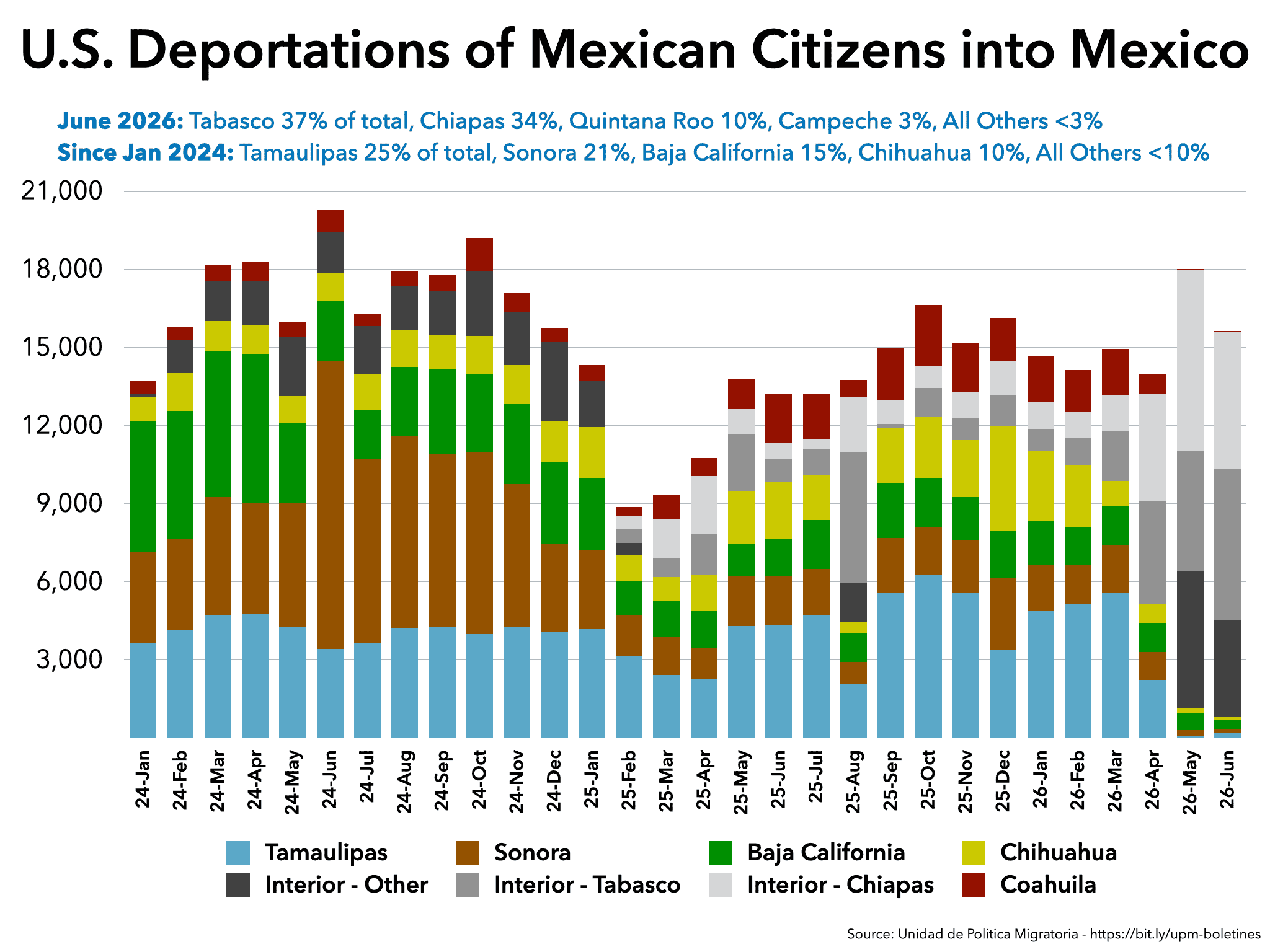
At Mexico’s northern land border, where the national government had invested in a series of reception centers in anticipation of the Trump administration’s mass deportations, the Trump administration’s shift has meant a sharp drop in arrivals of deported Mexican migrants. Those reception centers are mostly empty. The Migration Policy Unit counted 119 deportations into Nogales in June, down from a January-April average of 1,511 per month.
At the government shelter where it monitors arrivals, KBI encountered only 15 Mexican citizens over the entire month of May, many of whom were waiting for Mexican authorities to arrange transportation back to their home states. Mexican citizens still deported at the land border are more likely to be among the smaller number of recent border-crossers. (85 percent of those served by KBI since April 13 were recent border-crossers; it was 25 percent between March 1 and April 13.) Mexicans detained while living in the United States are now almost entirely deported by plane.
KBI has noted that those deported by land into Nogales are pregnant women, parents with young children, or people who were injured while scaling the wall or crossing the desert. Twenty percent of those interviewed in June suffered a serious injury, mostly from falls off the wall. Of those interviewed at the government shelter in Nogales in June, 18 percent reported having suffered serious health problems as a result of their journey (including fractures), suggesting that vulnerable individuals are being deported immediately, often without adequate medical care. Of the 15 Mexicans recorded in May, 42 percent were women; by contrast, in April prior to the 13th, only 7 percent of those at the government shelter were women.
What happens to third-country citizens
Even as the U.S. government deports about 1,100 citizens of third countries into Mexico each month, it is not doing so by air: third-country citizens continue to be deported across the land border. As a result, non-Mexicans now make up a much higher percentage of those deported through Nogales than in previous months. According to data from the Mexican Consulate in Nogales, in March and April, non-Mexicans represented just 10 percent and 7 percent, respectively, of those deported to Nogales. In May and June, they accounted for 25 percent and 34 percent, respectively, and of those, 83 percent and 85 percent were citizens of Cuba.
KBI does not have access to deportees from third countries. They are invisible in Nogales because once they are handed over by ICE to the National Institute of Migration (INM), Mexico’s immigration authority, they are immediately transported by escorted buses to Villahermosa and Tapachula—the same cities that are currently receiving the majority of U.S. flights deporting Mexican citizens.
This continues a practice dating back to the Biden administration, as Mexico’s non-governmental Institute for Women in Migration (IMUMI) documented in 2024. At that time, though, the third-country individuals being deported were recent border-crossers. Now, the Trump administration is deporting into Mexico thousands of people who have been in the United States for long periods. They are principally citizens of Venezuela, Cuba, Guatemala, Honduras, El Salvador, and Haiti, though a few come from other Latin American nations.
On the three-to-four-day road journey to Villahermosa and Tapachula, some buses make a stop in Mexico City to collect others. Those aboard are unshackled and fed; although the buses are far from comfortable, those are better conditions than those to which ICE subjects people deported by air. Most of the third-country migrants with whom Fray Matías has spoken identified Nogales as the site where they were deported.
In Tapachula
When the buses arrive
Fray Matías has observed an increase in the number of deported third-country migrants bused to Tapachula, a city of over 300,000 people. The majority of those whom Fray Matías has identified have been citizens of Cuba and Venezuela. Arrivals in Tapachula also include many citizens of El Salvador, Honduras, and Haiti. A large portion of the Cuban citizens are elderly, having spent much of their lives in the United States.
At first, Mexican authorities left them in public spaces, like the city’s central square. There, they were abandoned with little information about their location or what to do next.
More recently, instead of public spaces, authorities have been dropping third-country individuals off at Siglo XXI, the INM’s massive migrant detention center in Tapachula, which is the largest such facility in the Americas. However, Mexico’s government does not consider these people to have been officially “detained”: after a period of time in Siglo XXI that is usually brief but could extend up to seven or eight days, the INM releases them from the facility, at which time they are left to fend for themselves.
These third-country citizens are an invisible population in Tapachula, beyond the few who may be in the city’s central square. Fray Matías personnel mainly assist people at Siglo XXI, but not elsewhere. Tapachula’s migrant shelters have not filled up, nor does one notice people begging for money. Many appear to be finding places to rent, in miserable and crowded conditions. Their invisibility indicates the intense fear in which recently deported people are living.
No clear way to regularize migratory status in Mexico
Upon release, each individual gets a document, which appears to be a photocopied discharge letter, stating that the INM did not detain them for immigration reasons, but instead held them for statistical purposes only. (No statistics are publicly available.) Along with this document, the INM tells them that they have ten business days to regularize their migratory situation before they lose their right to remain in Mexico. During those days, the document states, they cannot leave Chiapas, Mexico’s southernmost state, where Tapachula is located.
This, too, is confusing, because there are no pathways to “regularization” for third-country citizens deported by the United States. The confusion is compounded by Mexican authorities’ failure to provide information about what will happen to them and what options they have. Many deported third-country citizens told Fray Matías that they had no knowledge they would be taken to a migrant detention center, or even that they were being taken to Tapachula. They also said they lacked any information about regularization and asylum processes.
ICE’s easily preventable actions are worsening trauma and desperation in Tapachula
KBI and Fray Matías have encountered a large number of cases of ICE failing to return people’s official identity documents—passports and ID cards—upon their deportation. This is true of both Mexican and non-Mexican citizens, although it appears to be happening more frequently to non-Mexican citizens. So not only are people being dropped deep in an unfamiliar country with no clear way to regularize their status or support themselves: many are also forced to fend for themselves with no way to prove who they are or what their nationality is.
Between December 2025 and July 2026, KBI interviewed 387 Mexicans deported through Nogales. Of them, 42% reported that their belongings—including identification documents, money, and other valuables—were not returned.
Separation from family members in the United States multiplies the trauma. Of Mexican citizens deported into Nogales with whom KBI interacted, 58 percent reported being separated from U.S. citizen family members by deportation. In some cases, parents said that ICE did not afford them any opportunity or choice to bring their U.S.-born children with them or to make childcare arrangements in the United States.
Many who might wish to return home have no way to do so
Despite the risks and conditions that they fled, some people sent to Tapachula are so desperate that they are willing to return to their countries of origin. Even for citizens of nearby Central American nations, this is difficult to do without the identity documents that ICE failed to return to them: proof of citizenship is required to enter other countries—or even to purchase a transportation ticket.
For citizens of more distant countries, the challenge is even greater, even if the deported individual can somehow obtain enough money to pay for the return trip. When those countries are Cuba, Venezuela, or Nicaragua—dictatorships with little or no consular presence, among other obstacles to return—getting a passport to guarantee passage home is nearly impossible.
Cuba has no consulate in Tapachula. That nation’s citizens must travel to Veracruz, on Mexico’s Atlantic Coast, a drive of at least 13 hours, while Mexico’s authorities actively prevent them from leaving Chiapas. Even if they do manage to leave the state, Cuban citizens bound for Veracruz must travel on roads that are notorious for organized crime activity like robbery and ransom kidnappings.
If they are able to arrive, the Cuban consulate then operates in a very slow and bureaucratic manner, doing no favors for people who had opted to flee the dictatorship. The last Cuban return case that Fray Matías accompanied was unsuccessful: the Cuban consulate refused to allow the accompanied individual to enter the country through any return process, even deportation from Mexico. They would instead have to go through a confusing internal process called “repatriation,” which proved impossible.
The embassy of Venezuela in Mexico City theoretically handles its citizens’ documentation needs. Here too, though, Mexico’s government prohibits Venezuelan migrants from traveling outside of Chiapas. In June, the Venezuelan ambassador visited Tapachula to reach humanitarian agreements with the INM, which opens the possibility for some return flights to Caracas. These have not occurred yet, though, and the June 24 earthquakes that hit the country have likely postponed any resolution for some time.
Nicaragua also lacks a consulate or presence in Tapachula, leaving its citizens cut off. Fray Matías has accompanied some stranded Nicaraguans who, because of their opposition to the Ortega dictatorship, have had their citizenship revoked and are now stateless.
Next steps when trapped in Tapachula
Once their ten-day period is over, deported third-country citizens in Tapachula have no documented status in Mexico. They cannot work in the formal economy, and they are subject to INM arrest and detention. As Mexico usually does not detain people for more than 36 hours at a time, they may be subject to “revolving door” cycles of detention, release, and re-detention. With nowhere else to go, migrants in Tapachula routinely get detained three, four, or five times.
This is especially the case for people from countries to which Mexican authorities cannot easily deport. Mexico does deport citizens of Guatemala, Honduras, and El Salvador aboard buses. This, too, presents a likelihood of harm if the deported individual had been seeking asylum in the United States to avoid facing danger upon return to one of those countries.
Some, too, may have had “Withholding of Removal” status in the United States, which would prohibit their deportation to El Salvador, Guatemala, or Honduras but not to other countries. DHS is not reliably informing INM about deported people who have “withholding” status, which raises the likelihood that Mexico could “chain-deport” them to the countries they fled and to which U.S. immigration courts had prohibited their removal, violating the principle of non-refoulement.
Mexico’s asylum system
Note: the processing timelines in this section reflect operational conditions prior to the final week of August 2026, when a new policy went into effect mandating the issuance of same-day refugee application certificates. This positive change protects asylum seekers from legal vulnerability, enabling them to immediately obtain temporary IDs and regularize their status. Additionally, it fast-tracks their access to essential rights, including formal employment, healthcare, and education.
Most, though, are stranded in Tapachula; that is nearly always the case for citizens of more distant countries like Cuba, Venezuela, Nicaragua, Haiti, or elsewhere in South America. Practically the only option that these people now have is to seek asylum with Mexico’s refugee agency (the Mexican Refugee Assistance Commission, COMAR).
COMAR, especially its Tapachula office, is overwhelmed and underfunded. The Trump administration’s 2025 foreign assistance cuts eliminated nearly all support to UNCHR that, in turn, was covering many of COMAR’s expenses. This has further reduced COMAR’s capacity, and the agency now takes weeks or months to initiate the asylum process and a year and a half, or even two for non-Spanish-speakers, to issue a decision.
Qualifying for asylum is difficult, too, for someone who has been living in the United States for a long time. Unlike someone whom U.S. authorities apprehended recently at the border, many of those arrested by ICE in the U.S. interior must prove that whatever well-founded fear of death or persecution they may have fled in their home countries remains active now, years or decades later. Documenting this threat poses a big additional challenge.
Even initiating an asylum process is difficult for those who arrive in Tapachula, disoriented, homeless, and often without identity documents, aboard the INM buses. COMAR requires applicants to provide a Mexican phone number and an address, which they must somehow procure, often with no access to funds, within the ten days of documented status that the Mexican government grants them.
At the outset of the application process, COMAR seeks to screen out applicants who show signs of having been economic migrants. If they are filtered out, they remain in undocumented limbo in Tapachula, vulnerable to detention, release, and further detention.
Those who initiate applications must then await an email indicating that their process has formally begun and that they have cases active before COMAR. While no guarantee of asylum, this does make detention far less likely. Before that email arrives, though, an encounter with INM can lead to detention at Siglo XXI.
Once the formal asylum application process begins, most applicants remain confined to Chiapas and must check in with COMAR every 10 or 15 days. Fray Matías has accompanied people who, after waiting nearly two years for asylum decisions, have more than 40 signatures on their paperwork, one for each check-in. Should they miss a single check-in, even for illness, COMAR may cancel the entire procedure.
To work legally while awaiting an asylum decision, people need a Visitor Card for Humanitarian Purposes, an INM-issued document that now requires a warrant (amparo) to obtain. That, in turn, requires the assistance of an attorney; Fray Matías helps as much as it can with the warrants, but many migrants stuck in Tapachula are not familiar with this process.
Thrown into poverty
While in Tapachula, many lack access to money, even if they were self-supporting in the United States. While Cuban people tend to have support networks that can transfer resources, some—and most other nationalities—often do not. And if ICE has retained their identity documents, even those who may have relatives or contacts in the United States cannot withdraw money except with help from a questionably trustworthy third party.
As a result, many third-country citizens bused to Tapachula are ending up homeless, even after having spent years building lives and livelihoods in the United States. This appears to be especially true for elderly citizens of Cuba, many of whom are spending their days in Tapachula’s central square.
Some whom Fray Matías has accompanied—mostly Cuban citizens, but some other nationalities as well—not only lack identification: they do not know the phone numbers of their family members in the United States. All they know is their children’s names, and they end up having to search on social media to see if they can locate them that way. If not, they are completely disconnected.
Security risks
Though it sits along a route heavily used by U.S.-bound cocaine traffickers, Chiapas was one of Mexico’s less-violent states until the 2020s, when organized-crime competition flared up in several municipalities. This coincided with a post-pandemic increase in northbound migration, particularly in Tapachula, and some criminal groups began to target migrants: for recruitment but more often for extortion and ransom kidnapping.
Mass kidnappings began in 2023 and 2024 along the 40-kilometer route between Tapachula and the Guatemalan border. The practice was so brazen and widespread that kidnappers began keeping hundreds at a time in cages resembling chicken coops until they paid ransoms, usually in the low hundreds of dollars. Notably, the kidnappings occurred on a grand scale with little interference from authorities, even though they took place along a principal road that is dotted with INM and National Guard checkpoints and posts.
Ransom kidnapping continues to be common in Tapachula today, even as the Mexican government brings busloads of third-country citizens to the city. While victims are reluctant to report what they underwent, Fray Matías has learned about several recent cases of kidnapping victims, including some who were tortured in captivity, leaving them with serious physical damage. One individual from Ecuador is currently in a vegetative state after being kidnapped.
Trauma
Uprooting from lives in the United States, cruel detention conditions, loss of identification documents, and forced transport to an unfamiliar city deep in a third foreign country—where homelessness, detention, and criminal predation are daily threats—is a terrifying chain of traumatization and retraumatization that is generating significant emotional and psychological impacts. In a recent exchange with a Tapachula hospital director, Fray Matías learned of an increase in patients with emotional and psychological impacts, many of them foreigners, due to the constant state of fear in which people are living.
Mexican citizens flown to Tapachula
For their part, the Mexican citizens aboard the ICE flights to Tapachula are not being received as they should be. Though they are in their own country (even though many have not lived there for decades), they too face immediate economic and security challenges. They, too, may have had their identification documents confiscated and not returned by ICE. They, too, are vulnerable to criminals who, since they may have lived and worked in the United States for years, view them as potential sources of money.
Mexico’s government had prepared buses to transport the Mexican ICE deportees to their home states, believing that they were from nearby states in the southern part of the country. Instead, though, ICE sent people from all over Mexico, including northern border states, to Tapachula.
Many deported Mexicans go directly to Tapachula’s bus station to seek ground transportation to their states of origin, although some remain rootless in Tapachula because they have been out of the country for so long or left the country when they were very young. The return to distant home states via land can be dangerous, especially when it involves traveling at night. Particularly in eastern Mexico’s Gulf Coast region, attacks on buses and their passengers are common, and if criminals identify a passenger as having recently arrived from the United States and thus with possible access to money, the risk is even greater.
Guatemalan humanitarian organizations recently told Fray Matías that Mexican citizens were also deported to Guatemala City under an agreement between the U.S. and Guatemalan governments to send third-country citizens there. When small groups of Mexican citizens arrive on the ICE planes, Guatemala’s migration authority takes them to the Mexican border near Tapachula, usually leaving them at the borderline in the pre-dawn hours, when road travel to Tapachula is particularly risky.
This must stop. While it continues, Mexico’s government has a humanitarian responsibility
A growing population in Tapachula is scared, traumatized, destitute, and physically vulnerable. They have no viable options other than “waiting for Trump to go away,” as some say—but even that guarantees little for them.
Their ever-worsening situation is not inevitable: it is the result of policy choices. Washington bears most of the blame for the humanitarian crisis in Nogales, Tapachula, and elsewhere. But Mexico City is also failing to do much within its power to ease the trauma.
Mexico’s government is constrained in its dealings with an aggressive U.S. administration: its northern neighbor has nearly triple Mexico’s population and about 15 times the GDP, and the Trump administration frequently threatens to block trade or even intervene militarily if it regards Mexico as insufficiently cooperative. The U.S. political opposition and U.S. civil society are pursuing strategies to reveal the many harms of the “mass deportation” policy and ultimately to end it, but for now Trump and his party have control of all branches of government and a quarter of a trillion dollars with which to carry it out between 2025 and 2029.
Even within that series of constraints, though, Mexico’s government has a humanitarian responsibility to the people whom it is receiving. Actions that the Sheinbaum administration could take now include:
To support people deported from third countries:
- Ceasing the mandatory busing of third-country citizens to Mexico’s far south and lifting the requirement that they be confined to Chiapas.
- Facilitating channels for consular assistance and assisted voluntary return: establishing flexible diplomatic mechanisms and agreements with countries such as Cuba, Venezuela, and Nicaragua so that deported individuals who wish to return voluntarily to their home countries can obtain travel documents and safe-conduct passes without having to undertake dangerous and illegal journeys.
- Make the asylum process requirements before COMAR more flexible by eliminating unreasonable demands on individuals from third countries deported to Mexico:
- Undo the requirement to process documentation for deportees from third countries within ten days, which requires a Mexican address and phone number.
- Relax the requirement for mandatory in-person sign-ins every 10 or 15 days.
- Prevent the cancellation of processes due to illness or force majeure.
- Facilitate access to Humanitarian Visitor Cards issued by INM.
- Making work permits available to people from third countries who lack other ways either to depart Mexico or to support themselves.
- Increasing funding and staffing for COMAR in order to reduce caseloads per worker and make asylum adjudications more efficient, even recognizing the reduced availability of support from UNHCR.
- Providing basic information to recent deportees about their rights and pathways to regularization in Mexico.
- Ending arbitrary “revolving door” detentions: ceasing use of the Siglo XXI detention center to repeatedly detain and release migrants who lack clear legal status or real alternatives for regularizing their status.
- Providing complementary protection for people who cannot return to their countries, including those whose re-entry would be rejected.
To support all deported people:
- Equipping the local public health network and hospitals in Tapachula with the capacity to provide specialized psychological care to deported individuals suffering from severe trauma, emotional crises, and disorientation.
- Providing safe and coordinated ground transportation from air arrival points (such as Tapachula or Villahermosa) to the home states of deported Mexicans, avoiding nighttime journeys that expose them to organized crime.
- Greatly increasing capacity to investigate, interrupt, and prosecute criminal groups that prey on migrants, and corrupt government officials who collude with those criminal groups.
- Implementing effective, rights-respecting security operations along the Tapachula-border route and on state highways to combat criminal gangs that kidnap, extort, and torture migrants.
- In diplomatic communications with Washington, being as forceful as possible in demanding that the Trump administration return to land-border deportations to northern border cities where the Mexican government’s reception capacity is installed and greater, and where organizations like KBI are present to receive and orient people.