Groundbreaking and historic
The Ethnic Chapter of Colombia’s 2016 Peace Accord is historic and unprecedented for both how it came to be and the level of integration of Afro-Colombian, Raizal, Palenquero, and Romn peoples’ rights. It recognizes and safeguards the individual and collective rights of Afro-Colombian and Indigenous peoples including their territorial rights, cultural identity, autonomy, self-government, and right to free, prior, and informed consultation and consent.
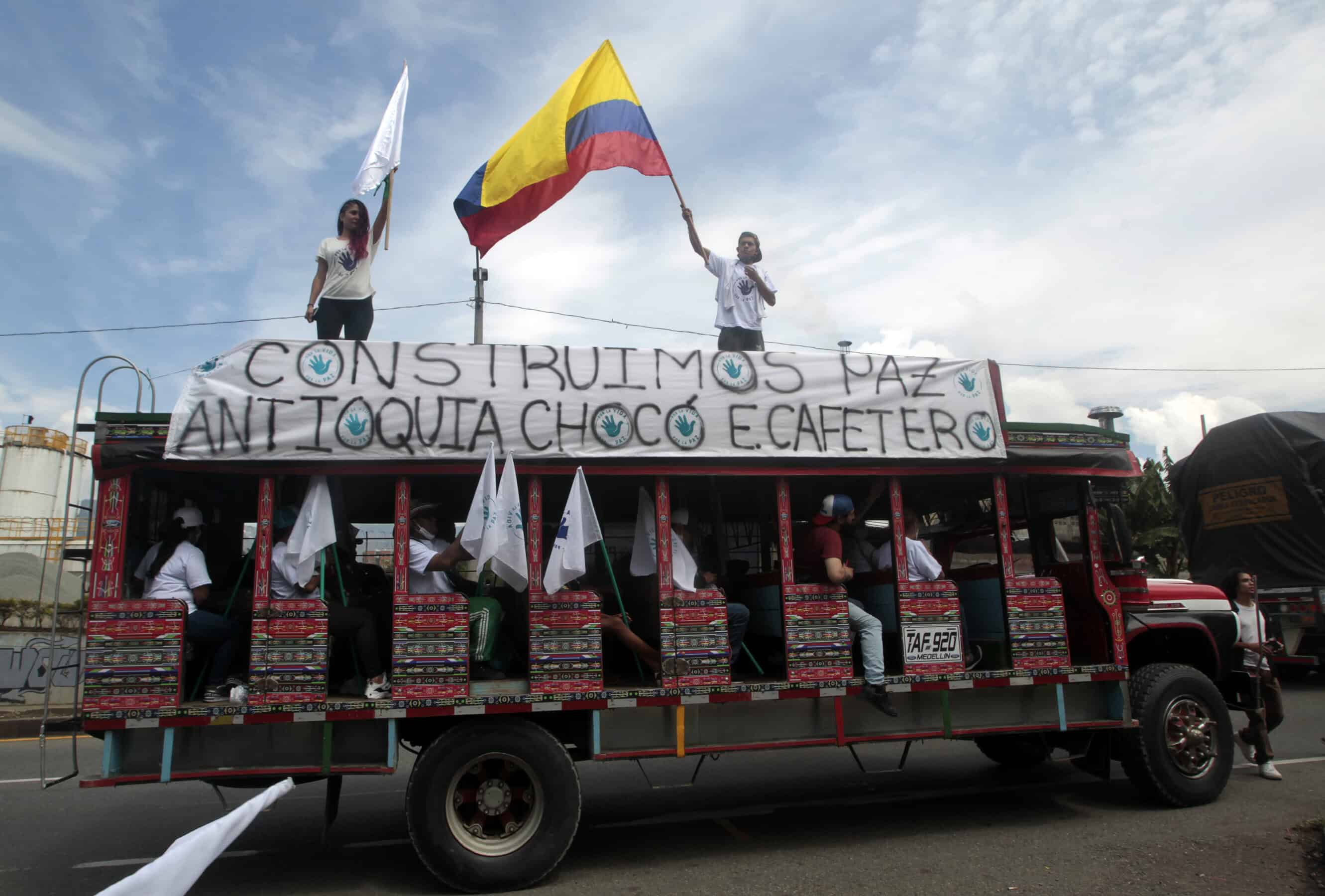
To achieve the inclusion of this chapter, Afro-Colombian and Indigenous groups and authorities unified and sustained a high-level transnational advocacy effort, which was complemented by mobilizations in Colombia. For example, Afro-Colombians organized a march in 2013, with the slogan “Otra Vez Sin Nosotros,” or “Again Without Us,” during the visit of a U.S. congressional delegation to drive home the point that negotiations over matters affecting their lives and territories were taking place (again) without their participation. The ethnic leaders continued to pressure their integration until August 24, 2016, the day the final agreement was signed.
The Ethnic Chapter’s provisions are binding across all six components of the Peace Accord: comprehensive rural reform, political participation, end of the conflict, solution to the illicit drugs problem, victims of the conflict, and implementation, verification, and public endorsement. According to the Kroc Institute, as of November 2025, only 14% of the Ethnic Chapter’s provisions had been fully implemented. By contrast, the Colombian government reports progress on 49.2% of these commitments as of August 31, 2026. The two monitoring systems measure implementation differently, but the gap also reveals a deep divide between Colombian institutions and what ethnic peoples expected to see realized in their territories.
Advances Towards Justice
One area where we saw advances was in the transitional justice system, which included ethnic representation for the first time in Colombian history. The Truth Commission had Indigenous and Afro-Colombian Commissioners who conducted their own prior consultations with territories, despite the constraints caused by COVID, to guarantee that the Ethnic Chapter of the Final Truth Report reflected what ethnic minority communities wanted to highlight. The chapter documents how Afrodescendants and Indigenous peoples were disproportionately affected by violence and the internal armed conflict. It not only narrates the violence, conflict, and abuses faced by these communities but also the bravery of many who tried to stop this violence and the resistance of ethnic communities. This is important because it strengthened ethnic communities, often marginalized and neglected, that are oniphery of power, as political actors and rights holders.
The Special Jurisdiction for Peace (JEP) also has Afro-Colombian and Indigenous female magistrates, a major milestone for inclusion in Colombia’s judicial system. The JEP opened macro case 09, which is focused on crimes committed against ethnic peoples and their territories. This case includes an estimated 375,967 ethnic minority victims from the Sierra Nevada de Santa Marta, Choco, the Pacific, Amazon, and Orinoco regions. Restorative sanctions were issued on behalf of Wiwa, Kankuamo, and Afro-Colombian communities.
The Ethnic Chapter’s recognition of the historical injustices of colonialism and slavery, and their continuing consequences for Afro-Colombian and Indigenous peoples, provides a critical foundation for communities’ demands for historical reparations. According to the Afro-Colombian Peace Council (CONPA), collective reparations for ethnic victims remain delayed. Of the 165 approved collective reparation plans for ethnic communities, only 4, or 2.4%, were fully completed by December 2024. Delays stem from insecurity, failures of institutional coordination, insufficient funding, and linguistic barriers. Insufficient resources were allocated to implement the JEP’s restorative sanctions.
Under-Implemented Areas
CONPA reports particularly severe disparities among ethnic groups when it comes to rural reform, in particular land access for Afro-Colombian communities. It found that roughly 80% of land awarded through the ethnic allocation mechanism went to establishing or expanding Indigenous reserves, while only 7.5% benefited Black communities through collective land titling. Just 2% of land formalized under the mechanism went to Afro-Colombians.
The High-Level Special Body for Ethnic Peoples (IEANPE) and Special Consultation Mechanisms (MEC) were established with a model that helps guarantee integration of the Ethnic Chapter in all phases of implementation. Both have helped guarantee ethnic perspectives in rural development planning. However, they are severely limited by insufficient funding, poor institutional coordination, and few opportunities for ethnic groups to influence decisions. Ethnic women continue to face huge barriers when it comes to exerting political leadership.
Security and the Aftermath of the Earthquake
Over the past decade, the greatest obstacle to the full implementation of the Ethnic Chapter has been the expansion of the illegal armed groups and worsening security in Indigenous and Afro-Colombian territories and urban communities. This is fueled by seven active internal armed conflicts, entrenched political polarization, widespread impunity, and lucrative illicit economies. Despite limited progress under the Petro government’s Total Peace policy, including a 2025 agreement with a faction of the ELN in Nariño, illegal armed groups expanded their numbers, territorial control, and influence. Their combined membership nearly doubled from 15,120 in 2022 to 28,282 by July 2026. The Gulf Clan expanded its territorial presence by 152%, FARC dissident groups by 109%, Segunda Marquetalia by 108%, and the ELN by 22%. This expansion has been accompanied by escalating kidnappings, extortion, forced recruitment of minors, and violence against civilians.
The International Committee of the Red Cross (ICRC) warned in 2026 that Colombia is experiencing its worst humanitarian crisis in a decade. In 2025, some 96,000 people were internally displaced, and another 155,000 confined (freedom of movement constricted) due to armed groups, including in Cauca, Chocó, Nariño, and Catatumbo. Indigenous communities are disproportionately affected by this; 782 victims of internal displacement were Indigenous, translating into more than 30% of Colombia’s Indigenous population.
Likewise, ethnic leaders consulted by WOLA noted that the August 10, 2026, earthquake affected, among many other areas, the department of Chocó and Buenaventura in the department of Valle del Cauca, two of Colombia’s most important centers of Afro-Colombian population that suffered greatly during the internal armed conflict. According to official figures, an estimated 11,000 homes were damaged in Buenaventura.
Despite announcements about the creation of the Milagro Fund and donations collected by a private foundation headed by the First Lady, only one house has been delivered in Buenaventura to a female head of household. In Quibdó, authorities presented a model home with just two bedrooms, but it was rejected because it was not culturally appropriate or suited to the community’s needs.
Educational infrastructure was also damaged in the affected territories. In Buenaventura, approximately 3,000 students were affected, including 1,500 receiving virtual instruction without guaranteed internet access or adequate equipment. This issue was expected to be addressed through the National Plan for Black Communities, mandated by Article 57 of Law 70 of 1993. However, the commission responsible for developing the plan has not yet been established.
A Government That Does Not Value Inclusive Peace or Ethnic Autonomy
The August 2026 change in government in Colombia is posing some serious risks for advancing the Ethnic Chapter, peace in general, and ethnic minorities’ rights and autonomy. The De la Espriella administration plans to dismantle and defund key peace institutions and efforts. The UN Security Council’s removal of monitoring of the Ethnic Chapter, JEP restorative sanctions, and comprehensive rural reform, at the Colombian government’s request, is also a step backward.
The Ethnic Chapter formally recognizes the Indigenous Guard and Cimmarona Guard as essential autonomous self-protection mechanisms. It mandates that the Colombian state strengthen them by guaranteeing institutional, logistical, and budgetary support. Furthermore, all State protection mechanisms should integrate a differentiated ethnic approach. It is therefore troubling that the De la Espriella government is trying to restrict them.
On September 30, the Regional Indigenous Council of Cauca (CRIC) rejected a draft Interior Ministry decree that would create a national information system to collect and profile information on Indigenous Guards. CRIC stressed that the Guards derive their authority from Indigenous communities, not the State, and warned that collecting information on their members could expose them to state surveillance, stigmatization, criminalization, or prosecution for their work defending Indigenous territories. It also rejected conditioning state protection on the disclosure of such information. CRIC urged Indigenous peoples nationwide to unite against measures that threaten their rights and defend the autonomy and self-governance of the Indigenous Guard.
Under the De la Espriella government, the right to prior consultation, a principle that guides the Ethnic Chapter, also faces severe structural threats from government directives and reforms that prioritize economic acceleration over authentic community consent. These measures impose rigid deadlines, eliminate essential proportionality tests, and allow environmental licensing to run parallel to consultations. These changes transform a fundamental right into a mere formality. Furthermore, systemic narratives advanced by economic and political elites framing ethnic communities as economic obstacles and extortionists are highly problematic. These increasingly criminalize ethnic minorities’ defense of their territories and undermine their physical safety and legal protections.
Plans to Restart Aerial Fumigations
The Abelardo De la Espriella administration plans to resume aerial fumigation with a different herbicide, glufosinate ammonium, because the Colombian Constitutional Court has banned glyphosate. It is advancing a pilot program in the Amazon using manned aircraft, with plans to add drones, despite fervent opposition from local communities. On September 12, a Colombian court suspended the pilot over environmental and health risks to local communities and ordered the government to provide scientific evidence on the risks of spraying glufosinate ammonium before proceeding. Ethnic communities are deeply concerned about the combined effects of renewed fumigation and expanding illegal mining on the sustainability of their territories.
Adverse Effects of Halt in U.S. Funding for Ethnic Groups
From 2017 until 2025, USAID funded two successive flagship programs geared toward Afro-Colombian and Indigenous communities totaling US$ 110 million. These were the Inclusion for Peace Activity (IPA) and Afro-Colombian Empowerment Activity (IPACE). While both programs left room for improvement, something that WOLA raised at the annual USAID consultation processes with U.S. civil society and ethnic partners did the same in the Colombian civil society consultations. These helped to consolidate the Ethnic Chapter on the ground by closing racial gaps and advancing localized human rights and development. Their abrupt closure, along with all the programs USAID financed in Colombia, was a major blow to peace efforts, in particular civil society organizations leading its implementation on the ground.
From one day to the next and without a transition, Colombian NGOS, ethnic organizations and regional implementers lost their primary funding, leading to suspension of operations, job losses, and forcing the closure of organizations. This has caused serious setbacks that undermine the advancement of the Ethnic Chapter and overall peace. For example, in the case of Chocó, armed groups have exploited the vacuum left after the closure of youth-at-risk programs, gang rehabilitation efforts, and cultural programs meant to stop inclusion of youth into criminal groups. The shutdown of financing for minority-owned businesses, leadership training, and rights protection efforts has also had repercussions for ethnic leaders’ safety. The political protection that came with being associated with a high-profile donor close to the Colombian government is no longer there.
What Can the International Community Do?
For international policymakers, including the U.S. Congress, the challenges facing the implementation of the Ethnic Chapter, ten years after its enactment, underscore the necessity to redouble efforts to advance peace and ethnic rights in Colombia.
In the U.S., the 120th Congress, which enters into session on January 3, 2027, should again impose human rights conditions on security assistance to Colombia and appropriate funds that address the root causes of violence and illegal armed economies and that strengthen peace, human rights, and ethnic groups. With the dismantling of USAID, the U.S. Congress will need to reconstruct a vehicle to implement an economic package that strengthens peace, human rights, and ethnic groups. With the dismantling of USAID, the U.S. Congress will need to rebuild a vehicle to implement an economic package that strengthens peace, human rights, and ethnic groups. This could be done through the State Department, using carefully crafted directive language; routing aid through multilateral agencies like the United Nations; and funding through the National Endowment for Democracy and its Core Institutes and the Inter-American Foundation.
Congress should also urge the Trump administration to report on the allocation of the 2026 funding that the U.S. Congress passed in a bipartisan manner, which includes, through the National Security Investment Programs account, $15 million to support human rights in Colombia in addition to $25 million to support Afro-Colombian and Indigenous communities. Congress should also consider holding hearings on the efficiency and human consequences of Abelardo De la Espriella’s mano dura security and anti-narcotics strategies that are supported by U.S. funding. It is also encouraged to push for an audit of the unaccounted-for funds that the first lady’s Colombia Luz y Sonrisas foundation received internationally to assist earthquake victims and the Colombian government’s response to the disaster. The protection of ethnic leaders and human rights defenders and conflict-affected communities should be a priority in its engagement with the Colombian government.
Other foreign governments, multilaterals, and civil society organizations should engage in sustained diplomatic engagement, international verification, financial support, and accountability to prevent further erosion of the Ethnic Chapter and Colombia’s broader peace commitments.