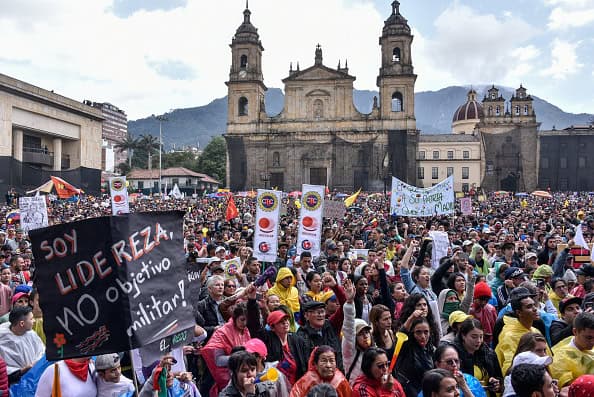
Ten years after Colombia signed its historic Peace Agreement with the Revolutionary Armed Forces of Colombia (FARC), the country faces the challenge of ensuring that transitional justice goes beyond holding perpetrators accountable to dismantle the gender discrimination and structural inequalities that facilitated the atrocities. This responsibility is particularly urgent for women and LGBTIQ+ people. These populations have suffered disproportionately from decades of armed conflict, and their experiences of sexual violence, internal displacement, persecution, and exclusion have long been marginalized or ignored by the justice system.
Created in 2018, the Special Jurisdiction for Peace (JEP) offers a unique opportunity to remedy these injustices and advance gender-transformative justice. It has made significant progress in recognizing gender-based violence and strengthened survivors’ rights. Yet persistent impunity, inadequate reparations, and mounting institutional challenges threaten its transformative promise. Moreover, the De la Espriella government’s decision to defund the JEP could seriously undermine this work in the future.
A groundbreaking peace agreement confronts entrenched gender inequality
Colombia’s 2016 Peace Agreement gained international recognition for incorporating 130 gender-related measures aimed at addressing the imbalanced impact of the armed conflict on women and LGBTQ+ people, protecting their rights and confronting structural discrimination. Established in 2018 as the judicial component of the Comprehensive System for Peace, the JEP introduced an innovative transitional and restorative model. It is designed to establish accountability for atrocities, guarantee victims’ rights to truth and justice, repair harm, and promote reconciliation.
Its mandate requires incorporating gender and differentiated approaches that recognize the distinct experiences of women, children, Indigenous and Afro-Colombian communities, and LGBTIQ+ people. Likewise, it guarantees that sexual violence is not subject to amnesty. These commitments represent a significant departure from traditional judicial approaches that have historically overlooked gender-based violence and marginalized survivors, especially women, rural and ethnic ones.
The importance of the mandate becomes evident when considering the magnitude of gender-based violence and longstanding impunity in Colombia. Women account for approximately half of the country’s more than 10 million registered conflict victims. Ninety percent of these victims have experienced internal displacement, while 43,602 were registered as victims of sexual violence. Another 26,509 LGBTQ+ people have been recognized as victims of displacement, enforced disappearance, sexual violence, and/or persecution motivated by prejudice.
Despite important legal and institutional reforms, survivors continue to confront deeply entrenched impunity, discrimination, gender stereotypes, limited resources, and significant barriers to accessing justice and reparations. According to Colombia’s Ombudsperson’s Office, 90 percent of cases involving violence against women, both within and outside the armed conflict, have not resulted in convictions. Moreover, only 862,201 women have received administrative compensation as a form of reparation. Against this backdrop, the JEP represented a historic opportunity not only to address conflict-related atrocities but also to overcome systemic gender discrimination and impunity that have long denied women and LGBTIQ+ survivors meaningful justice.
Breaking the silence surrounding gender-based violence
One of the JEP’s most significant achievements has been recognizing women and LGBTIQ+ people not merely as victims but as rights holders. These people are peacebuilders whose experiences are essential to establishing the truth. Its investigations have increasingly documented sexual violence, reproductive violence, and persecution based on sexual orientation and gender identity as patterns of organized criminality.
In Case 07, concerning the recruitment and use of children by the FARC, the JEP identified patterns of sexual and reproductive violence against forcibly recruited girls and adolescents and brought charges against former FARC leaders. In Case 03, involving extrajudicial executions, it investigated crimes motivated by victims’ sexual orientation. Its territorial investigations in Cauca, Valle del Cauca, and Nariño have also documented sexual violence, gender-based persecution, and the intersecting impacts of gender, ethnicity, and age on the victims.
The JEP’s most consequential achievement may be Case 11, opened in 2023 after sustained advocacy by women’s and LGBTQ+ organizations. This dedicated investigation covers gender-based violence, sexual violence, reproductive violence, and other prejudice crimes motivated by sexual orientation, gender expression, and/or gender identity. It has accredited 1,364 victims, 89 percent of them women, and has summoned and sentenced former FARC leaders to testify about gender-based violence within their ranks.
These investigations marked a significant departure from judicial approaches that have historically minimized gender-based violence or treated it as incidental to other crimes rather than recognizing it as a distinct pattern of armed conflict. Nevertheless, recognition alone is insufficient. Accountability must be established, especially among senior commanders, and meaningful sanctions and gender-transformative reparations must be put in place so that justice is delivered to the survivors.
Putting the survivors at the center of transitional justice
The JEP has expanded opportunities for women and LGBTIQ+ survivors to participate directly in judicial proceedings through preparedness and pedagogycal processes, accreditation, psychosocial and legal assistance, confidentiality protections, and dialogue mechanisms. These measures have enabled victims to participate in restorative processes, submit judicial evidence and challenge perpetrators’ accounts. They can also articulate their expectations for truth, justice, and reparations.
In Nariño, the JEP facilitated dialogue with women and LGBTIQ+ survivors. In Cauca and Valle del Cauca, it has created spaces for Afro-Colombian and Indigenous women to document the distinct harms experienced by their communities. These initiatives challenge traditional judicial practices that have historically silenced women and LGBTIQ+ survivors, recognizing their essential role in uncovering how the armed groups used sexual violence, gender discrimination, and persecution to exercise territorial and social control.
Despite these advances, significant barriers continue to undermine meaningful participation. This includes limited access to information, delays in accreditation, inadequate resources, and persistent security threats. For women and LGBTQ+ survivors living in territories where armed groups remain active, participating in judicial proceedings can expose them to intimidation and retaliation.
In Cauca, for example, survivors have expressed fear of seeking accreditation and sharing their experiences. Without stronger protection measures, sustained institutional support, and adequate resources, the JEP risks excluding precisely those survivors whose participation is essential to delivering meaningful, victim-centered justice.
Reparations must transform, not merely compensate
The JEP’s restorative justice model gives it an important opportunity to address the harms of gender-based violence and advance transformative reparations. Since 2024, its Restorative System has developed projects on searching for disappeared persons, humanitarian demining, commemoration, and community infrastructure. In 2025 alone, the JEP developed 151 restorative methodologies and organized 849 restorative encounters. Some restorative projects have also begun to include gender measures intended to benefit women, LGBTIQ+ victims, and affected communities.
However, several restorative measures have fallen short of gender expectations. In Case 01, concerning hostage-taking and kidnapping by the FARC, the JEP recognized sexual violence as a war crime and crime against humanity. However, according to the Colombian Commission of Jurists (CCJ), the judgment failed to adequately recognize sexual violence as an autonomous pattern of criminality, establish broader command responsibility, and incorporate gender-specific restorative measures.
Similar concerns have emerged in Case 03, involving extrajudicial executions, where victims’ perspectives were not adequately reflected in proposed reparations. These shortcomings have also been underscored by women and LGBTQ+ organizations, who have emphasized that reparations must go beyond symbolic recognition to address the economic, social, psychological, and collective consequences of gender-based violence. They should also confront structural discrimination and harmful social norms that enable these crimes.
Institutional progress faces persistent obstacles
The JEP has made significant progress in institutionalizing gender equality. In 2021, it adopted a policy to prevent discrimination based on sex, gender, gender identity, gender expression, and sexual orientation. It has put in place protocols for engaging survivors of sexual violence, incorporating intersectional approaches, and preventing workplace sexual harassment.
Women represent 53 percent of its magistrates. Specialized structures, including its Gender Commission and Office for Differential Approaches, have strengthened its capacity to integrate gender perspectives into judicial proceedings. In 2024, for example, it conducted 12 internal training sessions attended by 202 public officials. According to institutional assessments, tolerance for gender-based violence within the JEP declined by 40 percent between 2021 and 2023.
Even with these achievements, translating gender commitments into meaningful judicial outcomes remains a major challenge. In some cases, gender-based violence has not been fully recognized as a systematic and autonomous pattern of criminality. Some perpetrators’ refusal to acknowledge responsibility in this regard risks forcing survivors into adversarial proceedings that may expose them to further trauma and reduce access to justice.
Judicial delays, limited access to information, and the inconsistent incorporation of gender perspectives into judgements, sanctions and reparation are other factors. This can undermine survivors’ rights to justice and reparations. These obstacles are compounded by the JEP’s limited timeframe and growing financial constraints. Recent funding reductions by the Colombian government threaten its capacity to investigate complex crimes, ensure meaningful victim participation, and implement restorative sanctions. The funding cuts could seriously jeopardize the progress made towards gender-transformative justice.
A historic opportunity that Colombia cannot afford to lose
Ten years after Colombia’s Peace Agreement, the JEP stands at a critical crossroads. It has made significant progress in recognizing gender-based violence, strengthening women and LGBTIQ+ survivors’ participation, advancing accountability, and challenging gendered discriminatory judicial practices. Its legacy will ultimately depend on whether these achievements translate into gender justice, and lasting structural change.
To fulfill its transformative mandate, the JEP must consistently investigate, sanction, and repair gender-based violence as a systemic and autonomous pattern of criminality. It must establish accountability among senior commanders and guarantee safe and meaningful participation for women and LGBTQ+ survivors. Its reparations should address both gender-specific crimes and the structural inequalities that enable them, with a differentiated ethnic and intersectional approach.
Safeguarding its independence, institutional capacity, and adequate funding is essential. The JEP cannot effectively carry out this important work if its budget is cut and it does not receive political support from the highest levels of the Colombian State, the United Nations Security Council, the international community, and its civil society.
If Colombia fails to seize this opportunity to bring transformation, gender equality, reconciliation, and healing to women and LGBTIQ+, it risks perpetuating the very injustices the Peace Agreement set out to overcome. This opportunity remains open. Colombia’s ambitious model of gender-transformative transitional justice can become a reality if there is the political will required for it to happen. Without this, the JEP will be another sophisticated experiment with tremendous potential for gender-transformative change that will fail to live up to expectations and merely remain in discussions in academic circles.