
On October 25, President Luiz Inácio Lula da Silva secured a historic fourth term. He defeated Senator Flávio Bolsonaro in a closely contested runoff that pre-election polls had shown as a dead heat. Within 48 hours, Flávio Bolsonaro refused to concede, defied a Supreme Court order to surrender his passports, and fled Brazil to the United States via Argentina. The Trump administration subsequently indicated it would grant visas to the senator and his family. Upon arriving in the U.S., he posted a statement stating he was the true elected President of Brazil. This was later edited to say he was the real leader of Brazil. Lula begins his new term on January 5, 2027.
Lula Secures Win by Over 4 Million Votes
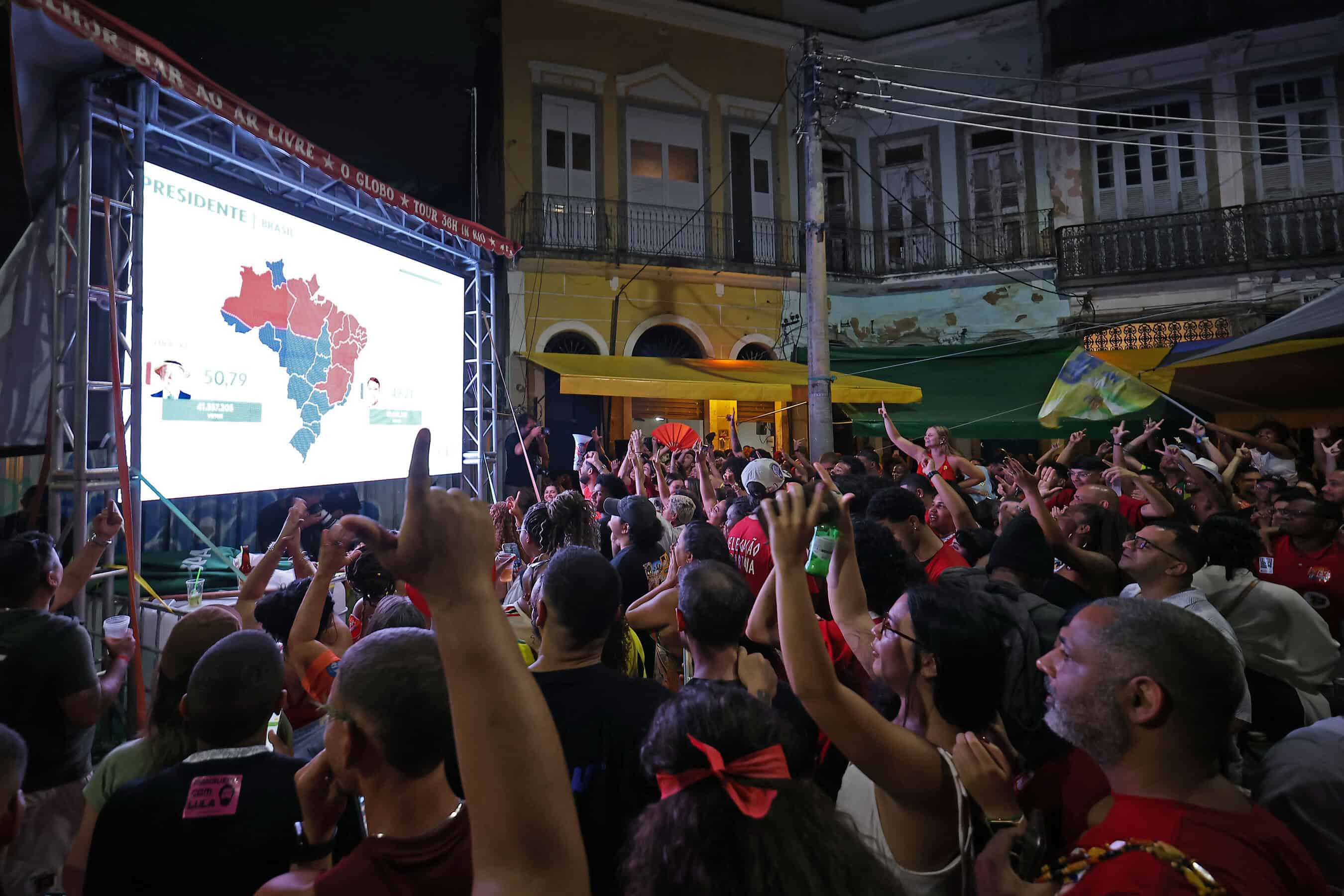
Lula secured 51.79 percent of valid votes, defeating Flávio Bolsonaro by more than 4.4. million votes and reversing his second-place finish in the first round. Voter abstention fell from 21.08 percent to 19.21 percent. This is the lowest level of abstention in a presidential runoff since 2006. Roughly 3 million additional voters cast ballots in the second round.
Lula gained approximately 10.4 million votes between rounds, improved his performance in every state, and swept all nine Northeastern states. He also made significant gains in the Southeast, particularly São Paulo, Minas Gerais, and Rio de Janeiro. In Minas Gerais, a pivotal state that has backed every presidential winner since 1989, Lula overturned Flávio Bolsonaro’s first-round lead of 588,000 votes.
In his victory speech, Lula described the results as “a defeat for denialism and lies.” The presidents of the Chamber of Deputies and the Senate, Hugo Motta and Davi Alcolumbre, congratulated him and called for national reconciliation.
An Unprecedented Comeback Fueled by Digital and Grassroots Mobilization
Lula’s victory was historic on two counts. He became the first presidential candidate in Brazil since 1989 to overcome a first-round defeat and win the runoff. Also, at age 81, he is the first Brazilian president democratically elected to four nonconsecutive terms.
His comeback was driven in part by renewed street mobilization, particularly among younger voters, and an aggressive digital campaign led by Congressman André Janones. The campaign represented a significant shift in Brazil’s political landscape, where supporters of former President Jair Bolsonaro had long enjoyed an advantage in digital organizing.
Janones created a WhatsApp channel called “Lula’s Army,” which grew to approximately 10.8 million followers. The channel coordinated online messaging, encouraged supporters to share campaign videos and hashtags, and mobilized voters. The effort connected digital organizing with grassroots mobilization. It energized supporters, reached undecided voters, and reduced abstention.
While the digital campaign’s full electoral impact remains difficult to quantify, many observers in Latin America are pointing to it as a model of effective political organizing. Particularly notable was its use of Meta-owned WhatsApp to counter alleged disadvantages Lula faced from Meta’s algorithms on other platforms.
Lula also benefited from government measures introduced between the two rounds. These include expanded social benefits, debt relief, fuel subsidies, and legislation reducing the workweek from 44 to 40 hours. These initiatives strengthened his appeal among working-class and lower-income voters, although critics question their fiscal implications and electoral timing.
Meanwhile, Flávio Bolsonaro struggled to expand his support. Throughout the runoff, polls consistently showed higher voter rejection of Flávio than Lula, with the gap reaching five points on October 21. Between rounds, he lost votes in six states and surrendered his lead in Minas Gerais.
His performance in the final televised debate on October 23 also drew criticism after he mocked Lula’s missing finger, which the president lost in a factory accident at age 17. Although Bolsonaro apologized on air, undecided voters participating in a qualitative study reportedly reacted negatively.
Lula’s victory also carried broader regional significance. At a time when several Latin American countries have elected right-wing-leaning governments, his reelection represented a notable exception to that trend. In his victory speech, Lula declared that Brazil would not accept being anyone’s “backyard.” A statement some regional observers interpreted as an assertion of sovereignty in response to the Trump administration’s policies toward Latin America.
Regional and International Leaders Recognize Lula’s Victory
Despite Brazil’s polarized political environment, international recognition of Lula’s victory came quickly. Right-leaning Latin American leaders, including Chile’s José Antonio Kast, Ecuador’s Daniel Noboa, Bolivia’s Rodrigo Paz, Paraguay’s Santiago Peña, Peru’s Keiko Fujimori, Panama’s José Raúl Mulino, and Colombia’s Abelardo de la Espriella, congratulated the president. Notably, El Salvador’s Nayib Bukele, a close political ally of the Bolsonaro family whose security policies Flávio had praised during his campaign, also congratulated Lula in a letter he sent on election day. Leaders across the political spectrum in Europe, Canada, India, China, and Russia also recognized the result.
The two notable exceptions were Argentina’s Javier Milei, who has not congratulated Lula, and U.S. President Donald Trump, who claimed without evidence that the election looked like another rigged election.” In this same statement, he insisted that he had not taken sides. The widespread international recognition, including leaders politically aligned with the Bolsonaro family, contrasted sharply with Flávio Bolsonaro’s refusal to concede.
Flávio Refuses to Concede as International Observers Validate the Vote
On election night, Flávio Bolsonaro threatened to challenge the results and asked the authorities to annul the election. He cited a two-hour extension of voting ordered by Supreme Court Justice Cristiano Zanin after transportation disruptions and flooding prevented some voters from reaching polling stations. Both campaigns had requested the extension, and only 34,3933 votes were cast for Lula after the regular closing time, representing less than one percent of his margin of victory.
International observers affirmed the integrity of the electoral process. The Organization of American States (OAS), which deployed an election observation mission, reported it had no doubts regarding the integrity of the official electoral data. The Carter Center similarly commended Brazil’s electoral authorities for conducting a transparent, well-organized election with results announced within hours. It also urged candidates and their supporters to respect the outcome. Even Flávio Bolsonaro’s own Liberal Party (PL) recognized Lula’s victory on Monday.
Flávio Bolsonaro Leaves Brazil Despite a Supreme Court Travel Ban
The post-election controversy escalated when Supreme Court Justice Alexandre de Moraes ordered Flávio Bolsonaro to surrender his regular and diplomatic passports within 24 hours and barred him from leaving the country. The decision came amid an investigation into alleged money laundering and currency evasion. This involves lawyer Willer Tomaz and approximately R$130 million (approx. US $24 million) in suspicious transactions. It followed remarks by Flávio’s brother Eduardo suggesting that the senator should leave Brazil if he lost the election.
Despite pledging on Monday to remain in Brazil and lead the opposition, Flávio reportedly left the country the following day with his wife and two daughters. News reports indicate that the family crossed into Argentina without passing through a regular immigration checkpoint. Argentine authorities said they had no record of his entry, while Brazilian Federal Police reported that he had not departed through regular immigration channels.
Lawmakers from Lula’s Workers Party subsequently requested Flávio’s preventative arrest and an Interpol red notice. After Milei’s involvement became apparent, Argentine opposition deputies filed a formal information request and a criminal complaint demanding transparency from President Javier Milei’s government over its alleged role in helping Bolsonaro.
The Trump Administration Welcomes Bolsonaro
The Trump administration’s response added a new dimension to the controversy. On Tuesday, a senior State Department official confirmed that the Trump administration would grant visas to Flávio Bolsonaro and his family, allowing them to enter the United States.
Allies of the senator claimed that U.S. officials had advance knowledge of his departure and helped facilitate it, although Washington has not confirmed those allegations.
That same evening, speaking at a rally in Corpus Christi, Texas, Trump again questioned Brazil’s election results without providing evidence. He maintained that he had not taken sides but said he did not like what he had seen. Trump had not publicly commented on Flávio Bolsonaro’s reported presence in the United States. Lula condemned the senator’s departure as “shameful.”
The developments raise significant questions for U.S.-Brazil relations. The Trump administration had already imposed tariffs on Brazil and sanctions on members of its judiciary, contributing to tensions with the current Lula administration. Its reception of Flávio Bolsonaro in Miami despite a Brazilian judicial travel ban will further complicate bilateral relations.
If Flávio remains in the U.S., two sons of former President Jair Bolsonaro who face Brazilian judicial proceedings will be in the United States. Eduardo Bolsonaro is already the subject of a Brazilian arrest warrant. Jair Bolsonaro himself left Brazil after losing his re-election bid in 2022. He eventually returned and faced Brazil’s justice system.
Implications for U.S.-Brazil Relations
Brazil’s democratic institutions upheld the electoral process, producing a decisive result validated by international observers and accepted by the defeated candidate’s own party. The controversy surrounding Flávio Bolsonaro’s departure has shifted attention from the legitimacy of the election to the U.S.’s response and relationship with Brazil.
President Trump’s unsupported allegations of electoral fraud, combined with his administration’s willingness to grant visas to a Brazilian senator subject to a judicial travel ban, place Washington at odds with regional and European governments that have recognized Lula’s victory.
The situation also raises a broader question: Should the United States become a refuge for political figures seeking to evade judicial proceedings in their home countries?
For the U.S. Congress, several issues warrant scrutiny, including how the State Department reached its visa decision. Did Trump administration officials have advance knowledge of Flávio Bolsonaro’s departure? Was any U.S. assistance provided to facilitate his escape? As Lula prepares to begin his fourth term, these questions will become an important test of U.S.-Brazil relations.