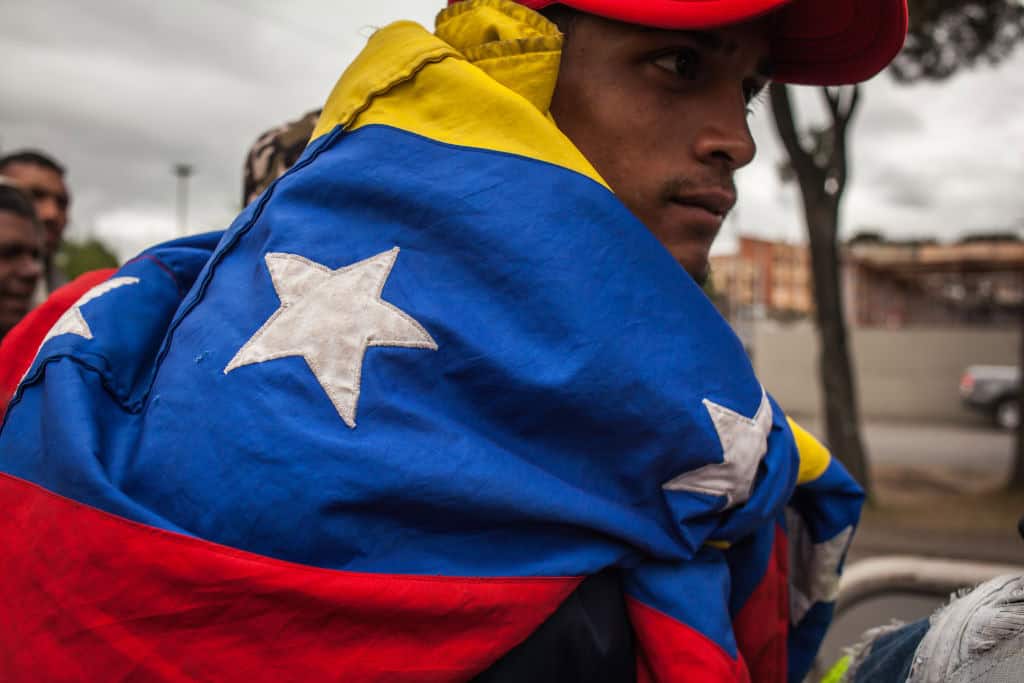



On August 23, Colombia’s President Abelardo de la Espriella ordered Migración Colombia (Colombia’s migration agency) and the National Police to launch nationwide operations to locate, identify, and deport migrants in irregular status, prioritizing foreign nationals allegedly linked to criminal activity and framing the crackdown under his nationalist “Colombia First” agenda. Colombia has migrants from different nationalities in the country who could be impacted by these policies and placed at risk of removal. Venezuelans by far make up the majority. This represents a deeply concerning reversal of Colombia’s internationally recognized approach to Venezuelan displacement and migration.
Scale of the Population at Risk
According to the latest data published by Migración Colombia, updated through June 2026, there were 2.8 million Venezuelans in Colombia. Of these, 527,525 were in irregular migratory status, while 320,369 were still in the process of obtaining temporary protected status (PPT) and had not yet been authorized. The ETPV (Estatuto Temporal de Protección para Migrantes Venezolanos) was a 10-year regularization program launched by the Colombian government in February 2021. It was specifically designed to provide legal status, social protection through the PPT, and economic integration to Venezuelans who met certain criteria and who applied in a specific timeframe. If De la Espriella’s policy is broadly applied, roughly 848,000 Venezuelans—along with other migrants with an in irregular status—could face deportation. Venezuelans have also continued arriving in Colombia, particularly following the persecution that followed Venezuela’s 2024 presidential elections.
Weakening Protection Pathways
Migration protections had already weakened under Gustavo Petro’s administration, which eliminated key institutions such as the Border Management Office and failed to establish broad regularization mechanisms for Venezuelans who entered Colombia after June 2023. The two mechanisms introduced during his presidency—the PEP Tutor (which provided a special legal permit to the caretaker or parent of children with PPT) and the Special Visitor Visa (a 2- year-valid visa that was made more flexible for Venezuelans) —had limited reach, burdensome requirements, and significant implementation delays. At the same time, longstanding obstacles to recognizing people in need of international protection persisted. These shortcomings were compounded by U.S. immigration and refugee policies during the Trump administration, like mass deportations and the termination of essential international cooperation supporting humanitarian assistance and migrant and refugee reintegration.
Unsafe Conditions in Venezuela
Conditions in Venezuela have worsened since the twin earthquakes on June 24, 2026; the humanitarian situation throughout the country has not experienced a significant improvement since January 2026, and there are no safe conditions for many Venezuelans to return. Venezuela has also not undergone a genuine and credible democratic transition after the U.S. illegally conducted a military operation that resulted in the capture of authoritarian leader Nicolás Maduro. Although there have been some openings, the laws used to persecute dissent and the repressive apparatus remain in place: hundreds of political prisoners are behind bars; members of the opposition are still banned from running for office; political parties remain under judicial intervention; and dozens of media outlets and websites are blocked. Venezuelans also continue to face a complex humanitarian emergency that has deepened since the earthquakes.
Human Rights Risks
By broadly linking irregular migration with criminality and prioritizing enforcement and deportation over protection and regularization, the government risks fueling xenophobia, stigmatization, family separation, and abuses against an already vulnerable population. Venezuela’s ongoing crisis also limits the country’s ability to safely and effectively receive returnees. This approach reflects a dangerous regional trend: tightening migration policies in ways that leave migrants and refugees unprotected and heighten their exposure to armed-group recruitment, organized crime, and labor and sexual exploitation.
Recommended Safeguards
Colombian authorities should immediately ensure that no one is subjected to arbitrary or collective expulsion. Every case must receive individualized due process, and refugees, asylum seekers, children, and others with protection needs must be afforded the safeguards required under Colombian and international law. Moreover, the Colombian government should adopt measures to expand safe legal pathways for migrants and refugees to obtain regular migration status and integrate into society, safeguarding their rights to work, healthcare, and education.