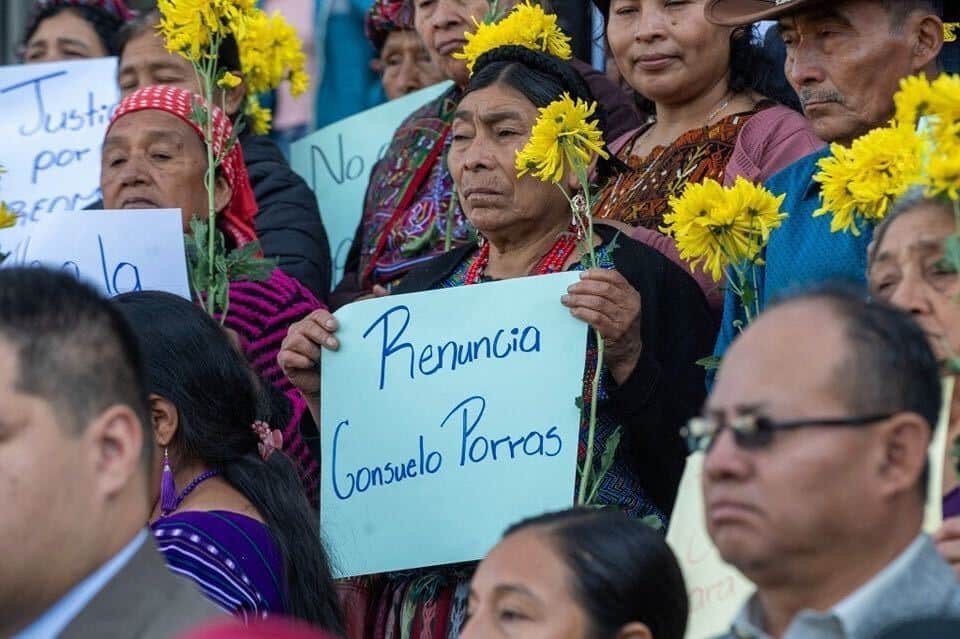
Guatemala once again faces a pivotal opportunity to restore democratic institutions and rebuild the rule of law by selecting a new Attorney General. The renewal of leadership at the Public Ministry comes after a deeply damaging period under Consuelo Porras, who has been sanctioned by the United States, the EU, and other countries for corruption and undermining democracy. During her tenure, high-impact investigations into corruption and organized crime were dismantled, impunity expanded, and justice operators–including judges, prosecutors, journalists, and Indigenous leaders–were systematically targeted and criminalized, with many forced into exile.
For Washington, this moment also presents a strategic opening. A credible and independent Attorney General could enable the United States to reestablish robust technical and financial cooperation with Guatemala on shared priorities such as combating organized crime, narcotrafficking, and corruption, issues that directly affect regional stability and U.S. national interests.
A Shortlist with High Stakes
Guatemala’s nominating commission has sent a shortlist of six candidates to President Bernardo Arévalo, who must make his selection before May 17, when Porras’s term expires. While the process has advanced, legal challenges filed before the Constitutional Court (CC) create uncertainty about whether this list will ultimately stand, as some candidates may still be included. For example, in the 2022 election, the CC forced the nominating board to include Consuelo Porras in the shortlist.
Among the six shortlisted candidates, some of them stand out for having professional trajectories free of credible allegations of corruption, favoritism, or links to impunity networks. Their records reflect technical competence, independence, and a demonstrated commitment to upholding the rule of law, qualities widely seen as essential for restoring public trust and strengthening institutional credibility within the justice system.
Other candidates present more mixed or concerning profiles. While some bring technical experience and long careers within judicial or prosecutorial institutions, they have faced varying degrees of criticism, including alleged political proximity, questionable past decisions, or indirect associations with actors who have historically undermined anti-corruption efforts. Even where accusations remain unproven, these concerns have raised legitimate doubts about their ability to lead with full independence and reinforce confidence in the institution.
At the same time, President Arévalo is likely to face significant external pressure in making his decision. Political elites, entrenched interest groups, and sectors resistant to accountability may seek to influence the outcome to preserve existing power dynamics or limit the scope of reform. Navigating these pressures will require a careful balance between political pragmatism and institutional integrity. To strengthen both the legitimacy of the appointment and public confidence, Arévalo should prioritize transparency in the selection process, clearly communicate the criteria guiding his decision, and choose a candidate whose record demonstrates not only technical capacity but also independence and a firm commitment to combating impunity.
Legal and Political Risks
The selection process is unfolding in a context of legal fragility. As was mentioned previously, Guatemala’s Constitutional Court, an institution with authority even above the Supreme Court, may still intervene due to pending legal challenges against the nominating commission’s decision by candidates excluded from the list but also by some groups criticized as being linked to Consuelo Porras, such as Fundación contra el Terrorismo. This creates uncertainty and opens the door to potential manipulation or delay tactics that could benefit entrenched interests seeking to preserve the status quo.
What’s at Stake
The election process will determine whether Guatemala moves toward accountability or remains captured by entrenched interests that depend on impunity. For decades, sectors of the private sector and political elite have invested in influence efforts abroad to protect themselves, including campaigns that helped weaken international support for the International Commission against Impunity in Guatemala (CICIG) when its investigations began to expose high-level corruption. Those same networks have not disappeared; they’ve evolved.
Today, the networks are being reactivated to shape narratives in Washington, spread disinformation, and defend figures like Attorney General Consuelo Porras, whose tenure has been marked by the rollback of anti-corruption efforts and the persecution of independent prosecutors and judges. The interests represented are not those of the broader population, but of powerful actors who have long benefited from a weak rule of law. They want to reduce international scrutiny and secure space to operate without accountability. A key tactic has been to frame Guatemala’s situation in ideological terms—right versus left—but this is a distortion: the country’s reality is better understood as a struggle between the rule of law and impunity.
President Bernardo Arévalo represents a direct threat to these networks because his administration has signaled a return to anti-corruption efforts and institutional independence. As a result, lobbying and influence campaigns seek to undermine his credibility internationally and constrain his room to maneuver, with the aim of weakening reform efforts before they can take hold.
Accountability must also extend to those who have actively undermined the justice system
Individuals who, from positions of power, dismantled anti-corruption efforts, obstructed investigations, or participated in politically motivated prosecutions, including actors within the judiciary and the Public Ministry under Consuelo Porras, should face credible, impartial investigations in line with due process.
Allegations that have circulated publicly, including serious claims of irregular or illegal adoption networks linked to past conduct, underscore the urgency of restoring a prosecutorial authority capable of pursuing sensitive cases without interference. Accountability is not only about addressing past abuses; it is essential to deter future ones and to signal that no one is above the law. Those who benefited from systems of impunity must no longer be shielded from scrutiny.
A Call for U.S. Engagement
The United States’ government should seize this moment to support a credible and transparent selection process and encourage the appointment of an Attorney General committed to independence and accountability. This includes clear diplomatic messaging, continued use of targeted sanctions where appropriate, and readiness to reengage in technical cooperation with a reformed Public Ministry.
Guatemalans deserve a justice system that protects their rights, not one that criminalizes those who seek accountability. A new Attorney General must also create conditions for the safe return of exiled prosecutors and judges, end the misuse of criminal law against independent actors, and lay the groundwork for structural legal-institutional reforms that promote judicial independence and an efficient system.
The decision now rests with President Arévalo—but the international community, particularly the United States, has an important role to play in ensuring that this process marks a genuine turning point toward the rule of law, rather than another missed opportunity.