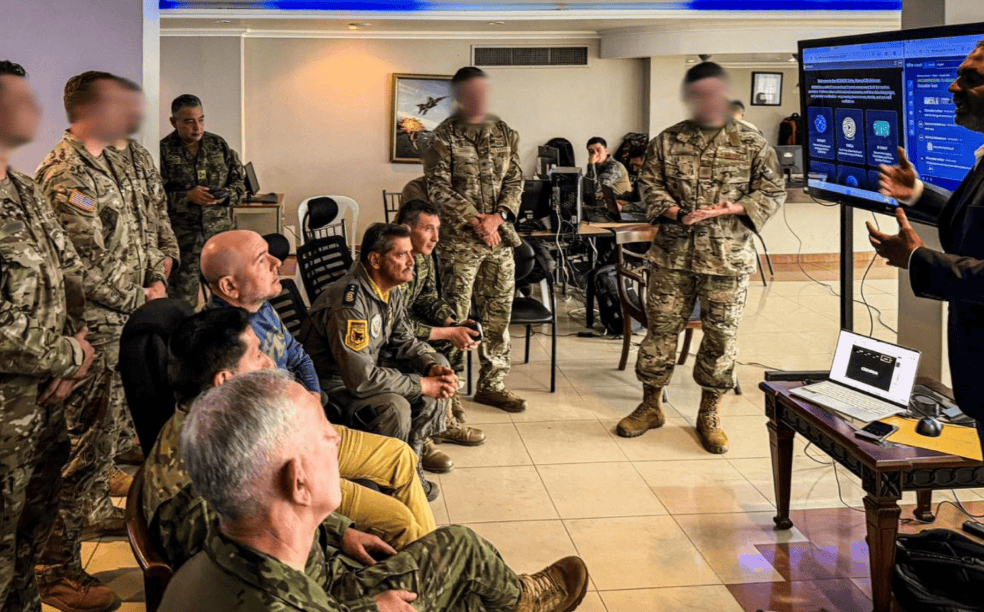


At a March 5 “Counter Cartel Coalition” conference, Secretary of Defense Pete Hegseth told assembled Latin American military leaders that, while he would prefer to fight organized crime, drugs, and migration alongside them, “America is prepared to take on these threats and go on the offense alone, if necessary.”
Just months prior, on January 3, the Trump administration used unilateral force, against any interpretation of international law, to extract Nicholas Maduro from Venezuela. That operation, three months later, has left the rest of his regime in power, with no clear path yet for when, or if, elections and a return to democracy might occur.
These words and actions illustrate that under the “Trump Corollary to the Monroe Doctrine”, as laid out in the National Security Strategy, administration officials want to go “kinetic” in Latin America and the Caribbean. We saw it in Caracas, and we’ve seen it with a campaign of lethal attacks on civilian vessels in the Caribbean and the eastern Pacific. Trump has repeatedly mentioned direct military action in Mexico, and there are now vague threats directed at Cuba every several days.
Changing face of intervention
U.S. intervention in Latin America is nothing new. But what we’re seeing now is different from the Cold War and the Drug War, when, with brief exceptions (Dominican Republic 1965, Grenada 1983, Panama 1989), U.S. personnel were not overtly firing their weapons. Most of the time, the U.S. government provided generous military, police, and intelligence aid, and host-nation governments fired the shots themselves.
Now, though, either U.S. troops are going in on their own, or they are carrying out operations against organized crime with host-nation personnel. And by “carrying out operations,” we mean not just drawing targets on the map: the administration wants to place U.S. personnel on or near the front lines, advising in real time and perhaps engaging in hostilities.
The New York Times reported that virtually every time Donald Trump talks to Mexican President Claudia Sheinbaum, he urges her to allow him to deploy troops to help fight Mexican organized crime. Administration officials propose that U.S. forces—Special Operations Forces or CIA personnel—join Mexican soldiers on raids of fentanyl labs. “American forces would participate in the raids with Mexican forces in the lead, commanding the mission and making key decisions… U.S. forces would be in support, providing intelligence and advice to frontline Mexican troops.” Sheinbaum keeps turning Trump down.
“Joint Targeting” and what that looks like on the ground
One nation has allowed the Trump administration to practice a version of what it has been urging on Mexico. In Ecuador, President Daniel Noboa has called for U.S. military personnel to aid his military’s fight against violent crime. The U.S. response intensified after the Trump administration added Ecuador’s two largest criminal organizations to the State Department’s Foreign Terrorist Organization list on September 4, 2025. (The administration has increased the number of Latin American groups on this list from four to nineteen, with two Brazilian groups likely to be added soon.)
Now, U.S. personnel are moving “toward ‘joint targeting’ efforts where U.S. technical expertise supports Ecuadorian Special Forces in precision raids,” according to U.S. Southern Command’s online magazine. “Over the past few months,” the New York Times noted, “U.S. Special Forces began helping Ecuadorian commandos train and plan for extensive raids that are expected to unfold across the country in the coming weeks,” with the participation of “dozens” of U.S. troops “who will advise and assist Ecuadorean soldiers, including in the sharing of intelligence, but will not participate directly in the missions.”
Those operations are underway, but the results so far are mixed at best. An early March raid near Ecuador’s border with Colombia gave more cause for concern than for celebration.
Ecuador’s early results
On March 3 and March 6, Ecuadorian soldiers participating in what they call “Operation Total Extermination” claimed that they destroyed an encampment of “Mono Tole,” a high-level leader of Comandos de la Frontera, a Colombian criminal organization whose leadership includes both former leftist guerrillas and former right-wing paramilitaries.
The “Comandos” are known for their brutality: WOLA staff visited this border region in late 2023 and heard alarming testimonies about their frequent attacks on social leaders and indigenous communities in Colombia’s border department of Putumayo, including an epidemic of gender-based violence. In an area where one mayor told us he had 14 police per shift for a municipality five times the size of Washington DC, the “Comandos” rarely face pressure from governments, which in the border zone are either absent or on their payroll.
“At the request of Ecuador, the Department of War executed targeted action to advance our shared objective of dismantling narco-terrorist networks” in Ecuador, tweeted Defense Department spokesperson Sean Parnell on March 6. The raid owed to a bilateral “exchange of strategic information and strengthening of capabilities,” Ecuador’s Defense Ministry stated. It is not clear how close U.S. personnel were to combat.
It is important to know more, because as the New York Times and USA Today later reported after visiting the area, Ecuador’s troops in fact appear to have attacked an active dairy farm, destroying residences and outbuildings.
Moreover, both papers’ accounts and a complaint from Ecuadorian human rights groups allege that Ecuador’s troops engaged in torture. They took four young men and demanded information about “hidden stashes” as they beat them with rifle butts, submerged their heads in a barrel of water, shocked them with stun guns, and choked them with their own shirts. Then they released them, sending them back into Colombia—a strange way to treat important criminal figures.
Ecuador’s Defense Ministry issued a statement denying that the target was a dairy farm. It stated that the four men’s apprehension “for investigative purposes” was “the result of intelligence information validated in cooperation with the United States.” Notably, the Ministry’s statement did not address the torture allegations.
It’s not clear that U.S. personnel were present during the torture, aware of it while it was happening, or whether they disclosed it to their superiors afterward, as they should. But this is a remarkably inauspicious beginning to the Trump administration’s new “joint targeting” model.
Legal and strategic costs
That entire model needs a fundamental rethinking before more people are hurt or killed, and U.S. credibility suffers further damage, for unclear strategic outcomes.
That rethinking starts with accountability. Unless Ecuador’s judicial system investigates the personnel facing those allegations—and, if necessary, tries them and holds them accountable—it is unlawful for the U.S. government to continue assisting their unit. The Leahy Law (Section 620M of the Foreign Assistance Act) states clearly that any foreign unit that commits gross human rights abuses—like torture—may not receive aid until “effective steps” occur to bring them to justice. There is no indication that an investigation is underway.
Rethinking means returning to legality. It is crucial to end operations in Latin America that violate U.S. law, international law, or both. The torture allegations are happening while the boat strikes in the Caribbean and eastern Pacific persist: every few days, Southern Command announces a new killing of civilians aboard a boat, claiming without evidence that the dead, who now total 164 people, were trafficking drugs. Perhaps some were, but being a low-level criminal aboard a boat carrying illegal drugs is not a crime that carries a death sentence, and anyone accused of a crime has a right to due process.
The U.S. military has assumed the stance of a policeman who, with no plausible claim to self-defense, shoots a fleeing criminal in the back. That is illegal whether it happens on U.S. soil or in international waters.
Over the past 40 years, much of Latin America has undergone quiet but heroic transitions away from brutal military dictatorships and civil wars, and toward democracy and the rule of law. In that context, the message that U.S. illegality sends throughout the region could hardly be more toxic.
Meanwhile, CBP’s seizures of cocaine at U.S. land and coastal borders show no change: they averaged 6,450 pounds per month in the six months since the strikes began, and 5,667 pounds per month in the six months prior. CBP is finding more cocaine, not less: the boat strikes haven’t moved the “cocaine supply” needle at all.
Rethinking means avoiding what didn’t work in the past. Other than cutting out the middleman and involving U.S. forces directly in human rights abuses, there is little new about the Trump administration’s approach to what it calls “narco-terrorism” in Latin America.
From Pablo Escobar to Chapo Guzmán to the leaders of the FARC, bombing violent and criminal groups, or killing and capturing their leaders, is a recipe that has been tried for nearly 50 years. So has eradicating the plants used to make some of the drugs, and setting fire to countless rural labs. Yet overdoses from drugs sourced from Latin America are near all-time highs, while criminal groups have diversified into many other illicit income streams, from precious-metals mining to migrant smuggling to extortion and much else.
Assessing what works
Organized crime is a threat to prosperity and human rights throughout our hemisphere. That is why it is so important to learn from past failures rather than double down on them. Learning begins with a clear-eyed assessment of why organized crime has been harder to fight than the region’s leftist insurgencies, most of which were either defeated or compelled to negotiate over the past 40 years.
Organized crime isn’t harder to fight because it hasn’t been attacked forcefully or “kinetically” enough: we’ve seen plenty of that. It’s because organized crime is better able to secure cooperation from corrupt elements within governments, security forces, justice systems, and licit businesses throughout the region. Corruption and collusion are real and endemic: the most powerful and effective criminals in Latin America do not need to hide out in what may or may not be dairy farms. They live in population centers and have robust networks of relationships.
Those networks can easily absorb bombs dropped on motorboats and farms. A more effective strategy starts with the credibility and effectiveness of judicial and law enforcement systems and civil societies.
Depriving organized crime of oxygen is the function of judges, prosecutors, investigators, witnesses, journalists, local officials, organizers, and human rights defenders who work—often at great risk—to break the ties of corrupt collusion that underlie the mediocre long-term results of past “kinetic” programs.
While that work moves forward, a host of proven short-term initiatives—hotspot policing, violence interruption, youth violence prevention programs, gang exit programs, public space improvements, body-worn cameras, and much more—can buy time for deeper reform, making citizens feel safer in the short term without violating rights or eroding democracy.
This is the polar opposite of White House official Stephen Miller’s troubling suggestion to Latin American military leaders gathered on March 5 that “you’re dealing with a lot of lawyers in your own country, I’m sure. You have my permission not to listen to them.” Lawyers, laws, law enforcement, and communities are the solution, not the obstacle. If the goal is long-lasting security and the rule of law, their courageous work is far more consequential than the armed forces’ “warrior ethos.”