

Imagine trying to protect a forest you can no longer enter or defend communities whose struggles you can no longer witness firsthand. For Fundación del Río, an environmental organization that spent nearly three decades working alongside Indigenous, Afro-descendant, and campesino communities in southeastern Nicaragua, this is the reality of exile.
In December 2018, Nicaragua’s government revoked the organization’s legal status and confiscated its properties, forcing its work beyond the country’s borders. Since then, Fundación del Río has continued to defend the territories and communities at the heart of its mission from afar, documenting environmental threats and advocating for the rights of people who remain in Nicaragua.
This year, the Washington Office on Latin America (WOLA) is honoring Fundación del Río with its 2026 Human Rights Award. This recognition underscores the importance of defending territorial rights, even as the consolidation of authoritarian rule makes protecting land and community rights an uphill battle.
Defending the land and the environment
Founded in 1990 as the first environmental organization in southeastern Nicaragua, Fundación del Río built its work around a conviction that conservation could not succeed without the participation of the people who lived closest to the land.
The organization worked with communities to protect forests and wildlife, strengthen education, and defend the rights of Indigenous, Afro-descendant, and rural residents. Its approach connected environmental protection with human rights, and the ability of communities to shape decisions affecting their territories.
In 2015, as a direct result of pressure from Fundación del Río and other national as well as international organizations, the San Miguelito wetlands received an international delegation from the Ramsar Convention – an international intergovernmental treaty dedicated to the conservation and sustainable use of wetlands to which Nicaragua is a party – to evaluate the potential damage of the proposed canal project through Lake Nicaragua. The group later concluded that the canal would cause critical damage to the environment and communities, and the project was eventually canceled.
Named a critically endangered species, the green macaw population has begun to increase as a direct result of binational conservation efforts with Fundacion del Rio at the helm.
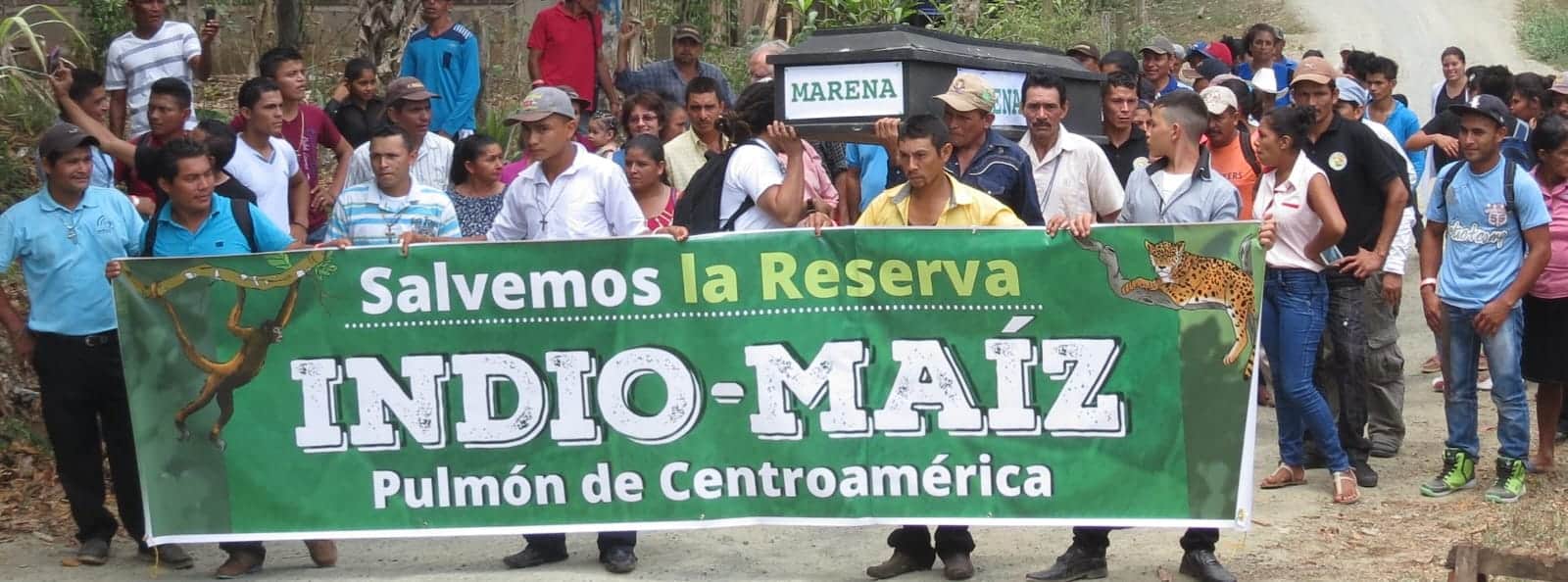
The organization has also played an important role in preserving the Indio Maiz Biological Reserve in Nicaragua, denouncing illegal logging, mining, and ranching within its borders. In July, they published a report on concessions granted to Chinese companies and the Indigenous communities they will impact.
Confronting an authoritarian regime
In Nicaragua, protecting the environment increasingly means confronting a regime unwilling to tolerate independent scrutiny.
Amaru Ruiz, spokesperson for Fundación del Río, explains that the organization found itself at odds with the regime through its work, making it a target. “We had already been receiving threats and being monitored because of our opposition to the interoceanic canal project imposed by the regime,” he says.
In April 2018, a fire swept through the Indio Maíz Biological reserve. Fundación del Río publicly criticized the government’s response, drawing attention to the environmental damage and the authorities’ handling of the emergency. More threats began pouring in, and as the country entered a period of political upheaval, those threats came to a head.
Massive protests swept across Nicaragua in 2018 and were met with severe repression from the regime. Over 350 people were killed during the social unrest. In the aftermath, authorities employed a campaign of intimidation against civil society groups, surveilling movements, imprisoning political opponents, activists, indigenous leaders, and others, and normalizing the use of enforced disappearance and torture. International experts reported that these actions could amount to crimes against humanity. Then, it began implementing a series of laws to snuff out the remaining organizations threatening its power.
That December, Nicaragua’s National Assembly revoked Fundación del Río’s legal status, along with many other organizations. To date, 5,635 organizations have lost their status. Fundación del Río’s properties were later confiscated.
“That was a time of collective mourning,” explains Ruiz, “these were some of the most difficult moments the organization had to face.”
They were then forced to adapt.
Working from exile
More than eight years after the government revoked its legal status, Fundación del Río continues its work from exile. Its staff have had to rebuild across borders, maintaining relationships with communities while adapting to a reality in which they can no longer work openly in Nicaragua.
The organization has continued documenting threats to natural resources and territorial rights. Its mining atlas tracks concessions and their implications for Indigenous and Afro-descendant territories, making information about resource extraction more accessible.
In July, they testified alongside other organizations in an IACHR hearing, denouncing the negative impacts of mining concessions on Indigenous and Afro-descendant communities.
Through Voces del Bosque (Voices of the Forest), Fundación del Río draws attention to Mayangna forest rangers and other Indigenous defenders facing criminalization and threats. Its advocacy has included efforts to secure recognition for political prisoners and promote international protective measures for people at risk.
It continues to document restrictions on freedom of association.
But this work does not come without cost. Even from exile, members of the organization must take serious measures to protect themselves. Though the organization works in a collective model, Ruiz is the sole spokesperson, as other members face cross-border threats for their association with the organization.
Honoring Fundación del Río
WOLA chose to honor a Nicaraguan organization this year to draw attention to the dramatic regression in human rights and democracy in the country, a situation which is often overlooked in regional and global spaces and viewed as intractable.
As democratic norms eroded and an increasing number of partner organizations, independent media outlets, and many other activists have been forced into exile, WOLA has sought to bring attention to the situation in Nicaragua through our Central America program, aiming to keep U.S. policymakers and others in the international community informed and engaged, as conditions worsen.
The award honors those who defend human rights and democracy against all odds. Fundación del Río embodies that commitment. Whether communities can decide what happens to their territories, access information about projects that threaten their livelihoods, and hold those in power accountable for the use of natural resources is all key to a democratic transition.
“We have a vision of enduring, of other generations joining the organization’s work and contributing to the defense of Nicaragua’s natural resources. In other words, it is a way to continue working toward the organization’s restoration in Nicaragua through democratic means,” Ruiz adds.
For WOLA, honoring Fundación del Río recognizes both the work it has already accomplished and its determination to help build a different future for Nicaragua. And it’s a reminder that they’re not taking on this fight alone.