
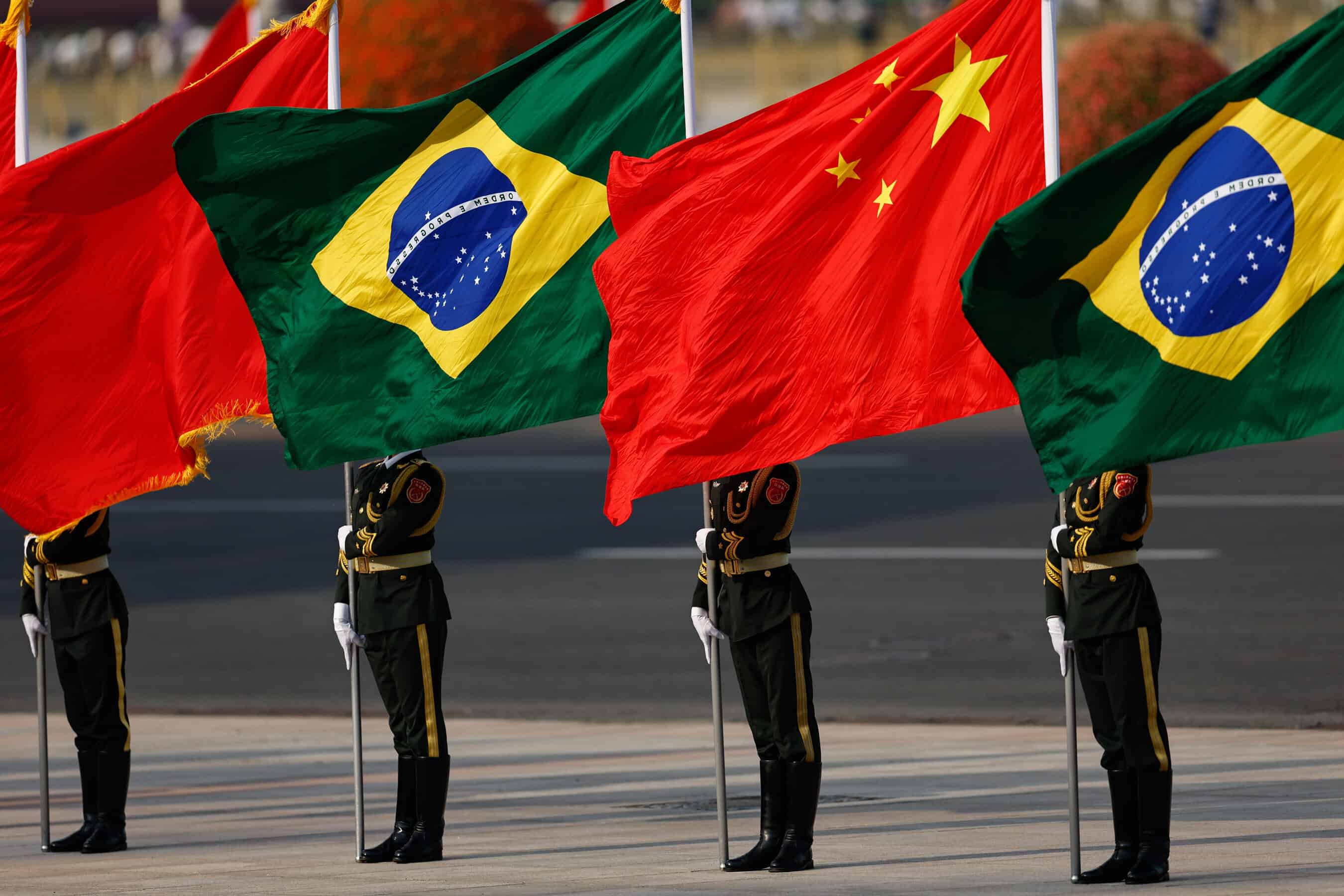


Coercive tariffs and visa retaliation cannot correct a trade imbalance that doesn’t exist in the first place. The U.S. is giving China its strongest argument yet for why Brazil should look elsewhere.
The Trade Rift Between the U.S. and Brazil
On July 15, 2026, the Trump administration imposed a fresh 25 percent tariff on most Brazilian imports, the culmination of a year-long Section 301 investigation into what U.S. Trade Representative Jamieson Greet called “unfair trade practices,” including Brazil’s digital payment system, court rulings affecting U.S. technology companies, and illegal forestation. Missing from the administration’s justification, however, was a basic fact: the U.S. runs a growing trade surplus with Brazil. That surplus more than doubled in 2025 to $14.4 billion in goods alone and exceeds $37 billion when services are included. Brazilian officials have privately suggested that the motives behind the measures are political rather than technical, helping explain why a year of negotiations produced no resolution. The Brazilian government has since moved to invoke its Economic Reciprocity Law and taken the dispute to the World Trade Organization.
This is not the U.S. government correcting a trade imbalance because no imbalance favoring Brazil exists. It is coercive economic statecraft directed at a country with which the United States already enjoys a substantial economic advantage. Whatever the Trump administration’s intended outcome, it is increasingly clear that it is making closer ties with China more economically attractive, diplomatically useful, and politically defensible for Brazil.
China Backs Brazil
The consequences became clear in late July, when the Brazilian government denied visas to two U.S. officials seeking to meet with Brazilian electoral authorities ahead of October’s presidential election. Days later, President Luiz Inácio Lula da Silva held a call of more than an hour with Chinese President Xi Jinping, with Xi publicly supported Brazil in “safeguarding its sovereignty and independence” and opposing foreign interference. Lula has also described Washington’s tariff pressure as an attempt to influence Brazil’s election. For him, the call with Xi was to reaffirm investors that Brazil is committed to diversifying its markets and trading partners. The two leaders also agreed to accelerate discussions over a Mercosur-China trade agreement.
Brazil’s sensitivity to foreign interference is not rhetoric imported from Beijing. Rather, it is rooted in the country’s own experience with outside intervention. Washington’s role in encouraging and backing the 1964 military coup that ushered in two decades of dictatorship looms large.
Brazil’s relationship with China predates the current confrontation and cannot be reduced to Trump-era tariffs. China overtook the United States as Brazil’s largest trading partner in 2009, and bilateral trade has since expanded thirtyfold, reaching nearly $100 billion annually. Since 2015, China has also been Brazil’s largest source of foreign direct investment. Crucially, this deepening relationship has survived Brazilian governments across the ideological spectrum. Jair Bolsonaro campaigned in 2018 on an explicitly anti-China platform and provoked Beijing by visiting Taiwan. Yet as president, standing in Beijing the following year, he dismissed a question about the apparent contradiction between his conservative politics and engagement with the Chinese Communist Party by stating that he was in a “capitalist country.” Trade with China expanded substantially during his presidency, and his government never seriously considered withdrawing Brazil from BRICS. If Brazil’s most Washington-aligned president in a generation did not decouple from Beijing, then Washington should be cautious about assuming that any future Bolsonaro-aligned government would do so.
That assumption is already being tested. In May, Flavio Bolsonaro, a sitting senator and the leading opposition candidate in October’s election, was received at the White House by Trump and separately met with Secretary of State Marco Rubio. This marked the first time a sitting U.S. president met with a declared Brazilian presidential candidate before the election itself. Bolsonaro discussed rare-earth minerals, tariffs, and designating Brazilian criminal organizations as foreign terrorist groups. With Trump, Flavio went beyond his father’s posture by signaling more openness to U.S. access to critical minerals. However, Brazilian agribusiness and heavy industry depend heavily on Chinese demand for soy, beef, and iron ore. This creates powerful domestic constraints against full alignment with Washington regardless of who occupies the Planalto.
Brazil’s Coveted Rare Earth Elements
At the center of this competition lies a resource the U.S. and China both want. Brazil possesses the world’s second-largest reserves of rare earth elements after China. This comes out to roughly 21 million tons, much of it is still untapped. Lula has approached that leverage pragmatically. After meeting with Trump in Washington in May, he made clear that Brazil has no reason to choose one suitor over another and welcomes investment in mining, processing, and production from whichever country offers the better partnership. For Brazil, rare earths are bargaining power, not a geopolitical concession to be handed automatically to either Washington or Beijing. U.S. tariffs weaken the U.S. government’s position precisely because they give Brazil fewer reasons to privilege American investment and Beijing more incentive to make an attractive counteroffer.
This points to the administration’s larger strategic challenge. The United States has never offered Brazil an economic proposition comparable in scale to what China has spent two decades constructing through infrastructure, trade, financing, and investment. Brazil has not formally joined the Belt and Road Initiative, but it has nonetheless received substantial Chinese state financing and investment through bilateral channels. The U.S. has no comparable infrastructure vehicle, regional investment strategy, or economic initiative commensurate with the competition it says China represents. In its place, Brazil increasingly sees tariffs, visa retaliation, and public threats.
For a country of Brazil’s size, economic weight, and long tradition of strategic autonomy, coercion is more likely to encourage diversification than compliance. It is also proving self-defeating. Analysts at the Peterson Institute for International Economics note that Brazil posted record exports after the first-round of 2025 tariffs. By year’s end, China accounted for roughly 37 percent of Brazilian trade, shipments to India had risen by more than 50 percent, and the U.S. share of Brazil’s trade had fallen to a record low. A tariff strategy meant to extract concessions has instead shown how easily Brazilian commodities can find alternative buyers.
Brazilian Public Opinion
Brazilian public opinion is beginning to reflect this shift. A PoderData poll conducted July 18–20, 2026, found that 52 percent of Brazilian voters favored deeper commercial ties with China, while 35 percent preferred closer relations with the United States. A year earlier, the figures were nearly reversed: 59 percent favored Washington and 32 percent favored Beijing. Pew’s 2026 global attitudes survey points in the same direction: favorable views of the United States fell by 17 points, while views of China rose by two. When asked which country is a more reliable partner, more Brazilians now choose China, signaling a rapid shift in perceptions of the two powers across the political spectrum.
None of this means Brazil is choosing China over the United States, nor that Beijing can replace Washington in every dimension of the bilateral relationship. Brazilian governments and economic elites still have powerful incentives to maintain close ties with the United States. But that is precisely why the current trajectory should concern the United States. Brazil does not need to become a Chinese ally for U.S. policy to fail. It only needs to conclude that strategic distance from Washington and deeper economic engagement with Beijing serve its interests.
That is increasingly what U.S. policy is encouraging. Every new tariff, visa restriction, and public threat gives China another opportunity to offer what the U.S.is withholding. This is markets, investment, diplomatic respect, and rhetorical support for Brazilian sovereignty. Washington claims to be correcting unfair trade practices and defending U.S. interests. Instead, it risks transforming an avoidable bilateral dispute into a strategic opening for its principal global competitor. If the Trump administration’s objective is to compete with China in Brazil, it cannot keep pursuing policies that make Beijing the easier partner to choose.