“We’ve been hit by two earthquakes: the one God sent us and the one led by the new president, Abelardo de la Espriella,” one community leader told WOLA.
This comparison captures a fear shared by leaders across insecure rural and urban areas in Colombia. The physical destruction caused by the August 10 earthquake is colliding with a sharp change in the national security policy. To understand what this means for civilians, WOLA interviewed 20 leaders involved in community self-protection efforts in conflict-affected areas in the Pacific region, Cauca, Antioquia, and the Colombian-Venezuelan border. WOLA withheld their identities for their safety.
A disaster response that has left communities exposed
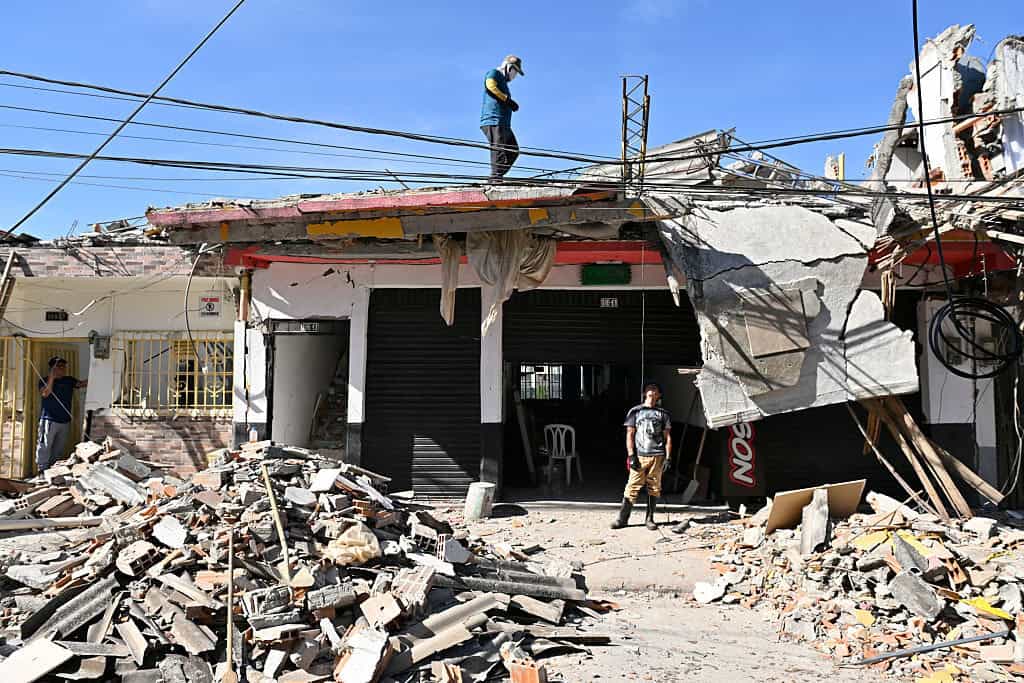
Colombia was already facing numerous complex conflict humanitarian emergencies when a 7.4 magnitude earthquake hit the Chocó department of the country on August 10. This was followed by over 150 aftershocks. According to Colombia’s National Disaster Risk Management Unit (UNGRD)’ s September 10 update, the earthquake left 331 persons dead, 111 missing, and 4,505 injured. It has affected 466,345 people in 497 municipalities across 16 departments. The disaster destroyed 36,327 homes and damaged another 201,939, while 759 buildings collapsed. It also affected 4,316 educational centers, 397 health centers, and 6,118 community centers.
Leaders described a response that has too often failed to reach the people most in need. They said assistance has been concentrated in urban areas, sometimes reaching neighborhoods with limited damage while affected rural communities wait for support. Some neighborhoods were overserved while others received no help. They reported little consultation with community leaders or ethnic authorities and no consistent effort to adapt aid to the needs of Afro-Colombian and Indigenous communities. In many places, solidarity networks and mutual aid have filled the gaps.
Leaders recognized the importance of President de la Espriella and other high-level officials’ visits to affected areas. What was glaringly missing from these visits was dialogue with the ethnic authorities and organizations, or a clear evaluation of the conditions on the ground and an assessment of potential harm of its interventions. In many cases, it tended to prioritize public displays of action, especially for the cameras doing so, the government violated the humanitarian “do no harm” principle, causing harm and weakening the response’s effectiveness.
Several leaders cited President de la Espriella’s August 16 distributions of soccer balls bearing his party’s logo to children in Buenaventura, even as families desperately needed food, water, and shelter, as an example of racial insensitivity. It was an apparently well-intentioned act that instead reinforced painful racial dynamics. For the leaders, the episode reflected a broader failure to listen to communities and respect their dignity.
Community members depict the national government’s earthquake response as improvised and poorly coordinated with community leaders and local authorities, which they also attribute to the de la Espriella administration’s failure to carry out an effective transition process. They shared that the new government not only showed an inability to listen to communities, but also that their first crisis overwhelmed them. They lacked the grasp of reality needed to understand the situation and respond as a government.
The shortcomings in disaster response also have consequences for security. Damaged roads and infrastructure hinder movement between communities. Power outages make it harder to detect armed incursions, alert protection networks, or help threatened residents reach safety. Destroyed homes and communal buildings leave people with fewer places to shelter. Leaders expressed particular concern about increased exposure to sexual violence and other forms of gender-based violence.
In places where the earthquake struck communities already facing overlapping humanitarian crises due to the armed conflict, such as San Juan and Baudó communities in Chocó, the August 10 earthquake struck areas already severely affected by armed conflict, particularly the San Juan and Baudó subregions. This disaster further exposes the limits of individual protection measures. Protecting a community leader is insufficient when entire communities are confined, their movements restricted, there is no adequate shelter, and essential community spaces are lost.
Children and adolescents face acute risks. Everyone interviewed identified children as among the least protected in the earthquake’s aftermath. Damage to schools and the suspension of classes disrupted their education and left many without the daily protection and food that schools provide. According to the United Nations, the quake damaged more than 3,800 educational facilities, affecting over one million students. Some 178,000 children are attending schools with serious structural damage. Leaders in Chocó and Valle del Cauca said illegal armed groups were exploiting the crisis to forcibly recruit children. This compounds an already acute crisis. Earlier this year, Colombia’s Human Rights Ombudsman warned of forced recruitment of children and adolescents in ten parts of the country, including both departments.
The earthquake has also drawn already strained institutions’ attention away from their regular protection and social service duties. According to the leaders, some local authorities now cite the emergency when they fail to respond to threats or provide essential services. People with illnesses, disabilities, and the elderly are particularly affected.
The National Indigenous Organization of Colombia (ONIC) did its own assessment of the earthquake’s damage on indigenous communities. They found hundreds of thousands of indigenous persons affected, with Chocó, Risaralda, and Valle del Cauca being the worst affected. They argue that assistance must be planned and delivered with the indigenous authorities. It is the authorities who have the knowledge of their territories and who can best identify needs and strategies for reaching isolated communities. ONIC also urged transparency in the spending and distribution of aid and called for the Colombian government to complement its assistance with that provided through international cooperation.
Marshall Plan for the Chocó
On September 7, the Colombian government announced it would implement a reconstruction strategy called the Marshall Plan for the Chocó (Plan Marshall para el Chocó. According to the government, this plan aims to transform the region by leveraging a $2 trillion COP (approximately $588 million USD) commitment from the private sector alongside public funding. José Leonidas Tobón, the Vice Minister of Rural Development, will be managing this plan. This project includes five highway projects, the construction of a boardwalk in Quibdó, improving the Bahia Solano airport, and seed capital for an interoceanic canal.
Leaders expressed concern that the Colombian government announced an entire megaprojects strategy without going through the prior consultation process with the territorial authorities in the Chocó. It has not shared the plan’s details with them nor taken the viewpoints of the affected communities into account. Given that most of the territory in the Chocó is collectively owned by Afro-Colombian and Indigenous peoples, this is highly problematic. Some community leaders fear that outside economic interests are using the earthquake and the disruption it has caused to advance long-standing projects without local consent. They warn that the crisis could enable land grabs and expand access to the region’s mineral and biodiversity resources, while leaving the affected communities with few of the benefits.
A military shift in an already fragile landscape
The risks related to the earthquake are unfolding as the new administration moves toward a mano dura security strategy. Since taking office on August 7, President Abelardo de la Espriella has ended political talks with illegal armed groups, restored active arrest warrants against their members, and promised a major offensive against groups that do not submit to justice. His administration has expanded military operations, including aerial bombardments, while pursuing closer security cooperation with the United States and Israel.
The government presents these measures as a way to weaken armed groups and confront extortion and drug trafficking. However, leaders WOLA interviewed noted that the restart of any aerial fumigation of coca crops would not end coca cultivation in the long term, and they fear that the pressure to produce rapid results will instead increase civilian harm. Armed groups already operate in and move through their communities. Military operations conducted without adequate safeguards could force families from their homes. The reliance on informants and pressure for arrests could also expose residents to false accusations and abuses by the security forces.
Leaders said illegal armed groups are preparing for confrontation. In the areas they described, the groups have tightened restrictions on movement, grown more suspicious of residents, and increased recruitment, especially of children and adolescents. Some leaders also fear that regions, like the Chocó, where most voters did not support the president electorally could face especially harsh treatment. These concerns underscore the need to assess the civilian consequences of the security strategy as it is implemented.
Interviewees were candid about the shortcomings of former President Petro’s Total Peace policy. They described some negotiations as improvised and noted that Congress had not passed legislation needed for certain processes to advance. Yet they also said some dialogues created space to address the underlying conditions driving the violence and, in certain places, reduced harm to civilians. Ending those channels without a credible means of protecting communities at risk leaves residents caught between military operations and armed groups’ retaliation.
The core concern is that arrests and battlefield gains alone will not dismantle armed groups. Inequality, limited services, and few viable livelihoods continue to drive recruitment and sustain illicit economies. Unless those conditions change, others will replace any of the people and groups removed.
Communities are unifying
The combination of the earthquake, the Colombian government’s hardline security approach, and the contraction of international cooperation is forcing leaders to rethink their collective security and auto-protection strategies. Many of these processes are having internal meetings to determine how best to confront this new scenario with fewer resources and less international accompaniment. All the leaders interviewed stated that the only way forward is through unity among communities, auto-protection strategies, and organizations. They are figuring out how to strengthen their processes from within, regionally, nationally, and internationally.
What international engagement can do
The leaders see international engagement as part of their protection. They ask international actors to bring attention to the effects of the government security policies and to press for direct dialogue between national officials, affected community leaders, and ethnic authorities (representatives of Afro-Colombian community councils and Indigenous cabildos). Security plans, they argued, should draw on local knowledge and be assessed against the risks of abuse and displacement. Guardrails are needed to make sure that the international law principle of distinction for civilians is safeguarded. They identified the U.S. Congress as a particularly influential voice with the Colombian government.
Leaders ask the international community to recommend to the Colombian government that it advance formal collective protection measures. They noted that some of these measures come from recommendations made by the Inter-American Commission of Human Rights, while others that are not part of these measures should also be made a priority.
The leaders also called for a sustained international presence in areas where communities have built collective security and self-protection processes. This includes unarmed internationals situated in the conflict areas or frequent visits by the United Nations and other international actors. Such a presence could help deter attacks, make threats against leaders more visible, and connect communities facing similar dangers so they can share strategies.
The earthquake has weakened the infrastructure and services on which civilian safety depends, just as a more aggressive security strategy raises the prospect of further confrontation. The leaders’ appeal is for a national response shaped with the communities who will bear its consequences. This is the only way to guarantee that disaster assistance reaches those most in need, and protection reflects the conditions on the ground. Security policies should not just be measured by the number of members of illegal armed groups killed, captured and extradited but whether civilians are safer.