
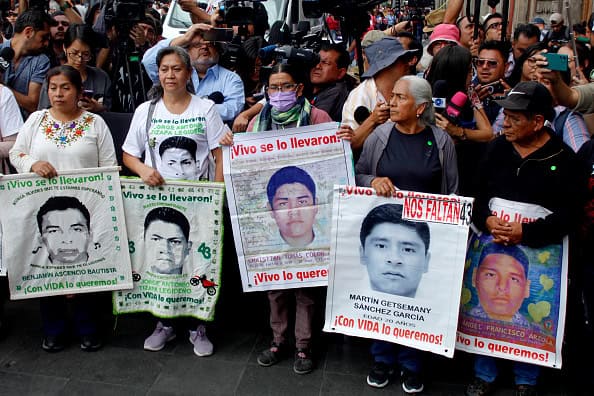


Twelve years after the enforced disappearance of 43 students in the Ayotzinapa case, and across three different federal governments, the families have overcome repeated attempts to block their access to truth and justice. But key obstacles remain.
Meanwhile, the struggle of families of people who have disappeared nationwide is advancing at the UN. This year, the UN Committee on Enforced Disappearances (CED) referred the situation of disappearances in Mexico to the General Assembly, recommending that Mexico receive international assistance to confront the crisis. However, the Mexican government has rejected the process.
With more than 131,000 people disappeared, it is essential that the Mexican State acknowledge the severity of the crisis and remove the obstacles preventing it from being addressed effectively, overcoming institutional resistance and listening to families in order to deploy all necessary measures for prevention, search efforts, and justice.
The Ayotzinapa Case: Progress and Setbacks 12 Years On
Since the night of September 26, 2014, the families in the Ayotzinapa case have had to overcome countless obstacles, including an attempt by various government institutions during the presidential term of Enrique Peña Nieto to present a false account of events: the so-called “historical truth” announced in 2015, which turned out to be a version built on fabrications and torture.
With support from the Mexican human rights organizations accompanying the families (Center Prodh, Tlachinollan, Fundar, and Serapaz), as well as the Argentine Forensic Anthropology Team (Equipo Argentino de Antropología Forense, EAAF), the Interdisciplinary Group of Independent Experts (Grupo Interdisciplinario de Expertos y Expertas Independientes, GIEI) of the Inter-American Commission on Human Rights, and other international bodies, the false version was disproven. The involvement of authorities at various levels before, during, and after the events was also revealed. Under the leadership of the first head of the Special Investigation Unit for the case in the National Prosecutor’s Office (Fiscalía General de la República, FGR), Omar Gómez Trejo (June 2019 to September 2022), important steps were taken in the criminal investigation.
Thanks to these efforts, several high-level officials have now been detained in connection with the case, mainly on charges related to irregularities in the investigation and organized crime, with their cases still pending resolution. But this has not translated into full access to truth and justice, nor has it resolved the obstacles. Among other things, in 2022 Gómez Trejo was forced to resign amid undue interference from other levels and offices within the FGR.
Meanwhile, Andrés Manuel López Obrador had come to the presidency in 2018 with a commitment to advance the case; his government created an inter-institutional commission for this purpose and invited the GIEI to return to Mexico, among other measures. However, over the course of his six-year term (2018-2024), the progress made suffered setbacks. López Obrador ultimately repeatedly discredited the families and their representatives, particularly Center Prodh, as documentation and investigation of the case revealed practices of impunity and opacity involving the armed forces. In July 2023, the GIEI announced its withdrawal from the case, largely because the armed forces refused to hand over all the information in their possession about the events.
To date, the armed forces have not shared all the information requested of them regarding the case, despite recent court orders mandating its immediate delivery. Meanwhile, some key figures remain fugitives. On the search front, in 12 years the government has managed to identify the remains of only three of the 43 disappeared victims.
This year has brought new causes for concern, now under the government of President Claudia Sheinbaum. In July, Mexico’s Supreme Court (Suprema Corte de Justicia de la Nación, SCJN), at the request of the President’s Legal Counsel Office (Consejería Jurídica de la Presidencia de la República), took up four extraordinary appeals filed against a 2018 ruling that ordered the creation of a special commission to facilitate access to truth and justice in the Ayotzinapa case. The SCJN’s decision, beyond failing to help clarify the case, creates considerable uncertainty by reopening the effects of a final ruling to review.
Also in July, the National Human Rights Commission (Comisión Nacional de los Derechos Humanos, CNDH), a body whose independence has notably deteriorated in recent years, published a document on the case that seeks to minimize the responsibility of the armed forces and to discredit a long list of Mexican human rights organizations, international organizations and bodies, independent experts, and even public officials who have supported the families or investigated the case, among others.
In recent weeks, news broke of the arrest of former Guerrero state governor Ángel Aguirre, accused of ordering the destruction of videos related to part of the enforced disappearance. The criminal case opened against him joins those already underway and, if sustained over time, could represent a step toward justice.
President Sheinbaum met with the families in late August and told them that current lines of investigation include a deeper analysis of phone communications, among others, committing to presenting a detailed report before the anniversary. She has also stated that she is seeking to have independent experts review the investigation being carried out by the FGR and the efforts made by the federal government, though this review has not yet taken place.
In conclusion, 12 years after the events, the families still do not know the truth about what led to the disappearance of their children, nor have they seen justice and accountability for the people and institutions responsible. They face a State that has made them many promises, but that on more than one occasion has sought to obstruct the investigation rather than advance it.
It will be essential that the Mexican government’s new efforts, both in terms of cooperation with independent experts and in what is presented in the upcoming report on the case, advance the investigation in order to build solid cases capable of bringing justice closer to the families.
The Disappearance Crisis Before the UN
On April 2, the CED Committee published a decision under Article 34 of the International Convention for the Protection of All Persons from Enforced Disappearance, referring the situation of disappearances in Mexico to the UN General Assembly. This followed the Committee’s conclusion that the situation has not improved in recent years despite efforts made, and that “there are well-founded indications that enforced disappearance has been and continues to be committed in the context of various widespread or systematic attacks” in Mexico.
This is the first time the CED has used this procedure, which seeks to have UN member States support Mexico with technical assistance on issues such as search efforts, identification, investigation, and protection for searching families.
For its part, the Inter-American Commission on Human Rights (IACHR) published a report in May that also documents the scale of the crisis and analyzes various patterns and aspects of the disappearances, underscoring the urgent need for vigorous action to address this phenomenon. The report contains a series of recommendations for the State.
Unfortunately, rather than seeing the UN procedure as an opportunity for collaboration with the international community, the Mexican government has rejected the CED Committee’s actions and conclusions.
The UN General Assembly is currently in session, and States will need to follow up on the CED’s decision. Given the scale of the crisis and in light of the obstacles that persist in ending it, it will be important for the international community to offer its support to Mexico, and for Mexico to seize this opportunity to strengthen the fight against disappearances with comprehensive measures, always keeping families at the center.