
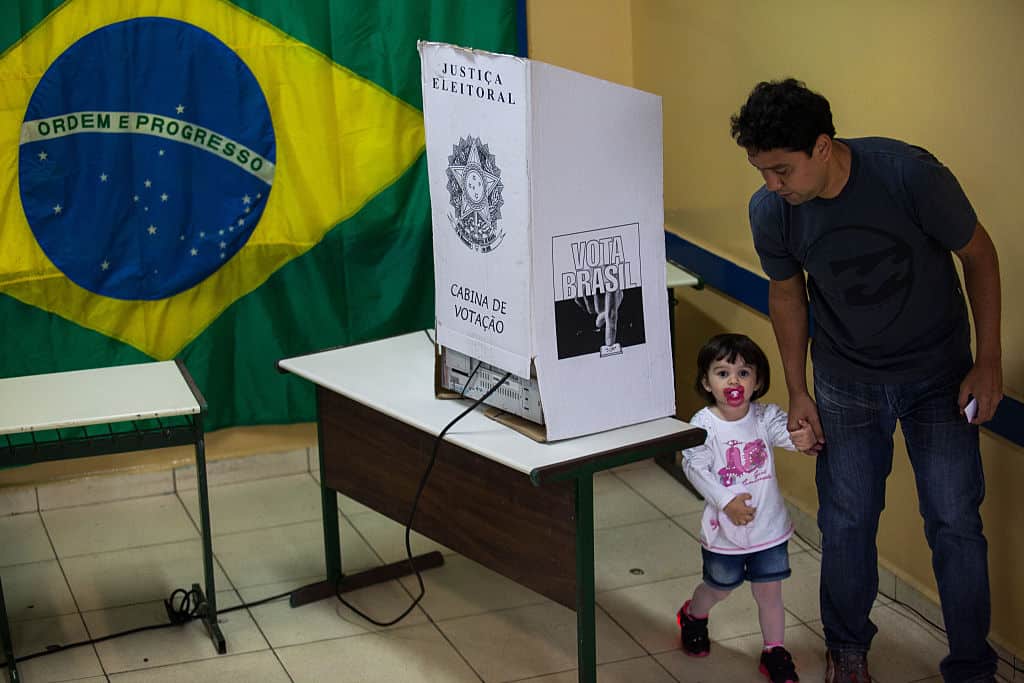

On Sunday, October 4, Brazil will elect its next President, 513 members of the House of Deputies, and two-thirds of the 81-seat Federal Senate, as well as all state governors, and state legislative assemblies. Polls show the Presidential race neck and neck. It’s playing out against a backdrop of public safety concerns and debates over political representation. The U.S.-Brazil relationship is also playing a role in these elections.
Here are five things to know.
1. The race is very close.
The race pits President Luiz Inacio Lula da Silva, 80, seeking an unprecedented fourth non-consecutive term, against Senator Flávio Bolsonaro, son of the former president Jair Bolsonaro. Recent surveys show the two frontrunners tied in hypothetical runoffs, holding a narrow numerical edge in several September polls. A BTG/Nexus poll also reveals a sharp gender divide. Flávio leads among men, while Lula holds an 18-point lead among women. Eleven other candidates are also on the ballot, including former governors Ronaldo Caiado and Romeu Zema, and self-help author Augusto Cury. None polls above single digits, but together they could keep either frontrunner below a first-round majority. If no candidate wins more than 50 percent of valid votes in the first round, the top two candidates will advance to an October 25 runoff.
2. Perception of violence is shaping voter preferences.
Public safety has emerged as voters’ top concern. In a September Quaest poll, 31 percent identified violence as Brazil’s most pressing problem. This is nearly twice the share who cited the economy (16 percent), followed by health and corruption (14 percent each). Though, the overall deteriorated security situation is mostly perception and not reality. The 2026 Anuário (FBSP) shows the lowest violent death rate since 2012 in Brazil. That said, police lethality, femicides, and digital crime are up. Organized crime and police operations like in Rio in October 2025, when a police raid on the Alemão and Penha complexes left 121 dead, dominate the news. Analysts also point to fiscal policy as a defining challenge for whoever wins, noting that high public debt combined with elevated interest rates will limit the next government’s options in other areas.
3. Representation is on the ballot.
Rules set by Brazil’s Superior Electoral Court (TSE) require parties to direct a share of campaign funding and broadcast time proportionally to Black, women, and Indigenous candidacies, with the Indigenous quota, approved in 2024, applying for the first time this year. Black candidacies have grown to 49.8 percent of the field, compared with 55.5 percent of the population. While Black candidacies now account for nearly halfof the total, researchers at Inesc warn that a 2024 constitutional amendment replaced proportional funding with a fixed 30 percent floor, so growth in candidacies may not translate into resources. Indigenous candidacies remain a small share of the total, 191 nationwide, or under 1 percent. The “Bancada do Cocar,” a movement backed by Brazil’s main Indigenous organization to elect Indigenous lawmakers (APIB), has organized 47 precandidates across 16 states, aiming to expand the five Indigenous seats currently in Congress.
At the same time, on LGBTQ+ issues, the leading presidential candidates present notably different records and platforms. Flávio Bolsonaro has made public overtures to LGBTQ+, Black, and Carnival constituencies during the campaign. This is an effort that allies describe positioning him as a more moderate alternative to traditional Bolsonarismo, the conservative movement that characterized Jair Bolsonaro’s presidency. Yet his formal government plan does not directly mention the LGBTQ+ population, according to analysis of the platforms registered with Brazil’s electoral authorities. Lula’s platform, by contrast, explicitly incorporates sexual orientation and gender identity into broader commitments to combat discrimination and violence. The other candidates vary from specific LGBTQ+ proposals to leaving the issue unaddressed.
4. The political aftermath of January 8, 2023, looms large.
Thousands of supporters of former President Jair Bolsonaro stormed Brazil’s Supreme Court, Congress, and presidential palace in Brasilia after falsely claiming fraud in the 2022 presidential election. The rioters called for military intervention to overturn the results and caused millions of dollars in damage. As a result, many were arrested.
The ensuing Supreme Court investigation uncovered evidence of a broader coup plot, leading to the prosecution and the conviction of Jair Bolsonaro with a 27-year prison sentence for his role in the attacks. Earlier, Brazil’s electoral court had barred him from holding public office until 2030 for abusing his authority and casting doubt on the country’s electoral voting system.
One of Bolsonaro’s sons, former Senator Eduardo Bolsonaro, was convicted in June 2026 for attempting to interfere with his father’s trial. However, he has not served his sentence because he fled to the U.S. in February 2025, and he was granted a green card earlier this year. In Brazil, Senator Flávio has positioned himself as the primary political heir and standard-bearer for Bolsonarismo. His proposals, should he win office, include reversing the judicial consequences of the January 8, 2023 riots and his father’s conviction.
5. The United States is Part of the Conversation.
U.S. tariffs on Brazilian exports and the Trump administration’s designation of two of Brazil’s largest criminal organizations as terrorist groups have emerged as issues in the campaign. This has added U.S.-Brazil bilateral tensions to an already polarized race. The relationship between the Bolsonaros and the Trump administration was strong during Bolsonaro and Trump’s first terms and has only strengthened in Trump’s second term. Although Trump has so far refrained from a direct endorsement, the administration has boldly shown its support for the Bolsonaro family and made clear they favor a Flávio Bolsonaro win. Both the tariff dispute between the two nations and Secretary of State Rubio opining on the Bolsonaro conviction are viewed by the Brazilian government as infringements on their sovereignty.
Adding to the tension have been actions by the Trump administration in recent months. In July, Brazil denied visas to two U.S. State Department officials to travel to Brasilia for meetings related to the electoral process. Brazilian officials characterized the proposed visit as an attempt to interfere in the election. The State Department described it as a routine visit focused on election integrity and fundamental freedoms. In retaliation, the U.S. revoked the Brazilian Ambassador to the U.S.’s visa. Brazil’s intelligence agency sent a report to the presidency, electoral court, and Ministry of Justice classifying the risk of foreign interference in the election as “critical.”