

Nicaragua has undergone one of the most severe cases of democratic backsliding in the Americas, with an increase in repression and severe limits on civic space following the 2018 protests. The Ortega-Murillo government has dismantled the separation of powers, subordinating the judiciary, the electoral authority, and the legislature to the executive. Freedom of association and religion have been systematically curtailed: thousands of NGOs, universities, and media outlets have been shut down or stripped of their legal status, the Catholic Church has faced sustained harassment including the expulsion and imprisonment of clergy, and independent civil society has effectively been erased from the country. Political parties have been banned or co-opted, elections have lost any competitive character and may end altogether, and dissent is met with arbitrary detention, forced disappearance, statelessness, and, increasingly, assassination beyond Nicaragua’s borders.
Despite the scale of this collapse, Latin American governments’ diplomatic response has been notably muted. Only a small number of countries in the region have taken consistent, high-profile positions condemning the regime or pushing for coordinated multilateral action, and regional bodies have struggled to sustain pressure over time. Actions to denounce the Ortega-Murillo regime and push for a democratic transition have primarily come from the United States, European governments, and UN human rights mechanisms, even as those actors face their own limitations and, at times, contradictions.
This piece examines key issues related to Nicaragua’s current human rights situation and the role of the international community.
A deteriorating human rights situation with repression transcending Nicaragua’s borders
The Ortega-Murillo government has enacted some of the region’s most restrictive anti-NGO laws and measures. In October 2020, Nicaragua’s National Assembly approved a law requiring Nicaraguans who work for “governments, companies, foundations, or foreign organizations” to register as foreign agents. This was followed by the March 2022 General Law for the Regulation and Control of Non-Profit Organizations, which gives the government the power to cancel the legal registry of organizations it contends are promoting “campaigns to destabilize the country,” and to seize an organization’s assets. Additional laws and reforms put in place in 2024 consolidate control over the non-governmental organizations that remain in the country and those that are newly created. Since 2018, authorities have canceled the registration of over 5,600 Nicaraguan civil society organizations.
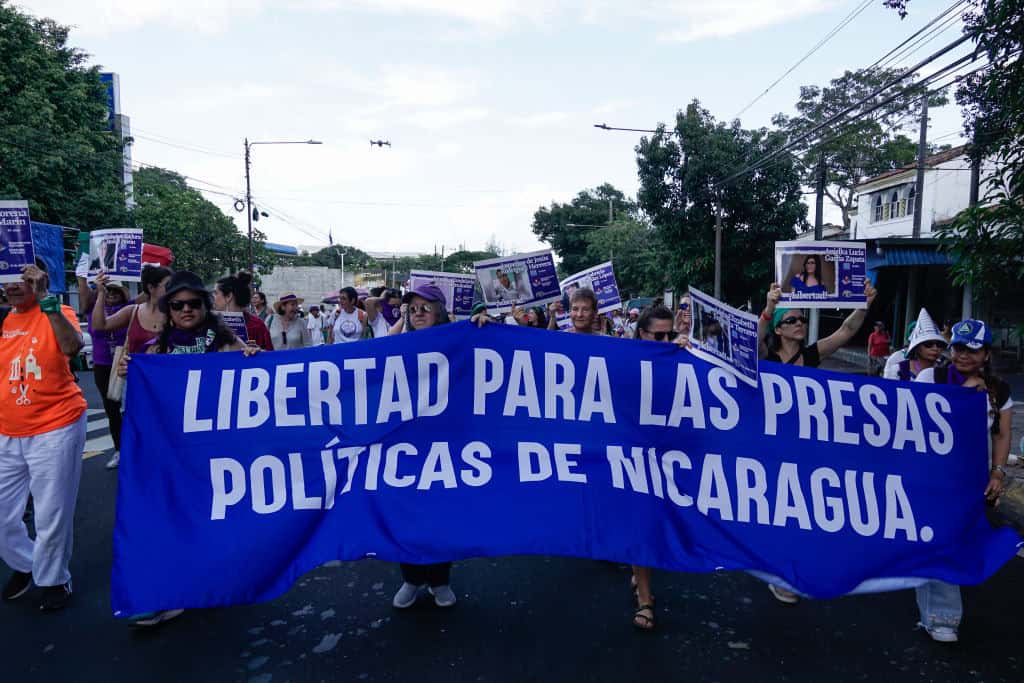
According to the Mechanism for the Recognition of Political Prisoners, as of July 31, 2026, there were 60 political prisoners in Nicaragua: 51 men and 9 women, 15 elderly adults, and 23 in a situation of forced disappearance. The UN Group of Human Rights Experts on Nicaragua (GHREN) March 2026 report documented 199 politically motivated arrests (174 men and 25 women) between April 2025 and mid-January 2026. GHREN’s most recent report, issued September 22, 2026, verified 161 cases of enforced disappearance and eight cases of individuals who died in state custody since April 2018 after inadequate medical care, unsanitary conditions, and, in several cases, torture or other ill-treatment. The report highlights the case of Brooklyn Rivera, a 73-year-old Miskitu political leader who died on June 1 while in custody, after being arbitrarily detained for more than 900 days during which his whereabouts and health status were largely unknown. Other political prisoners such as Víctor Boitano, Carlos Brenes, and Salvadora Martínez are older persons who are suffering from life-threatening or chronic illnesses.
The GHREN has widely documented the expansion of transnational repression, including the June 19, 2025 murder of Roberto Samcam, a retired Nicaraguan Army major living in exile in Costa Rica. By February 2026, the experts had documented more than a dozen murders, attempted murders, and assaults. The most recent case is the September 14 assassination attempt against campesino opposition leader Reinaldo Picado Miranda, exiled in Costa Rica, who had already survived another attempt on his life three months earlier. Nicaraguan organizations in exile have identified 16 people targeted in attacks between 2018 and 2026 (9 in Costa Rica and 7 in Honduras), with 11 killed. In addition, 452 Nicaraguans have been stripped of their nationality; many were political prisoners who were arbitrarily denaturalized after being expelled from the country, while another 200 Nicaraguans been prevented from re-entering after traveling abroad.
U.S. Policy: Actions and Inconsistencies
The U.S. government negotiated with the Ortega-Murillo government the February 2023 release of 222 political prisoners and their transfer to the United States. Current and past U.S. administrations have continued to impose targeted sanctions on Nicaraguan officials and private individuals and companies linked to the regime. State Department engagement has helped keep individual cases, such as Brooklyn Rivera’s, visible internationally.
In December 2024, the U.S. Trade Representative (USTR) initiated a review to determine whether Nicaragua’s labor, human rights, and rule-of-law practices constituted an unreasonable burden on U.S. trade, later determining that Nicaragua had engaged in increasingly widespread labor and human rights abuses and had systematically dismantled rule-of-law protections. On December 10, 2025, the USTR announced a phased-in tariff on all Nicaraguan imports not covered by CAFTA-DR: 0% as of January 1, 2026, rising to 10% in 2027 and 15% in 2028.
For their part, the U.S. Senate and House of Representatives have held hearings on the situation in Nicaragua in September 2026; bipartisan legislation has been introduced in the Senate to increase restrictions and sanctions on the Ortega-Murillo regime, while legislation presented in the House earlier this year would expand sanction criteria and U.S. support for human rights and democracy, among other measures. In recent years, Congress has consistently appropriated $15 million for democracy and religious freedom programs for Nicaragua.
While these measures are welcome, the Trump administration had adopted policies that have been to the detriment of support for Nicaraguan civil society organizations and the Nicaraguan population in the United States, including asylum seekers. The cancellation of USAID funds in January 2025 immediately affected Nicaraguan organizations, including independent Nicaraguan journalists, who rely almost exclusively on U.S. cooperation. With diminished U.S. support, the viability of digital platforms that enable Nicaraguan newsrooms to operate abroad, as well as support for protection measures and relocation expenses for journalists at risk, has been curtailed.
On the migration front, since 2018, more than 800,000 Nicaraguans have left the country, with over 342,000 requesting asylum in Costa Rica, the United States, Spain, and elsewhere. Notwithstanding this reality, in June 2025, the administration canceled the humanitarian parole program put in place by the Biden administration, which had provided 2-year legal status and work authorization for individuals from Cuba, Nicaragua, Venezuela, and Haiti. Approximately 93,000 Nicaraguans had benefited from this program. The administration then terminated Temporary Protected Status for Nicaraguans on July 8, 2025, a status that had been in place since 1999, leaving over 2,900 without legal status in the country. Media reports say U.S. authorities have returned almost 8,000 Nicaraguans to the country this year. The ICE Flight Monitor, managed by Human Rights First, reported nine removal flights to Nicaragua in July alone, up from seven in June.
Of the Nicaraguans detained and, in several cases, deported from the United States and returned to Nicaragua or a third country, are asylum seekers, including former political prisoners and their family members, undermining the protection those releases were meant to secure. In January 2026, ten UN Special Procedures sent a communication to the U.S. government expressing deep concern over the detention and risk of deportation of six Nicaraguan nationals — including human rights defenders, political opponents, indigenous leaders, and individuals with health conditions — to Nicaragua or third countries considered unsafe, such as Honduras. One example is Yadira Córdoba Obando, a human rights defender and member of Madres de Abril, who fled first to Costa Rica and later to the United States due to persistent threats linked to transnational persecution against Nicaraguan opposition figures. Yadira requested asylum in the U.S., but authorities detained her in Texas in August 2025 after a routine administrative appearance. Although she was ordered to be deported to Honduras, she was unable to board the scheduled deportation flight in January due to a transportation issue and was returned to detention. In February, she was deported to Mexico. An unnamed Nicaraguan campesino activist included in their communication was reportedly deported to Nicaragua in December 2025.
U.S. immigration enforcement policies have even impacted the 222 political prisoners the U.S. brought into the country in February 2023 as part of Operation Nica Welcome, none of whom have been granted asylum in the U.S. so far. Juan Barilla, a former member of the Nicaraguan Campesino Movement who was part of the group, was detained in April 2025 and deported to Honduras in November 2025. Marvin Castellón Ubilla, another former political prisoner, was detained by ICE in May 2026 and not released until July. Between April and September 2026, six more of the 222 political prisoners who came to the U.S. as part of the group were detained by ICE and remain in immigration custody. Partner organizations have reported that at least one family member of a political prisoner who was part of the group and who had requested asylum in the U.S. was deported back to Nicaragua and has been imprisoned by the Ortega-Murillo government.
Regional actions
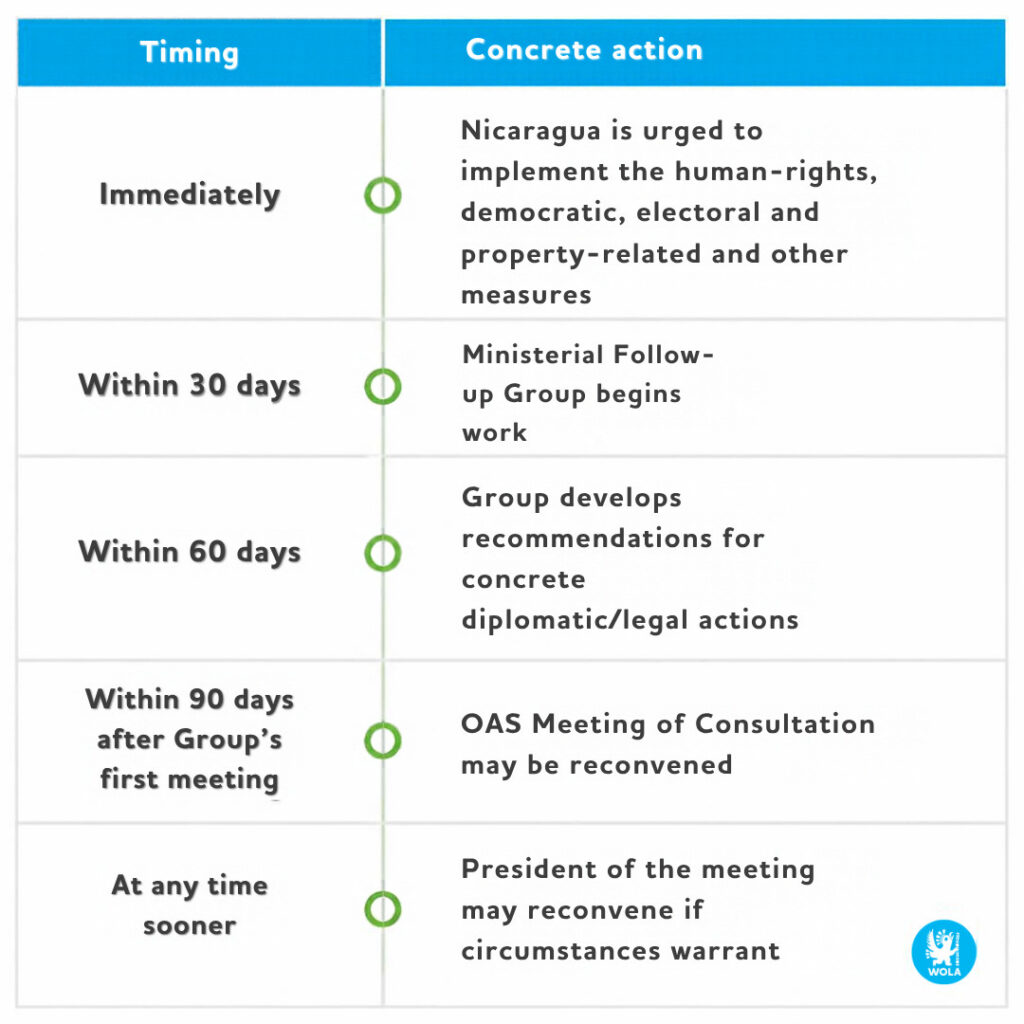
On October 2, 2026, the OAS held a meeting of consultation of ministers of foreign affairs to consider the situation in Nicaragua, spearheaded by the U.S. They adopted a resolution that calls on Nicaraguan authorities to free political prisoners and restore civil liberties, among other measures, and establishes a voluntary Ministerial Follow-Up Group as a path for potential coordinated action among member states, the details of which are laid out below. Notably, the group shall “seek prompt, direct engagement with the Nicaraguan authorities, pursuing a visit to Nicaragua, if possible, led by Ministers of Foreign Affairs.” Although Nicaragua’s withdrawal from the OAS limits the organization’s formal leverage and the Democratic Charter does not provide automatic enforcement mechanisms, the meeting served as a platform for governments to coordinate concrete actions.
The path forward
Nicaragua’s democratic collapse demonstrates both the scale of the Ortega-Murillo government’s repression and the limitations of an international response that has remained fragmented and inconsistent. However, actions in recent months, including renewed attention from the U.S. Congress, the Trump administration, and the recent OAS meeting, offer an opportunity for additional measures and increased coordination. Moving forward, the U.S. government, and other countries receiving Nicaraguan nationals should enact stronger protection for Nicaraguan asylum seekers at risk of deportation, while maintaining pressure on the Nicaraguan government for serious human rights violations and the erosion of democratic norms. At the same time, members of the international community should continue to support civil society actors who work to preserve democratic space. Independent journalists, human rights defenders, Indigenous and Afro-descendant leaders, opposition members, and others in exile remain essential sources of information and accountability. Protecting and funding these actors is an important component of maintaining the possibility of a democratic future in Nicaragua. The OAS Ministerial Follow-Up Group offers another opportunity for governments to strengthen coordination, but its significance will depend on what follows in the coming months. While these measures cannot resolve Nicaragua’s crisis on their own, they can help preserve democratic actors and human rights protections and build pressure for a democratic transition in the country.