

On September 11, Brazil’s Supreme Court found former President Jair Bolsonaro guilty, sentencing him to 27 years and three months in prison. The Court convicted him on several counts, including: armed criminal conspiracy, attempted abolition of the democratic rule of law, attempted coup d’état, violent destruction of public property, and damage to protected national heritage sites. Seven of Bolsonaro’s allies, including five military officers, were also convicted.
The Trump administration has reacted negatively to this historic ruling, ramping up tensions between the two nations. What is the significance of this decision? Why would the Trump administration seek to undermine it? What does this mean for the future of U.S.-Brazil relations? Here, we provide answers to these and more questions concerning this tense diplomatic moment.
Why was former President Bolsonaro on trial?
On January 8, 2023, a week after current president Luiz Inácio Lula da Silva took office, right-wing supporters of former Brazilian President Jair Bolsonaro stormed and vandalized the country’s Supreme Court, Congress, and presidential palace. Calling on the military to overthrow the country’s electoral results, his supporters claimed that the results of the October 2022 elections were fraudulent.
On October 30, 2022, Luis Inacio Lula da Silva won a narrow victory over the incumbent President Jair Bolsonaro in the runoff presidential election with 50.9% of the votes versus Bolsonaro’s 49.1%. Unlike the U.S., Brazil has a Superior Electoral Court responsible for safeguarding democracy in the country, which oversees regional courts that conduct elections. This court also investigates electoral crimes and has determined that the elections were conducted freely and fairly.
Since 2000, Brazil has conducted its elections smoothly using an electronic voting system. This highly efficient system enables real-time results as soon as the polls close, allowing the country to quickly determine which candidates have won. WOLA and other international organizations that observed the 2022 presidential runoff election can confirm that there were no issues with the system or the final electoral results. Additionally, Bolsonaro established a sort of “alternative monitoring commission” composed of members of the Armed Forces to oversee the election, and even this commission did not claim that there was fraud or any weaknesses in the integrity of the Brazilian electoral system.
Approximately 2,000 protesters were arrested due to the January 8 incident and later released. Supreme Court Judge Alexandre de Moraes launched a series of investigations that eventually led to the conviction of nearly 300 people for various charges, including attempting a coup. In November 2024, Bolsonaro was indicted for several crimes related to attempting to overturn the election results. On September 15, 2025, the court convicted him on five counts and sentenced him to twenty-seven years in prison.
The January 8 attack bore many similarities to the January 6, 2021, attack on the U.S. Capitol by Trump supporters, with both presidents, who were defeated in the elections, playing a key role in spreading disinformation about the results. While Bolsonaro claimed not to have orchestrated the attacks, he repeatedly undermined the Brazilian electoral system and its electronic voting system without providing evidence. For example, on July 18, 2022, he invited dozens of diplomats to the presidential palace, where he pointed to a Federal Police report alleging the hacking of electoral machines, which was subsequently debunked by the electoral authorities who investigated the matter.
What did Brazil’s Parliament conclude about the January 8 attack?
A Joint Parliamentary Committee of Investigation (CPMI) was set up in 2023 by the Brazilian Congress to investigate the January 8 attacks on the country’s executive, legislative, and judicial branches. This extensive investigation, conducted between May and October of that year, yielded two key conclusions. The first was that “the January 8 movement was not a spontaneous and sudden uprising, but the result of a planned, simulated, and organized mobilization.” The second was that Bolsonaro, his core ministers, and officers were responsible for the incident. The CPMI refers to January 8 as “an intentional and premeditated attempt at a coup d’état” where “protestors acted because they were manipulated through hate speech.”
According to the CPMI, in the months leading up to the elections, social media was utilized to spread disinformation, generate fear, disparage opponents, and subvert the electoral system. The report provides details of the totalitarian tactics used, the narratives advanced, propaganda, and the indoctrination that took place, some of which was done with public funds. The Bolsonaro administration changed 43 regulations and other tools that weakened the capacity of control agencies to prevent the development of the January 8 attack.
Actions taken to undermine the elections included the cooptation of the security forces “by distributing public offices, benefits, and funds.” The leniency and collusion of the security forces with the January 8 protestors came about due to prior efforts by Bolsonarismo to glorify Brazil’s authoritarian legacy and ideologically contaminate the military and police forces. Before, during, and after the elections, a campaign was launched to discredit the electoral system, obstruct voters, and pave the way for the idea that fraud was taking place. Bolsonarismo also attempted to subvert the constitutional order by claiming fraud, attempting to annul the elections, and seeking to have the armed forces intervene in the Superior Electoral Court.
Why is this a landmark, precedent-setting case in Brazil?
Brazil has a long and complicated history of state-sponsored human rights abuses, especially during the 21-year dictatorship from 1964 to 1985. Five decades later, in 2014, and after two years of investigation, Brazil’s National Truth Commission issued a report detailing human rights abuses committed by state agents during the dictatorship, including enforced disappearances, extrajudicial killings, and torture. The report identified 377 state agents as being responsible for these crimes.
Despite this and other transitional justice mechanisms, members of Brazil’s armed forces have not been brought to justice. The 1979 Amnesty Law granted impunity to state agents involved in human rights abuses, shielding them from prosecution. According to United Nations Special Rapporteur on the promotion of truth, justice, reparation, and guarantee of non-recurrence, Bernard Duhaime, “while Brazil has made significant progress to address these matters since 1985, the insufficient implementation of transitional justice policies to deal with the aftermath of the dictatorship has regrettably led to recurrent attacks on democracy, human rights and rule of law.”
Bolsonaro’s case, therefore, goes against decades of impunity for state actors in Brazil. It is the first time in this country’s history that a former president and military officers are tried and found guilty of undermining democracy.
How has the Trump administration reacted to the decision?
Initial reactions from the Trump administration have been negative. At a press event, President Trump scoffed at the verdict, stating, “very much like they tried to do with me, but they didn’t get away with it at all.” The next day, U.S. Secretary of State Marco Rubio tweeted that the decision amounted to a witch hunt and that the U.S. would respond accordingly. On September 22, they followed through on this warning by sanctioning Moraes’ wife and their joint holding company, Lex Institute.
This comes after a series of actions by the Trump administration following the news of Bolsonaro’s criminal prosecution. In early July, the administration began to threaten Brazil with 50% tariffs (10% reciprocal and 40% Brazil-only). Then, on July 18, the administration imposed visa restrictions on Supreme Court Judge Moraes, other Brazilian judicial officials, and their family members, and opened a Section 301 investigation under the U.S. Trade Act into Brazil’s alleged unfair trade practices. Among the allegations in the justification for the Section 301 investigation, the U.S. Trade Representative claims that Brazil, among other things, is employing discriminatory practices against U.S. entities in digital trade and electronic payment, granting other countries lower tariffs, and failing to address illegal deforestation that leads to an unfair advantage for Brazilian agricultural producers.
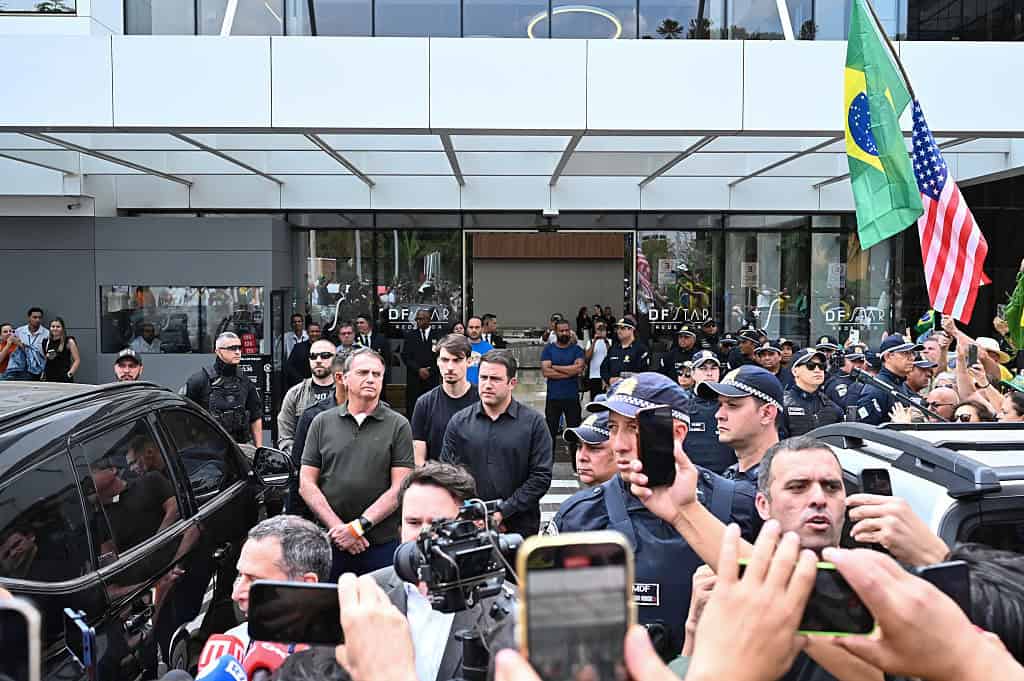
On July 30, the administration took a further measure and imposed Global Magnitsky sanctions on Judge Moraes. Unmoved by the U.S.’s actions, Judge Moraes imposed several restrictions on Bolsonaro, placing him on house arrest and making him wear an ankle bracelet. He was also prohibited from using social media, meeting with diplomats, speaking with others in the same trial, and giving interviews. The Trump administration also followed through on its tariff threats, which went into effect on August 6.
What implications do these actions have for trade and foreign policy?
The decision to impose tariffs in this manner is a weaponization and misuse of trade policy for political reasons. The actions against Judge Moraes are also a misuse of the Global Magnitsky Human Rights Accountability Act’s (GloMag) sanctions.
Representative James McGovern, a coauthor of GloMag, pointed this out in his August 20 letter to Secretary of State Rubio. Representative McGovern stated that “it is therefore disgraceful that the Trump Administration has deployed GloMag sanctions in a manner contrary to their purpose by undermining the Brazilian judiciary’s efforts to defend democratic institutions and uphold the rule of law.”
To discredit Judge Moraes and the judicial system, defenders of Bolsonaro say that this case is an example of judicial overreach prompted by a political agenda. The U.S. State Department’s 2024 annual human rights report on Brazil also repeats the anti-democratic narrative spread by Bolsonaro’s supporters, which claims that the courts are undermining free speech and democratic debate.
The Trump administration has made it commonplace to apply unconventional pressure tactics to bend countries to its will when officials disagree with a country’s decisions, or to get countries to carry out actions or policies in line with U.S. interests. In the Brazilian case, it’s a blatant effort to defend their political allies and punish the country’s judicial system.
Why do the Trump Administration and others defend Bolsonaro?
Bolsonaro’s presidential term overlapped with Donald Trump’s first term in office. The two men share a great affinity for one another. They use the same right-wing populist rhetoric, fiercely attack their opponents, and use words that incite fanatic supporters. Their governments have sought to promote anti-democratic policies, deny the climate crisis and health dangers posed by COVID-19, promote Christian nationalism, attack multilateralism, and pursue anti-gender, anti-diversity, and anti-reproductive rights agendas. Bolsonaro professed that his admiration for Trump led to his nickname “Trump of the Tropics.” The two men, their families, advisors, close associates, and political movements that support them hold each other in high regard.
Amongst their similarities is the fact that Trump and Bolsonaro were convicted of crimes by the courts in their respective countries. Trump sees a parallel between the legal cases against him and Bolsonaro’s situation. As such, he feels compelled to act to save his friend from the “witch hunt.” For Bolsonarismo, Trump’s reelection is a vindication that they would like to emulate in Brazil.
Other factors have contributed to the Trump administration’s actions towards Brazil. Bolsonaro’s son, Eduardo, a Congressman for the Liberal Party, temporarily fled to Texas in March 2025, claiming persecution from Judge Alexandre de Moraes. While in the U.S., he’s launched a full-blown advocacy campaign to seek revenge against Judge de Moraes. Prior to this, Judge Moraes had already inspired the ire of the right in Brazil and the U.S. when he temporarily banned X for not removing accounts that were spreading false information and inciting people to violence. Ultimately, X paid the fines imposed by the judiciary. The Brazilian and U.S. right consider these actions as judicial overreach and an effort to restrict freedom of speech.
What’s next in Bolsonaro’s case and U.S.-Brazil relations?
Bolsonaro’s lawyers plan to appeal the ruling, alleging the case was mishandled. A final decision could take years or even end up in a regional court. There is also the possibility that Bolsonaro and his allies could be granted amnesty. On September 18, an amnesty bill was fast-tracked and passed Brazil’s lower house of Congress, and is now under consideration in the Senate. The architects of this bill, Bolsonaro’s allies, claim that the Supreme Court is engaging in judicial overreach and that a constitutional amendment is needed to grant Congress the authority to vote via secret ballot before a lawmaker is arrested or convicted. The weekend of September 20-21, 2025, tens of thousands of Brazilians took to the streets to protest against the proposed legislation.
Regardless of how this all plays out within Brazil, it is essential that the Trump administration refrain from taking further action against Brazil that could influence judicial decisions or the general elections scheduled for October 2026.