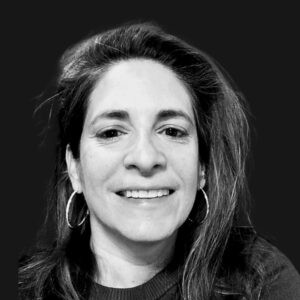
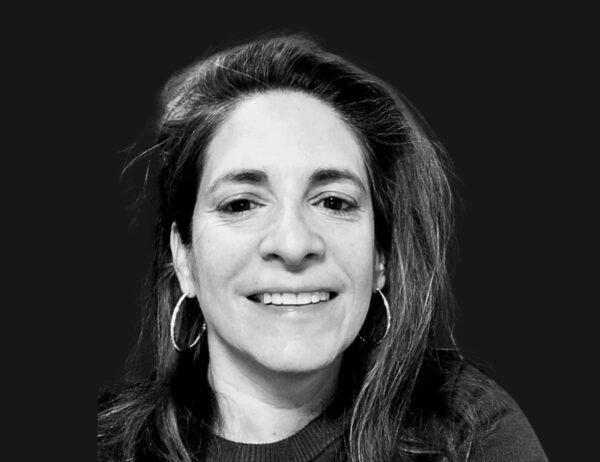

The landmark Inter-American Court ruling in favor of displaced Afro-Colombian communities, the five-year delay of the U.S.-Colombia free trade agreement, which forced a reduction in the killing of trade unionists and the protection of Afro-descendant workers, and the inclusion of the ethnic chapter within Colombia’s peace agreement. You may know these victories—but you might not know that Gimena Sánchez-Garzoli was instrumental in making them happen.
For someone who insists her work is collective, Gimena has left an undeniable mark. Born in Argentina, she grew up moving between countries after her family fled the dictatorship. “I was always the outsider who questioned the groupthink,” she recalls. Those experiences shaped her, but so did a deep conviction that diversity should be celebrated and a refusal to accept injustice. That combination has made her one of the leading voices on anti-racism and human rights in the region.
This year, WOLA’s Director for the Andes will receive the Louis B. Sohn Human Rights Award, a prestigious recognition in the field of human rights, for her decades of advocacy that centers Afro-descendant and Indigenous communities. Gimena’s first reaction when she learned the news? Surprise. “All of my work has really been collective with partners and colleagues,” she says. “To be individually singled out was very surprising.”
But Gimena’s impact over 25 years speaks for itself. She has consistently worked to hold the United States government accountable for its role in human rights abuses, particularly in Colombia, all while making anti-racism central to her work and amplifying the voices of those most affected: Afro-descendant communities, Indigenous peoples, internally displaced persons, and LGBTQ+ individuals.
Below is a Q&A with Gimena, in which she answers questions about her journey into human rights work, why anti-racism is central to her advocacy, and what gives her hope in turbulent times.
What first drew you to human rights work with a focus on anti-racism?
There are different reasons for my racial justice work. When I was about 15 years old, I was attacked in the New York City subway by people who were profiling me as belonging to a certain religion, which I wasn’t. That experience made me start reading and investigating why some people from this ethnic population had such hatred toward others. It also led me to interact with many different people and learn about their experiences, especially the struggles of Afro-descendant peoples. From there, I worked on environmental racism, then on issues affecting different ethnic groups, and eventually on ethnic minorities and conflict—specifically refugees and people impacted by displacement.
I also think that, unbeknownst to me, as a victim of Argentina’s dictatorship and having been forced to live in different countries as a result, this desire to work for human rights was always there. Since I was little, I have always been the outsider in many situations. I developed a very strong sensitivity to how people treated each other, and I always stood up to bullies. I think it was there for a very long time, but it didn’t really materialize until I was much older, when I started working in activism and politics.
Your work centers on those most impacted by U.S. policy—people who are most marginalized in Colombia, Haiti, Brazil, and Argentina. You work a lot with Afro-descendant, Indigenous, and LGBTQ+ communities. Why do you feel that this approach of amplifying marginalized voices is so important?
First, on the U.S. front, I was an international accompanier for Peace Brigades International during the peak of violence in Colombia. And while PBI’s approach is to prevent things from happening through protection by presence and political action, that was not always the case. I had worked with a community in Antioquia for a long time, first as part of their political network and then as an accompanier. This was an internally displaced community, and I had known them for many years. Seven members of that community, including a baby and children, were dismembered by paramilitaries of the AUC in collusion with a brigade of the Colombian Armed Forces, financed by the U.S. That experience made me really angry, and from there I became involved in advocating that this specific brigade no longer receive U.S. funding. To my knowledge, they have not received funding ever since.
This incident catapulted me into the U.S. human rights advocacy space. Then I was hired by WOLA, and I began to examine how U.S. policies, programming, and funding were involved in or linked to many of these human rights abuses.
Ever since I was very small, I have always defended people of all kinds, not just because I fit some of those categories, but also because I have always felt that diversity is a tremendous strength and something to be really celebrated. I always thought that imposing different ideas on other people, changing who they are, or trying to have them subsumed into another culture was not acceptable.
My work on Afro-descendant issues was solidified while I worked for one of my former bosses, Francis Deng, at the Brookings Institution. He’s Dinka, and his tribe was being enslaved by the Northern Sudanese. Through him, I learned a lot about the legacy of slavery around the world and about ethnic minorities. Since I was the only one who spoke Spanish at the office, I was assigned to Latin America and began going to Colombia to work with internally displaced Afro-descendant communities. At that time, there were mass displacements in Colombia’s Pacific region that affected Afro-descendants.
It snowballed from there, as I worked with all these different Afro-descendant leaders. Then they joined forces with Indigenous groups, and so my work became focused on issues related to Afro-descendant and Indigenous communities. But within that, I also worked with LGBTQ people and women who were in disadvantaged situations or being victimized because they were women. Throughout, protecting human rights defenders and social leaders has been imperative to guarantee that rights efforts could advance.
Can you explain a bit about your anti-racism work and how you incorporate it into your work?
I think that fundamentally scapegoating, attacking, persecuting, expressing violence toward, and alienating anyone due to their race is fundamentally wrong. And while I am not Afro-descendant, I have always strongly felt that in order to stop racism, it can’t just be Afro-descendant people defending themselves and trying to convince people not to be racist. As a white person, part of my responsibility as a human being is also to stand alongside them and say that’s wrong and take action when I see those types of injustices.
Afro-descendant people worldwide are disproportionately affected in so many ways, especially in the Americas and the Western Hemisphere, where they are ethnic minorities. You can see it in all the socioeconomic and violence indicators—they consistently face the worst outcomes, though there are exceptions. But to me, a major driving force behind this is racism and marginalization.
In Colombia, one thing that really stood out in all the cases I’ve worked on—because I’ve worked a lot on protecting people and seeking justice—is the stark difference in response between cases involving someone from an Afro-descendant background and those involving someone who isn’t. Indigenous cases often fall into this same pattern. Suddenly, the victims are stigmatized and blamed. All these prejudices come out: not wanting to help people, not wanting to acknowledge they’re internally displaced simply because they’re Afro-descendant or Indigenous, refusing to give them the same support that would go to mestizo or majority population victims. There’s also blaming female victims of color for somehow inciting sexual and other violence against them.
Right now, we’re experiencing a difficult moment for human rights in Latin America. What are your major concerns, or are there any new concerns that have emerged over the last year or so?
Every generation thinks its historical situation is unique, and actually, this moment isn’t so unique—challenges in history repeat themselves. Since World War II, the North American and European world has adopted (at least formally) a consensus on human rights, and the world has shown a certain respect for diplomacy and multilateralism. The anti-rights forces challenging this global consensus always existed, but did not have the tools and reach they do today. New factors, such as technological advances that have increased global interconnectedness, also play a role. It enables movements to become transnational and copy each other faster than before.
The biggest concern I have is apathy. Given the tremendous problems worldwide—across all sorts of inequalities—people will begin to think only of themselves and not of others. This can lead to people becoming desensitized to violence. With that, we see the level of tolerance shifting and shifting and shifting, until atrocities such as genocide are normalized. Or they begin to think that the problem is so huge that they can’t do anything about it and just focus on protecting themselves.
That’s the worst possible thing that could happen, and that’s what I’m most afraid of—especially for younger generations who didn’t live through the dictatorships in Latin America, particularly in the Southern Cone, who didn’t experience what happened in the ’70s and ’80s. They’re facing unsustainable and informal employment and public insecurity, so they see labor rights, protection of minorities, and migrants as a privilege that takes away from their well-being. This then becomes a slippery slope toward apathy about the mistreatment of others. That mistreatment left unquestioned then balloons and leads to grave abuses.
Do you have any examples of particular successes that you feel you’ve had or anything that really made a difference that you’re really proud of?
While there have been a lot of difficult situations—partners who’ve been killed, situations that could have been avoided that we weren’t able to help with, a lot of ugly things—there have also been some victories.
A huge one was being part of the collective effort that placed the U.S.-Colombia Free Trade Agreement on hold for five years, until a whole bunch of rights issues got attention and efforts were made to address them. It’s not so much that we wanted to stop it entirely—the free trade agreement eventually passed, and many of the negative rights consequences we predicted did happen. During the pause, it enabled debate on a wide range of issues and elevated the individual and collective rights of marginalized people and the environment in ways that hadn’t been done before.
Another one was working for justice for Afro-Colombians internally displaced due to Operation Genesis, a paramilitary-military operation that happened in 1997 in Colombia, which resulted in the mass displacement of thousands. I worked with those victims and the Comisión Intereclesial de Justicia y Paz, the human rights defenders who advocated for their physical protection and advanced their case from the time they were internally displaced until they returned to their lands. The returnees built a resistance community that defied the illegal armed groups still present in their collective territories, and 16 years later, the Inter-American Court of Human Rights ruled in their favor, finding Colombia responsible for not preventing the 1997 displacement of thousands of Afro-Colombians and the brutal murder of civilian Marino López Mena. While winning the case did not resolve all the injustices, it validated a group of victims who’d been stigmatized for over a decade.
And then there have been others—when human rights efforts finally work, and you get people released from captivity or prison, or you get people to act to stop things, or you get people out of horrible situations. Or when a peace agreement is actually signed, and efforts that looked impossible become a reality, like the ethnic chapter. There have been a lot of good things. It’s tricky because there may be a lot of bad, but those good ones inspire you to keep going.
What sustains you to keep working in human rights in the face of all these difficulties, and what gives you hope?
I think I’m an incredibly stubborn person, which may be good for human rights—I don’t know about other things. I really fundamentally believe that things can be and should be different, and I don’t want to accept certain things as normal. So I’m willing to do whatever it takes, or try to figure out how to help those who are trying to change reality, who have a different vision of what’s possible. I think what sustains me is my incredible stubbornness.
On a personal level, I really balance my life out. I learned early on, working in internal armed conflict scenarios and human rights, that if I wanted to do it in the long haul, I was going to have to balance it out. So I’m super into the arts, I dance, and I read like crazy about any random thing that has nothing to do with human rights. I do a lot of physical exercise because, while you need concentration, dedication, and persistence, you also need to meditate and clear your mind to keep doing it. I think it’s a combination of both that sustains me.
Humanity is resilient. The social movements in Latin America are incredibly inspiring. Human rights movements, women’s movements, Afro-descendant movements, Indigenous movements, LGBTQ+ movements—they’ve been resisting for centuries, and they keep going. They not only keep going, but they keep winning and advancing things. For me, that gives me tremendous hope. I think people in the United States could learn a lot from Latin American experiences, especially at this moment, which is incredibly turbulent and different for most generations here.
This is a period—even though, as I said, it’s not unique—when we all have to decide what we’re going to do. When I was younger, I read a book called Rhinoceros by a French writer, in which a town was taken over by a raging animal, like a bull in a china shop. Some people decided they wouldn’t do anything because they were too afraid, and they ended up becoming part of the destruction. Other people joined in breaking things because they thought that was the way to protect themselves. And then there were those people who said, “No, this is not how it’s supposed to be.”
I think this is a moment for people to really decide which of these roles they will play, because there’s no in-between or indifference at this time.