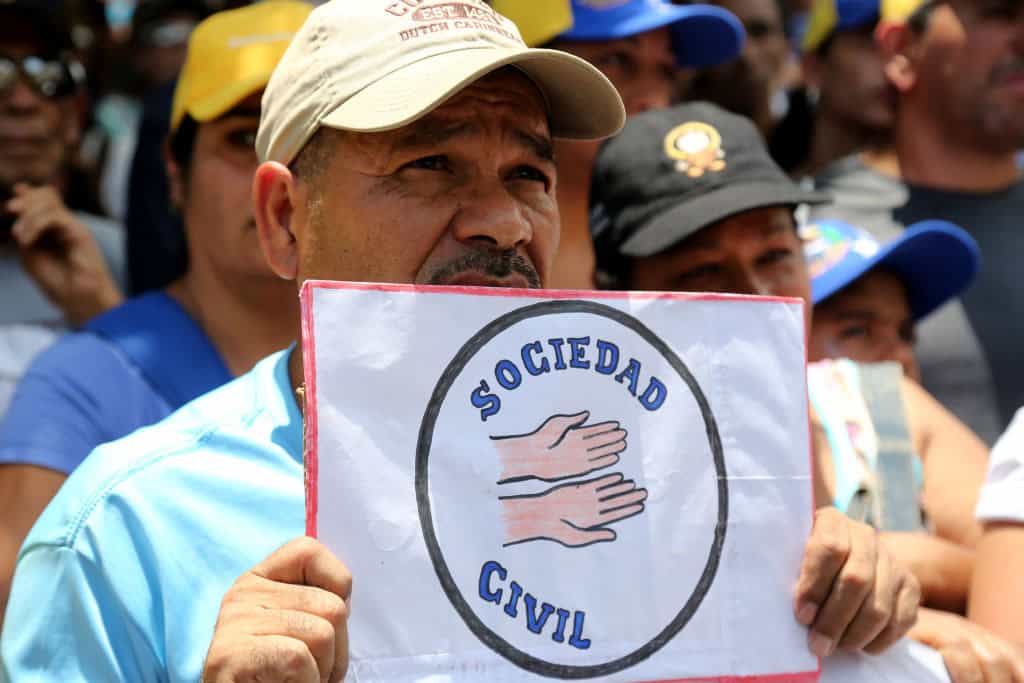




On November 15, 2024, Venezuela enacted a regressive law tightening state control over non-governmental organizations (NGOs). Popularly referred to as the Anti-NGO or Anti-Society Law, the Law on Oversight, Regularization, Operation, and Financing of Non-Governmental and Non-Profit Social Organizations requires NGOs to be authorized by the government to operate. The bill grants authorities discretion to deny authorization based on information about their sources of funding, to be evaluated according to political criteria or a perceived terrorism threat.
The NGO Oversight Law, coupled with the Trump administration’s rollback of U.S. foreign assistance allocated through cooperation programs with multilateral agencies and international organizations, has dealt a one-two punch to Venezuelan civil society. Hundreds of organizations now face the grim choice of going underground, relocating abroad, or shutting down operations altogether. Meanwhile, the White House’s efforts to discredit USAID and other channels of foreign funding have emboldened Venezuelan authorities, who have long sought to justify a crackdown against internationally funded human rights monitors and aid groups.
Despite immense threats to their personal safety and freedom, human rights defenders have played a vital role in documenting rights abuses over decades of the declining rule of law in the country. For some, however, the new NGO Oversight Law and cuts to vital U.S. funding spell a death knell.
What is the Anti-NGO Law?
The NGO Oversight Law, which had been a looming threat for several years, was passed by the National Assembly in August 2024 and mirrors restrictive NGO laws applied in Russia, Georgia, and Nicaragua. The new law undermines the constitutional right to freedom of association and threatens the closure of many organizations. It follows a playbook used by authoritarian regimes, perverting anti-terrorism laws, distorting recommendations from the Financial Action Task Force, and criminalizing cooperation with multilateral organizations to illegitimately consolidate power. By doing so, they evade their constitutional and international obligations, commit abuses with impunity, destroy democratic institutions, and avoid accountability to citizens and human rights organizations.
Authorities reserve the right to dissolve organizations accused of promoting “fascism” (Articles 15 and 23) or engaging “in activities inherent to political parties or organizations with political purposes” (Article 23). The Venezuelan government regularly labels the country’s opposition as “fascist,” allowing for broad discretion to apply the law to organizations that promote ideals or causes that are perceived as contrary to the ruling party. High on their priority of organizations to be targeted are likely to be those that expose human rights violations or oppose policies that undermine democracy.
The law is aimed at restricting organizations’ capacity to receive international funding. Indeed, the first sentence of a statement of motives that accompanied an earlier draft of the law refers to acts “promoted and financed from the centers of hegemonic power.” Long before the bill came into law, Venezuelan authorities publicly claimed to have a list of organizations whose activities would violate the precepts of the law.
How does the new NGO Oversight Law compare to other regressive laws enacted in Venezuela?
The NGO Oversight Law is the culmination of a decades-long assault on freedom of expression in Venezuela. Interior Minister Diosdado Cabello, widely viewed as the architect of the Venezuelan state’s repressive apparatus, has called for NGOs receiving U.S. funding to face investigations since at least 2014.
Former president Hugo Chávez himself sought to discredit and criminalize NGOs that spoke out against the country’s democratic decline. In 2010, groups allied with the governing United Socialist Party of Venezuela (PSUV) lodged criminal complaints against dozens of civil society organizations for “treason” and allegedly committing “crime[s] against national sovereignty.” This resulted later that year in the passage of the Sovereignty Law, which prohibited the international funding of civil society organizations for purposes related to promoting civic participation and allowed Venezuelan authorities to impose severe sanctions on organizations that failed to comply.
Successive measures have sought to criminalize certain forms of political speech while attempting to create a regulatory regime for NGOs. Following the July 28, 2024 elections in which the Maduro government claimed victory despite overwhelming evidence of its resounding defeat, authorities redoubled efforts to criminalize civil society, pushing through the NGO Oversight Law and advancing several other regressive measures.
Parallel to the NGO Oversight Law, the Simón Bolívar Law of 2024 enacted in November 2024 has introduced harsh penalties for individuals who express support for sanctions against Venezuela or reject the nation’s “legitimate authorities.” One of its most egregious articles (Article 23) provides for the creation of a national registry of natural persons and legal entities, national or foreign, suspected of engaging in “actions contrary to the state’s non-negotiable values and rights.” The mere shadow of doubt is now sufficient to label private citizens “suspect” and apply preventative measures against them—including confiscation of assets—without due process. In the context of the U.S. decision to revoke oil licenses granted to companies such as Chevron, the president of the National Assembly, Jorge Rodríguez, called on the prosecutor general to apply this law.
Venezuela’s National Assembly also has its sights on two additional bills that have not yet been approved—the Anti-Fascism Law and International Cooperation Law—that would grant further privileges to the state to dissolve organizations, meetings, and demonstrations at will. In sum, these extraordinarily arbitrary measures threaten to bring about the “civic death” of private citizens and organizations alike whose speech displeases the government.
Summary of Measures Restricting Venezuelan Civil Society
Venezuela has developed a comprehensive legal framework over the past decade aimed at criminalizing dissent, in flagrant violation of the 1999 Constitution and its international human rights obligations. The following list is not exhaustive and should also be considered in light of case law from the Supreme Court of Justice that also violates the right to freedom of association.
Click the arrow to expand a summary of restrictive civil society measures in Venezuela. The Anti-NGO Law is not an isolated instance, but rather the culmination of a long effort to close civic space in Venezuela.
| Full Name | Short Name | Date in which it entered into force (published in the Official Gazette) | Impact on Civil Society Organizations |
| Law for the Defense of Political Sovereignty and National Self-Determination | Sovereignty Law | December 23, 2010 | • Prohibited foreign funding for organizations that defend political rights or monitor the performance of public bodies. • Required NGOs receiving international funding to register with the government, although the law was never enforced. |
| Law Against Hatred, for Peaceful Coexistence and Tolerance | Law Against Hatred | November 10, 2017 | • Criminalized messages promoting “fascism, hatred or intolerance” and granted authorities broad discretion to determine what constitutes hate speech. • Imposed prison sentences up to 20 years for hate speech; used to criminalize journalists. |
| Joint Resolution No. 082 of the Ministry of People’s Power for Interior Relations, Justice, and Peace | Resolution on foreign NGO registry | October 27, 2020 | • Created a mandatory registry for international NGOs. • Required disclosure of all activities and funding sources. • Utilized to block foreign NGOs from working in Venezuela. |
| Administrative Proclamation 001-2021 and 002-2021 (Within the framework of the Organic Law Against Organized Crime and Terrorism Financing) | NGO registry proclamation | March 30, 2021 and May 3, 2021 | • Proclamation 001 did not come into force due to public outcry. It was amended and ultimately published as Proclamation 002 on May 3, 2021. Although some of the most problematic provisions from the original text were removed, the administrative order maintained: 1) an obligation for nonprofits to submit to the National Office Against Organized Crime and Terrorism Financing a list of national or foreign entities from which they receive contributions, and 2) a requirement for organizations to register with an Interior Ministry agency. • The provisions established in both texts were largely replicated in the NGO Oversight Law three years later. |
| Law on Oversight, Regularization, Operation, and Financing of Non-Governmental and Non-Profit Social Organizations | NGO Oversight Law (“Anti-NGO” or “Anti-Society” Law) | November 15, 2024 | • Mandated organizations to seek approval for inclusion in a special registry of approved NGOs. • Required detailed disclosure of funding sources and beneficiaries. • Allowed suspension of organizations deemed to promote fascism or incite hatred. |
| Organic Law of the Liberator Simón Bolívar Against the Imperialist Blockade and in Defense of the Bolivarian Republic of Venezuela | Simón Bolívar Law | November 29, 2024 | • Codified harsh penalties for any activities construed as supporting sanctions or rejecting the nation’s “legitimate” authorities. • Created a national registry of suspect individuals who, without due process, could face preventive measures including confiscation of assets. |
| Constitutional Law Against Fascism, Intolerance, and Neofascism | Anti-Fascism Law | April 2, 2024 (passed first debate), not yet approved | • Would expand government authority to restrict organizations labeled as “fascist.” • Would prohibit all meetings, demonstrations, and civil society groups that the state considers to promote fascism or “similar expressions.” |
| International Cooperation Law | International Cooperation Law | Draft debated in 2006, 2010, 2015, and 2022 (never formally passed), placed on the 2025 legislative calendar | • Would create a centralized authorization process to control the flow of foreign aid to NGOs. • Would mandate civil society organizations to provide information about their operations and beneficiaries to any citizen who requests it. |
How are NGOs reacting to the NGO Oversight Law?
After the law went into effect in November 2024, Venezuelan NGOs have two deadlines to comply with: by February 13, 2025 (90 days after the law came into effect), they had to obtain certification proving they have submitted the required documentation to the Public Registrar’s Office—with vague and arbitrary specifications—and by May 14, 2025 (180 days after the law came into effect), they must update their statutory bylaws and obtain registration certification. All organizations are required to submit detailed assembly minutes that include funding sources and audited financial statements. Some organizations have been ordered to turn over financial records since their founding, although the law does not say so. These requirements exceed what is constitutionally mandated, vary from office to office, and are prohibitively expensive since organizations must cover the costs of certified audits for each year of financial records.
Organizations have faced the difficult decision of submitting the documentation to continue operating, despite having no guarantees, certainty, or security. Organizations whose bylaws and institutional missions are determined to not satisfy the law must amend them by May 14, 2025, after which date the state will proceed to dissolve or fine organizations not in compliance.
While the bill does not explicitly require Venezuelan organizations to register as “foreign agents” as other bills modeled on Russia’s 2012 law, its intent is the same. Whereas it previously may have been sufficient for organizations to notify state authorities of their creation, all independent organizations (humanitarian, human rights, religious, and research, among others) now must seek authorization to exist in accordance with arbitrary criteria. This is especially concerning given the government’s documented policy of persecuting anyone affiliated—real or perceived—with the political opposition. Since it is in the Venezuelan government’s interest to allow humanitarian assistance, it is likely that the application of the law will be targeted at organizations that are inconvenient to those in power.
Already, on March 13, anti-corruption NGO Transparencia Venezuela (Transparency International’s Venezuela chapter) announced it had closed its doors and would continue operating from exile, noting their work was “incompatible” with the new regulations in Venezuela. Others have closed their doors without publicizing it so as to not put their members at risk. Members of Venezuelan civil society fear that as early as May, they could face the same fate as Nicaragua’s civil society, where the Ortega-Murillo regime has canceled the registry of over 5,400 organizations since 2018.
U.S. foreign aid freeze: A convenient measure for Maduro
As several international foundations ceased or reduced support for human rights, press freedom, and democracy programming in Venezuela in recent years, an increasing number of organizations looked to funding from U.S. government sources as a way to continue with their vital work. Therefore, the Trump administration’s January 20 executive order freezing U.S. foreign aid has functioned in tandem with the new NGO Oversight Law to accelerate the erosion of civic space in Venezuela. Local and international organizations received $210.8 million from USAID alone for varied projects in fiscal year 2023 concerning Venezuela, largely destined for humanitarian aid. With the exception of select programming for humanitarian assistance and one good governance program, USAID programs in Venezuela have been terminated. Implementers like the International Republican Institute (IRI) and the National Democratic Institute (NDI) have not been spared. In the case of the National Endowment for Democracy (NED), access to $239 million in congressionally approved funding was suddenly denied, creating a cash flow crisis that forced it to furlough 75 percent of its staff. After NED filed a lawsuit, the State Department took gradual steps for the restoration of access to the funds.
Many Venezuelan organizations receiving U.S. support have not been public about being funding recipients due to security concerns. The White House’s “radical transparency” executive order, which would make public “to the maximum extent permitted by law” information on which organizations received funding, has added to civil society’s fears. These organizations play a crucial role in exposing corruption, countering state media, and publishing reliable data on conditions in the country, putting them in the government’s crosshairs. At the same time, it is thanks to this work that the U.S. has access to reliable and timely data on political prisoners, including Americans who remain imprisoned in the country.
The freeze in U.S. foreign assistance has emboldened Venezuelan authorities’ repression of civil society and independent media, including convenient rhetoric for the Maduro government to further delegitimize NGOs and sow fear ahead of the February 13 registration deadline. Interior Minister Diosdado Cabello claimed to have a list of 500 people who were being investigated by the FBI for the USAID “corruption scheme.” While that figure is dubious, the sweeping claim hints at how the government may use the accusation of receiving U.S. funds as probable cause for criminal investigations. “Every member of the opposition is involved, they all received funds,” he observed. Cabello regularly appears in broadcasts, publicly naming media outlets, opposition figures, and human rights groups that he accuses of conspiring with USAID.
Diosdado Cabello’s threats against civil society are not empty. Acting on alleged ties to USAID funding, authorities arrested and disappeared Carlos Correa, a long-time human rights activist and founder of the NGO Espacio Público. He was released after nine days. Referring to his case, Cabello commented, “They aren’t NGOs. They’re money-laundering operations that use U.S. taxpayer dollars to conspire against governments.” Similar allegations were used to justify the arbitrary arrest of opposition organizer Luis Somaza, who has been imprisoned and held incommunicado since February 12 of this year. Attorney General Tarek William Saab, for his part, has announced 25 investigations against members of Juan Guaidó’s interim government for allegedly stealing USAID funds. USAID, however, notes it did not transfer funds directly to the interim government, but rather to private implementing partners that managed and disbursed them.
With Venezuelans facing unprecedented political persecution, Secretary of State Marco Rubio’s announcement of a humanitarian waiver to the foreign assistance freeze provided a glimmer of hope that some organizations would be exempted. Non-profit organizations in Venezuela provide life-saving aid to a population impoverished by years of economic crisis. However, it is unclear how many international organizations have successfully obtained a waiver from the U.S. Department of State and if that has translated into a restoration of the funds for local organizations.
The U.S. pause and subsequent cancellation of most U.S. funding, together with the NGO Oversight Law, pose an existential threat to the country’s civil society. In authoritarian states like Venezuela, once civic space is lost, it is difficult—if not impossible—to recover. At this crucial juncture, however, unless it reverses course through new programming or reversing cancelation notices, it would appear that the United States has all but withdrawn its backing for organizations crucial to collecting reliable data on the country’s human rights and humanitarian conditions.
With every passing day, more organizations are forced to lay off staff, dismantle infrastructure, and cease operations. With this, more valuable human rights defenders and humanitarian workers are fleeing the country. If Venezuelan civil society is to survive this latest wave of state repression, the U.S. must act urgently to express its backing of civil society organizations, including through retaining programs that support human rights, independent media, and democracy in the country.