


Table of Contents
I. July 28, 2024, as a pivotal moment in Venezuelan history
2. Post-election period: repression through “Operation Knock Knock”
3. A Sustained Attack: De Facto Suspension of Constitutional Guarantees
III. Regional, Local, and Legislative Elections Without Guarantees or Participation
IV. A Constitutional Reform on the Horizon? The Push Toward the Communal State
V. The Complex Humanitarian Crisis Continues
VI. The Venezuela–United States Relationship between 2024 and 2025
1. Revocation of Oil Licenses and Imposition of New Individual Sanctions
b. New Administration: Change in Policy
2. Freezing and Termination of Foreign Aid
VII. Some Conclusions on the Current Landscape
Executive Summary
July 28, 2024, marked a pivotal moment in Venezuela’s recent history. Presidential elections were held amid a context of civic space closure and systematic political persecution. Despite these adverse conditions, millions of people exercised their right to vote, hoping for a democratic and peaceful transition. However, this expression of the will of the people was met with a new wave of state repression, which led to multiple and serious human rights violations.
This report covers the period from January 2024 to July 2025. Given the overwhelming flow of events, the facts described and their analysis are current as of July 23, 2025. The report aims to consolidate key findings from secondary sources and qualitative evidence gathered through ongoing monitoring of the national and international context. The analysis is based on a predominantly descriptive methodology, supported by a review of reports and information produced by civil society organizations, statements from international bodies, and restricted-access sources of information compiled as part of WOLA’s advocacy and accompaniment work.
Based on the information obtained, this report concludes that between July 2024 and July 2025, a pattern of state repression became consolidated, one aimed at suppressing political participation and reinforcing authoritarian control over power. This pattern included arbitrary detentions, including of relatives of opposition leaders; illegal raids; enforced disappearances; judicial harassment; and the deaths of political prisoners while in custody. These events are not isolated incidents. According to the United Nations Independent International Fact-Finding Mission on Venezuela, all of these violations are part of a state policy intended to silence and neutralize dissent.
Following the 2024 presidential elections, and without the National Electoral Council (CNE) publishing the results or the supporting evidence, people were called to the ballot box again. The regional and legislative elections held in May 2025, as well as the municipal elections scheduled for July 27, took place under conditions that fail to meet the minimum standards to be considered free and democratic.
At the same time, the government has promoted the so-called “Communal State,” a political model that, under the guise of “participatory democracy,” replaces the constitutional order with centralized local power structures that lack guarantees of pluralism, free participation, or accountability. The intention to reform the Constitution based on these principles poses a direct threat to the democratic model, the rule of law, and the separation of powers.
The gradual closure of civic space has also been deeply alarming. Civil society organizations face arbitrary cancellations of legal status, abusive audits, smear campaigns, and regressive laws, including one that criminalizes the work of NGOs. Added to this are legislative attempts seeking to label these organizations as “fascists,” along with a sustained increase in digital censorship, surveillance, and information blockades. Despite this hostile environment, expressions of civic resistance persist, keeping the social fabric and the defense of human rights alive within the country.
At the international level, the landscape has undergone significant changes. In January 2025, Nicolás Maduro assumed a new presidential term illegitimately. This event coincided with the start of Donald Trump’s new administration in the United States, which profoundly reconfigured foreign policy towards Venezuela. Among the most significant changes were the revocation of oil licenses, the reactivation of deportation flights, and the tightening of other immigration measures, as well as the partial suspension of humanitarian aid and the dismantling of assistance programs. Additionally, bilateral negotiations focused on political exchanges without a human rights approach.
WOLA’s positions outlined in this text are based on international human rights law, as developed by international protection systems. They are also deeply influenced by the work of Venezuelan civil society, in an effort to amplify the voices and experiences of grassroots movements and social activism on the front lines of the struggle for democracy, justice, and dignity in Venezuela. In light of the countless violations described in the post-electoral context of this report, Venezuela demands a firm, coherent, and committed response in defense of human rights.
To this end, WOLA proposes a series of recommendations aimed at governments worldwide, with a particular emphasis on the United States. We urge governments to prioritize the defense of human rights and the restoration of democratic order in Venezuela as a central axis of any potential negotiations; to strengthen international mechanisms that are essential for uncovering the truth and pursuing justice; and to protect persecuted individuals who have fled the country by streamlining asylum and refugee processes, as well as ensuring access to regularization and socioeconomic integration pathways.
WOLA also calls for sustained support to civil society through consistent funding for organizations dedicated to human rights defense and the protection of civic space in Venezuela. We urge the international community to condemn laws that stigmatize and obstruct their work. Finally, we call for an end to the criminalization of Venezuelan migrants and the establishment of a coordinated humanitarian response that ensures their protection and full respect for their rights.
Introduction
It has been one year since the Venezuelan people went to the polls to elect a new president. July 28, 2024, marks a landmark in Venezuela’s recent history, as the population participated decisively in the pursuit of pathways toward a democratic and peaceful transition, despite a context of civic space closure and political persecution. This hope for change was met with unprecedented repression, resulting in a new list of countless victims of human rights violations, attacks against civil society, and the shrinking of spaces for social life. Nevertheless, a civil society still exists in Venezuela; it is resisting the blows of authoritarianism and is determined to preserve itself within the territory.
The landscape has changed dramatically since July 2024—not only in Venezuela, but also globally. Almost simultaneously with Nicolás Maduro’s illegitimate assumption of power in January 2025, Donald Trump began a new presidential term in the United States. This led to a significant shift in the U.S. approach to the Venezuelan situation. From the revocation of oil licenses, to the visit of a Trump administration official to Venezuelan territory to negotiate a prisoner exchange, the resumption of deportation flights to Venezuela, and the tightening of anti-immigration policies targeting the Venezuelan population in the U.S. The 2024–2025 period has been marked by overwhelming developments. Given the constant pace of these events, the facts described and the analysis presented are current as of July 23, 2025.
This is therefore a timely moment for the publication of this report, which aims to provide an account of the most relevant events, accompanied by an analysis of them in light of the current context, as well as to offer recommendations to decision-makers and key stakeholders who can influence the search for democratic openings in Venezuela—particularly the United States. Given the complexity of the situation in Venezuela and the magnitude of the serious human rights violations committed, this account is not intended to be exhaustive, but rather representative of the most significant developments that took place during the period under review. The report relies on a predominantly descriptive methodology, grounded in a document review of reports produced by civil society organizations, statements from international bodies, and restricted-access information sources collected as part of WOLA’s advocacy and accompaniment work. The analysis spans the period from January 2024 to July 2025 and aims to systematize key findings based on primary and secondary sources, as well as qualitative evidence gathered through ongoing monitoring of the national and international contexts.
The report addresses the significance of the events of July 28, 2024, and describes the sustained policy of political persecution against the opposition—or those perceived to be part of it—and its impact on the closure of civic space. It then outlines the context in which the regional and legislative elections took place in May 2025, along with the call for municipal elections scheduled for July of the same year. The report also analyzes progress toward consolidating a Communal State in Venezuela, a political project aimed at centralizing political and economic control within local structures that replace the democratic model established in the Constitution. Given its influential role, the report also examines the position of the United States and its relationship with Venezuela during this period. Finally, the report provides concluding reflections on the current situation in Venezuela and offers a series of recommendations for key stakeholders.
I. July 28, 2024, as a pivotal moment in Venezuelan history
Unlike the military dictatorships of the past, contemporary authoritarian governments often hold elections frequently, but with few or no guarantees of transparency. This presents major challenges and dilemmas for opposition movements in their efforts to achieve democratic transitions. Venezuela is no exception. After the opposition decided not to participate in the widely criticized and internationally unrecognized[1] 2018 presidential elections, which were called following the breakdown of constitutional order in 2017,[2] a series of political events led to a change in the opposition’s stance ahead of the 2024 presidential elections.
Following multiple failed negotiation processes between opposition and government representatives, there were at least two key developments leading up to the 2024 elections that are worth highlighting. On the one hand, the negotiation that led to the appointment of a new National Electoral Council (Consejo Nacional Electoral, CNE) in 2021, and on the other, the signing of the Barbados Agreements in 2023. Both events, in which the Kingdom of Norway played a mediating role,[3] contributed significantly to the opposition’s decision to participate in the presidential elections.
In 2021, the authorities of the CNE were renewed for the first time in 18 years. Five new board members were appointed, two of whom had no ties to the ruling party: Enrique Márquez, who is currently arbitrarily detained in the notorious torture center El Helicoide, and Roberto Picón, who is now in exile. This new composition of the CNE was responsible for creating a system to verify electoral tallies using a QR code. The system was first implemented during the 2021 regional elections.[4] According to the Carter Center, “The QR code allows for automatic reading of the results with a smartphone to capture error-free data during quick counts and parallel tabulation exercises.”[5] This was a decisive tool in the opposition’s effort to document electoral results in real time and demonstrate the victory of its candidate.
The authoritarian government and the opposition’s Democratic Unitary Platform (Plataforma Unitaria Democrática, PUD) were part of a formal negotiation process mediated by Norway. In these negotiations, the Barbados Agreements were signed on October 17, 2023, establishing a roadmap for holding free elections.[6] The following day, the United States issued a series of licenses to temporarily ease sectoral sanctions imposed on Venezuela,[7] with the aim of creating incentives for the government to fulfill its commitments. On October 22, 2023, the opposition held primary elections to select a unified candidate, resulting in the election of María Corina Machado.
In parallel with efforts to find solutions through a dialogue process supported by international actors, irregularities continued to occur, undermining the integrity of the electoral process. On June 14, 2023, the National Assembly announced the resignation of both the principal and alternate members of the CNE, despite the fact that they still had five years left in their constitutional term. On August 24, a new CNE was appointed. It was led by Elvis Amoroso, an outspoken supporter of Venezuela’s ruling party, the Unified Socialist Party of Venezuela (Partido Socialista Unido de Venezuela, PSUV), who had previously served as Comptroller General. In that role, Amoroso was responsible for a series of political disqualifications against opposition figures without due process, most notably the disqualification of María Corina Machado.[8]
Despite the agreement on electoral conditions signed in Barbados stating that all presidential candidates and political parties would be authorized to participate in the presidential election, provided they met the requirements established by Venezuelan law,[9] authorities continued to impose illegal obstacles to political participation. In November 2023, the parties involved in the negotiation process agreed on a procedure to review political disqualification measures, which consisted of reviewing precautionary appeals before the Political-Administrative Chamber of the Supreme Tribunal of Justice (TSJ in Spanish).[10] Although the disqualified candidates approached the court in good faith, on January 26, 2024, the TSJ announced its decision to uphold the political disqualifications of María Corina Machado and Henrique Capriles Radonski.
Such decision followed the appointment, on January 18, 2024, of Caryslia Rodríguez as President of the TSJ, a member of the PSUV. There is extensive documentation on the lack of independence and impartiality of the judiciary in Venezuela,[11] which has played a significant role in undermining the conditions for a credible presidential electoral process. Just one week after the opposition’s primary elections, Rodríguez, then acting as justice of the Electoral Chamber of the TSJ, had issued a ruling[12] suspending all effects of the different phases of the electoral process carried out by the National Primary Commission, and ordered the Attorney General to investigate alleged electoral offenses and other crimes. She was now being rewarded with the presidency of the country’s highest court.
Independent local organizations, the political opposition itself, as well as international independent observers and international organizations, documented serious irregularities throughout the electoral process. Violations of electoral regulations during the convocation process, failure to comply with the electoral timeline, deficiencies in the voter registration and update process, electoral bias, and violations of the right to access information, rendered the election incompatible with international electoral standards.
For example, of the 38 organizations authorized by the CNE to nominate candidates, 11 of them (equivalent to 28.94 percent) were either directly intervened by the TSJ or had rulings issued against them.[13] Intervention refers to the process by which the TSJ removes the leadership of a political party or association and imposes an ad hoc board, appointing its members.
María Corina Machado, the winner of the opposition’s primary, was arbitrarily barred from running in the election, and therefore was not allowed to participate in the presidential election. Nor was she permitted to substitute her candidacy with that of Corina Yoris.[14] Ultimately, the CNE authorized the registration of Edmundo González Urrutia as a candidate. No woman was allowed to run for the presidency.
Despite having an electoral process marked by persecution, the opposition remained committed to the electoral path, and voter participation was massive.[15] In part, confidence in the vote was tied to the strength of the Automated Voting System and its auditability. The system produces a verified paper trail, allowing the opposition to verify the results tallied by the electronic voting machines.
Shortly after midnight on July 28, the president of the CNE, Elvis Amoroso, issued the first bulletin announcing “irreversible” results that declared Nicolás Maduro the winner with 51.20 percent of the vote. He explained the delay in issuing the bulletin was the result of an “attack on the data system.” This claim was later echoed by Maduro himself and then by the Attorney General on July 29. That same day, in a rushed move, before the vote count was finalized and without publishing any supporting evidence, the CNE officially proclaimed Nicolás Maduro as the winner.
According to Venezuelan law,[16] the final tally report must include a detailed breakdown of the tabulated results by voting station. As of the date of this report’s publication, one year after the election, the CNE has not published those results, and its website remains offline.
The opposition, organized through the “Comando con Venezuela,” developed a decentralized system to monitor each voting station and transmit real-time electoral results using the QR codes from the tally sheets.[17] According to these publicly available results, Edmundo González Urrutia received at least 7,443,584 votes (67 percent of the total).[18] The verification of these tally sheets by independent media,[19] academics,[20] and international organizations,[21] along with public statements from electoral observation missions accredited by the CNE,[22] generated significant international pressure calling for transparent publication of the official results. As of the publication of this report, one year later, the CNE has not responded to this demand.
In an effort to bring closure to the matter and amid numerous protests across the country, Nicolás Maduro filed an appeal with the TSJ, although it was legally and procedurally inadmissible.[23] The following day, in record time, the Electoral Chamber accepted the appeal and, after an irregular expert review, validated the results announced by the CNE that declared Nicolás Maduro the winner. That TSJ ruling remains unpublished.[24] It is important to note that the issuance of this decision does not exempt the CNE from its obligation to publish the vote counts from each polling station. Nevertheless, based on these events, Nicolás Maduro was sworn in on January 10, 2025, for a new six-year presidential term. All of this took place in a context marked by fierce political persecution and sustained repression, as described below.
II. Political Persecution Policy: Sustained Repression and the De Facto Suspension of Constitutional Guarantees
The poor electoral conditions in which the presidential elections took place were exacerbated by a context of violence and political persecution. Although human rights violations intensified during the electoral period, the events described in this chapter are not isolated incidents but part of a state policy aimed at targeting the civilian population in Venezuela. This has been affirmed by the United Nations Independent International Fact-Finding Mission on Venezuela (FFM), which has found reasonable grounds to believe that between 2014 and 2024, crimes against humanity have been committed in Venezuela as part of a state policy to silence, discourage, and suppress opposition figures or those perceived as such, as well as government critics.[25]
As the FFM has noted in the past, Venezuelan authorities activate and deactivate “hard” and “soft” mechanisms of repression against real or perceived government opponents. These mechanisms are employed “with varying degrees of intensity depending on the nature and perceived significance of social dissent,” and they reinforce each other.[26] The FFM concluded that “after the July 28, 2024, presidential elections, the system of harassment and violent repression against opposition figures or those perceived as such was intensely and rapidly reactivated”.[27]
Along the same lines, the Inter-American Commission on Human Rights (IACHR) condemned the institutional violence during the electoral process in Venezuela and highlighted that “the regime in power is sowing terror as a tool to silence the citizenry and perpetuate the ruling authoritarian regime in power”.[28] In a subsequent statement in January 2025, the IACHR denounced the continued use of state terrorism practices to instill fear and exert control over the population.[29]
To understand why the expression sustained repression is used, it is important to distinguish three phases within the 2024–2025 period:
1. Pre-election period:
In addition to political disqualifications, a long-standing practice in Venezuela that has prompted multiple international statements on the matter,[30] obstacles to the registration of opposition candidates, discrimination against the right of Venezuelans abroad to vote, and other previously mentioned electoral irregularities, a series of additional human rights violations occurred. These included arbitrary detentions, enforced disappearances, and harassment of opposition figures, journalists, and human rights defenders.[31] The IACHR found that the State’s actions revealed “(…) a systematic pattern of political persecution and repression in Venezuela in the months leading up to the 2024 elections”.[32]
2024 began with Nicolás Maduro’s launch of the “Furia Bolivariana” Plan on January 18. The president himself described it as a “civic, military, and police plan to confront any terrorist attempts”.[33] On January 23, opposition party headquarters were vandalized, and arbitrary arrests were reported in 11 states. On that same day, without a court order, coordinators of the opposition party Vente Venezuela (led by María Corina Machado) in the states of Yaracuy (Luis Camacaro), Vargas (Juan Freites), and Trujillo (Guillermo López) were detained by the Bolivarian National Intelligence Service (SEBIN in Spanish). This marked the beginning of a long list of arrests of Vente Venezuela members, including Emil Brandt Ulloa, the director of the campaign in Barinas, and Henry Alviárez and Dignora Hernández, members of the organization and campaign team in Caracas. Four out of the nine national leaders of the Comando Con Venezuela, which is the political platform formed to support the candidacies of María Corina Machado and later Edmundo González Urrutia, had to take refuge in the Argentine embassy in Caracas. They are now in exile. Meanwhile, three others (Henry Alviárez, Luis Tarbay, and Perkins Rocha) remained arbitrarily detained at the time this report was finalized.[34]
One case deserves further analysis because the government used it to pressure the opposition. This is the case of the Comando Con Venezuela members who sought diplomatic asylum at the Argentine embassy in Caracas. Arrest warrants were issued against six members of the Comando con Venezuela, accused of terrorism, conspiracy, and treason. They stayed there for over a year. Following the announcement of the electoral bulletin by the CNE in July 2024 and Argentina’s refusal to recognize it, Venezuela severed diplomatic relations with Argentina, and Brazil took over custody of the embassy. However, on September 7, the Ministry of Foreign Affairs unilaterally revoked Brazil’s permission to guard the diplomatic premises. For more than a year, six people remained inside the embassy, surrounded by armed officials, with interruptions to electricity, internet, and water supplies. In December 2024, one of the people inside, Fernando Martínez Móttola, decided to leave the embassy and surrender to the Prosecutor’s Office. Just a few weeks later, he died from a brain hemorrhage, and it is believed his health may have deteriorated due to prolonged confinement and lack of medical attention.[35] This case, in which key members of Comando Con Venezuela were continuously at risk of arbitrary detention, was a constant source of pressure on the opposition in the electoral context.
The IACHR documented at least 50 detentions of opposition members, human rights defenders, and social leaders during the first half of 2024,[36] although local organizations report a higher number.[37] Many of the detentions of regional or local leaders occurred after María Corina Machado visited those areas as part of the electoral campaign. Examples include the cases of Emil Brandt Ulloa (Barinas) and Víctor Castillo (Portuguesa). Authorities also closed and fined commercial establishments used by opposition members, as well as confiscated means of transportation. There were reports of arbitrary detentions and harassment of providers of services to the opposition campaign, such as the sound system for public events. The opposition documented blockades of public roads by authorities and acts of vandalism against vehicles and other property.[38]
The persecution was not limited to political activists. On February 9, 2024, human rights defender and academic Rocío San Miguel was detained at Maiquetía International Airport and remained in a situation of enforced disappearance for six days[39]. This became an emblematic case that generated great fear within the human rights movement. In this case, authorities also detained five other family members, employing a pattern of family persecution with an unprecedented level of intensity. The United Nations Office of the High Commissioner for Human Rights (OHCHR)[40] denounced this forced disappearance, leading to the Ministry of Foreign Affairs to suspend its activities and expel its team from the country.[41]
Some common patterns in these arbitrary detentions include arrests without judicial warrants; denial of information about the detainees’ whereabouts for several days (effectively constituting enforced disappearances); imposition of public defenders against the will of the detainees and/or their families; and prolonged isolation. Another pattern is to hold arraignment hearings virtually, without the presence or knowledge of trusted lawyers or family members, as well as the denial of access to judicial files.
On July 17, just days before the presidential elections, Nicolás Maduro warned that “The fate of Venezuela in the 21st century depends on our victory on July 28. If you don’t want Venezuela to fall into a bloodbath, into a fratricidal civil war caused by the fascists, let’s ensure the greatest success.”[42] The goal of the pre-election repression was to neutralize opposition leaders and collaborators, discourage electoral participation, and intimidate the entire Venezuelan society.
2. Post-election period: repression through “Operation Knock Knock”
Following the CNE’s refusal to publish the electoral tallies and disaggregated results by voting station, as required by electoral law, and in light of the events described in the first section of this report, allegations of electoral fraud quickly emerged—prompting a response from citizens who took to the streets to demand transparency and respect for the popular will. The Venezuelan state reacted with a wave of repression that reached the threshold of state terrorism,[43] committing serious human rights violations.
The actions of the CNE and other authorities sparked massive and spontaneous protests nationwide. According to the human rights organization Provea, between July 29 and 30, 915 protests were recorded in 20 states; 138 of them were suppressed, and armed groups were present in 119[44]. According to official figures, 25 people were killed and 2,400 were arrested.[45] The mere existence of a message or photograph on a cell phone indicating support for the opposition was enough to incriminate a person. In the immediate aftermath of the election, the repression was massive and widespread. On August 1, 2024, Nicolás Maduro said in a speech: “Tocorón and Tocuyito (…) criminals (…) I’m going to put them all in Tocorón, in maximum security prisons, so they can pay for their crimes before the people.”[46]
An innovative method of repression and whistleblowing was the use of the VenApp application to report protesters and opposition figures.[47] This app had originally been developed to manage social programs, but in the post-electoral context, a tab was added to report so-called “fascist guarimbas.” Nicolás Maduro himself publicly ordered the use of the app for this purpose. Multiple national and international efforts eventually led to the app being removed from Google Play and Apple Store. Digital censorship and repression, including the blocking of YouTube, TikTok, and Twitter, as well as the use of VPNs to circumvent censorship, were also widely documented.[48]
The authorities framed this series of human rights violations as part of what is known as “Operation Knock Knock”.[49] The phrase, which refers to the onomatopoeia of knocking on a door and is popularly recognized in Venezuela from a traditional Christmas song, was coined by Diosdado Cabello in 2017.[50] This operation is marked by raids and arrests without judicial warrants, enforced disappearances, and institutionalized terror. It was widely promoted by the Minister himself, as well as on the social media accounts of the General Directorate of Military Counterintelligence (DGCIM) and the Scientific, Criminal, and Forensic Investigations agency (CICPC). The posts were accompanied by horror movie-themed music, distorted voices, and frightening imagery. As noted by the UN’s FFM, most of the individuals detained under this operation came from low-income neighborhoods and were identified by security forces through videos, photographs, or reports from government sympathizers.[51]
In the context of these mass arrests, at least 142 children and 180 women were detained, along with 16 persons with disabilities and 5 Indigenous individuals.[52] The mass detention of these populations is unprecedented. Torture of individuals detained for political reasons in Venezuela is widespread.[53] However, it is particularly important to highlight reports of torture against children, including beatings that resulted in the loss of teeth and chest burns caused by electric shocks used as a method of torture.[54]
By July 2025, one year after the elections, there were still four adolescents unjustly deprived of their liberty.[55] The detention conditions are deplorable; there have been recorded deaths in custody of people arrested in the electoral context due to various illnesses acquired in prison or from lack of treatment for pre-existing but treatable conditions, as well as deaths shortly after release.[56]
Although a series of conditional releases took place between November 2024 and January 2025,[57] the judicial processes have not been dismissed, and the individuals remain under a court-ordered reporting regime. To date, no criminal investigations are known to have been opened regarding the allegations of extrajudicial executions, torture, arbitrary detentions, or enforced disappearances committed during this period.[58]
A new pattern of repression was identified. The arbitrary annulment of passports without legal justification by the Administrative Service of Identification and Migration (SAIME in Spanish). The Center for Justice and International Law (CEJIL) documented 40 cases involving human rights defenders, social leaders, journalists, and family members,[59] and the IACHR described this as a “practice aimed at limiting free movement and instilling terror”.[60] The measure, which persists a year later, limits the right to free movement and “constitutes a form of reprisal for the defense of human rights, the exercise of freedom of expression, and political participation”.[61]
It was precisely in this repressive context that a long-standing threat looming over civil society materialized. The National Assembly’s approval of the Law on Oversight, Regulation, Action, and Financing of Non-Governmental Organizations and Related Entities.[62] This occurred on August 16, 2024, and the law took effect in November of the same year. This law, which requires organizations to obtain government authorization to operate in the country, undermines the constitutional and human right to freedom of association and threatens many organizations with imminent closure.[63] It includes seven types of sanctions (fines, annulment of registration, preventive suspension, dissolution, prohibition of registration, annulment of registration for organizations not domiciled in the country, and expulsion from the territory of foreign members of such organizations) and outlines 17 circumstances under which these sanctions could be applied. One of its key aims is to restrict the ability of organizations to receive international funding. Under this regulation, authorities reserve the right to dissolve organizations, with broad discretionary power to apply the law against those promoting causes or ideals perceived as contrary to the ruling party.
Just days after the law’s approval, on August 27, Diosdado Cabello, who had formally been out of the cabinet for 14 years, was appointed Minister of Interior, Justice, and Peace. From his weekly television show Con el Mazo Dando, which he has hosted since 2014, Cabello routinely discredits opposition figures, journalists, human rights defenders, and labor leaders, often as a prelude to their persecution or arrest. As Minister, he oversees public order, meaning that all agencies responsible for law enforcement and intelligence report to him. His appointment further reduced the chances of opening a dialogue to resolve the political crisis through negotiation.[64]
In addition to the Law on Oversight, another law with major implications for the closure of civic space entered into force on November 29, 2024. Known as the Bolívar Law,[65] this regulation imposes severe penalties, including up to 30 years in prison and a 60-year political disqualification, on individuals who express support for sanctions against Venezuela or reject the “legitimately constituted authorities.” There are also ongoing threats to pass at least two additional bills that would further restrict civic space: the Bill Against Fascism, Neo-Fascism, and Similar Expressions, which passed its first reading in April 2024, and the International Cooperation Bill, which the National Assembly has included in its 2025 legislative agenda.
On September 2, a judge with jurisdiction over terrorism cases issued an arrest warrant for Edmundo González Urrutia on charges including alleged usurpation of functions, forgery of public documents, and conspiracy. On September 7, in order to safeguard his freedom and physical integrity, the presidential candidate left Venezuela.[66] He has since been in Madrid, Spain, where he is seeking political asylum.
3. A Sustained Attack: De Facto Suspension of Constitutional Guarantees
Although the methods of repression have varied, the attack on the civilian population as part of a policy of political persecution has not ceased.[67] Without the publication of electoral results or any evidence of Nicolás Maduro’s alleged victory, the date on which a new presidential term was set to begin arrived, January 10, 2025.
A report published at the end of August 2024, anonymously by civil society due to fears of reprisals, identified that 76 articles of the Constitution, which guarantee rights, were being systematically ignored. As a result, 21.7 percent of the Constitution had been effectively suspended in practice.[68]
During the first 15 days of 2025, 84 new detentions were recorded.[69] On January 7 alone, there were seven arbitrary detentions and enforced disappearances recorded. One of the victims was Rafael Tudares Bracho, the son-in-law of Edmundo González Urrutia. While in most cases of enforced disappearance the person’s whereabouts become known after a few days, this case stands out because, more than six months after his detention, the whereabouts and physical condition of Rafael Tudares Bracho remain unknown.[70] According to reports from his wife, he was assigned a public defender against his will, and despite numerous unsuccessful visits to the courts, without access to his case file, she learned that he is being charged with the same crimes as her father. With Edmundo González Urrutia in exile and an arrest warrant issued against him, the authorities are targeting his family in an effort to pressure him into abandoning his political activity.
That same day, January 7, Carlos Correa, a well-known human rights defender and director of the NGO Espacio Público, was also detained.[71] He was forcibly disappeared for nine days before being released. Another significant case from that date is Enrique Márquez, who had served on the board of the CNE (appointed in 2021) and participated in the July 28 elections as a presidential candidate for the party Centrados.
The day before the inauguration, a protest took place in Caracas, during which María Corina Machado made her first public appearance in several months, despite the high risk of detention. That day, Machado was detained for various hours, forced to record a video, and then released.[72] Human Rights Watch verified photos and videos, concluding that the visual evidence was consistent with the opposition leader’s account.[73] Since then, following the detention of much of her close team and Edmundo González Urrutia’s exile, Machado has remained in hiding and has not made any further public appearances.
The United Nations High Commissioner for Human Rights documented 28 cases of people who remain disappeared following the presidential elections.[74] As noted in a joint statement by the IACHR and the UN Working Group on Enforced or Involuntary Disappearances:
“The increasing use of enforced disappearance as a weapon to silence opposition members, those perceived as such, pro-democracy activists, and human rights defenders aims to create a deterrent effect throughout society and is fueled by widespread impunity and selective justice”.[75]
A new pattern that worsened during this period was the arbitrary deprivation of liberty and enforced disappearance of foreign nationals accused of participating in conspiracies against the government. In February 2025, Nicolás Maduro announced that “more than 150 foreign mercenaries”[76] had been detained. In most cases, the right to consular assistance of foreign nationals, enshrined in the 1963 Vienna Convention on Consular Relations, has been violated.
Without having completed the audits mandated by Venezuelan law, published the electoral results, or reactivated the CNE website, legislative and regional elections were called. In anticipation of these elections, which took place on May 25, 2025, a new peak in repression emerged. On May 9, human rights defender and Provea member Eduardo Torres was detained; he remained forcibly disappeared for five days and is currently unjustly held in El Helicoide.[77] On May 23, the Minister of Interior announced the detention of opposition leader Juan Pablo Guanipa and 70 other people, accusing them of being “terrorists” and attempting to “sabotage” the regional and legislative elections.[78] It is important to note that Guanipa remains forcibly disappeared, as the authorities continue to withhold information about his whereabouts.[79] At least 17 other foreign nationals were also detained.[80]
The mass repression that took place in the days immediately following the election has now become more selective, but it has not stopped at any point. The severity of that period also changed society’s behavior: people have continued to protest and express their discontent, but through forms other than mass demonstrations, in order to protect their freedom and personal integrity.
III. Regional, Local, and Legislative Elections Without Guarantees or Participation
Following the widespread violation of the Venezuelan population’s right to political participation on July 28, 2024, and without having adopted any recommendations made by international electoral observation missions in the past, elections for governors and legislators were held on May 25, 2025, and local elections were called for July 27 of the same year. Since the presidential election, the website of the electoral authority has remained disabled, demonstrating the opacity surrounding these subsequent electoral processes. Electoral experts agree that the CNE “did not provide verifiable public information regarding the various stages it was carrying out within the schedule.”[81]
Regarding the May 25 elections, the irregularities were both evident and alarming.[82] A total of 569 positions were up for election: 285 National Assembly representatives, 24 governors, and 260 regional legislators.[83] Although the authorities claimed to have followed the electoral schedule, it was never published in the Official Gazette, in clear violation of electoral regulations. There were no independent observation missions. No campaign was conducted to update the Electoral Registry. It is unknown whether any audits of the Automated Voting System were carried out. Nor were the voting districts publicly disclosed.
As previously mentioned, the QR code was removed from the voting records. This code was a tool for citizen verification that had been crucial to the opposition’s real-time tally of the presidential election results. Additionally, holding both electoral processes simultaneously led to distortions, as some individuals ran for multiple positions in the same election (such as both for governor and representative to the National Assembly, or representative to the National Assembly and state legislative councilor).
A striking element of this election was the inclusion of the Essequibo region, a disputed territory. An ad hoc electoral district was created in the municipality of Bolívar state to elect a governor and 8 deputies. Experts have called this an “electoral fiction”.[84] The International Court of Justice, which is handling the territorial dispute, issued provisional measures requesting that Venezuela refrain from holding elections in Guyanese territory and from taking any actions aimed at annexing the disputed area. This has heightened tensions and raised international concern.[85]
The strategy of authoritarian governments in calling elections without guarantees is to force opposition parties into a dilemma over whether or not to participate, thereby provoking internal divisions. In the lead-up to the May 25 elections, there were intense debates within the opposition and broader society.[86] Maduro offered incentives to some opposition figures, including lifting certain political disqualifications. These debates led to the resignation of the Secretary General of the Democratic Unitary Platform, Omar Barboza;[87] the expulsion of Un Nuevo Tiempo and Movimiento por Venezuela from the Platform; and the expulsion of Henrique Capriles Radonski and other members from the political party Primero Justicia.[88] The final decision of the Unitary Platform and of María Corina Machado, as leader of the opposition, was not to participate.
Local organizations have denounced the official results as unverifiable and inconsistent, with no access to data or independent audits, further deepening public distrust in the process.[89] In fact, the President of the National Assembly, Jorge Rodríguez, announced details of the alleged electoral results before the CNE itself did. The CNE awarded victory in the parliamentary elections to Nicolás Maduro’s coalition with 82.6 percent of the vote, along with a win in 23 out of 24 governorships. Once again, disaggregated results were not published, nor were the legally required audits conducted to verify the outcome.[90]
Finally, with just 53 days’ notice, the CNE called for municipal elections to be held on July 27, 2025. However, the current mayoral term does not end until November of that year. Article 42 of the Organic Law of Electoral Processes (LOPRE in Spanish) requires that elections be called at least six months in advance. The previously described electoral deficiencies have only worsened. With at least 11 political parties intervened or under government control, 12 mayors disqualified, 8 mayors imprisoned, and ongoing political persecution, these elections are set to take place.[91]
IV. A Constitutional Reform on the Horizon? The Push Toward the Communal State
The Communal State, envisioned by Hugo Chávez as the highest expression of socialist society and promoted since 2006, is once again on the table. Its implementation is the main objective of the constitutional reform proposed by Nicolás Maduro. In this new attempt, Maduro submitted a proposal to the National Assembly, which is controlled by the ruling party, to amend 80 articles of the Venezuelan Constitution.[92] However, he later decided to postpone the reform until 2026. This is not the first attempt to reform the Constitution to formalize the Communal State; in 2007, Chávez promoted a similar reform through a referendum that was ultimately overwhelmingly rejected.
Despite this rejection, the National Assembly passed a package of seven laws in 2010 that established the legal framework for the communal state.[93] These laws define the comunas as the basic cells of the state, composed of spokespersons elected in citizens’ assemblies who are tasked with exercising popular power. They can be integrated into broader territorial structures, such as the communal city, communal federation, or communal confederation, with responsibilities that include promoting local development, contributing to the formulation of public policies, advancing communal justice, and fostering economic development, along with any other functions determined by the Executive.
Legal experts have warned that the communal state is unconstitutional, as it violates the Constitution by creating political entities that either strip municipalities and states of their powers or take responsibilities from the local governments without guaranteeing autonomy, decentralization, or political pluralism.[94] The consolidation of the communal state would also distort the right to democratic participation by replacing universal, direct, and secret suffrage with assemblies where the vote is politically controlled, bypassing the constitutional authority of the CNE.[95] Additionally, the comunas are explicitly tied to a specific political ideology, turning them into a mechanism that excludes from participating in civic life those who think differently.[96]
Nicolás Maduro has primarily understood the comunas as a mechanism for distributing goods and resources to secure political support, accompanied by constant rhetoric about popular power, but without granting communities the autonomy to solve their own problems. This has fostered a clientelist culture in which comunas are led by spokespersons who manage resources with little to no oversight.[97] Furthermore, the parish councils, previously elected by direct vote, have been eliminated, highlighting how the communal state project has already advanced in dismantling democratic structures and centralizing power, without achieving true citizen empowerment.[98]
Since 2021, Maduro’s government has taken steps to consolidate the Communal State, deepening Venezuela’s deinstitutionalization. In February, the executive submitted the draft Laws on Communal Cities and the National Communal Parliament to the government-aligned National Assembly. These drafts were approved during the initial discussion.[99] These laws establish that a communal city must have its own founding charter, parliament, governing council, electoral authority, moral council, and attorney general’s office, functioning almost like a mini-state within the state.[100] The Law on the National Communal Parliament grants it the authority to propose laws and legal reforms at all levels. Although it does not have general legislative power, it encroaches upon the constitutional powers of states and municipalities. It also allows communal councils to receive claims of gender-based violence, establishing offices and developing prevention plans funded by public resources.[101] This grants powers to structures that lack autonomy and the capacity to safeguard judicial guarantees, thereby assigning them functions that belong to the formal justice system.
Following the fraudulent elections of July 28, 2024, Maduro claimed that Venezuela “is ready to eliminate the old bourgeois state” and called on all authorities and security forces to work toward creating communal halls and circuits, consolidating popular power through a constitutional reform, which could take place in 2026.[102]
In this context, on December 15, 2024, elections were held for 28,486 peace judges and their alternates, who would serve as community mediators to resolve local conflicts through conciliation and mediation.[103] There is no public list of the elected judges, and the CNE did not publish any data on voter turnout for these elections. The Organic Law on the Special Jurisdiction of Communal Peace Justice allows for the election of three judges per territorial jurisdiction, along with their alternates.[104] This law opens the door to greater politicization of justice at the community level by introducing ideological and partisan components. This is evident in the requirements for becoming a peace judge, which include the following:
“(…) maintain impeccable conduct and refrain from promoting hatred, intolerance, discrimination, treason against the homeland, fascist or neo-fascist stances or similar expressions, and any other conduct that harms the interests of the Nation or publicly expresses disobedience or disregard for the Constitution of the Bolivarian Republic of Venezuela, the laws, and other acts issued by the organs of Public Power in the exercise of their functions, that dishonor the symbols of the Homeland and its cultural values, or that commit acts against the protection of sovereignty, nationality, territorial integrity, and self-determination”.[105]
However, following the election of the peace justices, there is still considerable confusion and uncertainty.[106] Although Nicolás Maduro has not been explicit about the scope of the constitutional reform he is promoting, the available public information suggests that it aims to further modify—or even eliminate entirely—fundamental aspects of the Constitution, such as decentralization, the role of municipalities, and Venezuela’s federal principle, replacing them with a structure centered on the so-called Popular Power.
This shift toward a Communal State would entail replacing the representative system with mechanisms of controlled participatory governance directed from the executive branch, thereby blurring the separation of powers. The objective would be to consolidate a model based on communities organized as “spatial nuclei of the Socialist State”,[107] not derived from universal suffrage, and which would function as the new foundation of public power. Within this framework, the role of peace judges and communal justice would be strengthened, establishing a parallel system to the ordinary judiciary, one that is deeply subordinated to political interests. This would amount to the consolidation of an institutional structure tailored to the interests of the ruling party.
V. The Complex Humanitarian Crisis Continues
It is impossible to fully grasp the severity of the Venezuelan situation, the widespread demand for change in electoral conditions, and the challenging context for political mobilization without considering the country’s ongoing humanitarian and economic crisis. Like repression, the humanitarian emergency has not ceased and has taken on new forms.[108]
The term Complex Humanitarian Emergency (CHE) is used internationally to describe major humanitarian crises of political origin, which stem from a multiplicity of factors,[109] particularly “fragility, tension, and/or political instability that, when sustained over a long period, lead to the breakdown and/or collapse of a country’s governance capacities, with large-scale and geographically widespread impacts that undermine multiple aspects of people’s lives”.[110]
In Venezuela, the Complex Humanitarian Emergency has resulted from an extended period of instability characterized by the dismantling of democratic institutions, the erosion of the rule of law, a systematic policy of persecution against real or perceived political opposition, the destruction of the productive sector, grand corruption, and the collapse of public services due to neglect and the misappropriation of public resources. As early as 2016, both the Secretary General of the OAS[111] and the UN[112] referred to the country’s serious humanitarian situation. The forced migration from Venezuela, characterized by urgent humanitarian needs and demands for international protection, made it impossible for the international community to ignore the crisis,[113] prompting the creation in 2019 of a UN-coordinated humanitarian response mechanism.[114]
Although there was a slight improvement in some economic indicators[115] and per capita income[116] between 2021 and 2024, these changes were insufficient to improve humanitarian conditions. According to the community-based assessment carried out by the HumVenezuela platform, deprivation of access to basic public services persisted. A comprehensive analysis of the data shows that at least 13.5 million people are facing critical humanitarian needs, and 5.6 million are experiencing severe needs.[117] HumVenezuela also documented a rise in the intention to migrate, noting that “[b]y June 2024, the intention to migrate had dropped to 11.7 percent, but it jumped to 17.2 percent in November, increasing in at least half of the country’s states”.[118]
Regarding the country’s economic situation, it is worth noting that the Central Bank of Venezuela (BCV in Spanish) has not published official inflation figures since November 2024. Meanwhile, independent economic analysts and experts have been subjected to persecution by the authorities. In June 2025, at least eight economists and financial analysts were arbitrarily detained.[119]
Following this wave of repression, the website of the Venezuelan Observatory of Finance (OVF in Spanish) ceased to function, limiting access to its reports on Venezuela’s financial situation. As of March 2025, the OVF had reported a monthly inflation rate of 13.1 percent and a cumulative rate of 36.1 percent. In its last report, dated June 9, it recorded an inflation rate of 26 percent. Previously, it had reported an annual inflation rate of 85 percent for the entire year of 2024[120]. This context has a direct impact on the population’s purchasing power: the minimum wage in Venezuela remains at 130 bolívares, equivalent to approximately USD$1.20 according to the official BCV exchange rate on July 16, 2025, an amount that is entirely insufficient given the continued rise in prices. According to the Social Documentation and Analysis Center of the Venezuelan Federation of Teachers, the cost of the basic food basket stood at over $503 in April.[121]
Adding to this critical situation is the United States’ decision to freeze and reduce international aid programs. While in 2024 the U.S. funded 52.2 percent of the Humanitarian Response Plan in Venezuela,[122] by July 2025, it had contributed only 3.8 percent. The 2025 Humanitarian Response Plan requires $606.5 million, of which only 9.5 percent, equivalent to $57.5 million, has been funded.[123]
VI. The Venezuela–United States Relationship between 2024 and 2025
The events of July 28 and the following days in Venezuela sparked a strong international reaction.[124] The authoritarian nature of Nicolás Maduro’s government, as well as the lack of legitimacy of his mandate, were laid bare. This response led to the expulsion of Venezuelan diplomatic personnel from eight countries[125] and orders to the embassies of three European countries to reduce their staff and restrict their movement within the territory.[126] The two international missions invited to observe the election concluded in their official statements that the electoral event did not meet the conditions of a free and democratic election.[127] Alongside other statements from independent international organizations and entities, this strengthened the near-uniform call from the international community for the publication of the electoral tallies. This included governments with closer relations to Nicolás Maduro, such as Colombia and Brazil. The Permanent Council of the OAS unanimously approved a resolution demanding the prompt publication of the electoral results.[128] On September 5, 2024, the UN Security Council addressed the situation in Venezuela in a private session,[129] following a historic joint statement from UN Special Rapporteurs and Working Groups expressing concern over allegations of serious human rights violations.[130]
In this section, however, we focus specifically on the relationship between the United States and Venezuela. The U.S. has significant economic and political influence in Venezuela and has consistently condemned the democratic erosion in the country. However, since Maduro assumed the presidency in 2014, four U.S. presidential terms have passed, and the approaches of Barack Obama, Joe Biden, and Donald Trump, respectively, have been very different. After the 2018 presidential elections, along with nearly 60 other countries, the U.S. broke diplomatic and consular relations with Venezuela, refusing to recognize Nicolás Maduro as the elected president. Although the policy did not formally change, during President Biden’s administration, the U.S. government held direct talks with Maduro and issued licenses to ease economic sanctions, aiming to promote negotiations between the opposition’s Democratic Unity Platform (PUD) and the government, and to encourage the holding of free elections.[131] Nicolás Maduro’s inauguration took place on January 10, 2025, and just ten days later, Donald Trump assumed the presidency for a second time. Below is an overview of the main actions taken since then.
1. Revocation of Oil Licenses and Imposition of New Individual Sanctions
a. Background: The U.S. granted licenses during the negotiation process prior to the presidential election
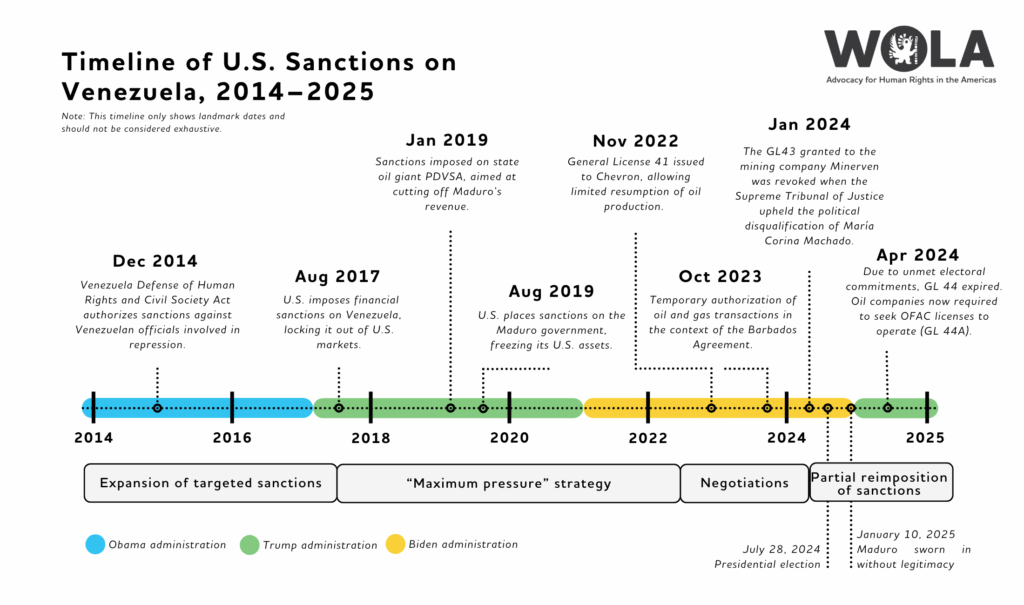
Since 2005, the United States has gradually expanded its sanctions policy on Venezuela.[132] Until 2017, sanctions were limited to individuals and the prohibition of arms sales. Beginning that year, they were extended to include financial and sectoral sanctions, as well as sanctions targeting the government itself. In January 2019, under Executive Order 13850, the U.S. Department of the Treasury designated PDVSA, froze all its assets under U.S. jurisdiction, and prohibited U.S. companies and individuals from conducting transactions with the entity.[133]
In November 2022, in the context of negotiations between the Venezuelan government and the opposition’s PUD, OFAC issued General License (GL) 41 to Chevron,[134] allowing the company to expand its operations in Venezuela. The following year, on October 18, 2023, the U.S. Department of the Treasury issued GL 44, temporarily authorizing transactions related to the oil and gas sector in Venezuela.[135] The issuance of GL 44, along with other measures, coincided with the signing of the Barbados Agreement. The logic behind the Biden administration’s approach was to offer incentives to the Venezuelan government to allow free and fair presidential elections in 2024, making those incentives conditional on compliance with the agreement. It is important to note that the United States was not a formal party to the negotiation process between the Venezuelan government and the PUD. Instead, it engaged in parallel negotiations directly with the government of Nicolás Maduro, which took place with the mediation of Qatar.[136]
After Venezuela’s highest court decided to uphold the political disqualification of María Corina Machado, who had been chosen through a primary process as the opposition’s presidential candidate, OFAC revoked a license (GL 43) that had authorized transactions with Minerven, a state-owned gold mining company.[137] Later, when GL 44, authorizing transactions in the oil and gas sector, expired, the administration chose not to renew it, citing the Venezuelan government’s breach of the Barbados Agreement. In its place, on April 17, 2024, OFAC issued GL 44A, which gave companies 45 days (until May 31, 2024) to wind down operations previously authorized under GL 44. It also noted that companies could apply for specific licenses from OFAC to operate in Venezuela, which would be evaluated on a case-by-case basis.[138]
Not all information about the individual licenses granted under GL 44A is public. However, press reports and oil sector experts have revealed that under this general license, individual licenses and so-called “comfort letters” were issued, which can be categorized according to their purpose. These included, for example: licenses for oil production (Chevron, Repsol, Maurel & Prom); for natural gas projects with Trinidad and Tobago (BP and Shell in partnership with the National Gas Company of Trinidad and Tobago); and the purchase or exchange of petroleum derivatives (such as ENI/Repsol, Reliance, and Global Terminal).
According to Francisco Palmieri, then Head of Mission of the U.S. Venezuela Affairs Unit, as of May 2024, there were between 20 and 50 applications for private licenses.[139] There is no publicly available information on all the companies that applied or on those that were granted licenses. As a general practice, the U.S. Department of the Treasury does not publish individual licenses or comfort letters; it publishes only general licenses, regulations, and other non-confidential information.[140]
Although the licenses issued by the Department of the Treasury do not permit the payment of taxes or royalties to the Venezuelan government or PDVSA, it is essential to understand the regulatory framework under which authorized companies operate in Venezuela. This framework fosters opacity. Following the sectoral sanctions imposed by the United States in January 2019, Venezuela enacted a regulation known as the “Anti-Blockade Law”.[141] Under this framework, which contradicts the provisions of the Organic Law on Hydrocarbons regarding transparency and public access to oil contracts, a regime of secrecy, confidentiality, and limited disclosure of information was established (articles 37 and onward), and restrictions on commercialization were lifted for specific categories of actors in sectors deemed strategic (article 31). As a result, Venezuela has pursued a policy of privatizing PDVSA, through the transfer of oil rights to mixed enterprises, circumventing the legal framework that governs these contracts, which are considered matters of national public interest.[142]
In conclusion, although the Biden administration granted incentives in the pre-electoral context and later responded to noncompliance with the Barbados Agreement, the approach it chose allowed Chevron (under GL 41) and other companies that had obtained specific licenses to continue operating.
b. New Administration: Change in Policy
Since Donald Trump’s election in November 2024 and into his second term, there has been considerable speculation about what his administration’s strategy toward Venezuela would be, or should be. Whether it would mark a return to the so-called “maximum pressure” policy of his first term, or whether it would instead adopt a more transactional or pragmatic approach.[143] However, the actions taken by the administration up to the closing date of this report still raise questions about the nature of U.S. foreign policy toward Venezuela.
The appointment of Marco Rubio as Secretary of State and Christopher Landau as Deputy Secretary, along with the naming of Mauricio Claver-Carone as Special Envoy for Latin America, generated high expectations among the Venezuelan opposition,[144] as all three figures have ties to the Latin American region.
To address the situation in Venezuela, Trump also appointed Richard Grenell as Special Envoy.[145] Although special envoys require Senate confirmation when they operate under the authority of the Secretary of State, the Senate Foreign Relations Committee, controlled by a Republican majority, supported President Trump’s position that the envoy role falls under the president’s direct authority and does not require legislative confirmation. At least one member of the House of Representatives has asked the Secretary of State to clarify the role of special envoys, specifically referencing the mission in which Richard Grenell visited Caracas and met with Nicolás Maduro in January.[146]
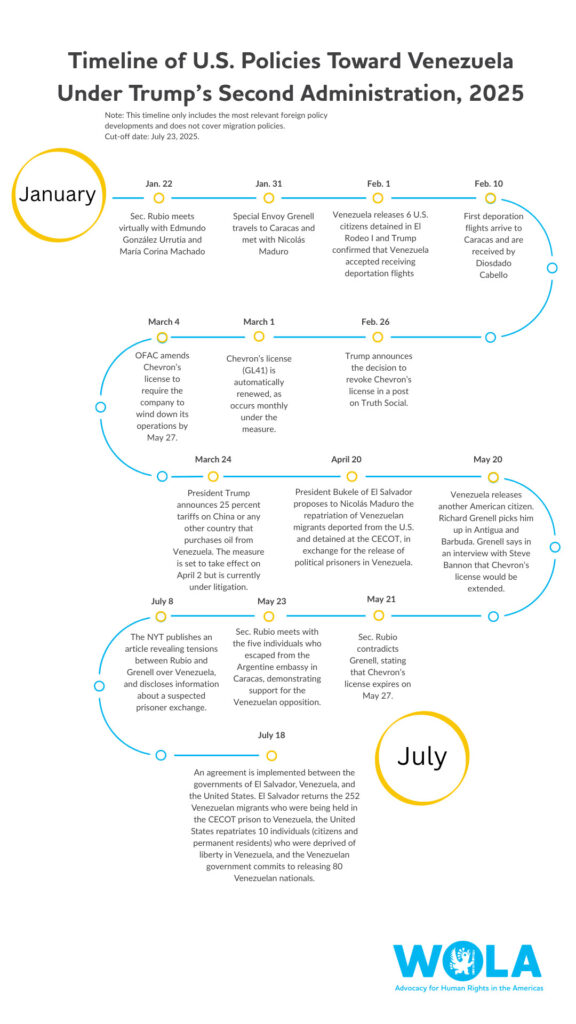
As the timeline reveals, there are reasons to believe that differing positions on Venezuela exist within the Trump administration, with competing interests at play: on one hand, the need to control migration and ensure that Venezuela continues to receive deportation flights without interruption; on the other, the goal of countering an authoritarian government with political and economic ties opposed to U.S. interests. In February 2025, President Trump announced on social media[147] his decision to revoke Chevron’s license (Chevron being responsible for 25 percent of Venezuela’s oil production[148]), a move that the Department of the Treasury later carried out. However, before the period for the company to cease operations, Richard Grenell publicly stated that the license would be extended—something that Marco Rubio immediately denied.
Below is a timeline of foreign policy actions under President Trump’s second administration, illustrating these contradictions.
The humanitarian emergency and the context of grand corruption predate international sanctions.[149] However, it is also true that these sanctions affect public finances, which in turn harms the population’s quality of life.[150] Economists project that the revocation of licenses, particularly Chevron’s, could cause a contraction of between 2 and 3 percent of the GDP in 2025, with a 20 percent drop in the oil sector and a decrease in the availability of foreign currency in the exchange market.[151] Moreover, the revocation of licenses, combined with the imposition of a 25 percent tariff on any country importing Venezuelan oil,[152] could limit Venezuela’s capacity to import the diluents required to produce gasoline and diesel. This would have a profound impact on the already reduced productive sector and ultimately affect the population. Additionally, if these tariff measures were implemented, it would reduce the likelihood that China, responsible for purchasing 69 percent of Venezuela’s exports through 2024,[153] would continue to buy from the Caribbean country. In this scenario, Venezuela would have to sell its oil at steeper discounts in unauthorized oil markets.
As some analysts predicted at the start of Trump’s term, it appears that the administration’s policy toward Venezuela consists of a middle path between maximum pressure and pragmatism,[154] with unprecedented measures; for example, designating the Venezuelan gang Tren de Aragua as a terrorist organization and invoking a wartime law to supposedly combat it.[155]
As of July 18, 2025, Venezuela had received 43 deportation flights carrying nearly 8,500 people from the United States or Mexico, including at least one thousand minors.[156] Notably, some of these deportation flights from U.S. soil have reportedly been operated by Conviasa, an airline sanctioned by the United States. The license granted for repatriation flights explicitly states that they must originate from countries outside U.S. jurisdiction.[157] To date, there is no public record that Conviasa has been granted a separate license by the U.S. Department of the Treasury to operate these flights.
In response to the events of July 28 and the subsequent repression, the Biden administration imposed individual sanctions on 16 public officials aligned with Nicolás Maduro’s government, including members of the CNE, TSJ justices, and officials from the Bolivarian National Intelligence Service (SEBIN).[158] The decision was based on their alleged role in consolidating violations of popular sovereignty. Under Trump’s second administration, as of July 17, 2025, the individual sanctions imposed have focused specifically on members of the gang known as Tren de Aragua,[159] which was designated in February as a Foreign Terrorist Organization (FTO).[160]
On July 18, an agreement was implemented involving the governments of El Salvador, Venezuela, and the United States. El Salvador returned to Venezuela 252 Venezuelan migrants who had been deported from the U.S. without due process[161] and had been held in the Center for the Confinement of Terrorism (CECOT) in El Salvador. In exchange, Venezuela handed over to the U.S. ten individuals, at least four of whom were American citizens and five lawful permanent residents. Additionally, Venezuela committed to releasing 80 people who were imprisoned for political reasons. However, as of July 23, only 72 releases had been confirmed.[162] In carrying out this process, Venezuelan authorities did not consider vulnerability criteria related to age, gender, or urgent medical needs. Over the same weekend that these releases were taking place, other individuals were arbitrarily detained.[163] This underscores that repression in Venezuela has not ceased, and that the practice of carrying out arrests between states as a bargaining tool with another state, “hostage diplomacy”, reinforces authoritarian practices and undermines global security.[164]
While the revocation of oil licenses sends a message to Nicolás Maduro following the events of July 28, the measure should not be viewed in isolation. Simultaneously, the termination of cooperation programs (especially those related to democracy and human rights), the closure of regularization pathways for migrants and refugees in the United States, and negotiations with those in power to carry out deportation flights without due process protections are all measures that harm the Venezuelan population living under an authoritarian government and contribute to the shrinking of civic space in Venezuela. The contradictory signals within the U.S. administration also negatively affect the ability of other countries, particularly in Europe and Latin America, to coordinate a coherent foreign policy aligned with shared democratic goals.
2. Freezing and Termination of Foreign Aid
On the very day he took office, President Donald Trump issued a series of executive orders. One of them halted all international assistance, initially for a 90-day period, in order to review all programs under guidelines issued by the Secretary of State.[165] The global impact of this measure has been devastating.
The decision to suspend international cooperation from the United States was openly celebrated by authoritarian governments that the U.S. itself considers adversaries.[166] One such government is that of Venezuela. The Minister of Interior, Justice, and Peace, Diosdado Cabello, who is sanctioned and has a formal indictment from the U.S. Department of Justice, made the following statement in response to President Trump’s decision:
“The opposition is falling apart out there, and we have to help them finish falling apart. When the enemy is struggling, you leave them alone and do nothing. Let them keep crashing into reality. Now that USAID pulled the ladder out from under them, they don’t even show up on social media anymore”.[167]
In another speech, in addition to accusing electoral organizations, human rights groups, and media outlets of corruption, he stated that the U.S. measure had “internationalized the ‘Knock Knock’”,[168] a reference to the wave of persecution launched after the July 28 election to target real or perceived opposition members.
Beyond the possibility of allocating funds from various budget lines for foreign assistance, Congress had appropriated $50 million for democracy programs in Venezuela for fiscal year 2024, as well as funding to support host communities receiving migrants from Venezuela.[169] The same amount was designated by Congress for fiscal year 2025,[170] as reflected in the continuing resolution passed in March of this year, though with slightly different conditions.[171] If the draft explanatory statement[172] accompanying the preliminary version of the House Appropriations Bill for fiscal year 2026 were to be approved, $50 million would be allocated to Venezuela under the new National Security Investment Programs.[173]
However, in July 2025, Congress passed a measure to rescind more than $8 billion from the current fiscal year’s budget, primarily from foreign assistance. The full implications of that rescission are yet unknown.[174] Therefore, as of the close of this report, it is not possible to confirm how much funding remains available for assistance to Venezuela for the current year, nor how much will ultimately be allocated for fiscal year 2026.
In addition to these resources, the United States contributed $210.8 million to Venezuela in 2024 through the U.S. Agency for International Development (USAID), of which $154.3 million was allocated to humanitarian assistance and $12.15 million to health.[175] By June 2025, U.S. assistance through USAID had decreased to $13 million, with $11.5 million designated for humanitarian aid and $1.5 million for health.[176] As noted earlier, U.S. funding for the Humanitarian Response Plan dropped from covering 52.2 percent in 2024 to only 3.8 percent in 2025.[177]
According to information gathered by WOLA, there are reasons to believe that all USAID-funded programs related to democracy and human rights in Venezuela have been terminated. Some humanitarian programs that had ended received waivers extending funding through September 2025, but implementing organizations remain uncertain about continuing into fiscal year 2026. Due to the climate of fear in Venezuela and uncertainty in the U.S. regarding the future of international cooperation, there are obstacles to accessing up-to-date information about program status. One media outlet published a table showing the status of USAID programs presented to Congress in March, but that information may be outdated.[178]
As WOLA has explained,[179] the U.S.’ decision coincided with the enactment of the Law on Oversight, Regulation, Operation, and Financing of Nonprofit Social Organizations in Venezuela, which was specifically adopted to persecute civil society and undermine the right to association. The White House’s executive order on “radical transparency,” which would make public “to the fullest extent permitted by law”[180] information on which organizations received funding, has significantly increased the risks faced by civil society in Venezuela, whether because they receive U.S. support or because they risk being criminalized under that pretext.[181]
The termination of programs and reduction of available funds to address the complex humanitarian emergency in the country, combined with the impact of these measures on countries hosting migrants and refugees, leave the most vulnerable populations unprotected.[182] As documented by HumVenezuela in its latest household survey,[183] the intention to emigrate increased significantly in the second half of 2024. Adding to this are the grand corruption that persists in Venezuela, the economic impact of revoking oil licenses, the perception of dialogue with Maduro’s government regarding the release of American citizens, and the acceptance of deportation flights, without any democratic concessions in return. The foreign policy of the Trump administration points to a transactional stance toward Venezuela that neither prioritizes human rights nor identifies diverse pathways to address the consolidation of the autocratic model entrenched in the country.
Meanwhile, armed and criminal groups operating in border areas, including the National Liberation Army (ELN) and the Tren de Aragua, exploit the situation of migrants and refugees, turning them into victims of recruitment, trafficking, and human smuggling.[184] Humanitarian workers along the Colombia-Venezuela border have warned that, due to drastic reductions in their presence resulting from a lack of funding, there will be insufficient capacity to respond to a new surge in migration in that region. This surge involves the convergence of migratory flows of both people returning from the United States and those fleeing Venezuela, as conditions in the country have not improved.[185]
Finally, it is important to emphasize that, in a context of extreme opacity and impunity in Venezuela,[186] it is thanks to independent civil society that the international community has access to reliable data and documentation regarding the humanitarian situation, human rights violations, foreign nationals detained, corruption, illicit economies, the actions of armed groups, and other issues. Hence, the importance of preserving civic space and contributing to the sustainability of the social fabric in Venezuela.
3. Dismantling of Protection and Regularization Measures, Mass Deportations, and Criminalization of Venezuelan Migrants and Refugees
The Trump administration has acknowledged that Venezuela is ruled by an authoritarian government and denounced its ties to illicit economies. By reissuing a travel warning[187] advising U.S. citizens of the risks associated with traveling to Venezuela, the U.S. has also acknowledged that it is not a safe country. However, that same logic has not been applied to Venezuelan migrants and refugees in the United States. Instead, the administration has maintained negotiation channels that, so far, have been focused on securing Venezuela’s acceptance of mass deportation flights and the release of U.S. citizens or permanent residents.
According to the Migration Policy Institute (MPI), as of April 29, 2025, Trump had enacted 181 executive actions on immigration.[188] Not only have some of these measures faced legal challenges and judicial checks, but the administration also faced budgetary limitations in implementing its promise of mass deportations. However, on July 4, Congress passed a budget law allocating more than $170 billion to immigration enforcement through the end of fiscal year 2029.[189] A comprehensive analysis of all immigration measures enacted since January that affect Venezuelan nationals, including those beyond U.S. borders, is beyond the scope of this report. Nevertheless, this section aims to show how the immigration policies adopted are disproportionate and discriminatory against Venezuelans on the basis of their nationality. It also highlights how these policies targeting people fleeing an authoritarian regime and a complex humanitarian emergency stand in stark contrast to the administration’s stated intention of supporting efforts toward a democratic transition in Venezuela.
President Trump has described the arrival of Venezuelan nationals to the United States as an “invasion”,[190] labeling them as “criminals”.[191] According to United Nations agencies, nearly 8 million Venezuelans have left the country since 2014. Of this unprecedented migration flow in the region, 85 percent reside in Latin America and the Caribbean.[192] According to the U.S. Census Bureau, by the end of 2023, there were approximately 1 million Venezuelan nationals[193] in the United States, accounting for less than 2 percent of the country’s total immigrant population.[194] Thanks to Temporary Protected Status (TPS) and humanitarian parole measures that the current administration has sought to end, more than 70 percent has, or still had as of January 2025, a regular immigration status. It is also worth noting that over 75 percent of Venezuelan nationals in the U.S. arrived after 2010,[195] demonstrating that this is a population fleeing a long-standing crisis and the erosion of democracy in Venezuela.
As WOLA has previously noted,[196] there has historically been bipartisan recognition of the severe crisis Venezuela is facing, which has led to the creation of immigration pathways for those fleeing the country. In fact, in 2021, during his first term, President Trump issued an order to defer the removal of Venezuelan nationals from U.S. territory for 18 months.[197]
Below is a summary of the main measures adopted by the Trump administration during his second term through July 2025 that have had a particular impact on Venezuelan nationals. Many of these measures remain under judicial review[198] and may be revoked or modified.
| Measure | Date | Observations |
| End all humanitarian parole programs for Cuban, Haitian, Nicaraguan, and Venezuelan nationals.[199] | January 20, 2025 | In May, after a federal judge blocked the government from ending this program, the Supreme Court allowed the revocation of this legal status. |
| Terminate the use of the CBP One app as a tool for Customs and Border Protection to schedule appointments at points of entry for individuals intending to seek asylum or report to immigration authorities.[200] | January 20, 2025 | In April, DHS indicated that migrants who entered the U.S. via CBP One must leave immediately; the app was renamed CBP Home and now includes a feature for “self-deportation.” |
| Annul the extension of the 2023 TPS designation, which had been granted until October 2026.[201] | January 29, 2025 | In May, the Supreme Court granted the Trump administration’s request to lift a temporary injunction on this measure, which had been previously issued by a federal judge in California. Litigation was still ongoing as of July 2025. Additionally, the 2021 TPS designation for Venezuelans is set to expire in September 2025. |
| End the Safe Mobility Initiative, closing its regional offices (Guatemala, Costa Rica, Colombia, Ecuador), and suspend the Refugee Admissions Program[202]. | January 20, 2025 | Refugees who had submitted resettlement applications before January 20 face uncertainty. Litigation was ongoing as of July 2025. |
| Designate the Tren de Aragua as a Foreign Terrorist Organization (FTO).[203] | February 20, 2025 | This designation served as the basis for invoking the Foreign Enemies Act and deporting Venezuelan nationals to El Salvador. |
| Invoke the 1789 Foreign Enemies Act in response to the alleged “invasion” by the Tren de Aragua.[204] | March 15, 2025 | Authorizes officials from various agencies to apprehend, detain, and remove persons classified as foreign enemies, in accordance with the proclamation. |
| Deported 252 Venezuelans to El Salvador, where they were held at the Terrorism Confinement Center (CECOT).[205] During the time they were there, the Venezuelan individuals remained incommunicado. The U.S. and Salvadoran authorities did not disclose the official list of people transferred to CECOT.[206] | March 15, 2025 | These individuals were deported under the Foreign Enemies Act of 1798, invoked by order of President Trump concerning members of the Tren de Aragua. Their cases have no connection to El Salvador; they were deported without access to judicial or administrative proceedings, nor the opportunity to prove their innocence in the United States. They were also not presented before a judge in El Salvador. Independent United Nations experts indicated that these deportations and detentions under conditions of incommunicado custody could amount to enforced disappearances. |
| Partially restrict and limit entry of Venezuelan nationals (“Travel ban”).[207] Entry to the United States is suspended for Venezuelan nationals, both as immigrants and non-immigrants, holding B-1, B-2, B-1/B-2, F, M, and J visas.[208] The measure applies to foreign nationals who were outside the U.S. on the effective date (June 9, 2025) and did not have a valid visa at that time. | June 4, 2025 | The measure will be reviewed 90 and 180 days after issuance to evaluate if it is still appropriate. |
| Reach an agreement with the government of El Salvador and with those in power in Venezuela to repatriate the 252 individuals who remained in detention in El Salvador back to Venezuela. | July 18, 2025 | The U.S. secured the release of 5 U.S. citizens and 5 permanent residents. The agreement included the release of 80 Venezuelan individuals detained for political reasons. As of the closing date of this report, the decarceration of 72 people had been confirmed, while new arbitrary detentions also occurred. The U.S. had deported the group of 252 migrants to El Salvador under the invocation of the Foreign Enemies Act, alleging they were members of the Tren de Aragua. However, U.S. authorities did not provide evidence of this and subsequently handed these individuals over to the Venezuelan government, which, according to the proclamation invoking this law, the Tren de Aragua supposedly has direct ties with. |
The deportation flights to Venezuela have been received by Venezuelan authorities, who have claimed credit for doing so under the framework of the “Return to the Homeland Plan,” which Nicolás Maduro described as “a first step toward an agenda of understanding”[209] between Venezuela and the United States. These deportation flights are received by State security forces and, on some occasions, have been personally received by Interior Minister Diosdado Cabello[210] and by Alexander Granko Arteaga,[211] chief of the Special Affairs Division (DAE) of the DGCIM. Both officials have been sanctioned by the U.S. Department of the Treasury and have been pointed at by the UN FFM as responsible for serious human rights violations.[212]
Due to the lack of guarantees for due process in the context of deportation proceedings, it has not been possible for a competent and independent authority to assess the well-founded fear of Venezuelan nationals of returning to the country they fled.[213] In the repressive context in Venezuela described in this report, human rights organizations and independent media have faced obstacles in documenting the fate of deported individuals once they arrive in Venezuela.
In sum, these policies and actions have left the Venezuelan migrant and refugee population in the United States in a situation of deep vulnerability and lack of protection, facing the risk of being deported to a country that does not offer safe conditions or respect for their fundamental rights. This scenario contradicts the official recognition of the humanitarian crisis and the authoritarian nature of the Venezuelan government, perpetuating serious injustices and exposing these individuals to the very dangers they sought to escape.
VII. Some Conclusions on the Current Landscape
Based on the information gathered and analyzed during the period from January 2024 to July 2025 (with a cut-off date of July 23), it is clear that the 2024 presidential election in Venezuela was profoundly marked by structural irregularities, political persecution, and a lack of transparency, which therefore, prevented a free, fair, and competitive electoral process. Despite massive citizen participation and a democratic commitment to the electoral path, Nicolás Maduro consolidated his authoritarian control, taking office without evidence to support his election. The following are some conclusions from this research:
- The policy of persecution on political grounds has not ceased. Through arbitrary detentions, enforced disappearances, torture, harassment, and restrictive laws, the Venezuelan government has deepened an apparatus of political persecution and social control that reaches the threshold of state terrorism practices and has continued to commit acts that, under international law, could constitute crimes against humanity. This repression intensified in the immediate aftermath of the presidential election and was massive in scale. Over time, the methods of repression have evolved, but the attack on the civilian population, carried out as part of a policy to silence, discourage, and suppress the opposition or those perceived as opposition, continues.
- A legal framework to close civic space has been consolidated. In Venezuela, a regulatory framework has been established aimed at severely restricting the rights to freedom of expression, association, and political participation. In addition to existing laws such as the Constitutional Law Against Hatred, for Peaceful Coexistence and Tolerance, and the Organic Law Against Organized Crime and Financing of Terrorism, frequently used to criminalize dissent, new regulations have been introduced. This is the case of the Law on Oversight, Regulation, Operations, and Financing of Non-Governmental Organizations and Non-Profit Organizations. Furthermore, the National Assembly is debating bills such as the Law on International Cooperation and the draft Law Against Fascism, Neo-Fascism, and Similar Expressions, which would further expand the state’s powers to control and penalize the legitimate exercise of fundamental rights, particularly in contexts of criticism of power or citizen mobilization. This legal framework, as a whole, consolidates an architecture of control that deepens the closure of civic space in the country.
- Post–July 28 elections, held without minimum conditions, undermine public trust in voting. The regional and legislative elections held in May 2025, as well as the scheduled municipal elections on July 27, are being conducted without minimum standards of transparency, fairness, and legality. This deepens the crisis of institutional legitimacy. Far from correcting the serious irregularities of the July 28, 2024 presidential election, the state has continued to instrumentalize electoral processes to consolidate its power, using strategies to divide the opposition, imposing unverifiable results, and disregarding constitutional mandates and international recommendations. These elections weaken citizens’ trust in the right to vote as a tool for democratic change.
- The constitutional reform promoted by Nicolás Maduro for 2026 seeks to consolidate the Communal State. The push for the Communal State in Venezuela represents a direct threat to the democratic system, to the federal model enshrined in the Constitution, and to the principle of popular sovereignty based on universal suffrage. Although presented as a form of citizen empowerment, the communal project is, in reality, advancing toward the authoritarian centralization of power, replacing formal and representative institutions with structures controlled by the executive branch, limiting political participation to those aligned with the official ideology, and creating a parallel justice system without guarantees or independence. The possible constitutional reform proposed by Nicolás Maduro for 2026 aims to consolidate this model, institutionalizing a deeply exclusionary and clientelist government and undemocratic political order.
- The complex humanitarian emergency in Venezuela persists and worsens in multiple dimensions. Despite certain indicators of economic recovery between 2021 and 2024, the complex humanitarian emergency in Venezuela continues and worsens across multiple dimensions, critically affecting the fundamental rights of millions of people. The prolonged deprivation of basic goods and services, the lack of official information on key economic indicators, and the persecution of experts who monitor the crisis have created an environment of extreme vulnerability. This situation is further aggravated by the drastic reduction in international funding, which threatens to dismantle the already fragile humanitarian response. Without accounting for this structural emergency, it is impossible to fully understand the barriers to political participation or the extent of public discontent.
Regarding the relationship between the United States and Venezuela, it is worth noting that while a bipartisan understanding still exists in the U.S. recognizing that Venezuela has an authoritarian government that commits serious human rights violations, the foreign policy approach toward Venezuela has varied from one administration to another. Some concluding reflections on this relationship include:
- There is reason to believe that differing views on Venezuela exist within the Trump administration, along with competing interests. On one hand, there is the need to curb migration and ensure that Venezuela continues receiving deportation flights without interruption; on the other, there is the goal of countering an authoritarian government with political and economic ties that run counter to U.S. interests.
- The revocation of oil licenses should not be analyzed in isolation or considered the sole indicator of the Trump administration’s stance toward Maduro. While this measure may be seen as undermining the pillars supporting the authoritarian government in Venezuela, its impact must be assessed based on verifiable evidence. The termination of cooperation programs, the closure of legal pathways for migrants and refugees in the U.S., and transactional negotiations with those in power in Venezuela to carry out mass deportation flights, are all measures that affect the Venezuelan population living under authoritarian rule and contribute to the closing of civic space in the country.
- Licenses granted under the Biden administration produced mixed results. These licenses were intended to offer incentives for the Venezuelan government to allow free and fair elections, and those negotiations contributed to the signing of the Barbados Agreement. After the violation of that agreement, the broad oil license was revoked and replaced with a case-by-case licensing framework. However, those licenses operated within an opaque regulatory framework in Venezuela (the Anti-Blockade Law), which fosters corruption.
- The revocation of licenses under the Trump administration may also have mixed effects. The complex humanitarian emergency and grand corruption in Venezuela predate sectoral sanctions. However, various studies indicate that such sanctions exacerbate the economic crisis, leading to significant humanitarian impacts. The revocation of licenses, combined with the imposition of a 25 percent tariff on any country importing Venezuelan oil (a measure currently under litigation), could restrict Venezuela’s ability to import the diluents necessary for producing gasoline and diesel, deepening the impact on an already diminished productive sector and, ultimately, the general population. For this reason, all efforts should be made to mitigate the humanitarian impact of such sanctions. Furthermore, an objective evaluation based on verifiable evidence is needed to assess whether these measures contribute, or not, to building pathways toward a peaceful and democratic transition and to undermining the pillars supporting the repressive structure in Venezuela.
- The reduction of international cooperation by the United States and other donors diminishes the international community’s ability to access reliable and up-to-date information about the situation in Venezuela. In addition to the Venezuelan legal framework that criminalizes international cooperation and restricts the work of civil society, the sharp decrease in assistance and cooperation further threatens the sustainability of civil society in Venezuela, especially in a context marked by a complex humanitarian emergency and political persecution of independent civil society work.
- There is a contradiction between the U.S. government’s support for the democratic cause in Venezuela and its policies toward those who have fled the authoritarian government and the complex humanitarian emergency. The combination of this emergency, political persecution, and the closing of civic space remains a central factor driving forced displacement from Venezuela. Restrictions imposed by several countries in the region and the tightening of migration policies, including the termination of TPS and humanitarian parole, as well as mass deportations and other measures, worsen the vulnerability of migrants and refugees and fail to address the root causes of their displacement.
VIII. Recommendations
In Venezuela, there is a civil society that is determined to preserve civic space and defend the democratic principles enshrined in its Constitution. To achieve this, support from other international actors is essential. From WOLA, we offer the following recommendations to governments that have active diplomatic and commercial relations with Venezuela, as well as to those that, while not formally engaged, maintain channels of communication with those in power.
- In response to repression and human rights violations in Venezuela:
- Make the immediate end of repression, the release of individuals arbitrarily detained, and access to information on the whereabouts of victims of enforced disappearances a central pillar of any negotiation process.
- Uphold and adhere to the principles set forth in the Declaration Against Arbitrary Detention in State-to-State Relations. This includes opposing hostage diplomacy, ensuring compliance with the Vienna Convention on Diplomatic Relations, and ensuring that negotiations are oriented toward respecting human rights, preserving civic space in Venezuela, and pursuing pathways to democracy.
- Fund and protect civil society initiatives both inside and outside Venezuela, with the aim of safeguarding civic space in the country and contributing to the capacity to continue documenting the situation on the ground, including human rights violations.
- Fund and support international mechanisms that contribute to uncovering the truth about human rights violations, to justice, and to holding perpetrators accountable—efforts that, in turn, strengthen global security. In this regard, international cooperation aimed at international human rights systems must be restored and strengthened.
- Support efforts to restore democracy and preserve civic space in Venezuela:
- Without ceasing to stress the lack of recognition of the results of elections held without minimum guarantees on July 28, 2024, promote a coordinated strategy that combines various mechanisms to open democratic avenues, end repression, and protect human rights.
- Emphasize the need for strict standards to any future election, in accordance with recommendations made by independent international missions and local expert organizations. These include ensuring the recovery of the independence and impartiality of the CNE, the reinstatement of political parties and candidates, the transparent publication of electoral calendars, the conducting of technical audits, updating the electoral registry, and enabling independent international observation.
- Fund and support national and international actors that monitor and document electoral processes, with emphasis on technical aspects (registration, tallying, audits) and their political impact.
- Raise awareness about the regressive and authoritarian nature of the constitutional reform proposed by Nicolás Maduro for 2026, urging respect for the principles of political pluralism, local autonomy, and universal, direct, and secret suffrage.
Some specific recommendations for decision-makers in the United States are:
- Promote a human rights and democracy-centered approach as the cornerstone of foreign policy, including the framework under which various sanctions are applied, and ensure that such sanctions do not deepen the humanitarian emergency or negatively affect the well-being of the civilian population. Prioritize sanctions targeting individuals and groups responsible for corruption and human rights violations, instead of broad sectoral measures.
- Link any sanctions relief to concrete and measurable actions by the Venezuelan government, such as the release of political prisoners, electoral guarantees, and an end to persecution. While the imposition of sectoral sanctions should not be an end in itself, nor should they be considered immutable, for them to be effective tools of foreign policy, there must be a robust and comprehensive strategy on Venezuela. This strategy should support the efforts of the Venezuelan people to build pathways toward a democratic and peaceful transition and contribute to weakening the pillars of the repressive structure in Venezuela.
- In the event that sanctions are lifted or licenses granted, it is essential that the Department of the Treasury, the Department of Justice, the Department of State, and other relevant agencies are able to assess and implement mechanisms to prevent the unintended consequence of fueling corruption in Venezuela through operations in opaque legal frameworks. U.S. foreign policy should be guided by the need to foster transparency and combat corruption, as well as by respect for human rights, which requires constant calibration and a careful assessment of all aspects of this complex issue.
- To address the complex humanitarian emergency and the needs of the Venezuelan migrant and refugee population:
- Refrain from using rhetoric and policies that criminalize Venezuelan migration, and promote measures for regularization, protection, and humanitarian reception.
- On this point, we especially recommend to the U.S. government: Ensure that any policy aimed at combating transnational crime and illicit economies originating in Venezuela is based on verifiable evidence, avoiding generalizations that criminalize Venezuelan individuals based on their nationality. Actions in this area must align with the principles of due process, the presumption of innocence, and international human rights standards, as well as with existing U.S. law.
- Include the analysis of the humanitarian emergency in any assessment of the Venezuelan political context, as well as in public policy responses to migration from Venezuela.
- Reverse the defunding of the humanitarian response. Funding levels for the Humanitarian Response Plan must be urgently restored and increased, prioritizing the most vulnerable populations and critical sectors such as health, food, education, and water/sanitation.
- Urge the Venezuelan state to resume the regular publication of economic and social statistics, and to end the criminalization of independent analysts and organizations that produce reliable data.
- Coordinate regional efforts to address the growing intentions to migrate and the international protection needs of the Venezuelan migrant and refugee population, particularly those displaced to neighboring countries. Host countries should establish mechanisms for migration regularization, international protection, and employment authorization for migrants and refugees.
- Prioritize flexible, direct, and long-term funding for organizations operating both inside and outside the country, especially those working with vulnerable populations. Contribute to the diversification of funding sources and adopt measures to overcome the barriers imposed by the Venezuelan government that seek to criminalize and restrict the work of civil society organizations.
- Strengthen multilateral and regional channels to support humanitarian cooperation under the principles of neutrality, impartiality, and independence.
[1] “Presidenciales 2018,” Observatorio Electoral Venezolano, 20 de mayo de 2019. https://oevenezolano.org/tag/presidenciales-2018/.
[2] Red Electoral Ciudadana. “REC: Ante la ruptura del hilo constitucional en Venezuela y la grave crisis que atraviesa el país.” PROVEA, 25 de abril de 2017. https://provea.org/actualidad/rec-ante-la-ruptura-del-hilo-constitucional-en-venezuela-y-la-grave-crisis-que-atraviesa-el-pais/.
[3] Norway, Ministry of Foreign Affairs. “The Venezuelan Negotiation Process,” 2024, https://www.regjeringen.no/en/topics/foreign-affairs/peace-and-conflict-resolution/norways_engagement/venezuela_negotiations/id2674295/
[4] Ana María Rodríguez Brazón. “Venezuela eliminaría para elecciones regionales el código QR que le permitió a Edmundo González validar su triunfo”, El Tiempo, 20 de mayo de 2025, https://www.eltiempo.com/mundo/venezuela/venezuela-eliminaria-para-elecciones-regionales-el-codigo-qr-que-le-permitio-a-edmundo-gonzalez-validar-su-triunfo-3455360.
[5] The Carter Center. Observation of the 2024 Presidential Election in Venezuela July 2024, Final Report,
[6] Ministerio de Asuntos Exteriores de Noruega. Acuerdo parcial sobre la promoción de derechos políticos y garantías electorales para todos, 13 de agosto de 2021. https://www.regjeringen.no/contentassets/ac03d5655a8448e0a9653cd95d5c7978/garantias-electorales.pdf.
[7] U.S. Embassy Caracas. “Signing of Electoral Roadmap Between the Unitary Platform and Representatives of Maduro,” October 18, 2023, https://ve.usembassy.gov/signing-of-electoral-roadmap-between-the-unitary-platform-and-representatives-of-maduro/
[8] Laura Cristina Dib. “Explainer: What Happened With the Key Electoral Body in Venezuela and Why Does it Matter?,” WOLA, September 7, 2023, https://www.wola.org/analysis/explainer-what-happened-with-the-key-electoral-body-in-venezuela-and-why-does-it-matter/
[9] Point 11 of the Barbados Agreement
[10] Ministerio de Asuntos Exteriores de Noruega. Procedimiento para la Revisión de las Medidas de Inhabilitación Acordadas por la Contraloría General de la República, 30 de noviembre de 2023, https://www.regjeringen.no/contentassets/ac03d5655a8448e0a9653cd95d5c7978/procedimiento.pdf
[11] United Nations, Human Rights Council. Detailed findings of the Independent International Fact-Finding Mission on the Bolivarian Republic of Venezuela, A/HRC/48/CRP.5, September 16, 2021, https://www.ohchr.org/sites/default/files/Documents/HRBodies/HRCouncil/FFMV/A-HRC-48-CRP.5_EN.pdf; Consejo de Derechos Humanos, ACNUDH. Independencia del sistema judicial y acceso a la justicia en la República Bolivariana de Venezuela, doc. A/HRC/44/54, 29 de septiembre de 2020, https://docs.un.org/es/A/HRC/44/54; CIDH. Situación de derechos humanos en Venezuela. Institucionalidad democrática, Estado de derecho y derechos humanos en Venezuela. OEA/Ser.L/V/II, doc. 209, 31 de diciembre de 2017, https://www.oas.org/es/cidh/informes/pdfs/venezuela2018-es.pdf
[12] At the time of this publication, the decision (Ruling 122 of the Electoral Chamber of the Supreme Tribunal of Justice, dated October 30, 2023) has not been published on the TSJ’s official website; Acceso a la Justicia. “Suspensión Cautelar de los Efectos de las Elecciones Primarias de la Oposición,” 30 de octubre de 2023, https://accesoalajusticia.org/suspension-cautelar-de-los-efectos-de-las-elecciones-primarias-de-la-oposicion/
[13] Espacio Público. “Opacidad del CNE en información pautada por el calendario electoral,” 18 de julio de 2024. https://espaciopublico.ong/opacidad-estatal-en-informacion-pautada-por-el-calendario-electoral/.
[14] DW. “Venezuela: impiden inscripción de candidata opositora”, 26 de marzo de 2024, https://www.dw.com/es/venezuela-impiden-inscripcipercentC3percentB3n-de-candidata-opositora/a-68665893
[15] According to el Comando con Venezuela, it was recorded that at least 11 million voters participated.. Comando con Venezuela. “Resultados elecciones presidenciales: Nacional,” 2024, https://resultadosconvzla.com; In its official bulletin, the CNE estimated more than 12 million valid votes; however, the document is not available for public consultation. CNE Venezuela. “Consejo Nacional Electoral anunció segundo boletín con resultados de la elección presidencial 2024,” Instagram, 2 de agosto de 2024, https://www.instagram.com/reel/C-LsBnoBsk5/?hl=es.
[16] Consejo Nacional Electoral. Resolución n.º 120801-0493 Caracas 202.º y 153.º, 1 de agosto de 2012, https://identidad.reniec.gob.pe/documents/d/guest/7-4-venezuela-reglamento-general-de-la-ley-organica-de-procesos-electorales, arts. 382 y 383.
[17] Comando Con Vzla. Informe Técnico Electoral sobre las Actas y los Resultados de la Elección Presidencial del 28 de julio de 2024 en Venezuela, https://ganovzla.info/wp-content/uploads/2024/10/Informe-tecnico-electoral-sobre-las-actas-y-los-resultados-de-la-eleccion-presidencial-del-28-de-julio-de-2024-en-Venezuela1.pdf
[18] Comando con Venezuela. “Resultados Con Vzla”, https://resultadosconvzla.com/
[19] Regina Garcia Cano, Joshua Goodman, and Angeliki Kastanis. “Revisión de AP a actas de la oposición expone serias dudas sobre resultados electorales en Venezuela,” AP News, 3 de agosto de 2024, https://apnews.com/world-news/general-news-domestic-news-domestic-news-72fc10b86aa82c2cc58324fd0a6f4e4f ; Samantha Schmidt et al. “Maduro perdió las elecciones según actas recopiladas por la oposición,” The Washington Post, 5 de agosto de 2024, https://www.washingtonpost.com/world/2024/08/04/maduro-gonzalez-election-actas-analysis-2/
[20] Walter R. Mebane. Analysis of the Venezuela 2024 Presidential Election. August 11, 2024, https://websites.umich.edu/~wmebane/Venezuela2024.pdf
[21] Misión de Observación Electoral. “Revisión de actas y documentos electorales: Elección Venezuela 2024,” 3 de agosto de 2024, https://moe.org.co/revision-de-actas-y-documentos-electoraleseleccion-venezuela-20243-de-agosto-de-2024/
[22] United Nations. “Venezuela: Guterres Calls for ‘Complete Transparency’ Following Disputed Presidential Election,” July 29, 2024, https://news.un.org/en/story/2024/07/1152606.
The Carter Center, “Carter Center Statement on Venezuela Election,” July 30, 2024, https://www.cartercenter.org/news/pr/2024/venezuela-073024.html.
[23] Acceso a la Justicia. “Seis observaciones al recurso contencioso electoral ante el TSJ sobre las elecciones del 28J,” 8 de agosto de 2024, https://accesoalajusticia.org/seis-observaciones-recurso-contencioso-electoral-ante-tsj-sobre-elecciones-28j/
[24] Ruling 031 of August 22, 2024. The above can be verified on the TSJ website, where only an excerpt is available. Tribunal Supremo de Justicia, “Decisiones – Tribunal Supremo de Justicia,” 2025, http://www.tsj.gob.ve/decisiones#.
[25] United Nations, Human Rights Council. Detailed Findings of the Independent International Fact-Finding Mission on the Bolivarian Republic of Venezuela, Doc. A/HRC/45/CRP.11, September 15, 2020, https://www.ohchr.org/sites/default/files/Documents/HRBodies/HRCouncil/FFMV/A_HRC_45_CRP.11.pdf; Doc. A/HRC/57/CRP.5, October 14, 2024, https://www.ohchr.org/sites/default/files/documents/hrbodies/hrcouncil/sessions-regular/session57/advance-versions/a-hrc-57-crp-5-en.pdf.
[26] United Nations, Human Rights Council. Independent International Fact-Finding Mission on Venezuela. The State Apparatus, Its Repressive Mechanisms, and Restrictions on Civic and Democratic Space. Doc. A/HRC/54/CRP.8, September 18, 2023, https://www.ohchr.org/sites/default/files/documents/hrbodies/hrcouncil/sessions-regular/session54/advance-versions/A_HRC_54_CRP.8_EN_0.pdf, para. 1555.
[27] United Nations, Human Rights Council. Report of the independent international fact-finding mission on the Bolivarian Republic of Venezuela. Doc. A/HRC/57/57, September 19, 2024, https://www.ohchr.org/sites/default/files/documents/hrbodies/hrcouncil/sessions-regular/session57/advance-versions/a-hrc-57-57-en.pdf, para. 34.
[28] IACHR. “IACHR and SRFOE Condemn State Terrorism Practices in Venezuela,” Press Release No. 184/24, August 15, 2024, https://www.oas.org/en/iachr/jsForm/?File=/en/iachr/media_center/preleases/2024/184.asp.
[29] IACHR. “The IACHR Condemns the Ongoing Practices of State Terrorism in Venezuela and Recalls that María Corina Machado is a Beneficiary of Precautionary Measures,” Press Release No. 009/25, January 9, 2025, https://www.oas.org/en/iachr/jsForm/?File=/en/iachr/media_center/preleases/2025/009.asp.
[30] Corte IDH. Caso López Mendoza Vs. Venezuela. Fondo, Reparaciones y Costas. C No. 233, 1 de septiembre de 2011.https://corteidh.or.cr/docs/casos/articulos/seriec_233_esp.pdf;
Inter-American Commission on Human Rights (IACHR). Venezuela: Serious Human Rights Violations in Connection with the Elections, OEA/Ser.L/V/II, Doc. 253/24, December 27, 2024, https://www.oas.org/en/iachr/reports/pdfs/2025/report-venezuela-serioushhrr-violations-connections-elections.pdf.
[31] Inter-American Commission on Human Rights (IACHR). “IACHR Urges Venezuela to End Political Persecution and to Enable Free Elections,” Press Release No. 159/24, July 8, 2024, https://www.oas.org/en/iachr/jsForm/?File=/en/iachr/media_center/preleases/2024/159.asp.
[32] Inter-American Commission on Human Rights (IACHR). Venezuela: Serious Human Rights Violations in Connection with the Elections, OEA/Ser.L/V/II, Doc. 253/24, December 27, 2024, para. 37, https://www.oas.org/en/iachr/reports/pdfs/2025/report-venezuela-serioushhrr-violations-connections-elections.pdf.
[33] Laboratorio de Paz. Reporte Furia Bolivariana, 23 de enero 2024, https://labpaz.org/reporte-furia-bolivariana-23-de-enero-2024
[34] Human Rights Committee Vente Venezuela. Interview, March 2025.
[35] Florantonia Singer. “Los opositores refugiados en la Embajada de Argentina en Caracas, liberados y trasladados a ‘suelo estadounidense’,” El País, May 6, 2024, https://elpais.com/america/2025-05-07/los-opositores-refugiados-en-la-embajada-de-argentina-en-caracas-liberados-y-trasladados-a-estados-unidos.html; WOLA, “Urgent call to protect political asylees in the Argentine Embassy in Caracas,” December 17, 2024, https://www.wola.org/2024/12/urgent-call-to-protect-political-asylees-in-the-argentine-embassy-in-caracas/
[36] Inter-American Commission on Human Rights (IACHR). Venezuela: Serious Human Rights Violations in Connection with the Elections, OEA/Ser.L/V/II, Doc. 253/24, December 27, 2024, https://www.oas.org/en/iachr/reports/pdfs/2025/report-venezuela-serioushhrr-violations-connections-elections.pdf.
[37] Foro Penal registered 181 detentions between January 1st and July 27 2024. Foro Penal. Reporte Especial sobre Represión Política en Venezuela, 2024, https://foropenal.com/reporte-sobre-la-represion-en-venezuela-ano-2024/
[38] Human Rights Committee Vente Venezuela. Interview, March 2025.
[39] Amnesty International. Urgent Action: Venezuelan defender must be released, February 20, 2024, https://www.amnesty.org/en/documents/amr53/7734/2024/en/
[40] ACNUDH, Twitter (now X), 13 de febrero de 2024, https://x.com/UNHumanRights/status/1757307231614202368
[41] VTV. “Venezuela suspende actividades de la Oficina Técnica de Asesoría del ACNUDH,” 15 de febrero de 2024, https://www.vtv.gob.ve/venezuela-suspende-actividades-oficina-tecnica-acnudh/
[42] Alexis Correia. “¿Qué amenazas hizo Nicolás Maduro sobre la posibilidad de “guerra civil” y “baño de sangre” en Venezuela?,” Espaja.com, 19 de julio de 2024, https://espaja.com/explain/elecciones-2024-que-amenazas-hizo-nicolas-maduro-sobre-la-posibilidad-de-guerra-civil-y-bano-de-sangre-en-venezuela
[43] Inter-American Commission on Human Rights (IACHR). Venezuela: Serious Human Rights Violations in Connection with the Elections, OEA/Ser.L/V/II, Doc. 253/24, December 27, 2024, https://www.oas.org/en/iachr/reports/pdfs/2025/report-venezuela-serioushhrr-violations-connections-elections.pdf.
[44] Observatorio Venezolano de Conflictividad Social (OVCS). “Conflictividad social en Venezuela durante julio de 2024,” 23 de agosto de 2024, https://www.observatoriodeconflictos.org.ve/tendencias-de-la-conflictividad/conflictividad-social-en-venezuela-durante-julio-de-2024; Provea. Informe especial: La ruta del cierre democrático, 2024. https://provea.org/wp-content/uploads/2025/05/Provea-Informe-Anual-2024-22_Informe_Especial.pdf
[45] ABC, “El fiscal general de Venezuela cifra en cuatro los muertos en las protestas tras conocerse los resultados,” agosto 12, 2024, https://www.abc.es/internacional/fiscal-general-venezuela-cifra-muertos-protestas-resultados-20240812214107-nt.html ; Provea. “Informe Especial. Gobierno de Maduro rompe cifras históricas de represión en Venezuela,” 23 de agosto de 2024, https://provea.org/actualidad/informe-especial-gobierno-de-maduro-rompe-cifras-historicas-de-represion-en-venezuela/
[46] Nicolás Maduro, X, 1 de agosto de 2024, https://x.com/NicolasMaduro/status/1819174829746008323
[47] Probox. “#TerrorEnRedes: VenApp, la aplicación que “evolucionó” para reprimir,” 27 de agosto de 2024, https://proboxve.org/publicacion/terrorenredes-venapp-la-aplicacion-que-evoluciono-para-reprimir/
[48] Conexión Segura y Libre & VE Sin Filtro. Redes de Control: Censura y represión digital en las elecciones presidenciales en Venezuela, 2025, https://vesinfiltro.org/res/files/informe-presidenciales_2024-VEsinFiltro.pdf
[49] Conexión Segura y Libre & VE Sin Filtro. Redes de Control: Censura y represión digital en las elecciones presidenciales en Venezuela, 2025, https://vesinfiltro.org/res/files/informe-presidenciales_2024-VEsinFiltro.pdf
[50] Derechos Humanos de Venezuela en Movimiento. Informe: Crisis postelectoral y de DDHH 2024 en Venezuela. El Libro Negro de la Dictadura 2024, 29 de agosto de 2024 https://provea.org/wp-content/uploads/2024/09/Libro-Negro-Informe-DDHH-Vzla.pdf
[51]UN, OHCHR. Report of the Independent International Fact-Finding Mission on the Bolivarian Republic of Venezuela, doc. A/HRC/57/57, 17 September 2024, https://docs.un.org/en/A/HRC/57/57, para. 59.
[52] Provea. Informe especial: La ruta del cierre democrático, 2024. https://provea.org/wp-content/uploads/2025/05/Provea-Informe-Anual-2024-22_Informe_Especial.pdf ; Amnesty International. Venezuela: Mass Arrests of Vulnerable Groups, 8 August 2024, https://www.amnesty.org/en/documents/amr53/8396/2024/en/
[53] Provea. “Informe Especial:Gobierno de Maduro rompe cifras históricas de represión en Venezuela,” 23 de agosto de 2024, https://provea.org/actualidad/informe-especial-gobierno-de-maduro-rompe-cifras-historicas-de-represion-en-venezuela/
[54] Florantonia Singer. “Perdieron piezas dentales y les pusieron electricidad”: la denuncia de las madres de los menores encarcelados por Maduro,” El País, 4 de octubre de 2024, https://elpais.com/america/2024-10-04/perdieron-piezas-dentales-y-les-pusieron-electricidad-la-denuncia-de-las-madres-de-los-menores-encarcelados-por-maduro.html
[55] Justicia, Encuentro y Perdón. “Mil vidas tras las rejas desde las elecciones presidenciales: el costo humano de la persecución en Venezuela,” 12 de julio de 2025, https://www.jepvenezuela.com/2025/07/12/mil-vidas-tras-las-rejas-desde-las-elecciones-presidenciales-el-costo-humano-de-la-persecucion-en-venezuela/.
[56] Justicia, Encuentro y Perdón. “Omisión, Impunidad y Dolor: Hay una responsabilidad directa del estado venezolano por las muertes bajo su custodia,” 7 de mayo de 2025, https://www.jepvenezuela.com/2025/05/07/omision-impunidad-y-dolor-hay-una-responsabilidad-directa-del-estado-venezolano-por-las-muertes-bajo-su-custodia/
[57] Ministerio Público.Comunicado, Instragram, 25 de enero de 2025, https://www.instagram.com/mpublicove/p/DFQNv2qpsB8/comunicadoel-/
[58] According to the OHCHR, “In mid-August 2024, the Attorney General stated that numerous investigations and expert analyses had been conducted regarding the deaths that occurred during the post-electoral protests. However, the publicly available information is minimal and refers almost exclusively to the deaths of two members of the Bolivarian National Guard and two militants of the ruling party.”
Marta Valiñas, “Statement by Marta Valiñas, Chair of the Independent International Fact-Finding Mission on the Bolivarian Republic of Venezuela, at the 58th Session of the Human Rights Council,” OHCHR, 18 March 2025, https://www.ohchr.org/en/statements-and-speeches/2025/03/statement-marta-valinas-chair-independent-international-fact
[59] CEJIL. “Anulación de pasaportes en Venezuela”, abril de 2024, https://cejil.org/publicaciones/anulacion-de-pasaportes-en-venezuela/
[60] Inter-American Commission on Human Rights (IACHR). Venezuela: Serious Human Rights Violations in Connection with the Elections, OEA/Ser.L/V/II, Doc. 253/24, December 27, 2024, https://www.oas.org/en/iachr/reports/pdfs/2025/report-venezuela-serioushhrr-violations-connections-elections.pdf, para. 81
[61] IACHR. “Venezuela Must Restore the Unlawfully and Arbitrarily Revoked Passports of Opposition Activists, Rights Defenders, and Journalists”, IACHR Says, 20 May 2025, https://www.oas.org/en/iachr/jsForm/?File=/en/iachr/media_center/preleases/2025/106.asp&utm_content=country-ven&utm_term=class-mon
[62] República Bolivariana de Venezuela, Gaceta Oficial Extraordinaria 6.855, 15 de noviembre de 2024, https://www.wola.org/wp-content/uploads/2025/03/gaceta_oficial_6855_15_11_2024.pdf
[63] Laura Cristina Dib, Alex Bare. Venezuela’s New NGO Law and U.S. Funding Freeze Are a Death Blow to the Country’s Civil Society, WOLA, 9 April 2025, https://www.wola.org/analysis/venezuelas-new-ngo-law-and-u-s-funding-freeze-are-a-death-blow-to-the-countrys-civil-society/
[64] Alicia Hernández. “Quién es Diosdado Cabello, uno de los “hombres más poderosos” de Venezuela (y cuál es la estrategia de Maduro al nombrarlo ministro de Interior),” BBC Mundo, 29 de agosto de 2025, https://www.bbc.com/mundo/articles/clyn2l824k2o
[65] Gaceta Oficial, Ley Orgánica Libertador Simón Bolívar Contra el Bloqueo Imperialista y en Defensa de la República Bolivariana de Venezuela, No. 6.859 Extraordinario, 29 de noviembre de 2024, https://www.aporrea.org/media/2024/12/ge-6859.pdf. This law was passed after the U.S. House of Representatives approved the BOLIVAR Act, which temporarily prohibits any Executive Branch agency from contracting with the Maduro government (H.R. 825, https://www.congress.gov/bill/118th-congress/house-bill/825).
[66] IACHR. IACHR Condemns Forced Exile of Edmundo González and Acts of Aggression at Argentina’s Embassy in Venezuela, 13 September 2024, https://www.oas.org/en/iachr/jsForm/?File=/en/iachr/media_center/preleases/2024/215.asp&utm_content=country-ven&utm_term=class-mon
[67] UN, OHCHR. Venezuela: Harsh Repression and Crimes Against Humanity Ongoing, Fact-Finding Mission Says, 18 March 2025, https://www.ohchr.org/en/press-releases/2025/03/venezuela-harsh-repression-and-crimes-against-humanity-ongoing-fact-finding; OHCHR. Venezuela: Continuing Crackdown on Government Critics in Venezuela, 13 May 2025, https://www.ohchr.org/en/press-briefing-notes/2025/05/venezuela-continuing-crackdown-government-critics-venezuela
[68] Derechos Humanos de Venezuela en Movimiento. Informe: Crisis postelectoral y de DDHH 2024 en Venezuela. El Libro Negro de la Dictadura 2024, 29 de agosto de 2024, https://ddhhenmovimiento.info/2025/01/05/crisis-postelectoral-y-de-derechos-humanos-2024-en-venezuela/
[69] UN, OHCHR. Venezuela: Harsh Repression and Crimes Against Humanity Ongoing, Fact-Finding Mission Says, 18 March 2025, https://www.ohchr.org/en/press-releases/2025/03/venezuela-harsh-repression-and-crimes-against-humanity-ongoing-fact-finding
[70] Mariana González de Tudares, X, July 7 2025, https://x.com/MarianaGTudares/status/1942186193740845316
[71] International Service for Human Rights (ISHR). “Venezuela: Over 80 NGOs demand immediate release of human rights defender Carlos Correa,” 10 de enero de 2025, https://ishr.ch/latest-updates/venezuela-ngos-demand-immediate-release-of-human-rights-defender-carlos-correa/
[72] Julie Turkewitz. “Venezuela’s Opposition Leader Is Forcibly Detained and The Released,” The New York Times, January 9, 2024, https://www.nytimes.com/2025/01/09/world/americas/venezuela-maria-corina-machado-detained.html
[73] Juanita Goebertus, X, January 22 2025, https://x.com/JuanitaGoe/status/1882169526961471877
[74] OHCHR. HC Türk Updates Council on the Human Rights Situation in Venezuela, 27 June 2025, https://www.ohchr.org/en/statements-and-speeches/2025/06/hc-turk-updates-council-human-rights-situation-venezuela; As of June 30, 2025, Foro Penal documented 50 cases of people whose whereabouts remain unknown. See: Amnesty International. Disappearances Without a Trace: The Crime of Enforced Disappearance in Venezuela, 2025, https://www.amnesty.org/en/documents/amr53/0083/2025/en/
[75] IACHR & UN WGED. Experts Urge Venezuela to Comply with International Law to Prevent Irreparable Harm to Victims of Enforced Disappearance, 28 February 2025, https://www.ohchr.org/en/press-releases/2025/02/experts-urge-venezuela-comply-international-law-prevent-irreparable-harm
[76] TalCual. “Maduro aumentó a 150 la cifra de presuntos mercenarios detenidos en Venezuela,” 9 de enero de 2025, https://talcualdigital.com/maduro-aumento-a-150-la-cifra-de-presuntos-mercenarios-detenidos-en-venezuela/.
[77] WOLA. “Venezuela: Authorities Must Immediately Release Eduardo Torres, End Persecution of Human Rights Defenders, and Cease All Forms of Politically Motivated Repression”, 30 May 2025, https://www.wola.org/2025/05/venezuela-authorities-must-immediately-release-eduardo-torres-end-persecution-of-human-rights-defenders-and-cease-all-forms-of-politically-motivated-repression/
[78] France 24. “Detienen en Venezuela al opositor Juan Pablo Guanipa, Aliado de María Corina Machado, por “boicot” electoral,” 24 de mayo de 2025, https://www.france24.com/es/ampercentC3percentA9rica-latina/20250523-detienen-en-venezuela-al-opositor-juan-pablo-guanipa-aliado-de-marpercentC3percentADa-corina-machado-por-boicot-electoral
[79] Infobae. “El hijo de Juan Pablo Guanipa dijo desconocer el paradero de su padre al cumplirse un mes de su detención,” 24 de junio de 2024, https://www.infobae.com/venezuela/2025/06/24/el-hijo-de-juan-pablo-guanipa-dijo-desconocer-el-paradero-de-su-padre-al-cumplirse-un-mes-de-su-detencion/
[80] TeleSUR. “Diosdado Cabello denuncia planes ‘terroristas’ de extrema derecha para sabotear las elecciones,” 19 de mayo de 2025, https://www.telesurtv.net/diosdado-cabello-denuncia-planes-de-extrema-para-sabotear-las-elecciones/.
[81] Efecto Cocuyo. “Las patas que cojean en las elecciones regionales y parlamentarias del 25 de mayo,” 24 de mayo de 2025, https://efectococuyo.com/politica/las-patas-que-cojean-en-las-elecciones-regionales-y-parlamentarias-del-25-de-mayo/
[82] Transparencia Venezuela. “Elecciones regionales y legislativas de Venezuela 2025: Un proceso lleno de sombras,” junio de 2025, https://transparenciave.org/elecciones-regionales-y-legislativas-de-venezuela-2025-un-proceso-lleno-de-sombras/.
[83] CNN en Español. “Venezuela vuelve a tener elecciones tras las polémicas presidenciales: ¿qué se vota el 25 de mayo?,” 25 de mayo de 2025, https://cnnespanol.cnn.com/2025/05/23/venezuela/elecciones-25-mayo-legislativas-regionales-que-se-vota-orix.
[84] Alicia Hernández. “Qué significa que Venezuela haya elegido un gobernador de la disputada región del Esequibo (y cuál es la respuesta de Guayana),” BBC News Mundo, 26 de mayo de 2025, https://www.bbc.com/mundo/articles/czxy0zggr75o
[85] Nadeska Noriega. “¿Cuál es el valor del Esequibo y qué tan probable es una guerra?,” Connectas Plataforma para las Américas, 28 de marzo de 2025, https://www.connectas.org/analisis/cual-es-el-valor-del-esequibo-y-que-tan-probable-es-una-guerra/
[86] Efecto Cocuyo. “¿Votar en contextos autoritarios? Fernando Mires y Armando Chaguaceda lo analizan,” 28 de abril de 2025, https://efectococuyo.com/politica/fernando-mires-y-armando-chaguaceda-analizan-votar-en-contextos-autoritarios/
[87] El Nacional. “Omar Barboza renunció como secretario de la Plataforma Unitaria Democrática,” 13 de marzo de 2025, https://www.elnacional.com/2025/03/omar-barboza-renuncio-como-secretario-de-la-plataforma-unitaria-democratica/
[88] EFE. “El antichavista Henrique Capriles, expulsado de su partido político por <<traicionar>> la unidad,” 15 de abril de 2025, https://efe.com/mundo/2025-04-15/venezuela-henrique-capriles-expulsado-partido-primero-justicia/
[89] Transparencia Electoral. “Elecciones en Venezuela: la abstención como respuesta a la falta de garantías,” 27 de mayo de 2025, https://transparenciaelectoral.org/blog/elecciones-en-venezuela-la-abstencion-como-respuesta-a-la-falta-de-garantias/ ; Acceso a la Justicia. “La opacidad marca la pauta de las elecciones del 25 de mayo,” 21 de mayo de 2025, https://accesoalajusticia.org/opacidad-marca-pauta-elecciones-25-de-mayo/
[90] El País. “Así le hemos contado las elecciones parlamentarias y regionales en Venezuela 2025,” 26 de mayo de 2025, https://elpais.com/america/2025-05-25/elecciones-parlamentarias-y-regionales-en-venezuela-2025-en-vivo.html
[91] Tal Cual. “Elecciones municipales llegan con alcaldes detenidos e inhabilitados,” 8 de junio de 2025, https://talcualdigital.com/elecciones-municipales-llegan-con-alcaldes-detenidos-e-inhabilitados/ ; Acceso a la Justicia. “Elecciones municipales exprés,” 26 de junio de 2025, https://accesoalajusticia.org/elecciones-municipales-expres/
[92] La Hora de Venezuela, “‘Reforma constitucional abriría las puertas a un Estado Comunal en Venezuela,’” Connectas Plataforma para las Américas, 22 de abril de 2025, https://www.connectas.org/reforma-constitucional-abriria-las-puertas-a-un-estado-comunal-en-venezuela.
[93] National Assembly of Venezuela. Ley Orgánica de las Comunas, Decembre 21 2010, https://www.asambleanacional.gob.ve/leyes/sancionadas/ley-organica-de-las-comunas.
[94] Allan Brewer Carías. Sobre el poder popular y el Estado comunal en Venezuela, 2011, https://allanbrewercarias.com/wp-content/uploads/2011/01/78.-Brewer-CarpercentC3percentADas.-Sobre-el-Estado-Comunal…opular-en-Venezuela-31-12-2010.doc.pdf.
[95] Rafael Badell Madrid. Del Estado federal al Estado comunal (Academia de Ciencias Políticas y Sociales, 2021), https://www.acienpol.org.ve/wp-content/uploads/2021/09/DEL-ESTADO-FEDERAL-AL-ESTADO-COMUNAL.pdf.
[96] Jesús María Casal. “¿Qué implica el relanzamiento del Estado comunal?,” Prodavinci, 9 de agosto de 2021, https://prodavinci.com/que-implica-el-relanzamiento-del-estado-comunal/.
[97] Margarita López Maya, “Socialismo y comunas en Venezuela,” Nueva Sociedad, 2018, https://static.nuso.org/media/articles/downloads/3.TC_Lopez_Maya_274.pdf.
[98] Casal, “¿Qué implica el relanzamiento?”
[99] Acceso a la Justicia. “Venezuela, hacia el afianzamiento del poder popular y el Estado comunal,” 28 de abril de 2021, https://accesoalajusticia.org/venezuela-hacia-afianzamiento-poder-popular-y-estado-comunal/.
[100] Ibid.
[101] Ibid.
[102] TeleSUR. «Venezuela avanza en la construcción del Estado Comunal», 21 de febrero de 2025, disponible en: https://www.telesurtv.net/venezuela-avanza-en-la-construccion-del-estado-comunal/.
[103] Efecto Cocuyo, «Jueces de paz: cuáles son sus competencias y por qué genera incertidumbre sus funciones», 15 de enero de 2025, https://efectococuyo.com/cocuyo-chequea/jueces-de-paz-cuales-son-sus-competencias-y-por-que-genera-incertidumbre-sus-funciones/.
[104] República Bolivariana de Venezuela. Ley Orgánica de Justicia de Paz Comunal. Gaceta Oficial No. 6.854 Extraordinario, 14 de noviembre de 2024, http://www.tsj.gob.ve/documents/10184/170761/COMPENDIO+NORMATIVO+JUSTICIA+DE+PAZ+COMUNAL+7/fa9ea035-d45b-45d5-bcd5-1e710ac3746c
[105] Gobierno de la República Bolivariana de Venezuela, Reglamento para las elecciones de las juezas y jueces de paz comunal del 15 de diciembre de 2024, 2024, https://www.caracas.gob.ve/wp-content/uploads/2024/11/Reglamento-1.pdf.
[106] Efecto Cocuyo, «Jueces de paz», 2025, https://efectococuyo.com/cocuyo-chequea/jueces-de-paz-cuales-son-sus-competencias-y-por-que-genera-incertidumbre-sus-funciones/.
[107] Casal. “¿Qué implica el relanzamiento?”, 2021, https://prodavinci.com/que-implica-el-relanzamiento-del-estado-comunal/
[108] Alerta Venezuela. “2025: Una emergencia que no cesa,” February 11 2025, https://alertavenezuela.org/blog/2025/02/11/2025-una-emergencia-que-no-cesa/
[109] Civilis Derechos Humanos et al. Manual sobre el derecho a la protección internacional en crisis mayores, April 2019. https://humvenezuela.com/wp-content/uploads/2020/10/Manual-Derecho-a-la-Protección-Internacional-en-Crisis-Mayores.pdf.
[110] Jo D’Elia, Carlos Pedraja y Feliciano Reyna Ganteaume. Los papeles del marco internacional en la emergencia humanitaria compleja de Venezuela, 2021, https://www.mpil.de/files/pdf6/blog-delia-pedraha-y-reina.pdf.
[111] General Secretariat of the Organization of American States. Call to Convene the Permanent Council to Address the Defense of Democracy in Venezuela. OAS.org, May 30, 2016. https://www.oas.org/documents/spa/press/OSG-243.es.pdf
[112] La Nación. “Ban Ki-moon: ‘En Venezuela hay una crisis humanitaria.’”, August 10 2016. https://www.lanacion.com.ar/el-mundo/ban-ki-moon-en-venezuela-hay-una-crisis-humanitaria-nid1926563/.
[113] Human Rights Watch. “Venezuela’s Humanitarian Emergency.” April 4, 2019. https://www.hrw.org/report/2019/04/04/venezuelas-humanitarian-emergency/large-scale-un-response-needed-address-health
[114] Office for the Resident Coordinator in Venezuela, UN Office for the Coordination of Humanitarian Affairs (OCHA), y UNETE Intersectoral Coordination Group. “Venezuela – UN Humanitarian Scale-Up, Situation Report, January–April 2019.” Unocha.org, May 15 2019. https://www.unocha.org/publications/report/venezuela-bolivarian-republic/venezuela-un-humanitarian-scale-situation-report-january-april.
[115] International Monetary Fund (IMF). “Real GDP growth, annual percent change, Venezuela,” https://www.imf.org/external/datamapper/NGDP_RPCH@WEO/VEN?zoom=VEN&highlight=VEN ; Voz de América. “Venezuela 2024: economía cierra con mejores cifras, futuro político sigue siendo incierto.” Voz de América, December 24 2024, https://www.vozdeamerica.com/a/venezuela-resumen-anual-2024-economia-politica-/7907214.html.
[116] Between 2023 and 2024, the median household income increased by 65.4 percent, rising from $102.5 to $169.6 per month, which represents an estimated increase of $2.3, going from $3.4 to $5.7 per day. HumVenezuela. Final Report of the Community Diagnostics, 2024, February 4, 2025, https://reliefweb.int/report/venezuela-bolivarian-republic/reporte-final-de-los-diagnosticos-comunitarios-2024
[117] Alerta Venezuela. “2025: Una emergencia que no cesa,” February 11 2025, https://alertavenezuela.org/blog/2025/02/11/2025-una-emergencia-que-no-cesa/
[118] HumVenezuela. Reporte Final de los Diagnósticos Comunitarios, 2024, February 4 2025, https://reliefweb.int/report/venezuela-bolivarian-republic/reporte-final-de-los-diagnosticos-comunitarios-2024
[119] Ramón Cardozo Álvarez. “En Venezuela medir la inflación es un acto subversivo,” DW Global Media Forum, June 2025, https://www.dw.com/es/en-venezuela-medir-la-inflacipercentC3percentB3n-es-un-acto-subversivo/a-73036068
[120] Infobae. “Tras la detención de cinco economistas, una ONG venezolana advirtió que existe un ‘desbordamiento represivo’ del régimen de Maduro,” June 18 2025, https://www.infobae.com/venezuela/2025/06/18/tras-la-detencion-de-cinco-economistas-una-ong-venezolana-advirtio-que-existe-un-desbordamiento-represivo-del-regimen-de-maduro/.
[121] Federación Venezolana de Maestros. “Canasta alimentaria familiar – abril 2025”, May 21 2025. https://fvmaestros.org/canasta-alimentaria-familiar-abril-2025/.
[122] OCHA Financial Tracking Service. “Venezuela: plan de respuesta humanitaria 2024.” OCHA.org, 2024. https://fts.unocha.org/plans/1158/summary.
[123] OCHA Financial Tracking Service. “Venezuela: plan de respuesta humanitaria 2025,” OCHA.org, 2025, https://fts.unocha.org/plans/1277/summary.
[124] Provea. Informe especial: La ruta del cierre democrático, 2024. https://provea.org/wp-content/uploads/2025/05/Provea-Informe-Anual-2024-22_Informe_Especial.pdf, pp. 162 ff.
[125] Initially, the diplomatic delegations of Argentina, Chile, Costa Rica, Peru, Panama, the Dominican Republic, and Uruguay were expelled; in January, Paraguay was added to this list. See: DW. “Venezuela ordena a siete países retirar personal diplomático,” July 29 2024, https://www.dw.com/es/venezuela-ordena-retirada-de-personal-diplompercentC3percentA1tico-de-siete-papercentC3percentADses-latinoamericanos/a-69802260 ; CNN. “Venezuela rompe relaciones diplomáticas con Paraguay por reconocimiento a Edmundo González,” January 6 2025, https://cnnespanol.cnn.com/2025/01/06/venezuela/venezuela-rompe-relaciones-diplomaticas-paraguay-apoyo-edmundo-gonzalez-orix
[126] El País. “Venezuela limita sus relaciones con Países Bajos, Francia e Italia por su “conducta hostil”,” 14 de enero de 2025, https://elpais.com/america/2025-01-14/venezuela-limita-sus-relaciones-con-paises-bajos-francia-e-italia-por-su-conducta-hostil.html
[127] The Carter Center. Observation of the 2024 Presidential Election in Venezuela July 2024, Final Report,
https://www.cartercenter.org/resources/pdfs/news/peace_publications/election_reports/venezuela/venezuela-final-report-2025.pdf; United Nations (UN). “La gestión de los resultados electorales en Venezuela no cumplió con los estándares de transparencia necesarios para ser creíbles.” UN News, August 14 2024. https://news.un.org/es/story/2024/08/1532016.
[128] OAS, Permanent Council. “La situación en Venezuela.” X, August 2024. https://x.com/OEA_oficial/status/1824555424282010085?lang=en.
[129] UN. UN Security Council in Review, September 2024, https://main.un.org/securitycouncil/sites/default/files/2024/UNpercent20Securitypercent20Councilpercent20inpercent20Review_Monthlypercent20Newsletter_Septemberpercent202024.pdf
[130] UN. “Venezuela must stop human rights violations following elections, say experts.” September 4, 2024. https://www.ohchr.org/en/press-releases/2024/09/venezuela-must-stop-human-rights-violations-following-elections-say-experts
[131] Congressional Research Service. “Venezuela: Political Crisis and U.S. Relations,” April 4, 2025, https://www.congress.gov/crs-product/IF10230
[132] Clare Ribando Seelke. “Venezuela: overview of U.S. sanctions policy.” Congress.gov, 4 de junio de 2025, https://www.congress.gov/crs-product/IF10715.
[133] Office of Foreign Assets Control. Issuance of a New Venezuela-related Executive Order and General Licenses; Venezuela-related Designation, January 28 2019, https://ofac.treasury.gov/recent-actions/20190128
[134] Office of Foreign Assets Control. Authorizing certain transactions related to Chevron Corporation’s joint ventures in Venezuela, November 26 2022, https://ofac.treasury.gov/media/929531/download?inline
[135] Office of Foreign Assets Control. Authorizing Transactions Related to Oil or Gas Sector Operations in Venezuela, October 18 2023, https://ofac.treasury.gov/m
[136] Miami Herald. “Secret deal: Biden offered normal relations with Venezuela if Maduro agreed to elections,” August 9, 2024, https://www.miamiherald.com/news/nation-world/world/americas/venezuela/article290702924.html
[137] Office of Foreign Assets Control. Authorizing Transactions Involving CVG Compañía General de Minería de Venezuela CA, October 18 2023, https://ofac.treasury.gov/media/932226/download?inline.
[138] Office of Foreign Assets Control. Authorizing the wind down of transactions related to oil or gas sector operations in Venezuela, April 17 2024, https://ofac.treasury.gov/media/932826/download?inline.
[139] Bloomberg. “US Official Says OFAC Reviewing 20-50 licenses,” May 23, 2024, https://news.bloomberglaw.com/bankruptcy-law/us-official-says-ofac-reviewing-20-50-venezuela-licenses-efecto
[140] Office of Foreign Assets Control. “Venezuela-Related Sanctions,” https://ofac.treasury.gov/sanctions-programs-and-country-information/venezuela-related-sanctions
[141] Asamblea Nacional Constituyente. Ley Constitucional Antibloqueo para el Desarrollo Nacional y la Garantía de los Derechos Humanos. Publicada en Gaceta Oficial No. 6.583 Extraordinario, October 12 2020, http://spgoin.imprentanacional.gob.ve/cgi-win/be_alex.cgi?Documento=T028700033940/0&Nombrebd=spgoin&CodAsocDoc=2307&Sesion=2023551607
[142] José I Hernández. “Los Nuevos Contratos Petroleros en el Derecho Venezolano, ” Revista Venezolana de Legislación y Jurisprudencia, December 2024, pp. 79-114; Benedicte Bull, Antulio Rosales. “How Sanctions Led to Authoritarian Capitalism in Venezuela,” Current History (2023) 122 (841): 49-55
[143] The Dialogue. “Where Are the U.S. Relations With Venezuela Headed?,” December 13, 2024, https://thedialogue.org/analysis/where-are-u-s-relations-with-venezuela-headed ; David Vought and Patricia Ventura, “There’s a More Effective Way Forward than ‘Maximum Pressure’ for Venezuela,” Energy Source, Atlantic Council, December 3, 2024, https://www.atlanticcouncil.org/blogs/energysource/theres-a-more-effective-way-forward-than-maximum-pressure-for-venezuela/; José Ignacio Hernández, “As Maduro Goes Rogue, Trump Has Choices to Make,” Americas Quarterly, February 6, 2025, https://americasquarterly.org/article/as-maduro-goes-rogue-trump-has-choices-to-make/.
[144] Agenda Pública. “Entrevista a María Corina Machado,” January 7, 2025, https://agendapublica.es/noticia/19547/maria-corina-machado-propongo-proceso-reencuentro-perdon-basado-justicia-sin-ningun-tipo-resentimiento
[145] AP. “Trump appoints longtime foreign policy adviser Richard Grenell to serve as special missions envoy,” December 14, 2024, https://apnews.com/article/richard-grenell-secretary-of-state-trump-5e7410edd659870307a5eba762f8136c
[146] House Foreign Relations Committee. “Meeks Demands Answers from Rubio Over Official Status and Duties of Special Envoys,” May 20, 2025, https://democrats-foreignaffairs.house.gov/2025/5/meeks-demands-answers-from-rubio-over-official-status-and-duties-of-special-envoys
[147] Donald J. Trump, Truth Social, February 26, 2025, https://truthsocial.com/@realDonaldTrump/posts/114071774104516883.
[148] Luisa Palacios. “The Impact of the New U.S. Oil Tariffs on Venezuela,” Columbia University, April 1, 2025, https://www.energypolicy.columbia.edu/the-impact-of-the-new-us-oil-tariffs-on-venezuela/
[149] Transparencia Venezuela. Sanciones Internacionales, ¿Origen o Fin de la Crisis?, 2020, https://transparenciave.org/wp-content/uploads/2020/12/Sanciones-Internacionales-TV-.pdf
[150] Ibid; Manuel Sutherland. Las sanciones económicas contra Venezuela: Consecuencias, Crisis Humanitaria, Alternativas y Acuerdo Humanitario, Provea, November 2020, https://provea.org/wp-content/uploads/2020/11/infome_sanciones_v5.pdf
[151] Ahiana Figueroa. “How Chevron’s Exit Will Impact the Venezuelan Economy,” Connectas, https://www.connectas.org/how-chevrons-exit-will-impact-the-venezuelan-economy
[152] The White House. “Executive Order: Imposing Tariffs on Countries Importing Venezuelan Oil,” March 24, 2025. https://www.whitehouse.gov/presidential-actions/2025/03/imposing-tariffs-on-countries-importing-venezuelan-oil/
[153] U.S. Energy Information Administration. Country Analysis Brief: Venezuela, February 2024, (Washington, DC: EIA, 2024), https://www.eia.gov/international/content/analysis/countries_long/Venezuela/pdf/venezuela_2024.pdf.
[154] Naím, Moisés. “What Does Trump 2.0 Mean for Venezuela?,” February 3, 2025, https://www.project-syndicate.org/commentary/what-is-trump-administration-venezuela-policy-by-moises-naim-2025-02
[155] See section VII.3 of this report.
[156] Arepita, a Venezuelan media outlet, maintains this database built from public information: https://docs.google.com/spreadsheets/d/1z6LdNNi778BoGNhAB_Tq9bjJcAHFJqu_zEGmDdkkvb8/edit?gid=0#gid=0
[157]Office of Foreign Assets Control, OFAC. General License 45B, February 29, 2024, https://ofac.treasury.gov/media/932686/download?inline
[158] Office of Foreign Assets Control, OFAC. “Treasury Targets Venezuelan Officials Aligned with Nicolas Maduro in Response to Electoral Fraud”, September 12, 2024, https://home.treasury.gov/news/press-releases/jy2577
[159] Office of Foreign Assets Control, OFAC. “Treasury Sanctions Top Leaders of Tren de Aragua,”
July 17, 2025, https://home.treasury.gov/news/press-releases/sb0195
[160] State Department. “Designation of International Cartels,” February 20, 2025, https://www.state.gov/designation-of-international-cartels/
[161] OACNUDH. Alto Comisionado para los Derechos Humanos de la ONU expresa preocupaciones de derechos humanos por las deportaciones desde Estados Unidos, May 13, 2025, https://www.oacnudh.org/alto-comisionado-para-los-derechos-humanos-de-la-onu-expresa-preocupaciones-de-derechos-humanos-por-las-deportaciones-desde-estados-unidos/
[162] Justicia, Encuentro y Perdón (@JEPvzla), X, July 23, 2025, https://x.com/JEPvzla/status/1948055092827185184.
[163] France 24. ¿“Puerta giratoria” en Venezuela?: tras excarcelaciones, surgen denuncias de nuevas detenciones, July 23, 2025, https://www.france24.com/es/ampercentC3percentA9rica-latina/20250723-puerta-giratoria-en-venezuela-tras-excarcelaciones-surgen-denuncias-de-nuevas-detenciones
[164] Government of Canada. Declaration Against the Use of Arbitrary Detention in State-to-State Relations, https://www.international.gc.ca/news-nouvelles/assets/pdfs/arbitrary_detention-detention_arbitraire-declaration-en.pdf.
[165] The White House. “Reevaluating and Realigning United States Foreign Aid,” January 20, 2025, https://www.whitehouse.gov/presidential-actions/2025/01/reevaluating-and-realigning-united-states-foreign-aid/
[166] WOLA. “Trump’s Pause of U.S. Foreign Assistance to Latin America: An ‘America Last’ Policy.” February 3, 2025. https://www.wola.org/analysis/trumps-pause-of-u-s-foreign-assistance-to-latin-america-an-america-last-policy/
[167] El Universal, “Diosdado Cabello: La oposición extremista quedó destrozada después que la USAID “les sacara la escalera””, February 23, 2025, https://www.eluniversal.com/politica/202311/diosdado-cabello-la-oposicion-extremista-quedo-destrozada-despues-que-la-usaid-les-sacara-la
[168] El Heraldo. “El ministro de Interior de Venezuela dice que la USAID ‘pagó’ unas primarias antichavistas.” YouTube, February 4, 2025. https://www.youtube.com/watch?v=jceJ8EV_Eg8.
[169] U.S. Congress, Committee on Appropriations. Further Consolidated Appropriations Act, 2024, H.R. 2882/Public Law 118-47, https://www.govinfo.gov/content/pkg/CPRT-118HPRT55008/pdf/CPRT-118HPRT55008.pdf pps. 1122-1123.
[170] Congressional Research Service, Library of Congress. “U.S. Foreign Assistance to Latin America and the Caribbean: FY 2025 Appropriations,” January 14, 2025, https://www.congress.gov/crs-product/R48266#:~:text=Thepercent20Unitedpercent20Statespercent20haspercent20long,ofpercent20assistancepercent20topercent20thepercent20region
[171] U.S. Congress. Full-Year Continuing Appropriations and Extensions Act, 2025. H.R. 1968/Public Law 119-4, https://www.congress.gov/search?q=percent7Bpercent22sourcepercent22percent3Apercent22legislationpercent22percent2Cpercent22searchpercent22percent3Apercent22citepercent3APL119-4percent22percent7D
[172] U.S. Congress, Mr. Diaz-Balart, Committee on Appropriations. Report: National Security, Department of State, and Related Programs Appropriations Bill, 2025, https://docs.house.gov/meetings/AP/AP00/20250723/118543/HMKP-119-AP00-20250723-SD002.pdf
[173] U.S. Congress. H.R. _, Bill: Making appropriations for National Security, Department of State, and Related Programs for the fiscal year ending September 30, 2026, and for other purposes, July 2025, https://docs.house.gov/meetings/AP/AP00/20250723/118543/HMKP-119-AP00-20250723-SD002.pdf
[174] U.S. Congress, H.R.4 – Rescissions Act of 2025, 119th Cong., presented to the President on July 18, 2025,https://www.congress.gov/bill/119th-congress/house-bill/4/text.
[175] Foreign Assistance, https://foreignassistance.gov/
[176] Ibid.
[177] See chapter V. OCHA Financial Tracking Service, “Venezuela: plan de respuesta humanitaria 2025,” OCHA.org, 2025, https://fts.unocha.org/plans/1277/summary.
[178] Politico, Usaid – Active programs list (light green highlight), https://www.politico.com/f/?id=00000195-d4ba-dc7d-add5-f6fe93e40000
[179] Laura Cristina Dib and Alex Bare. “Venezuela’s New NGO Law and U.S. Funding Freeze Are a Death Blow to the Country’s Civil Society.” WOLA, April 9, 2025. https://www.wola.org/analysis/venezuelas-new-ngo-law-and-u-s-funding-freeze-are-a-death-blow-to-the-countrys-civil-society/
[180] The White House. “Radical Transparency about Wasteful Spending,” February 18, 2025. https://www.whitehouse.gov/presidential-actions/2025/02/radical-transparency-about-wasteful-spending/.
[181] Caracas Chronicals. “USAID’s Funding Freeze Meets Anti-NGO Law in Venezuela,” February 11, 2025, https://www.caracaschronicles.com/2025/02/11/usaids-cut-meets-anti-ngo-law-in-venezuela/
[182] Christina Noriega, “Trump’s Aid Freeze Is Undermining His Immigration Policy.” Foreign Policy, May 14, 2025. https://foreignpolicy.com/2025/05/14/us-aid-cuts-colombia-venezuela-migrants-trump-immigration/.
[183] HumVenezuela. Reporte Final de los Diagnósticos Comunitarios, 2024, February 4, 2025, https://reliefweb.int/report/venezuela-bolivarian-republic/reporte-final-de-los-diagnosticos-comunitarios-2024
[184] World Bank Group. Cabra-Ruiz, Nicolás et al. Policy Research Working Paper. Forced Displacement, the Perpetuation of Autocratic Leadership, and Development in Origin Countries, January, 2025, https://documents1.worldbank.org/curated/en/099311301282539013/pdf/IDU16c569dbe13693148bc180a7155fdb8e85136.pdf
[185] Caracas Chronicles. “A Silent Emergency is Unfolding on the Colombia-Venezuela Border,” July 14, 2025, https://www.caracaschronicles.com/2025/07/14/a-silent-emergency-is-unfolding-on-the-colombia-venezuela-border/
[186] Venezuela ranks 178th out of 180 countries in Transparency International’s Corruption Perceptions Index: https://www.transparency.org/en/cpi/2024/index/ven
[187] Department of State. Venezuela travel advisory. May 12, 2025, https://travel.state.gov/content/travel/en/traveladvisories/traveladvisories/venezuela-travel-advisory.html
[188] MPI. “In First 100 Days, Trump 2.0 Has Dramatically Reshaped the U.S. Immigration System, but Is Not Meeting Mass Deportation Aims,” April 24, 2025, https://www.migrationpolicy.org/article/trump-2-immigration-first-100-days
[189] Adam Isacson. “Trump Budget Bill Threatens Migrant Rights and Civil Liberties: Ugly Consequences of a Police State Agenda,” WOLA, July 11, 2025, https://www.wola.org/analysis/trump-budget-bill-threatens-migrant-rights-and-civil-liberties-ugly-consequences-of-a-police-state-agenda/
[190] The White House, “Invocation of the Alien Enemies Act Regarding the Invasion of The United States by Tren De Aragua,” March 15, 2025, https://www.whitehouse.gov/presidential-actions/2025/03/invocation-of-the-alien-enemies-act-regarding-the-invasion-of-the-united-states-by-tren-de-aragua/.
[191] Axios. “Trump keeps calling Venezuelan and Congolese migrants criminals.” October 2, 2024, https://www.axios.com/2024/10/05/trump-migrants-venezuelan-congolese-rhetoric
[192] Grupo Interagencial de Flujos Migratorios Mixtos, Plataforma R4V, https://www.r4v.info/ .
[193] United States Census Bureau, Explore Census Data, Census.gov, 2025, https://data.census.gov/table/ACSSPP1Y2023.S0201?q=Venezuelan.
[194] Jeanne Batalova and Ana Alanis Amaya. “Venezuelan Immigrants in the United States,” Migration Policy Institute, February 5, 2025, https://www.migrationpolicy.org/article/venezuelan-immigrants-united-states.
[195] United States Census Bureau. Explore Census Data, Census.gov, 2025, https://data.census.gov/table/ACSSPP1Y2023.S0201?q=Venezuelan
[196] WOLA. “By Terminating Legal Pathways, the U.S. Is Abandoning Venezuelans”, February 14, 2025. https://www.wola.org/analysis/terminating-legal-pathways-u-s-abandoning-venezuelans/.
[197] The White House. “Memorandum on Deferred Enforced Departure for Certain Venezuelans.” Archives.gov (The White House), January 19, 2021. https://trumpwhitehouse.archives.gov/presidential-actions/memorandum-deferred-enforced-departure-certain-venezuelans/.
[198] Just Security. Litigation Tracker: Legal Challenges to Trump Administration Actions, July 17, 2025, https://www.justsecurity.org/107087/tracker-litigation-legal-challenges-trump-administration/
[199] The White House. “Securing Our Borders,” January 21, 2025, https://www.whitehouse.gov/presidential-actions/2025/01/securing-our-borders/
[200] Ibid.
[201] U.S. Citizenship and Immigration Services and U.S. Department of Homeland Security. “Termination of the October 3, 2023 Designation of Venezuela for Temporary Protected Status,” Federal Register, February 29, 2025, https://www.federalregister.gov/documents/2025/02/05/2025-02294/termination-of-the-october-3-2023-designation-of-venezuela-for-temporary-protected-stat
[202] Camilo Montoya-Galvez. “Trump Officials Closing Immigration Offices Biden Set Up in Latin America,” CBS News, January 23, 2025, https://www.cbsnews.com/news/trump-officials-closing-immigration-offices-biden-set-up-latin-america/.
The White House. “Realigning the United States Refugee Admissions Program,” January 20, 2025, https://www.whitehouse.gov/presidential-actions/2025/01/realigning-the-united-states-refugee-admissions-program/.
[203] U.S. Department of State. “Foreign Terrorist Organization Designations of Tren de Aragua, Mara Salvatrucha, Cartel de Sinaloa, Cartel de Jalisco Nueva Generacion, Carteles Unidos, Cartel Del Noreste, Cartel Del Golfo, and La Nueva Familia Michoacana,” February 20, 2025, https://www.federalregister.gov/documents/2025/02/20/2025-02873/foreign-terrorist-organization-designations-of-tren-de-aragua-mara-salvatrucha-cartel-de-sinaloa.
[204] The White House. “Invocation of the Alien Enemies Act Regarding the Invasion of the United States by Tren de Aragua,” March 15, 2025, https://www.whitehouse.gov/presidential-actions/2025/03/invocation-of-the-alien-enemies-act-regarding-the-invasion-of-the-united-states-by-tren-de-aragua/.
[205] Adam Isacson. “288 People Rendered to El Salvador’s Mega-Prison. We Only Know 258 of Their Names,” April 22, 2025, https://adamisacson.com/288-people-rendered-to-el-salvadors-mega-prison-we-only-know-257-of-their-names/
[206] Human Rights Watch. “US/El Salvador: Venezuelan Deportees Forcibly Disappeared,” April 11, 2025, https://www.hrw.org/news/2025/04/11/us/el-salvador-venezuelan-deportees-forcibly-disappeared; Office of the United Nations High Commissioner for Human Rights, “UN Experts Alarmed by Illegal Deportations from the United States to El Salvador,” April 30, 2025, https://www.ohchr.org/en/press-releases/2025/04/un-experts-alarmed-illegal-deportations-united-states-el-salvador
[207] The White House. “Restricting the Entry of Foreign Nationals to Protect the United States from Foreign Terrorists and Other National Security and Public Safety Threats,” June 4, 2025, https://www.whitehouse.gov/presidential-actions/2025/06/restricting-the-entry-of-foreign-nationals-to-protect-the-united-states-from-foreign-terrorists-and-other-national-security-and-public-safety-threats/.
[208] WOLA. “Travel Ban and Its Impact for the Nationals of Cuba, Haiti, and Venezuela: What You Need to Know,” June 12, 2025, https://www.wola.org/analysis/travel-ban-and-its-impact-for-the-nationals-of-cuba-haiti-and-venezuela-what-you-need-to-know/.
[209] BBC News Mundo. “Maduro habla de un ‘primer paso por una agenda de entendimiento’ entre Venezuela y EE.UU. al recibir los primeros vuelos de migrantes deportados,” February 11, 2025, https://www.bbc.com/mundo/articles/cpdx7w7zgpvo.
[210] NTN24. “‘Ese cuento de que todos tienen antecedentes penales es mentira, muy pocos’: Diosdado Cabello en la llegada de deportados desde EE. UU.,” February 10, 2025, https://www.ntn24.com/noticias-actualidad/ese-cuento-de-que-todos-tienen-antecedentes-penales-es-mentira-muy-pocos-diosdado-cabello-en-la-llegada-de-deportados-desde-ee-uu-538482.
[211] Monitoreamos. “Alexander Granko acompañó a Diosdado Cabello a recibir migrantes repatriados de México,” March 20, 2025, https://monitoreamos.com/venezuela/alexander-granko-acompano-a-diosdado-cabello-a-recibir-a-migrantes-repatriados-de-mexico
[212] United Nations, HRC. Detailed findings of the Independent International Fact-Finding Mission on the Bolivarian Republic of Venezuela, doc. A/HRC/51/CRP.3, 20 September 2022, https://www.ohchr.org/sites/default/files/documents/hrbodies/hrcouncil/ffmv/2022-09-20/FFMV-CRP-3-English.docx
[213] SwissInfo. “Dos militares desertores entre venezolanos deportados desde EEUU, dice titular de Interior,” February 17, 2025, https://www.swissinfo.ch/spa/dos-militares-desertores-entre-venezolanos-deportados-desde-eeuupercent2C-dice-titular-de-interior/88889095