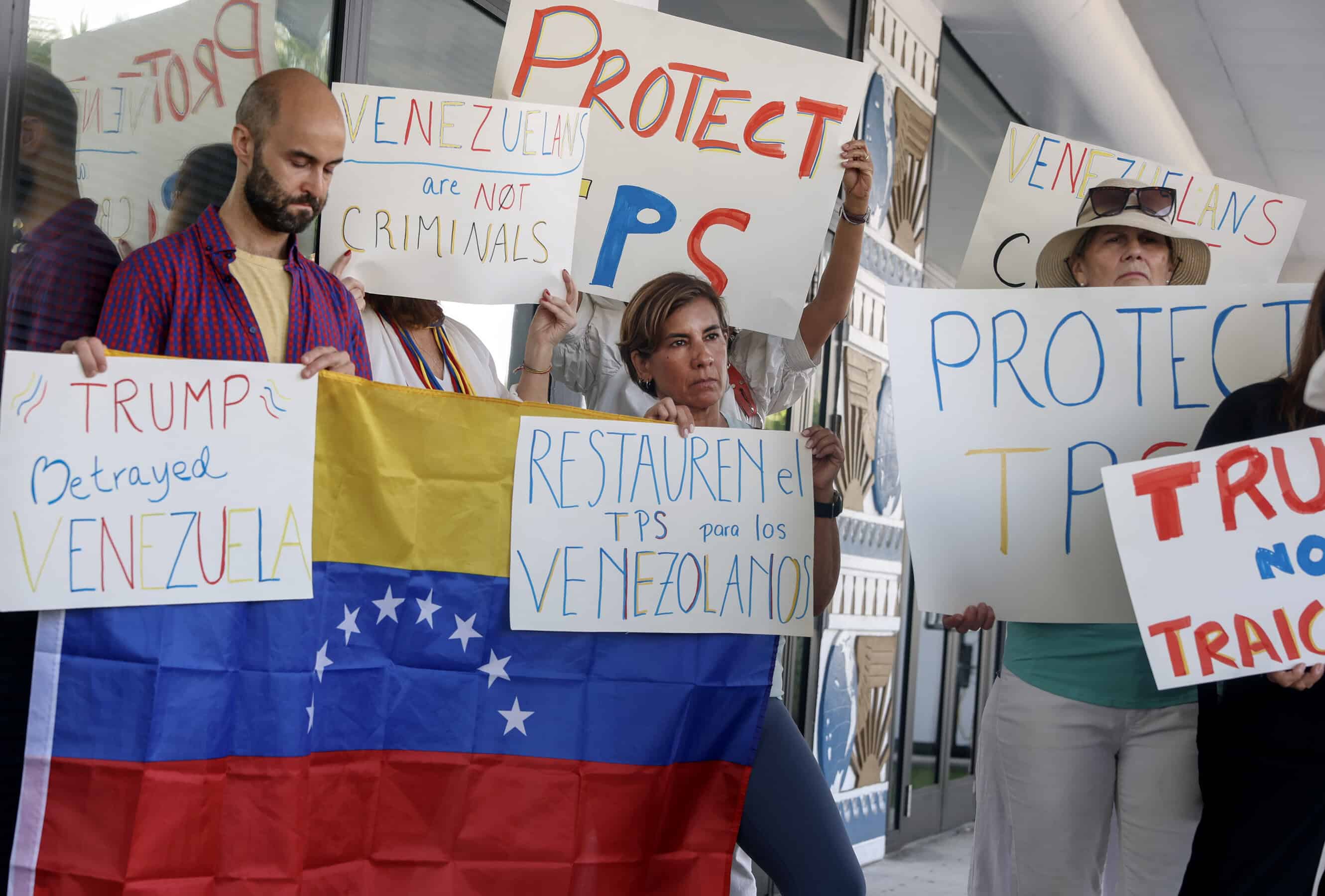




On May 19, 2025, the U.S. Supreme Court temporarily paused a federal court ruling from California that had blocked the Trump administration’s attempt to revoke Temporary Protected Status (TPS) for approximately 350,000 Venezuelans designated in 2023. As a result, the decision to end this immigration protection remains in effect—at least for now.
What is TPS?
TPS (Temporary Protected Status) is a mechanism created by Congress in 1990 that allows the U.S. government to grant temporary protection from deportation to people from countries affected by war, natural disasters, or severe humanitarian crises.
Although it does not provide permanent residency, TPS allows recipients to:
- Apply for renewable work permits, and;
- Remain legally in the U.S. for the duration of the designation.
In March 2021, the U.S. Department of Homeland Security first granted TPS eligibility to Venezuelans in response to the country’s “severe humanitarian emergency” and widespread human rights violations, among other critical conditions.
What changed in 2025?
At the start of the year, the Biden administration had extended TPS for Venezuelans until October 2026. However, in February, the Trump administration—shortly after the term began—argued that the program no longer served the national interest. It claimed that “certain conditions for the 2023 TPS designation of Venezuela may continue; however, there are notable improvements in several areas such as the economy, public health, and crime that allow for these nationals to be safely returned to their home country.”
There is no evidence to support the claim of “significant improvements” that would make Venezuela safe for return. HumVenezuela’s 2024 Household Survey firmly describes the existence of a “stagnant crisis.” While 500,000 people moved out of humanitarian need compared to 2023, another 900,000 fell into severe humanitarian need. Hunger levels have risen, and 46.7 percent of the population still lacks access to medication due to the collapse of the healthcare system. Although some indicators, such as inflation, show signs of recovery, the latest report from the UN Office for the Coordination of Humanitarian Affairs warns of a potential economic downturn, fueled by new oil sanctions imposed by the Trump administration.
Beyond humanitarian concerns, recent months in Venezuela have been marked by a surge in state repression. Reports from national and international organizations document an unprecedented wave of state repression following the July 2024 elections, reaching a peak of nearly 2,000 political prisoners. This political persecution—described as a crime against humanity by the UN Fact-Finding Mission on Venezuela—exacerbates the insecurity and lack of guarantees for Venezuelans returning from abroad. For example, in an intimidating gesture, Interior Minister Diosdado Cabello, widely considered the architect of the state’s repressive apparatus, has been welcoming repatriated individuals at Maiquetía International Airport.
In light of these and other troubling conditions, a federal court in California blocked Secretary Noem’s attempt to revoke TPS, finding that doing so would cause irreparable harm to beneficiaries. But on May 19, the Supreme Court stepped in and temporarily lifted that protection, responding to an emergency request from the government. As a result, the effort to end TPS for Venezuelans is once again moving forward, even as the broader legal battle continues.
What does this mean for Venezuelans with TPS?
The immediate impact is uncertainty. Although the revocation process can proceed, the legal battle is not over. The case is now on appeal before the Ninth Circuit and could eventually return to the Supreme Court if it agrees to formally review it. In the meantime:
- It is unclear when people will lose their status and work authorization.
- The information published on the U.S. Citizenship and Immigration Services (USCIS) website is confusing, as it does not specify when status and work authorization will be terminated.
- The attorneys leading the defense have filed an emergency motion to protect those who have already re-registered and received valid permits through October 2026.
It’s worth noting that the Supreme Court’s decision does not prevent challenges to the notice issued on February 3, 2025, by Homeland Security Secretary Kristi Noem, which aims to invalidate key documents such as:
- Work permits (EADs),
- Form I-797,
- Form I-94.
All of these documents had been extended through October 2, 2026, under the current designation.
Why does it matter?
The revocation of TPS could have devastating consequences:
- It would affect tens of thousands of families currently living and working legally in the U.S. and put at risk of deportation people who cannot safely return to Venezuela — a country where human rights are systematically violated and where there is a serious context of political persecution.
- It would result in significant economic losses, considering that 350,000 people are working and paying taxes in the U.S.
As we at WOLA warned in February: By terminating legal pathways, the U.S. is abandoning hundreds of thousands of Venezuelans with status living in the country.
For more, read WOLA’s in-depth analysis on TPS here.