
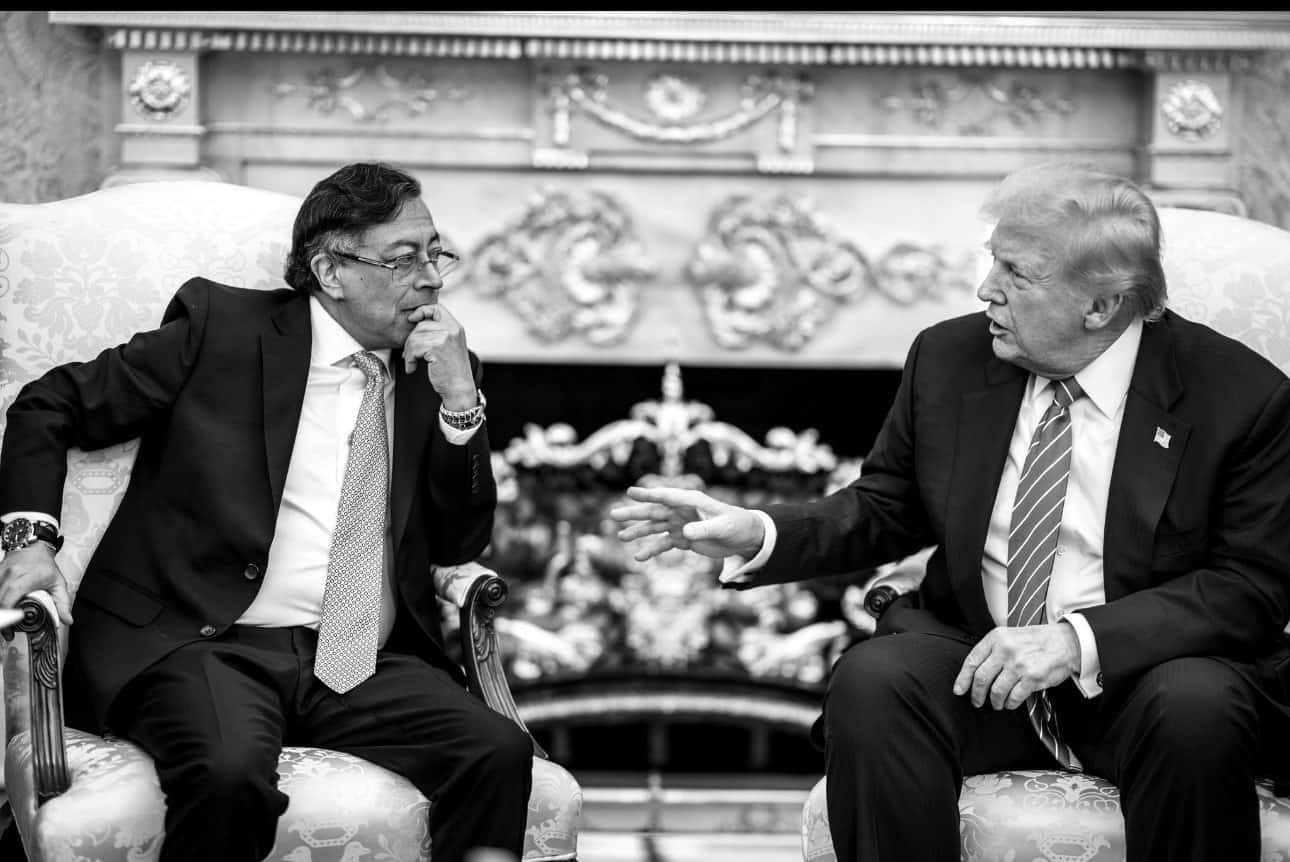


After a year of tensions, insults, and President Trump threatening Colombian President Gustavo Petro, saying that he could meet the same fate as Nicholas Maduro, an unexpected phone call between the two leaders on January 27 reversed the situation. The brief conversation ended with an official invitation for Petro to travel to the White House to meet with Trump in person.
Despite concerns about the meeting’s outcome, it was ultimately productive and helped mitigate tensions. Here, Colombian Ambassador Daniel Garcia-Peña and U.S. Senator Rand Paul should be congratulated for working to restore diplomacy amid a dangerous crisis.
The closed-door nature of the meeting was crucial. Hard-hitting questions from the press would have changed the outcome, since both men would have felt compelled to speak to their base. In the end, Trump was able to show that his strategy of exerting maximum pressure to advance U.S. interests, in this case concerning narco-trafficking and Venezuela, is effective with Colombia. Petro was able to show his base that his peace strategy of dialoguing with everyone to avert violence and advance Colombia’s interests, while not ceding dignity or sovereignty, worked with Trump.
The meeting, however, failed to set out a clear path forward for the bilateral relationship and address several “elephants in the room.” These include the ongoing boat strikes, Colombia’s decertification, Petro’s Office of Foreign Assets Control (OFAC) sanctions listing, and restarting U.S. international cooperation to Colombia. Whether the meeting will be a durable success depends on both nations’ ability to address those issues through respectful diplomatic channels. If not, tensions will continue. Here are some key factors for the bilateral relationship moving forward.
Colombia’s Upcoming Elections
The meeting took place just weeks before the legislative elections in Colombia, scheduled for March 8, and the first round of the presidential elections, on May 31. Colombia’s political opposition parties–especially those on the far right– were hopeful that this meeting would go south so they could affirm that Petro had ruined the relationship with Colombia’s top priority country, the U.S. Petro’s successful handling of this meeting, however, dealt a blow to this narrative. At the same time, Ivan Cepeda, the leading candidate on the left, adopted a tougher stance toward the U.S. after January 3. Now that the relationship is no longer combative, his anti-U.S. electoral strategy may be less effective.
As the elections approach, it remains unclear whether the Trump administration will seek to influence Colombia’s elections, as it did in Argentina and Honduras. Regardless of the administration, we are likely to see some U.S. policymakers in Congress take sides to try to influence the outcome. There is a minority group of policymakers who speak to their U.S. constituencies by making anti-Petro and anti-left remarks, such as Senator Bernie Moreno, who has been a staunch opponent of Petro. Upon leaving the White House meeting, Moreno stated that he’d be vigorously monitoring the Colombian elections.
Drugs and the fight against narcotrafficking
The main points discussed during the presidents’ meeting were the fight against narco-trafficking, the economic recovery of Venezuela, energy initiatives, and border security. A major concern for the Colombian government was that Trump had not been adequately informed about the country’s achievements against narco-trafficking, and at the meeting, Petro was able to speak to Trump directly about Colombia’s efforts. Petro then asked Trump for the U.S.’s help in going after a list of drug kingpins who live outside of Colombia in places such as Miami and Dubai. To show his commitment to these issues, Petro also reiterated a proposal that he’d previously made to Maduro in Venezuela, to no avail, to have Colombia and Venezuela work together to go after drug traffickers in the border areas.
Petro argued that permanently eradicating coca plants, rather than fumigating with glyphosate, was the best approach, showing Trump a video of rural farmers engaged in crop-substitution efforts. Petro also asked Trump to mediate between him and Ecuadorian President Noboa to resolve a recent diplomatic dispute stemming from Colombia’s insufficient actions against drug trafficking along their shared border– a standoff which led Ecuador to slap tariffs on Colombian goods. Petro additionally renewed a request previously made to President Biden, calling on the U.S. to declassify archives related to the 1948 assassination of Eliecer Gaitan and the 1985 attack on the Palace of Justice.
Venezuela
Both leaders discussed how to revive Venezuela’s economy, and the proposal of exporting Venezuelan natural gas through Colombia was presented as a win-win for all three countries. However, key issues such as human rights, justice, a clear transition to democracy, respect for the country’s self-determination, and the inclusion of diverse sectors of Venezuelan society in determining the country’s future were not raised. Petro also mentioned that sanctions against Venezuela impede its economic recovery. Trump said he didn’t believe in sanctions.
Energy
Lastly, additional energy-related business ventures that could benefit both the U.S. and Colombia were put on the table. During his trip, Petro’s delegation later met with U.S. business leaders in the cacao and chocolate sector with a view to opening markets for rural farmers who switch from coca to cacao.
Regional Security
The meeting took place amid regional concerns about the Trump administration’s actions and policies. In November 2025, the Trump administration released its National Security Policy. This policy includes the Trump Corollary to the Monroe Doctrine, which calls for the “potent restoration of American power and priorities, consistent with American security interests.” It views the region as a source of U.S. strategic resources and seeks to prevent non-hemispheric actors from dominating it. For the U.S., the use and threat of force to obtain its interests remains on the table.
The meeting also left important questions unanswered. Will the U.S. lift Colombia’s decertification status, and will Petro be removed from the OFAC sanctions list? Now that anti-narcotics cooperation with Colombia is strengthened, will the U.S. cease the illegal boat strikes off of Colombia’s coasts? These have extrajudicially executed 145 people in 39 attacks since September 2, 2025, which Petro has condemned in the past, stating it was an aggression against all of Latin America. The strikes have also paralyzed and frightened legitimate economic maritime activities, such as fisheries operating on Colombia’s Pacific and Caribbean Coasts. Far more rights-respecting and effective are the operations like the Colombia-U.S. interception of a narcosub that occurred on February 10, where the people on board were arrested, and the cocaine was seized.
A new economic package for Colombia?
Another vital question left unanswered was whether Colombia will again be the recipient of robust U.S. foreign assistance. Colombia was the largest recipient of U.S. assistance in the region, and the 2025 funding cuts were a major blow to Colombia’s ability to address the root causes of violence and illegal armed groups that are fueled by illicit economies. U.S. support is needed to strengthen justice, human rights, and ethnic communities in areas hard hit by the drug trade. A civil society that helps dismantle illegal armed groups and holds institutions accountable in matters of justice and corruption is key. The 2016 peace agreement with the FARC, which has its 10th anniversary in November, remains the best way to approach the structural problems that underlie violence and conflict.
The recently passed FY2026 budget appears to be moving in the right direction in terms of foreign aid. On February 3, Trump signed into law the bipartisan National Security, Department of State, and Related Programs (NSRP) Appropriations for 2026, which provides $50 billion in foreign assistance.
The joint explanatory statement accompanying the bill, which includes funding directives, appropriates $37.05 million in foreign military financing, $25 million in National Security Investment for Afro-Colombian and Indigenous Communities, $20 million to address illicit mining, and $15 million for human rights, while the House report, which also includes funding directives, appropriates $103 million in support for Colombia through the International Narcotics Control and Law Enforcement account. The bill also includes human rights conditions for receiving U.S. assistance.
Lessons from the past should be incorporated moving forward
Decades of experience between the U.S. and Colombia on addressing narco-trafficking and the lessons of Plan Colombia have shown that a hardline military approach does not end narco-trafficking. Rather, an integral approach is needed that includes strengthening justice, tackling corruption, prohibiting the ability for illegally obtained funds to be laundered, and addressing the socioeconomic and market issues that push persons to participate in the drug trade.
Moving forward, the relationship should prioritize putting U.S. foreign aid back on the table. For the drug and other illicit economies to be addressed, progress must be made in land titling and reform, justice, rights protections, and engaging ethnic communities. Likewise, efforts need to be made to address the corruption and impunity that facilitate illegal economies and the presence of armed groups along both sides of the Colombia-Venezuelan border. The dismantling of illegal armed groups is only possible by addressing the protection and economic needs of communities living in these areas.
The most recent developments in the U.S.-Colombia relationship show that, despite efforts in both countries to politicize it for electoral and personal gain, the relationship is standing the test of time. Colombia should take advantage of this political opening to continue to insist to the Trump administration that illegal boat strikes will not cease narco-trafficking and that the approach requires respectful cooperation that integrates the lessons learned from the failures and successes of the past. Colombian Legislative and Presidential candidates should focus on how to get the relationship back on track so it addresses the mutual interests of both countries.