The Facts
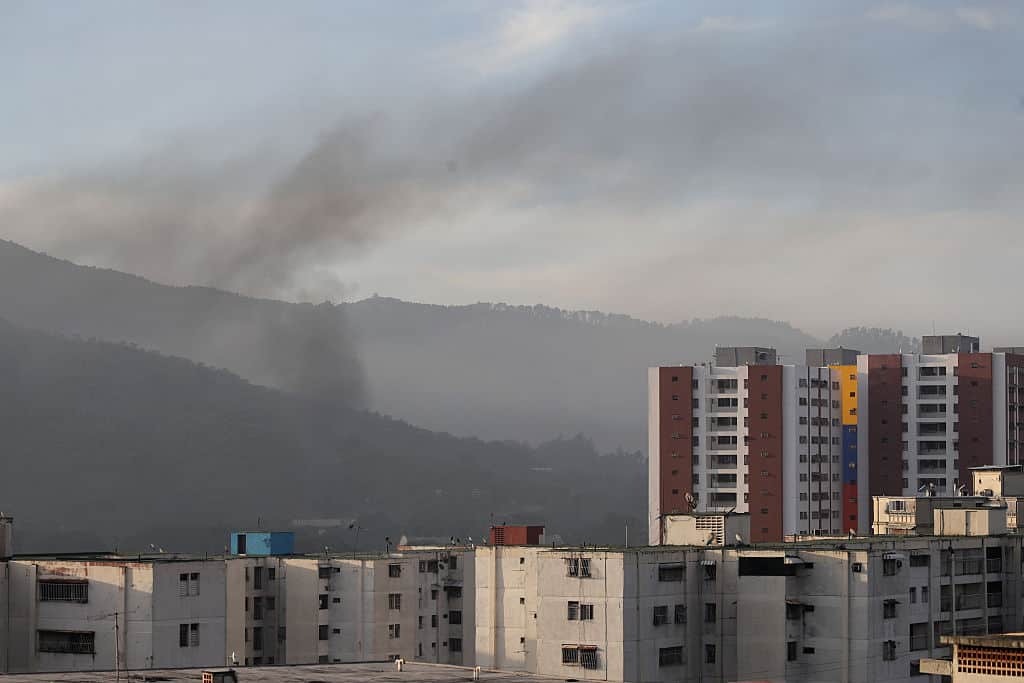
In the early morning of January 3, we woke to an event we no longer believed possible in this century: a U.S. military attack on a South American capital. The attack culminated in the capture of Venezuela’s de facto president, Nicolás Maduro, and his wife, Cilia Flores, and their subsequent transfer to New York to stand trial on multiple charges related to “narco-terrorism.” Local journalists estimate that at least 77 people were killed in the attack, including three civilians, while the Cuban government confirmed that 32 members of its armed forces also died during the operation, acknowledging the presence and involvement of Cuban intelligence and military personnel in Venezuela–something Venezuelan authorities had consistently denied for years.
Soon thereafter, on January 5, then-Vice President Delcy Rodríguez was sworn in as acting president, while her brother, Jorge Rodríguez, was reaffirmed as president of the National Assembly a few days later. The minister of Interior, Justice, and Peace, whom many commonly refer to as “the number two in Chavismo,” Diosdado Cabello, and the minister of Defense, Vladimir Padrino López, remain in their posts.
The position of the White House leadership was clear from the outset: President Donald Trump claimed a military victory, made no mention of democracy or human rights in his first address on January 3, and placed energy and oil considerations at the center of his discourse. In the days that followed, Secretary of State Marco Rubio attempted to “ease” the widespread concern generated by several of President Trump’s remarks (including the statement that “the U.S. will govern Venezuela”) and presented a “three-phase plan” for the country consisting of a stabilization phase, a recovery phase, and finally a transition phase. The details of how each phase would be implemented, the timeframes for each, and which Venezuelan and international leaders and organizations would be involved in their design and execution remain unknown.
As this article is being written, the new de facto authorities in Venezuela, beyond maintaining a defiant rhetoric toward the administration in Washington, in which they condemn the events of January 3, are clearly “cooperating” with the U.S. government. The reopening of embassies, the lifting of sanctions, and much closer joint work in the coming months are anticipated. While the Venezuelan opposition is also in dialogue with the White House, as demonstrated by the January 16 meeting between opposition leader María Corina Machado and Donald Trump, it remains unclear how and under what conditions it will participate in the transition that Washington says it seeks to promote.
The Two Truths
The early morning of January 3 sets a grim precedent for hemispheric relations. As we at the Washington Office on Latin America (WOLA) stated immediately following the armed intervention:
“The Trump administration carried out the strike without the authorization of the U.S. Congress and in violation of limits on the president’s constitutional war powers. The U.S. actions also violate international law. There appears to be no legitimate claim of self-defense on the part of the U.S.”
Article 2(4) of the Charter of the United Nations (UN) establishes that: “Members shall refrain in their international relations from the threat or use of force against the territorial integrity or political independence of any state, or in any other manner inconsistent with the Purposes of the United Nations.” As a UN member, the U.S. government committed a clear violation of a principle enshrined in the Charter. Likewise, through this action, the Trump administration made clear to Latin America and the world its intention to openly disregard the basic principles governing relations among states and to act unilaterally—including through the use of force—to advance its foreign policy objectives.
That said, a second truth, equally important and necessary to state, is that this condemnable breach of international law by the U.S. government occurred in a country governed by an authoritarian elite that for years has systematically violated international human rights law. It is difficult to fully convey the magnitude of the fact that Venezuela is the only country in the Americas with an open investigation at the International Criminal Court (ICC). The crimes under ICC investigation include political persecution, imprisonment or other severe deprivation of physical liberty, torture, rape, and/or other forms of sexual violence by civilian authorities, members of the armed forces, and government supporters. Although Venezuelans voted for a change in government on July 28, 2024, by electing candidate Edmundo González Urrutia, as the Venezuelan opposition demonstrated with evidence, Nicolás Maduro chose to disregard the will of the Venezuelan people. The suffering of Venezuelans amid the complex humanitarian emergency, sustained repression, and the exodus of more than 25% of the population in just a decade is difficult to capture through data or indicators alone. The Venezuelan tragedy has affected the entire region and extends beyond the borders of Latin America.
This does not justify a military attack by a major power. It does, however, show that in the Venezuelan case, two complex truths coexist: the Trump administration’s open violation of international law and the reality of a country that continues to live under an authoritarian and repressive regime that lacks any legitimacy. Caught between these two truths are the people of Venezuela, and their diaspora forced across the world, who hope that the international community, including the U.S. government, will make the necessary effort to set the country on a path toward the genuine democratic transition that Venezuelans are calling for, rather than merely replacing one authoritarian leadership with another.