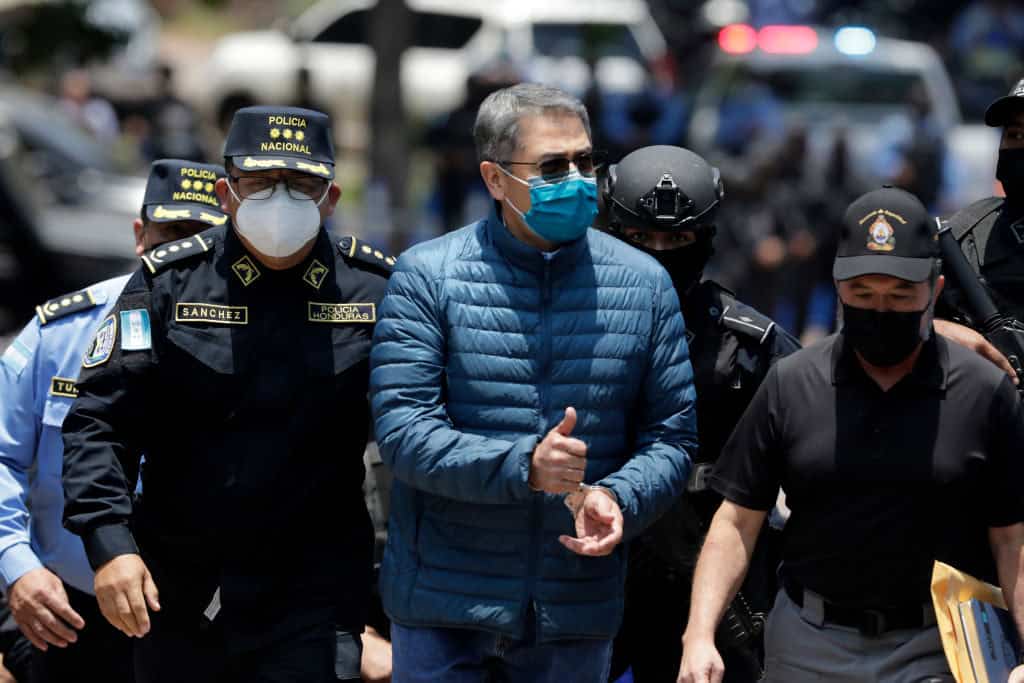

During the presidency of Juan Orlando Hernández (JOH, 2014–2022), Honduras was known for large-scale drug trafficking and corruption, as well as for its severe human rights violations, especially targeting defenders of land, environment, and journalists. On November 28, 2025, President Donald Trump announced on social media that he would issue a “full and complete pardon” to Hernández, an announcement that immediately raised serious concerns given the gravity of Hernández’s convictions. Just three days later, on December 1, Trump formally granted the pardon, and Hernández was released that day. This abrupt reversal came despite Hernández’s 45-year sentence, issued in June 2024 after a U.S. federal jury found him guilty of conspiring to import cocaine into the United States and committing related firearms offenses.
Below, we provide an overview of President Donald Trump’s pardon of former Honduran President Juan Orlando Hernández and its implications for justice, drug policy, human rights, and democratic governance in Honduras
Juan Orlando Hernández charges and connections with transnational criminal organizations, including the Sinaloa Cartel
In March 2024, a U.S. federal jury in Manhattan found Hernández guilty of three charges: conspiring to import cocaine into the United States, using and carrying machine guns and destructive devices to advance that trafficking conspiracy, and conspiring to use such weapons.
The verdict followed extensive evidence presented by prosecutors showing Hernández’s role in a large-scale, state-enabled criminal network in which he leveraged the power of the Honduran government to protect and expand cocaine trafficking operations. U.S. authorities described the scheme as “state-sponsored drug trafficking,” emphasizing that Hernández used public institutions, security forces, and political influence to shield traffickers in exchange for bribes and political support. In June 2024, he was sentenced to 45 years in prison, a prosecution driven by the scale of corruption, the corrosive impact of his actions on Honduran institutions, and the consequences of his drug-trafficking activities for U.S. communities.
Prosecutors documented that from at least 2004 until 2022, drug-trafficking organizations moved hundreds of thousands of kilograms of cocaine through Honduras to the U.S. under his protection.
- During his sentencing, it was noted that over “400 tons” (or “hundreds of tons”) of cocaine were trafficked under this scheme.
- The indictment alleges that JOH used the Honduran National Police and military to protect drug shipments transiting Honduras.
- Weapons, machine guns, and destructive devices were used by the drug traffickers he conspired with to safeguard shipments.
- JOH received millions of dollars in drug-money bribes from trafficking organizations and used those funds to finance his political rise and campaigns. As one key example, prosecutors said that a payment of about US$1 million was made by the Sinaloa Cartel (via its leader at the time, Joaquín Guzmán Loera, aka “El Chapo”) to JOH’s brother and close ally (also convicted of drug trafficking in the U.S.) in exchange for continued protection of the cartel’s drug-trafficking operations in Honduras.
- Prosecutors argued that money from drug trafficking was used to bribe election officials and influence elections, helping to ensure JOH’s electoral victories in 2013 and 2017.
Contradictions in President Trump’s rhetoric and policies to address drug trafficking
The pardon of Juan Orlando Hernández, one of the few former heads of state ever convicted in U.S. courts for drug trafficking, carries profound implications for U.S. foreign policy, the rule of law, and anti-corruption efforts in the region. By overriding that conviction, the United States risks undermining its own justice system’s credibility, signaling that even the highest-level officials may be shielded when it suits political or strategic interests.
This sets a troubling precedent, especially given the U.S. prosecutions of other powerful figures such as JOH’s brother and Mexico’s former public security minister Genaro García Luna, prosecutions that were hailed as breakthroughs in holding elites accountable for collusion with organized crime. It also has some similarities with the 2020 decision at the end of Trump’s first term in the Cienfuegos case, where the Department of Justice dropped a strong indictment against Mexico’s former defense minister at Mexico’s insistence, an episode U.S. investigators later described as defining the limits of U.S. security policy and damaging bilateral cooperation.
Regionally, the pardon could weaken cooperation on drug trafficking and corruption by eroding trust in U.S. commitments to accountability and the rule of law. It may embolden impunity for elites implicated in organized crime and corruption, while hampering future investigations that depend on the deterrent effect of credible prosecutions. More broadly, the pardon muddies U.S. policy messages on anti-drug efforts at a time when other U.S. actions frame counter-narcotics as a priority, and could signal to other governments that political considerations can trump legal accountability even in the most serious cases, diminishing the normative weight of U.S. justice efforts in the hemisphere.
At the same time that Trump is using the U.S. military to pressure Venezuela’s authoritarian regime led by Nicolas Maduro, framing it as a counter-narcotics operation, Trump is pardoning a former president who was actually convicted of using his office to facilitate the shipment of massive quantities of cocaine to the United States. The cocaine deliveries facilitated by JOH dwarf the amount of illegal drugs allegedly being carried by speed boats being attacked by the U.S. Navy in the Caribbean and eastern Pacific. These attacks have resulted thus far in 87 deaths and are considered illegal under domestic and international law..
While JOH was convicted and sentenced in a U.S. federal court after receiving due process, the people on the boats being destroyed in the Caribbean and Pacific on the orders of U.S. officials are being extrajudicially killed.
Beyond drug trafficking, Juan Orlando Hernandez was responsible for grave human rights violations that remain unpunished
Under his mandate, reports documented that dozens of journalists, lawyers, and human rights defenders were killed, threatened, or attacked, including the high-profile assassination of activist Berta Cáceres in 2016. Estimates compiled by civil-society sources suggest that between 2001 and 2021, there were around 219 murders of journalists and defenders, of which a substantial fraction occurred during the Hernández years: roughly 34 in his first term (2014–2018) and another 14 in his second (2018–2022). This data reveals a systematic failure of the state to protect vulnerable rights-defenders. Impunity remains the norm (only about 10% of journalist-killings have resulted in conviction), and the official protection mechanism lacks capacity and trust.
Likewise, international observers criticized the reelection of JOH in 2017, a result reached after controversial constitutional changes that triggered protests and a political crisis marked by repression. Security forces repressed major protests, and military policy and police used excessive force, including live ammunition, against demonstrators. Human rights groups documented multiple protester deaths and many injuries by both lethal and less-lethal weapons. The government expanded the role of militarized forces in domestic law enforcement. These forces, critics say, often used disproportionate force and contributed to human rights violations.
What’s next
Members of Congress have sharply criticized the pardon, and resolutions condemning the decision have been introduced in both chambers (H.Res. 929 and S.Res. 530). Beyond considering those measures, Congress could use its oversight authority to scrutinize the administration’s justification for the pardon and assess its potential implications for U.S. security interests and bilateral relations with Honduras, among other concerns.
In Honduras itself, authorities have already reactivated domestic charges and sought an international warrant for Hernández’s arrest on separate fraud and money-laundering allegations, underscoring the unresolved nature of his legal jeopardy and the potential for diplomatic friction.