In contexts of deep political polarization, WOLA aims to provide elements for an objective analysis rooted in universal principles. Treating human rights as ideological markers rather than internationally recognized standards erodes democracy. We see two realities that can hold true simultaneously. On the one hand, the U.S. military action in Venezuela is contrary to international law and forms part of the administration’s broader foreign policy objectives, made clear in the National Security Strategy, which focuses on domination and advancing U.S. interests over the protection of democracy and human rights. On the other hand, Venezuela is under an authoritarian government that hung on to power without legitimacy after losing the last presidential election and that brutally oppresses its citizens. The Venezuelan population, who suffer the most, is in the middle, faced with a dire economic and humanitarian situation, as well as political persecution. However events are interpreted, the reality is that with Maduro out–Venezuela’s history has taken a turn. Efforts are needed to steer the current context towards a true democratic transition and not just a change in some of its main characters.
Here, we examine who is leading Venezuela following the U.S. military’s capture of Nicolás Maduro, how the U.S. administration has responded, the current human rights situation, and how to support Venezuelans in their struggle for democracy.
What happened in Venezuela on January 3rd and who is leading the country now?
In the early hours of January 3, the U.S. military conducted a raid in Caracas to capture Venezuela’s de facto president, Nicolás Maduro, and his wife, Cilia Flores. U.S. strikes targeted air defenses, airports, a port, and military bases before special forces engaged Maduro’s security detail at his heavily fortified compound, where they captured both Maduro and Flores. Local journalists estimate 77 people were killed in the attack, including three civilians. The Cuban government acknowledged that 32 members of their military were killed, therefore confirming the fact, long denied by the Venezuelan government, that the Cuban military operates in Venezuela.
On January 5, Maduro and Flores, appeared before a court in the Southern District of New York on charges including “narco-terrorism conspiracy”, “cocaine importation conspiracy”, and weapons possession-related charges. The charges against Maduro are not new and stem from an earlier 2020 indictment of several Venezuelan officials and Colombian guerrilla figures.
Delcy Rodríguez, who was the de facto Vice President, was sworn in as Venezuela’s interim president on January 5, after the Supreme Court invoked Article 234 of the Constitution to address the president’s “temporary absence”. This maneuver, also used by the judiciary after Chávez’s death, allows the existing government to remain in power without calling new elections, effectively maintaining the same authoritarian system that operated under Maduro. Rodríguez was sworn in by her brother, National Assembly President Jorge Rodríguez, flanked by Maduro’s eldest son, in a ceremony underscoring the dynastic and insular nature of those currently in power in Venezuela.
The Rodríguez siblings, together with Defense Minister Vladimir Padrino López and Interior Minister Diosdado Cabello, are widely regarded as the most powerful figures in Venezuela. Delcy Rodríguez has occupied positions in the government since the Chávez era and, as vice president, oversaw the civilian intelligence service SEBIN, which has been implicated in gross human rights violations, including torture.
Rodríguez has held a dual, contradictory narrative, condemning the U.S.’s actions while speaking of a cooperation agenda with the U.S. She has said that Maduro is the only president, claiming for the respect of Venezuela’s sovereignty. At the same time, one statement reads in part, “We extend an invitation to the U.S. government to work jointly on an agenda of cooperation.” Whether she will be the figure who opens the door to a chance at democracy remains to be seen.
The CIA reportedly believes that Rodríguez may be more inclined toward pragmatism than other senior officials. Unlike López and Cabello—who directly control military, police, and paramilitary forces, respectively—Rodríguez is not named in the 2020 indictment against top Venezuelan officials. President Trump has threatened to subject Rodríguez to “bigger” consequences than Maduro if she does not do “what’s right”.
What has the administration said about Venezuela’s future, and how does Venezuela’s oil industry factor in?
Perhaps one of the most concerning outcomes of U.S. actions is the undermining of Venezuelans’ agency. After Venezuelans committed themselves to a democratic route in 2024 despite the lack of conditions for free and fair elections, domestic mobilization was brutally repressed, and international pressure failed to produce a peaceful solution to the crisis. Of the 11 million people who participated, over 7 million (67%) voted to elect Edmundo González Urrutia as president, with backing from María Corina Machado, and over 2,000 people were detained while defending those results. Meanwhile, President Trump said in his first address after the strike that the United States was “running the country” and dismissed the opposition’s leadership, saying that Machado “doesn’t have the respect within the country.”
The Trump administration initially issued three immediate demands to Rodríguez, covering Venezuela’s dealings with U.S. adversaries and involvement in drug trafficking. The release of political prisoners and respect for the electoral results of the 2024 presidential elections were not a part of those initial demands.
Speaking to the press on January 7, Secretary of State Marco Rubio spoke about democracy for the first time. He outlined a three-phase plan for its recovery that includes stabilization, recovery, and finally, transition. Particularly notable are Rubio’s assurances that phase two–recovery–will include a national reconciliation “so that the opposition forces can be amnestied and released from prisons or brought back to the country, and begin to rebuild civil society.”
The administration has called the operation a “success” despite it not yet being a democratic transition, and has reiterated that Delcy Rodríguez is cooperating. President Trump also met with representatives of the oil and gas industry and, although his messages on social media suggested that the U.S. was going to take Venezuela’s oil, on January 9 he issued an Executive Order that establishes that the funds are sovereign property of Venezuela, and they will be held in U.S. custody for governmental and diplomatic purposes, shielded from creditors and private claims. The order aims to ensure “economic and political stability in Venezuela”. The decisions on how to use those funds to respond to the needs of Venezuelans should be consulted with Venezuelan civil society and experts across different fields. Those purposes can only be achieved through a genuine democratic transition in Venezuela that reestablishes the rule of law.
What is the human rights situation in Venezuela following the U.S. attack?
The fact that Nicolás Maduro is in U.S. custody does not mean the regime has fallen. People outside Venezuela may wonder why, if Maduro was so unpopular, the streets are not filled with people celebrating. The answer is in repression. Following the presidential election of 2024 and the National Electoral Council’s decision not to publish the detailed results as required by law, people mobilized and protested across the country. Even in the poorest areas of the country, where there is more social control from the government, people were defiant against authoritarianism and knocked down the statues of Hugo Chávez. The repressive apparatus brutally cracked down on civil society, committing new crimes against humanity and inhibiting people from demonstrating again.
In Venezuela, there is a policy to silence and quash the opposition or those perceived as members of the opposition, as outlined by the United Nations Fact-Finding Mission. The Mission has studied in detail the way the repressive apparatus operates, its mechanisms, and the legal frameworks used to justify these actions. This structure remains in place today, and urgently needs to be dismantled as part of a broader democratization agenda in Venezuela.
The government does not provide official data on the people detained and, in fact, several dozens of people remain forcibly disappeared. According to accounts from Non-Governmental Organizations, the number of political prisoners is estimated at between 800 and 1,000. On January 8, the president of the National Assembly, Jorge Rodríguez, announced the release of “an important group” of Venezuelan nationals and foreigners as an act of peace. On January 14, Delcy Rodríguez insisted that 406 people had been released, and her brother had lashed out earlier at civil society organizations reporting otherwise. At the time, only 100 people had been released since January 8, and, from the information gathered, not unconditionally, meaning they are released under precautionary measures, with criminal procedures remaining open. This would not be the first time that the government uses political prisoners as a bargaining chip, and there is no guarantee that it will not become a revolving door, with new detentions in the future.
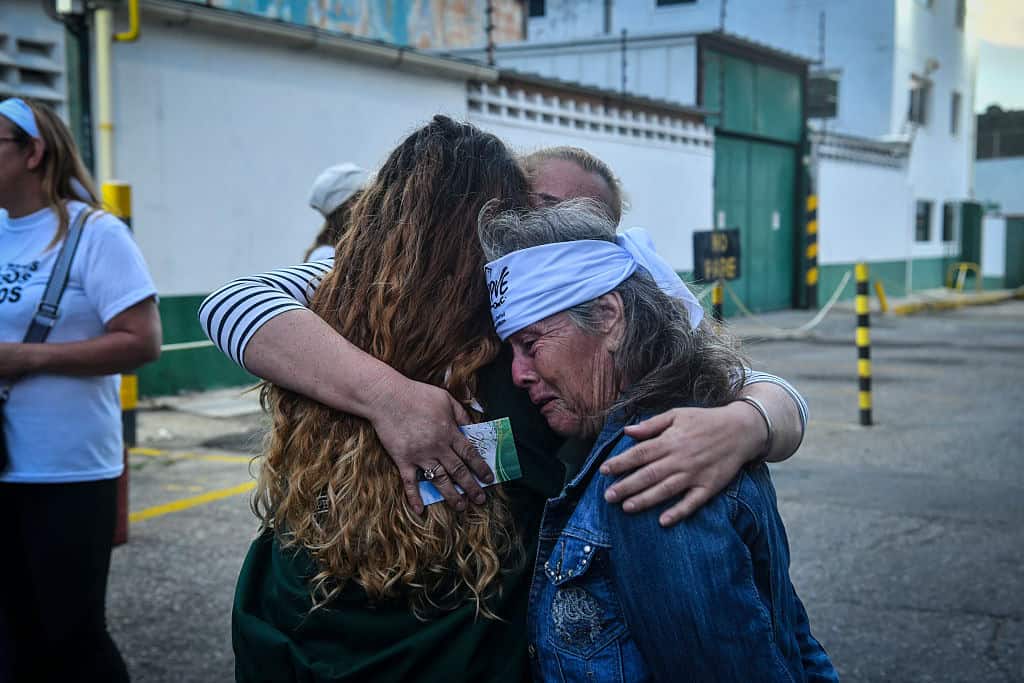
Trump also affirmed that Venezuela was “releasing a large number of political prisoners”, even though the current number remains low compared to the total (less than 10%). It would not be the first time that the government uses releases of political prisoners as leverage, and then it becomes a “revolving door” where new arbitrary detentions take place. WOLA celebrates every release of people unjustly detained, including journalists, foreign nationals, and human rights defenders, but we also have a responsibility to point out how re-victimizing and opaque the process of release has been. Family members of those detained and those disappeared have been anxiously waiting to hear from their loved ones; some have traveled hundreds of kilometers from all over the country to go to the detention centers located in Caracas, awaiting all night with no food, desperately calling for some clemency from authorities.
What is needed to steer the context towards a democratic transition?
Nicolás Maduro had been in power since the death of Chávez in 2013, who took office in 1998. Combined, they ruled the country for 26 years. The dismantling of democratic institutions was gradual, and it will take a long time to rebuild the rule of law. That has to be a priority for all actors. However, in the short term, the challenge Venezuelans face is, first, how to recover their right to self-determination, and, second, how to get the Trump administration to use its leverage to redemocratize the country rather than just prioritizing its domestic political and economic revenues.
Amongst the list of immediate issues that should be addressed, embedded into a broader agenda aimed at rebuilding the rule of law, is the need to have those in power in Venezuela unconditionally release all political prisoners, both nationals and foreigners. Authorities also need to provide information on the whereabouts of those who remain forcibly disappeared. A step in the right direction would be to accept the visit in loco requested by the Inter-American Commission of Human Rights and UN mechanisms and bodies, which can conduct independent verification of the process of release of political prisoners and assess the human rights situation.
Another key step would be the derogation of laws and measures specifically used for political persecution, such as the Law to Regulate and Control NGOs, the Law against Hatred, and the Simón Bolívar Law. It is also urgent for those in power in Venezuela to cooperate with the humanitarian response plan under UN coordination, without undue obstacles, so that humanitarian actors can operate in accordance with the humanitarian principles of humanity, impartiality, neutrality, and independence. These are all issues in which the U.S. and other governments, as well as international human rights bodies, should press on.
The U.S. Congress should also assert its power over the use of military force abroad, demand accountability for the Executive’s actions in Venezuela, and ensure funding for democracy in Venezuela. Simultaneously, the U.S. Congress and the administration should stand with Venezuelan victims of human rights violations and with civil society in their claim for the unconditional release of all political prisoners, the dismantling of the repressive apparatus, and respect for fundamental freedoms. Now, more than ever, it is crucial to maintain bipartisan support and understanding of the complex dimensions of the Venezuelan crisis and the need for a democratic transition.