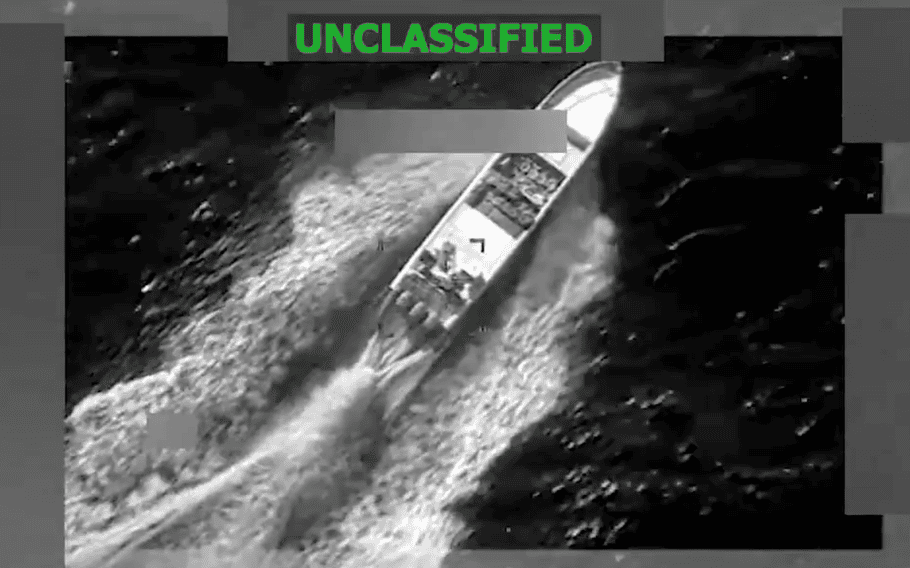




The U.S. military attacks that began last September, targeting boats allegedly smuggling drugs in the Caribbean Sea and eastern Pacific Ocean, have largely faded from the headlines. Other momentous events have dominated the news in the opening weeks of 2026, from the U.S. invasion of Venezuela to deadly shootings by federal immigration agents in Minneapolis, to President Trump’s threats to take over Greenland.
Media coverage of the boat attacks includes some spikes in attention: when the boat strikes first began on September 2, with detailed revelations in early December that survivors of the first attack were killed by subsequent strikes; and in the wake of the January 3 military incursion into Venezuela. More recently, coverage has been sparse.
Attention may wax and wane, but we should never normalize extrajudicial executions. Below are five things you need to know about the continuation of these illegal strikes.
- Media attention on the strikes has fallen.
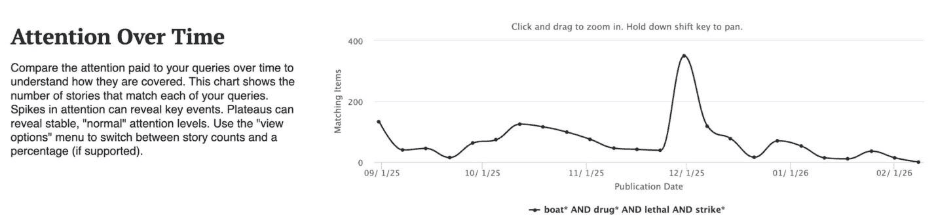
Search of mediacloud.org coverage of articles with the words “boat, drug, lethal, and strike” shows coverage slowing to a trickle in late January and early February.
An analysis of New York Times API search results, performed with assistance from Claude Code, concluded that “Absent major controversy (war crimes allegations, congressional hearings), the strikes themselves no longer generate significant dedicated coverage. They have become part of the scenery rather than front-page news.”
But while media coverage has slowed and the headlines have all but disappeared, the Trump administration has continued its campaign of maritime attacks. The final three days of December 2025 were the most lethal since the initial strikes on September 2, with three attacks killing 18 people. This burst of violence at year’s end raised the total number of fatalities to 124 over four months.
Following the January 3 U.S. military incursion into Venezuela to extract Nicolas Maduro, nearly three weeks passed before another boat strike was carried out–the longest lull between strikes since the first attack in September. But attacks resumed with a January 23 strike that killed three people, followed by strikes on February 5 and February 9 that took at least four more lives.
- Trump is trying to normalize lethal military force under the banner of a war on “narco-terrorism.”
Amid the swirl of major developments in early 2026, it’s understandable that the boat strikes would recede from the headlines. But the result is alarming: extrajudicial executions conducted by the U.S. military seem to be evolving into business as usual. Just as the U.S. killings of those aboard targeted vessels are entirely premeditated and intentional, the ongoing attacks at sea appear designed to normalize killings at President Trump’s discretion, both within the U.S. military chain of command and in the eyes of the American people.
By labeling the boat crews as “narco-terrorists” (but providing no public evidence for their claims), Trump and his aides are weaponizing Americans’ genuine grief over drug addiction and overdoses by targeting supposed culprits. Crucially, with the exceptions of a few known survivors, the people aboard the boats are utterly annihilated, erasing them as individuals and leaving only the menacing specter of “narco-terrorism” emphasized in official rhetoric.
In announcing the attacks, the administration is blending one strike into the next with formulaic repetition, using the same format and nearly identical language in X posts by Defense Secretary Pete Hegseth or, more recently, by Marine General Francis Donovan, the new commander of U.S. Southern Command. The boat strikes are becoming routinized at the Pentagon—or at least within the Southern Command—and risk becoming normalized and unstoppable in the eyes of lawmakers and the public. The consolidation of the strikes at sea could also embolden Trump to escalate further by ordering strikes on land.
In the weeks leading up to the U.S. incursion into Venezuela, Trump warned that land strikes in the country might be imminent. But reports suggest that Trump, key White House aides such as Stephen Miller, and many Republican lawmakers want to conduct U.S. military operations targeting cartels inside Mexico. The maritime strikes and pressure centering the “narco-terrorism” narrative on Maduro and Venezuela were the administration’s Plan B. With Maduro removed and enthusiasm strong among some in the MAGA base for continued military action against drug cartels, the possibility of land strikes could re-emerge.
- The boat strikes are illegal as ever.
The Trump administration claims that the United States is engaged in a “non-international armed conflict” with drug cartels and that designating such groups as terrorist organizations confers authority to target their members militarily. But in fact, the U.S. is not at war with drug cartels, which are criminal enterprises that require a law enforcement response, and Foreign Terrorist Organization (FTO) designations do not authorize military operations.
Some of those aboard the targeted boats may indeed have been transporting illegal drugs (as Trump officials claim, without presenting evidence). But involvement in drug smuggling is not a capital offense under U.S. or international law, much less justification for extrajudicial execution. Indeed, the U.S. Coast Guard, with occasional Navy support and modest funding, has decades of experience in boarding vessels suspected of transporting illegal drugs or other contraband and detaining their crews for potential prosecution in U.S. federal courts.
On those missions, use of deadly force is prohibited by law and policy unless there is a clear self-defense justification: that the U.S. personnel involved face an imminent threat of death or serious injury. The videos that the administration shares on social media do not show self-defense situations: those aboard the boats are not firing at U.S. aircraft or drones, and often do not even appear to be aware that they are under attack. These guardrails on the use of force are not merely incidental; they go to the heart of how the state can employ power to provide security while ensuring due process of law.
Those being killed by U.S. military strikes at sea are denied any due process whatsoever, their lives ended by missile attacks carried out at the orders of President Trump and Secretary Hegseth, or the Southcom commander, with no basis under either U.S. or international law. They are asserting and exercising an apparently unlimited license to kill people that the president deems to be terrorists.
Revelations that survivors of the initial boat strike on September 2 were killed by follow-up strikes led to speculation that the subsequent strikes constituted “war crimes.” But since there is no actual war against drug trafficking organizations, peacetime rules of engagement and international human rights law apply, meaning that the military’s follow-up strikes against the survivors were extrajudicial executions, just as the other killings caused by these attacks. If the U.S. were indeed at war, then a so-called “double-tap” strike to kill survivors would be a textbook example of a war crime. Reports have also emerged that the September 2 attack was carried out by military aircraft imitating a civilian aircraft, conduct which would also be in violation of the laws of armed conflict, if the U.S. were actually at war.
Congressional efforts to rein in the boat strikes legislatively through War Powers Act Resolutions fell short, narrowly, in 2025 and 2026. But the failure to prohibit further boat strikes does not amount to a positive congressional authorization, known as an authorization for the use of force (AUMF). Without an explicit congressional authorization, the Trump administration has leaned on the fanciful “non-international armed conflict” argument that legal experts have repeatedly and convincingly debunked.
- Blowing up alleged drug boats is useless for the stated purpose of stopping drug trafficking.
The Trump administration launched these unlawful attacks in the name of fighting so-called “narco-terrorism” and halting the flow of illegal drugs into the United States. Within the United States, drug overdose deaths have been declining since 2023, but substance use disorders and overdose deaths remain severe problems that require vigorous federal government action. So the Trump administration has identified a significant public concern.
Likewise, the administration grasped a reality that has long been in plain view but is rarely acknowledged by U.S. leaders of any stripe: the traditional U.S. drug interdiction mission has little to show for itself. Drug trafficking organizations predictably hedge against possible product losses due to interdiction by producing more drugs and by diversifying their smuggling routes, collaborators, and technologies. Recognition of this stubborn reality should lead policymakers to reduce their expectations of what interdiction can contribute to the overall effort to address overdoses and other drug-related problems.
Trump and his team, however, have embraced an even less effective, more expensive, and fully unlawful version of interdiction based on lethal violence as a first resort. The administration’s basic argument seems to be that lethal military strikes against alleged drug smugglers would not only prevent the targeted shipments from reaching their destinations but would also deter drug smuggling more widely, given the risk that smugglers would face sudden death, rather than possible detention by the Coast Guard and prosecution in U.S. federal courts.
In response to U.S. military operations targeting their vessels and crews for destruction, drug trafficking organizations can be expected to respond by seeking out less risky routes and technologies. These could include, but are not limited to, more use of cargo containers, more small craft taking short hops up coastlines, and more use of land and aerial routes. Blowing up small boats does make for a violent spectacle, but the resulting drug war “body count” will do nothing to actually hinder drug trafficking, disrupt organized criminal networks, or address U.S. drug problems.
The blatant illegality of the boat strikes is also beginning to erode the already-limited effectiveness of interdiction by discouraging law enforcement cooperation and intelligence-sharing on the part of long-standing partners in the U.S. drug interdiction mission, such as France, the Netherlands, and the United Kingdom. Governments recognize that engaging too closely with the obviously unlawful conduct of the Trump administration and the U.S. military risks implicating their own personnel in illegal and potentially criminal acts.
The Trump administration’s hyper-militarized drug war thus delivers the worst of both worlds: the military’s massive firepower is largely irrelevant to the business of drug trafficking, while the international cooperation required to disrupt and weaken organized criminal networks is fraying because of lawless U.S. conduct.
Likewise, for the most part, boats engaged in smuggling drugs from South America through the Caribbean or in the eastern Pacific would be transporting cocaine. It is difficult to measure the short-term impact that the strikes may be having on drug supplies, because most data about seizures, price and purity, hospitalizations and overdoses, and similar indicators are delayed for months or even years.
One partial indicator that is available, though, is Customs and Border Protection’s (CBP) seizures of cocaine at borders and along coasts, which the agency reports monthly. The CBP data are now current through January 2026. Five months and at least 131 extrajudicial killings later, CBP is finding at least as much cocaine as it did before.
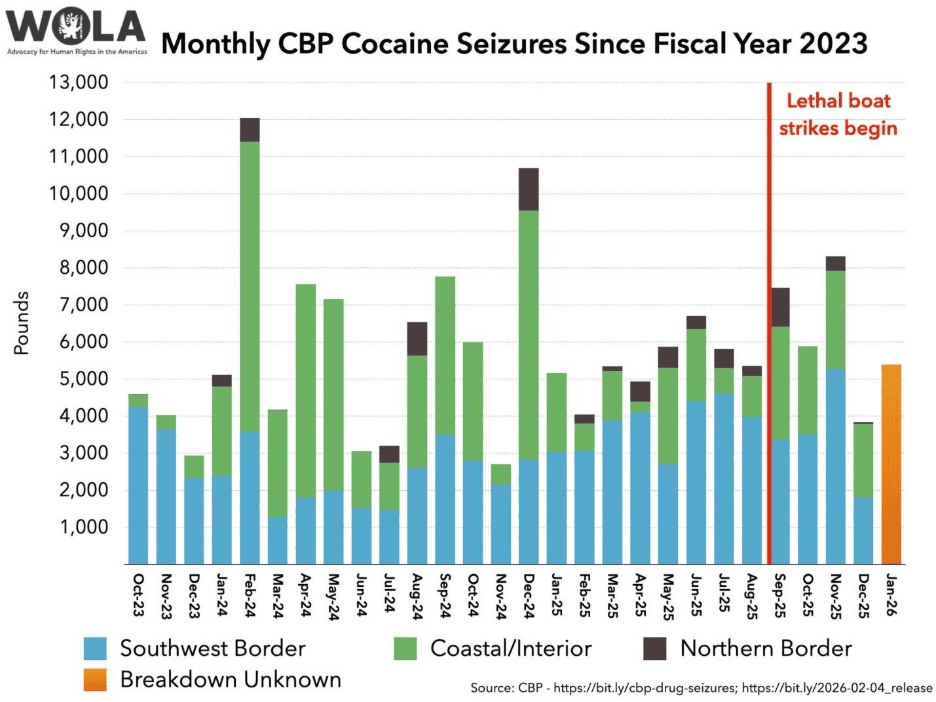
- Average month’s seizures September 2025-January 2026: 6,178 pounds
- Average month’s seizures September 2024-August 2025: 5,866 pounds
- Average month’s seizures October 2023-August 2025: 5,688 pounds
- An administration wielding violence outside the law–abroad and at home.
For Trump and his aides, the political value of normalizing the boat strikes may actually have little to do with claims of halting drug flows and dismantling drug cartels. Even if the boat strikes appear ineffective or counterproductive, they can pay political dividends if they accustom enough Americans to the president having a license to kill people he deems to be “terrorists,” contrary to U.S. and international law, and without any congressional authorization. That acclimation could happen both abroad and at home. The administration’s own words and behavior provide ample reason for concern.
Administration officials’ readiness to label political opponents and critics as “domestic terrorists” suggests not simply an intent to demonize opponents, but to justify the government’s use of force against them. Last September, Trump issued a secret National Security Presidential Memorandum (NSPM-7) that instructed his administration to compile a list of groups to be designated as “domestic terrorist organizations,” despite the lack of any legal basis for such a categorization.
In this context, the apparent willingness of at least one sector of the U.S. military to wield violence outside the law—essentially placing compliance with Trump’s desires above obedience to the Constitution—becomes even more threatening. The threat grows when the Department of Justice—no longer independent of the White House—issues secret Office of Legal Counsel opinions “legalizing” the military orders.
The sense of menace is underscored by Trump’s oft-expressed intention to deploy active-duty U.S. troops in American cities, including by invoking the Insurrection Act of 1807. At a gathering of top U.S. military leaders last September, Trump told the assembled commanders that troops would be needed on U.S. streets to counter the “enemy from within”.
“This administration has asserted the prerogative to kill people outside the law, solely on the basis of the president labeling them terrorists,” according to Brian Finucane, a former State Department lawyer who specializes in counterterrorism issues and the laws of war. “And there are no obvious limits to this license to kill. The president has wielded that authority in the Caribbean and the Pacific and could wield it domestically. Indeed, the fact that they invoked domestic terrorism to justify the killings of Renee Good and Alex Pretti suggests they already might have.”
Perhaps this will go no further. The American people, Congress, and the military itself may reject such uses of force against the president’s political opponents. But many things once thought beyond the pale have happened in the past year, while U.S. institutions have struggled to respond to a president who has sought to wield power unchecked. We need to stay vigilant—and never normalize a single boat strike.