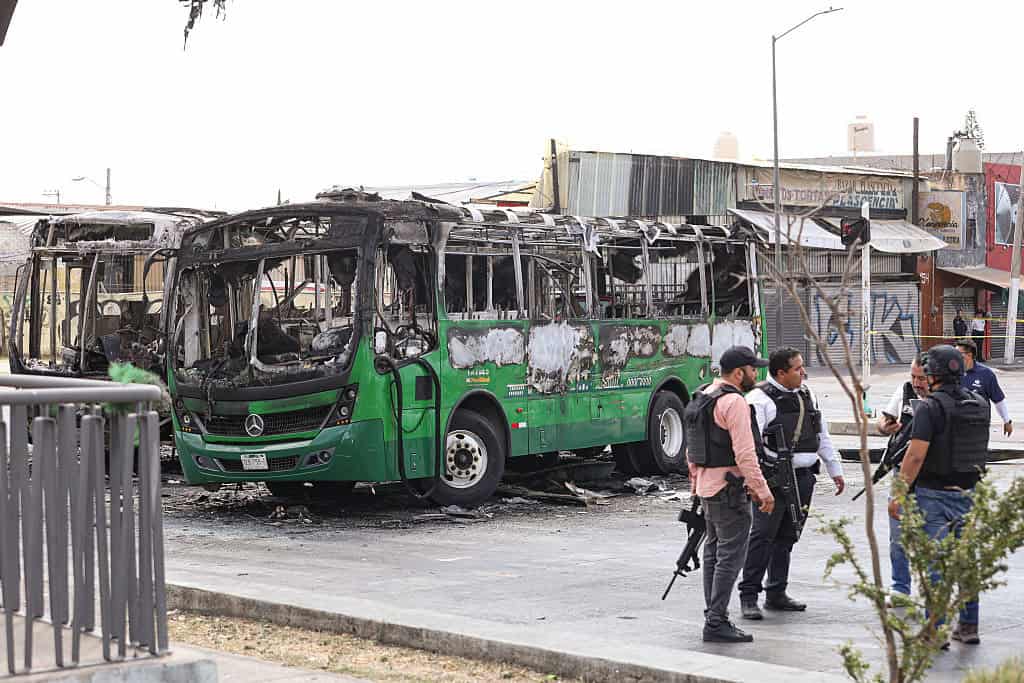


The death of Nemesio “El Mencho” Oseguera Cervantes, leader of the Jalisco New Generation Cartel (CJNG), resulting from a Mexican military operation carried out on February 22, has been widely labeled in the media as a major ‘win’ in the war on drugs.
But the outcome of the operation—acts of violence in which dozens of members of the security forces and others have lost their lives, a day of blockades that disrupted the lives of the population, and the possibility of further violence in the medium term—illustrates the need to question how ‘success’ in this war is being measured.
The February 22 operation
The February 22 operation was aided by intelligence provided by the United States through the Joint Interagency Task Force-Counter Cartel established last January by the U.S. Department of Defense. Although the operation was carried out by Mexican forces, President Donald Trump referred to the role of the United States in no uncertain terms: “We’ve also taken down one of the most sinister cartel kingpins of all. You saw that yesterday.”
More broadly, the operation takes place in a context of intense pressure from the Trump administration for Mexico to demonstrate tangible results in the fight against drug trafficking. This pressure has included threats of and imposition of tariffs, as well as the possibility of unilateral U.S. military action on Mexican territory. In this context, the government of President Claudia Sheinbaum has complied with a series of U.S. security requests over the past year, from the deployment of additional troops to the shared border and the seizure of 320 tons of illicit drugs, to the direct handover of 92 individuals wanted by the United States, in addition to the extradition of dozens of others—high-visibility actions for the U.S. government.
However, no matter how much media attention it receives, there’s little reason to believe that eliminating a criminal leader will translate into solutions for people and communities in the United States who are struggling with addiction and other health problems associated with illicit drug use. Instead, there are reasons to think that such an action may lead to more violence in Mexico.
The “kingpin” strategy
Decades of evidence show that the strategy of decapitating organized crime groups, known as the kingpin strategy, can trigger more homicides in affected areas, as well as lead to the fragmentation of groups—making them more difficult to dismantle due to the large number of groups and the lack of a clear command structure—and to greater conflict, resulting in an increase in violence.
A relevant, if not identical, example is the violence that has been taking place in the Mexican state of Sinaloa since the second half of 2024, stemming from the handover to the United States by Joaquín Guzmán López—son of “El Chapo” and member of a faction of the Sinaloa cartel—of criminal leader Ismael “El Mayo” Zambada, also of the Sinaloa cartel. This event sparked an internal war within the criminal organization, leading to a surge in homicides and disappearances.
In recent decades, a long list of criminal leaders have been captured or killed in Mexico. The kingpin strategy was particularly evident during the administration of Felipe Calderón (2006-2012)—a period that also saw a high level of bilateral cooperation with the United States—but it has never been completely abandoned.
Time and again, the arrests or deaths of criminal leaders are heralded as ‘decisive blows’ in the war. But year after year, the illicit drug market continues to thrive and evolve. This should come as no surprise: drug prohibition places a highly lucrative industry in the hands of criminal organizations, generating profits that empower these groups to foster collusion with authorities and influence many areas of daily life. Until this model changes, decapitating criminal groups will hardly make the illicit drug industry disappear.
Meanwhile, for the Mexican population, the cost of the war has been enormous. Starting with Calderón’s six-year term, homicides have risen dramatically—with more than 400,000 people killed in the last two decades—as have disappearances. Currently, there are more than 130,000 people disappeared and missing in the country. In many cases, the disappearances are perpetrated by organized crime groups, who often operate with the tolerance or collusion of state agents. The overwhelming majority of crimes committed against the population go unpunished.
What is needed to reduce violence?
Improving public security and reducing the power of criminal organizations in a sustainable manner requires breaking these cycles. Among other things, this involves strengthening the capacities and accountability of security and justice institutions, prioritizing reducing collusion between authorities and criminal groups, and significantly improving the investigation and prosecution of violence, corruption, and financial crimes.
Some of the actions implemented under Sheinbaum’s administration focus on aspects of the above. Compared to her predecessor, Andrés Manuel López Obrador, Sheinbaum is seen as having shifted strategy toward more actively pursuing a range of criminal actors. However, both presidents have continued with a model of militarization of public security that has been in place for decades and has diverted both attention and resources away from the need to improve civilian capacities as a structural response to violence.
For its part, the most relevant actions the United States could take to reduce violence in Mexico include reorienting drug policy—leaving behind the ‘war’ in the hemisphere in favor of a public health approach—and significantly reducing arms trafficking to Mexico. The Trump administration’s 2025 Statement of Drug Policy Priorities includes the goals of reducing overdose deaths in the United States and providing effective treatment and recovery services. However, this statement contrasts with the nearly $1 trillion cut over the next 10 years to Medicaid, the primary source of addiction treatment.
At the bilateral level, cooperation should support the consolidation of institutional capacities to reduce violence, as mentioned above. As of now, appropriations legislation passed by the U.S. Congress during the Trump administration is far from leaving the war on drugs behind, but it does identify the need to reduce the impunity of criminal organizations. In this context, it is important not to prioritize short-term, high-profile actions over long-term strategies, especially without considering the consequences these may have for the population, and to recognize that such ‘victories’ in the war do not improve the lives of those most affected by violence.