


When WOLA set its new strategic priorities in 2024, we consciously included promoting LGBTQ+ rights and gender diversity on the list. This decision would prove to be increasingly relevant. Within months, the president of Argentina would equate “gender ideology” to “child abuse” on the international stage, and the incoming administration in the United States would move to erase legal transgender identities . But attacks on the LGBTQ+ community are not necessarily new to the region. In Nicaragua—where an authoritarian state has ruled with an iron fist for years—LGBTQ+ activists have long been a target of the regime. What may appear to be an attack on one community points to something larger and is cause for concern.
Attacks on LGBTQ+ rights are not a side effect of rising new forms of authoritarianism, but the first step on the road to consolidating power. When governments set out to dismantle democratic norms, LGBTQ+ people are attacked, their rights threatened, and they become some of the first to lose protection. These attacks are an early indicator of democratic backsliding.
Across the Americas, we’re seeing this strategy play out. This is an authoritarian playbook for a new age. Unlike 20th-century dictatorships, today’s authoritarian movements erode democracy through culture wars, not coups. Manufacturing an existential threat to “traditional family values” creates a moral emergency that justifies concentrating power and marginalizing opponents. Now, the concept of “gender ideology” is being weaponized globally, and LGBTQ+ communities in the region are feeling the heat.
Nicaragua
Daniel Ortega was democratically elected as President of Nicaragua in 2006, marking the Sandinistas’ return to power after 16 years. Though the Sandinista movement was traditionally a leftist party, under Ortega it has shifted towards more conservative social stances.
Gay marriage is illegal in Nicaragua, and the ability for members of the LGBTQ+ community to exercise their rights remains limited as the regime’s choking of civil society has severely impacted queer organizations and movements in the country. But the situation for these communities goes beyond a constricted civic space; LGBTQ+ organizations are explicit targets of the regime.
The regime accelerated its attack on civil society in 2018, following a series of massive protests that erupted across Nicaragua. LGBTQ+ organizations were at the helm of these protests and faced subsequent repercussions, including surveillance, enforced disappearance, arbitrary detention, and torture. Then, a series of anti-NGO laws began taking out Nicaragua’s organizations one by one as they faced restricted access to funding and cancellation of their legal statuses. In 2021, Nicaragua’s oldest LGBTQ+ organization, Fundación Xochiquetzal, was shuttered along with 45 other organizations.
Argentina
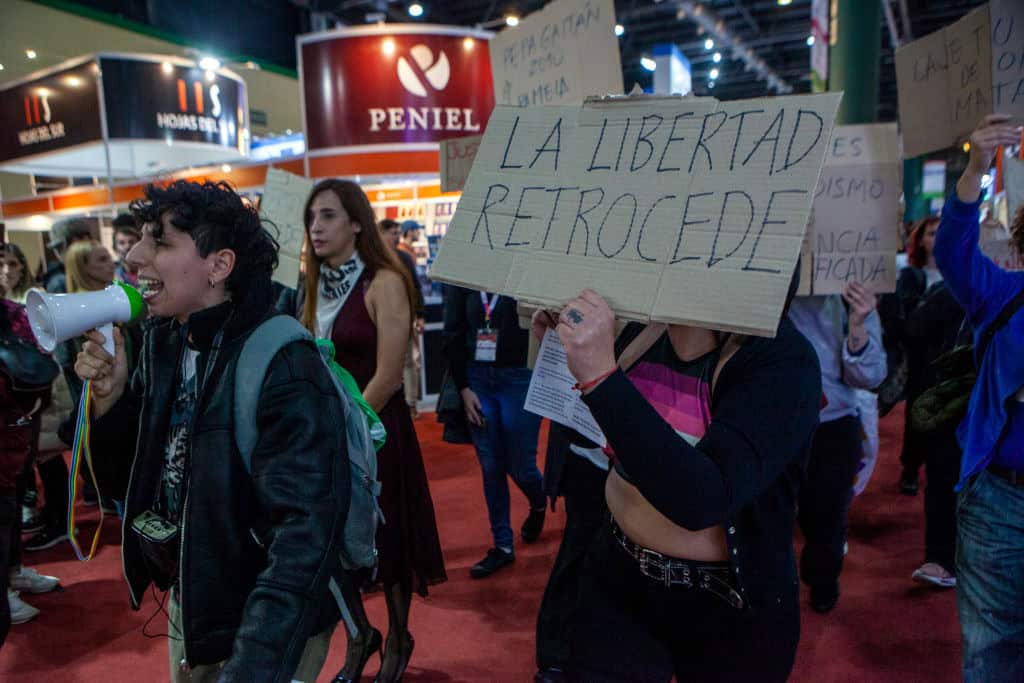
In Argentina, Javier Milei was elected in 2023, running on a platform of “traditional family values” and “anti-woke” ideology, and he moved quickly to turn that rhetoric into policy.
Within his first year, his administration closed the National Institute Against Discrimination, Xenophobia, and Racism (INADI). It eliminated the Ministry of Women, Gender, and Diversity, dismantling the institutional infrastructure that had made Argentina a regional leader on gender and LGBTQ+ rights.
His Justice Minister dismissed transgender and nonbinary identities as “subjective fabrications” before Congress, and Milei himself condemned “wokeism” at the World Economic Forum in Davos in January 2025, stating, “…in most extreme cases, gender ideology is simply child abuse; they are pedophiles.” He also falsely claimed that gender affirming care “mutilated children” and that trans women were abusing cis women in prisons.
United States
In 2025, the U.S. joined the chorus, marking a global shift in the protection of LGBTQ+ rights. In particular, the trans community has been under fire, with the administration taking action to remove their rights on its first day in power. On January 20, 2025, President Trump signed an executive order, declaring that the U.S. government would recognize only two sexes fixed at birth, withdrawing protections for transgender people, including military service, education, housing, and immigration, and ordering all federal agencies to end any reference to gender identity. Subsequent orders have restricted access to affirmative care, banned transgender individuals from serving in the military, and gutted funding for organizations working on LGBTQ+ issues.
The Trump administration has introduced broader anti-LGBTQ+ directives that erode workplace protections, funding for community health, and diplomatic recognition. Internationally, cuts to foreign aid and the enforcement of global gag rules have gutted funding, forcing many organizations to reduce operations or shut down entirely. Meanwhile, on the global stage, the U.S. has normalized the use of anti-rights rhetoric that has sent ripples throughout the world, further impacting these already vulnerable communities.
A warning for democracy
Setbacks against LGBTQ+ rights function as an early warning system for democratic health. The pattern is consistent: where these protections erode, broader freedoms follow. Governments that move to strip rights from LGBTQ+ communities rarely stop there.
The case of Nicaragua shows us where this road leads. What began with restrictions on NGO funding has led to political prisoners, forced exile, and the complete dismantling of civil society. In Argentina and the United States, it is too soon to draw the same conclusions, but the warning signs are there and should concern us all.
In 2026, Reporters Without Borders ranked Argentina 98th out of 180 on its press freedom index, an 11-space drop from 2025, citing institutional hostility, online harassment, and even the rhetoric of President Milei. In the U.S., Freedom House recorded the sharpest decline among countries rated “Free,” noting that the U.S. had hit its lowest score since the organization began tracking it.
The logic is the same in every case: if rights are conditional for one group, they are conditional for all. This is why WOLA tracks these issues. The erosion of LGBTQ+ rights across the region is inseparable from the broader threats to democracy and human rights that define our mission.
Pride is political not by choice, but by necessity. At WOLA, we understand that LGBTQ+ rights are human rights. As long as governments in the Americas continue to use LGBTQ+ communities as a wedge to consolidate power, we will continue to sound the alarm.