



 Read a printer-friendly (PDF) version of this report | Lea el resumen ejecutivo en español
Executive Summary
Since September 2, 2025, top U.S. officials have posted 63 videos to social media, showing the moments when 221 people’s lives ended as the small boats on which they were traveling exploded, torn apart by bombs and missiles fired by the U.S. armed forces in the Caribbean Sea and the Eastern Pacific Ocean.
After nearly 11 months, the Trump administration’s new video postings barely register in U.S. and regional news. Each attack is so similar to those that came before it that there is little “news handle” to grab onto. The boat strikes are blending into the background, buried under layers of newer crises distracting public opinion. After initial shock and outrage, the consequences of these illegal, lethal operations are becoming normalized.
This report explains why the U.S. government’s boat strikes are not normal and must never become so. They are murder under domestic law and extrajudicial killings under international human rights law. They are the result of the executive branch’s reckless use of the “terrorist” label to enable employing the U.S. military to target civilians. Their deaths come with no presentation of any evidence of wrongdoing, much less any due process for those being attacked. They must stop now, and those who have ordered and carried them out must be held accountable in all available venues.
The boat strikes are more than just a counter-drug strategy gone awry. They have grave implications for U.S. democracy, transparency, checks on executive power, and civil-military relations. They are emblematic of an aggressive, militarized reset of U.S. relations with Latin America that could set back causes that human rights, democracy, environmental, and anti-corruption advocates have defended for over half a century. They are a poor approach to drug policy, based on a fundamental misunderstanding of how organized crime works and how to confront it. They pose a vexing challenge to the next U.S. administration.
Because the consequences of the boat strikes extend across so many areas, this is a lengthy report. We divide its narrative into nine distinct sections.
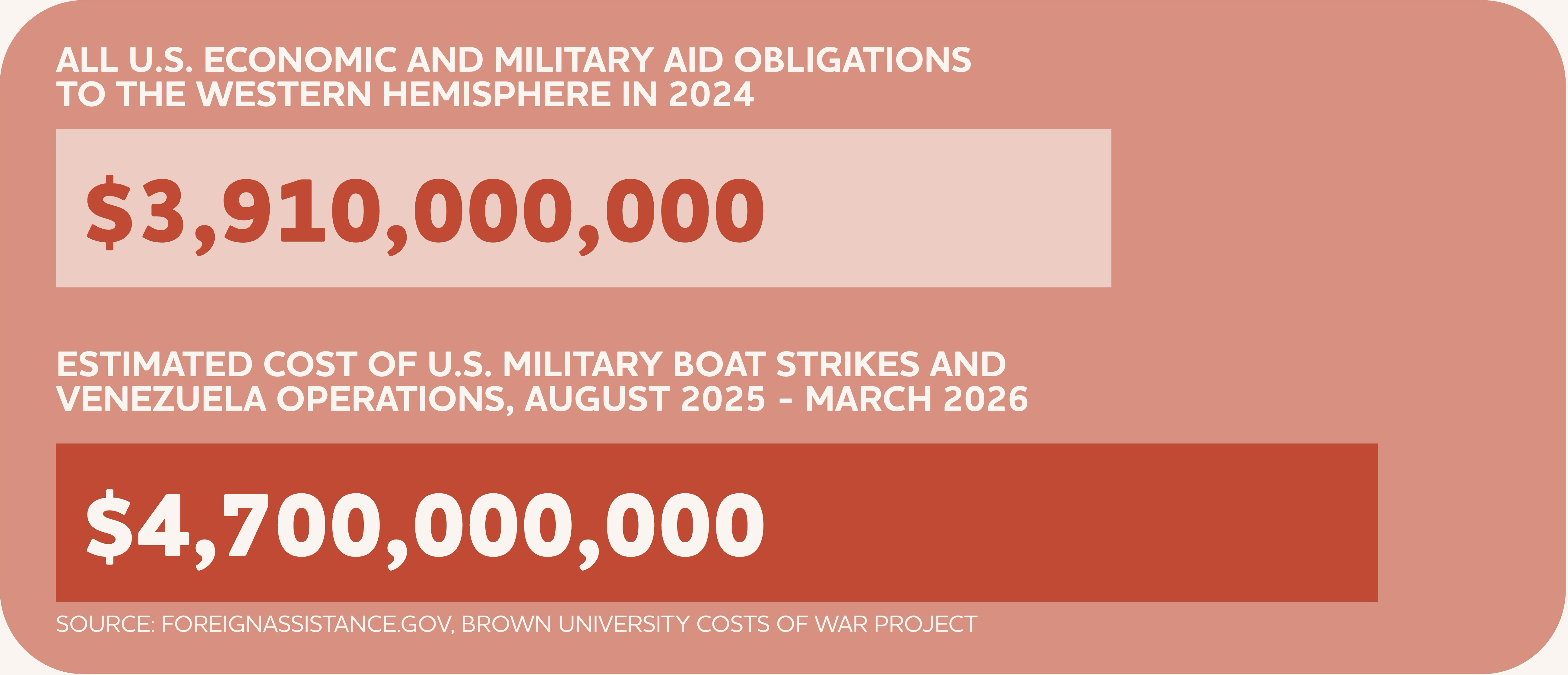
Section 1 explains the strikes’ scope, stated purpose, and death toll. Though the administration posts videos and general information about each attack, nearly everything else about what it calls “Operation Southern Spear” remains secret, including its mission and the reasons Defense Department officials opt for lethal strikes rather than ongoing, longstanding maritime law enforcement practices. This section discusses what we know about the military assets being employed and the operation’s cost so far, which rivals the annual amount of foreign aid that the U.S. government provided to the hemisphere before 2025, when the Trump administration cut it back dramatically.
Section 2 explains how the boat strikes fit within the Trump administration’s broader, more aggressive vision for U.S.-Latin American relations. This vision calls for a region-wide military offensive against what the administration calls “narco-terrorism,” with U.S. armed forces often at the forefront. This section summarizes what we know about the internal deliberations and legal maneuvers at the White House and the Department of Defense in the run-up to the strikes. At their core is a crucial document: a still-secret September 5, 2025, memo from the Department of Justice that seeks, through convoluted arguments, to compel the U.S. military to follow what are quite clearly illegal orders.
Section 3 explains the illegality of the boat strikes across several dimensions. The strikes fit firmly within the definition of murder under Section 1111 of Title 18 of the U.S. Code, among other statutes. Under international law, they are extrajudicial executions. They are not “war crimes” because the United States is not at war. While the Justice Department’s memo contends that the United States is in an armed conflict with a secret list of criminal groups designated as “terrorist,” it is unconstitutional to involve the U.S. military in a conflict without congressional authorization. To get around that concern, the legal hair-splitting continues, with the argument that this “armed conflict” does not meet the definition of “hostilities” under war powers laws and therefore does not require Congress to sign off. The standing order to commit murder and defy constitutional war powers places the U.S. military in a difficult and dangerous position with potential domestic implications.
Section 4 discusses the questionable quality of the intelligence used to target civilians aboard the boats, none of whom were accused of committing a capital offense in the first place. Defense Department officials reportedly do not know the identities of many of the people they are killing, yet they consider them all to be at least “affiliates” of terrorist organizations, a broad term that could end up including people a few degrees removed from the criminal groups themselves. As a result, there is a high probability that some or most of those killed were passengers, migrants, trafficking victims, fishermen, or, at worst, impoverished low-level drug couriers.
Section 5 brings together what we know about the victims themselves; because of organized crime or repressive government control of their communities, loved ones, in most cases, have not been able to come forward and tell their stories. In Trinidad and Tobago, coastal Venezuela and Colombia, and elsewhere, portraits that emerge are of people who were not involved in drug trafficking at all, or, when they were, of many people who agreed to crew boats for modest pay out of economic desperation. Often, their stories confirm grave doubts about U.S. intelligence and targeting.
Section 6 discusses options for holding accountable those who violated the law by planning and ordering the boat strikes. The answer is not straightforward for uniformed personnel: they have a responsibility to disobey illegal orders, but the Justice Department’s memo—however spurious its arguments—has added a patina of legality to the illegal orders issued to them. Possible accountability avenues include the U.S. civilian and military justice systems; civil litigation on behalf of the victims’ families in U.S. courts; foreign courts seeking redress for their citizens’ murders; and international and inter-American bodies whose findings can reveal truth and build memory but cannot compel the U.S. government to punish officials or provide reparations. Accountability will be a struggle.
Section 7 explores other states’ responses to the boat strikes, their possible complicity, and the steps that at least some have taken to criticize the policy or avoid being implicated in it. Several Latin American governments have applauded the boat strikes, and some—notably El Salvador, the Dominican Republic, and Trinidad and Tobago—appear to have lent logistical support. Others have voiced criticism, although several have undergone recent government changes that have brought to power leaders uncritical, or even supportive, of the policy. A few NATO countries—Canada, the United Kingdom, France, and the Netherlands—have taken steps to avoid sharing intelligence about suspected maritime trafficking that could enable a lethal U.S. strike.
Section 8 finds that despite the killing and the aggressive rhetoric, the boat strikes’ impact on the trafficking of cocaine, the main drug flowing from South America, has been slight to non-existent. Available information about cocaine markets in the United States and seizures at U.S. borders does not show the boat strikes “moving the needle” at all. Traffickers continue to have other options unaffected by the strikes, ranging from short-hop coastal boat trips to the use of container ships and overland routes.
Section 9 concludes with recommendations for institutions and actors in the U.S. government, other states, and international organizations. The overarching, immediate call to action is to cease the boat strikes and rescind all enabling orders right away. These murders on the high seas must end, and the United States must return to legality. Then, it will be vital to set in motion a series of measures, from accountability to institutional safeguards, to prevent the U.S. government from ever repeating this tragic mistake—and to prevent the boat strikes from ever being considered “normal.”
1. A secret policy with a public social media campaign
1.1. Data about the strikes
Like most lethal U.S. military operations, the boat strikes happen in secrecy. We don’t know exactly where most occur, what aircraft or weapons are employed, why the tempo of attacks ebbs and flows, what contraband U.S. commanders believe is aboard, or which criminal groups U.S. commanders believe those aboard are affiliated with.
Unlike most lethal U.S. military operations, U.S. authorities publicize most or all boat strikes after they occur. Each incident gets announced via a social media post and, more recently, a press release. Each announcement features a video of the fatal moment, names the official who gave the order and the ocean in which it occurred, states the number of people killed—always referred to as “narco-terrorists”—and the number of survivors, if any. U.S. authorities are not rigorous about reporting failures to rescue those survivors.
We cannot say with certainty whether the public announcements offer a complete accounting of the boat strikes. U.S. Southern Command personnel told the Defense Department’s Inspector General in April 2026 “that it could not provide a publicly releasable accounting of all U.S. military strikes and interdictions conducted under OSS.”[1] The initials “OSS” stand for “Operation Southern Spear,” the name that the Department of Defense coined in November 2025 to refer to the use of lethal force against civilian vessels believed to be smuggling drugs.
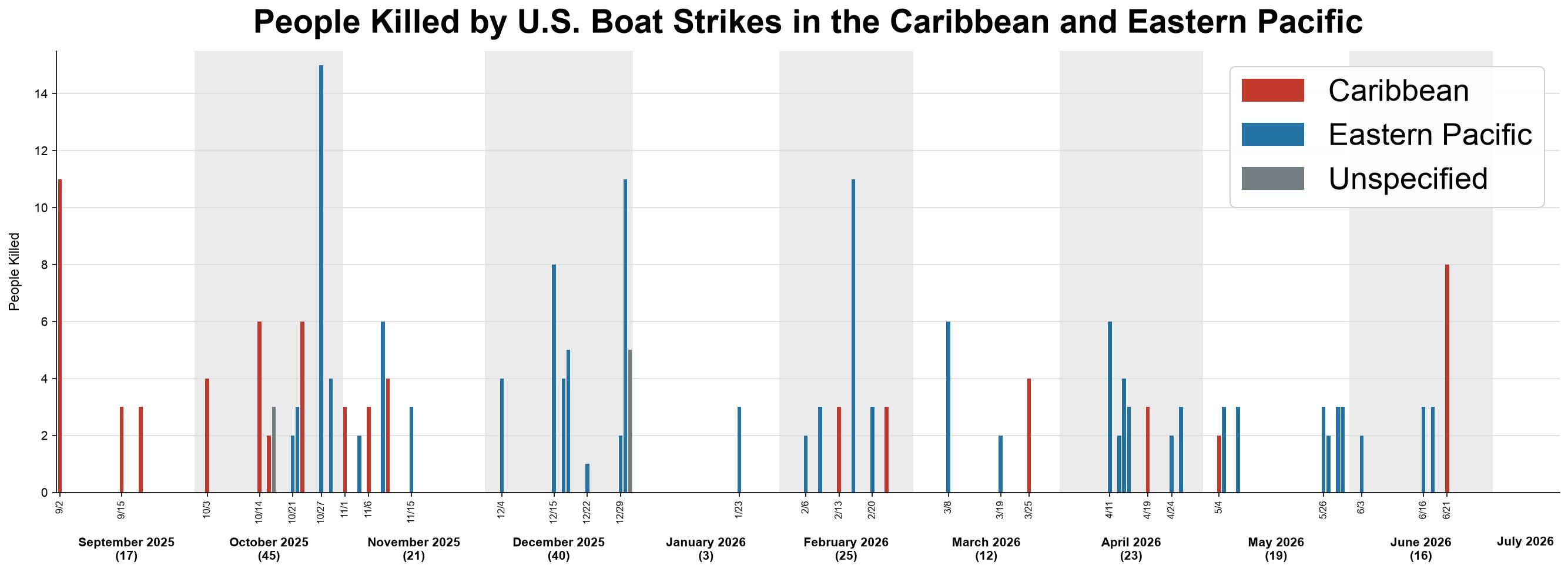
WOLA has tracked all these public announcements; a table summarizing them, with links to each, is published at https://www.wola.org/2025/11/us-military-strikes-trump-drugs-caribbean/. As of July 14, 2026, these announcements total as follows.[2]
- 67 boats struck in 63 individual attack events.
- 221 people reported killed, including 23 survivors who were not recovered, and 2 survivors whom U.S. authorities killed in a follow-up strike.
- 3 survivors reported recovered.
- 44 strikes in the Eastern Pacific Ocean. 17 strikes in the Caribbean Sea. 2 strikes in unspecified locations.
- 30 strikes reported as directed by Southern Command Commander Gen. Francis Donovan (95 reported killed). 19 strikes reported as directed by President Donald Trump (76 reported killed). 14 strikes reported as directed by Secretary of Defense Pete Hegseth (50 reported killed).
- As noted in the above list, official announcements reported that 28 of 224 people—over 10 percent—initially survived the attacks on the vessels they were aboard. In November 2025, the Washington Post revealed that the first strike, on September 2, initially left two survivors clinging to wreckage, only for the commander of the U.S. military’s Joint Special Operations Command (JSOC) to order a follow-up strike to kill them.[3]
1.2. “Southern Spear”: even the goals are secret
On November 13, 2025, more than two months after the first strike took place, Secretary of Defense Pete Hegseth announced that the military effort to disrupt drug trafficking by groups the Trump administration has designated “terrorist” would henceforth be called Operation Southern Spear (OSS). “The OSS mission statement is classified,” the Department’s Inspector General reported in May 2026.[4]
A new component, Joint Task Force (JTF) Southern Spear, began operating within U.S. Southern Command (SOUTHCOM or USSOUTHCOM), the unified combatant command responsible for U.S. military activities in Latin America and the Caribbean minus Mexico and the Bahamas. “Details about JTF Southern Spear,” such as its size, command, and capabilities, “are not publicly releasable,” the Inspector General added.[5]
In fact, the same report continued, “USSOUTHCOM said that it could not publicly release its measures of effectiveness for assessing the conduct of OSS.”[6] Even the ranking Democrat on the Senate Armed Services Committee appears to be in the dark. “The administration has failed to explain the long-term objectives of this mission or provide any evidence of reduced drug flows into the United States,” Sen. Jack Reed (D-Rhode Island) said in May 2026. “I would ask for a credible answer to this most fundamental question: What is the operation actually meant to accomplish?”[7] The Trump administration deploys graphic video footage to publicize and extol the boat strikes but falls silent when it comes to describing the mission’s actual aims and results.
1.3. Assets and costs
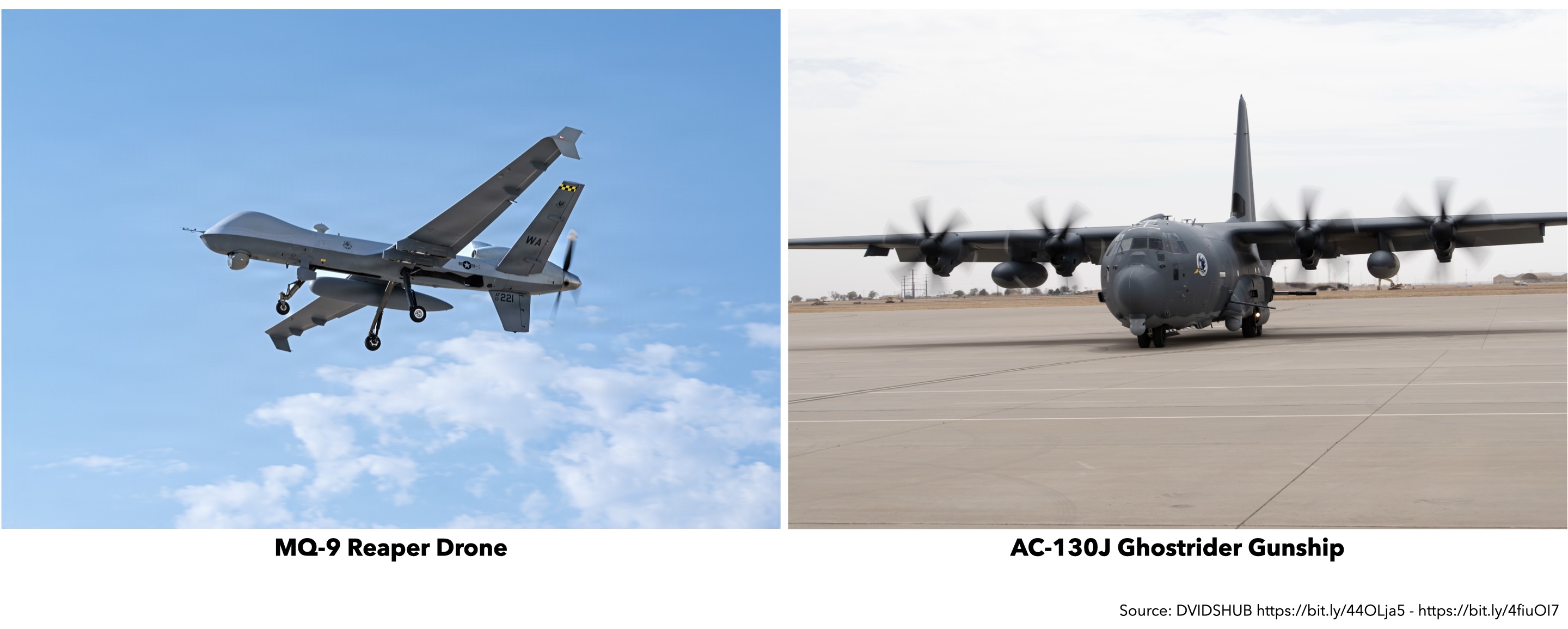
Beyond the announcements and videos, U.S. authorities have not disclosed further details about how the strikes are carried out. The aircraft and munitions used are classified, though based on the videos and consultations with military experts, the New York Times concluded that the U.S. military is employing both armed drones, such as the MQ-9 Reaper, and manned aircraft, such as the AC-130J Ghostrider gunship.[8] These are firing glide bombs or laser-guided missiles, including the AGM-176 Griffin, the AGM-114 Hellfire, and perhaps the AGM-179 Joint Air-to-Ground Missile.[9] In April 2026, the Times learned that U.S. armed forces quietly “increased the number of secret fixed-wing attack aircraft and armed MQ-9 Reaper drones operating from bases in El Salvador and Puerto Rico,” giving them enough aerial assets to avoid having to keep transferring them between the Caribbean and Eastern Pacific.[10]
The array of naval assets supporting “Southern Spear” is larger than any the SOUTHCOM area of responsibility has seen since the 1962 Cuban Missile Crisis.[11] Some of these assets have supported other missions, such as the January raid in Caracas and the boarding of boats suspected of violating sanctions on Venezuela’s oil, and some have since been redeployed elsewhere. Nonetheless, the Defense Department Inspector General listed a presence that accounted for about 10 percent of the U.S. Navy’s deployed fleet, according to the Washington Post.[12]
This has come at a steep cost, particularly for a hemisphere that had received less than $4 billion per year in U.S. assistance overall in recent years.[13] The Brown University Costs of War Project estimated that all U.S. operations related to boat strikes and the January 3 operation in Venezuela, taken together, cost $4.7 billion for the period of August 1, 2025 to March 31, 2026.[14] The Defense Department Inspector General estimated that costs specific to the “Southern Spear” boat-strikes campaign were approximately $647 million between September and March.[15] The costs of munitions expended in each strike, the Costs of War project estimated, range from “approximately $267,870-$1,071,480.”[16]
1.4. A radical departure from longstanding practice
The U.S. military has long-established policies, procedures, and protocols for countering small-craft drug trafficking on the high seas. In the late 1980s, Congress passed legislation making the Department of Defense the U.S. government’s lead agency for overseas drug interdiction.[17] Since then, the U.S. Coast Guard and its Helicopter Interdiction Tactical Squadron (HITRON), often with the Navy and other U.S. and allied governments’ agencies, has been conducting frequent and aggressive drug interdiction operations in the same waters where the boat strikes are taking place.[18]
They act on imagery and intelligence gathered and analyzed at Joint Interagency Task Force-South, a SOUTHCOM component in Key West, Florida, that operates with liaison officers from 19 countries.[19] These operations continue today alongside the strikes; at times, they are international collaborations, such as the Colombia-led Orion campaigns carried out in the Caribbean, which have involved as many as 62 countries and Interpol.[20]
These operations are law enforcement actions: their goal is not to destroy the boats and obliterate the people on them, as one would do to an enemy combatant in wartime, but to stop the vessels, seize their cargo as evidence, and arrest their crew members who, as criminal defendants, are potentially valuable intelligence sources.
Long-established procedures govern how to stop and board these vessels through careful escalation of the use of force, with minimal loss of life. U.S. or allied personnel hail vessels and order crews to stop; if pursuit continues, they may fire warning shots or employ sharpshooters to disable vessels’ engines.[21] “More than 1,000 vessels have been stopped this way, without deliberate loss of life,” wrote a former Coast Guard Caribbean Basin-area commander and a former Navy surface warfare officer at USA Today. “It is effective, lawful, and consistent with both our national values and our obligations under the law of the sea.”[22]
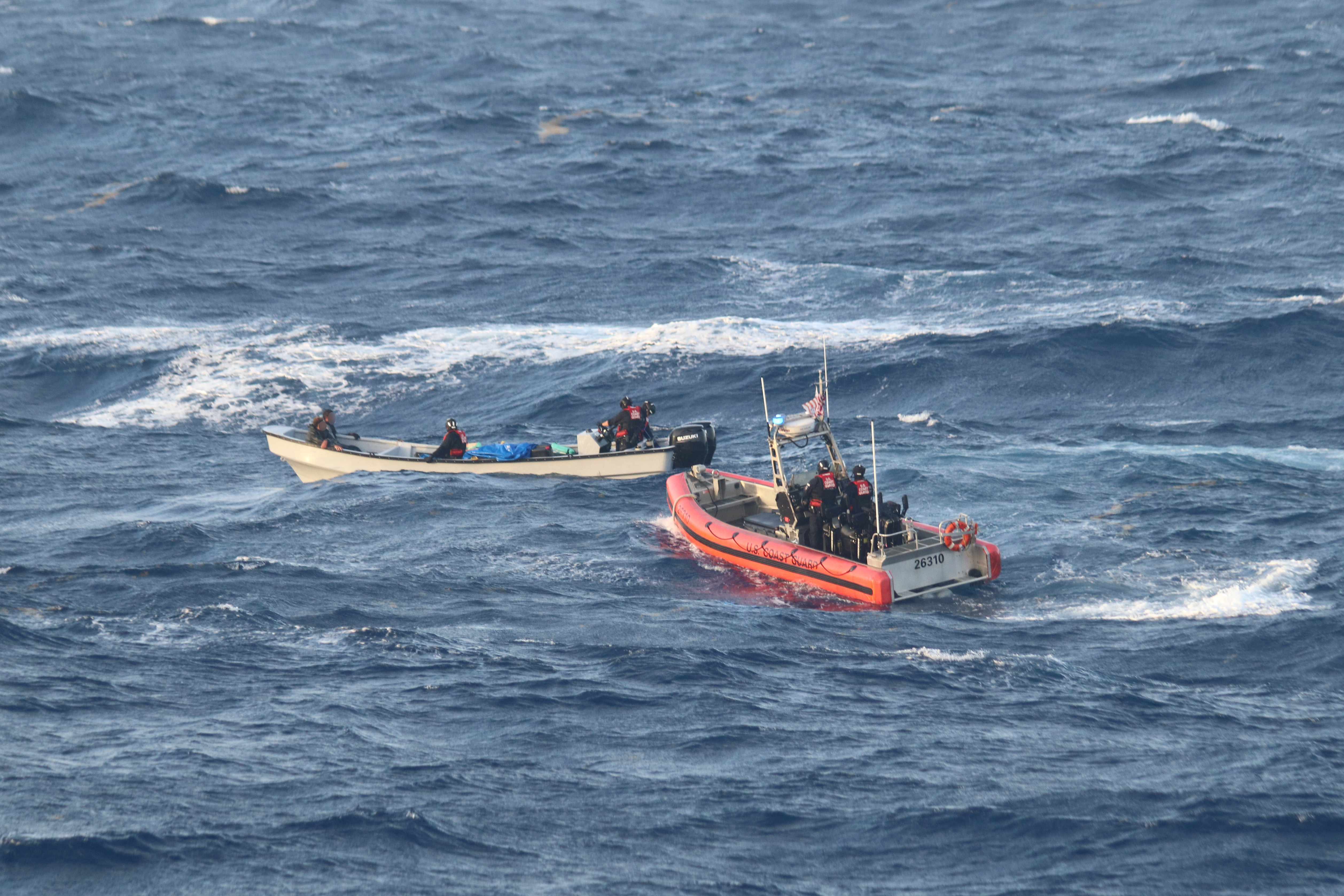
“A Coast Guard Cutter Vigilant (WMEC 617) small boat crew interdicts a suspected drug trafficking vessel in the Caribbean Sea, July 25, 2025.” Photo from DVIDSHUB.[23]
“The only flaw,” Dave Petri and William Baumgartner continued, “is that we have not assigned enough ships and aircraft to this effort.” Indeed, there is a very long record—in the public domain, from annual “posture hearings” before the House and Senate Armed Services Committees—of past SOUTHCOM commanders complaining to Congress about a severe lack of resources with which to carry out this mission.[24] As a lower-tier item on the Pentagon’s long list of global priorities, the traditional, less-lethal approach to maritime drug interdiction was chronically under-resourced.
The Trump administration’s radical response to the limits of the traditional interdiction mission has been to apply lethal military force. On September 3, 2025, in the wake of the first boat strike, Secretary of State Marco Rubio, in Mexico at the time, described the U.S. rationale for attacking suspected drug smugglers:
The United States has long—for many, many years—established intelligence that allow us to interdict and stop drug boats, and we did that. And it doesn’t work. Interdiction doesn’t work because these drug cartels—what they do is they know they’re going to lose two percent of their cargo. They bake it into their economics. What will stop them is when you blow them up, when you get rid of them.[25]
Despite the claim that they “don’t work,” traditional U.S. law enforcement operations continue alongside the boat strikes, with no public clarity about how the Trump administration and the U.S. military are deciding whether to target a vessel “the traditional way” or with a lethal strike. “USSOUTHCOM said that it could not provide a publicly releasable description of how it determines whether to conduct a lethal strike under OSS or non-lethal interdiction under JIATF-South for a given narco-trafficking boat,” the Defense Department Inspector General reported in May 2026. Officials interviewed by the New York Times and the Latin American Center for Investigative Journalism (El CLIP) similarly refused to describe any criteria or process.[26]
2. The strikes and the Trump administration’s “lethal” doctrine
2.1. The “narco-terrorism” focus
The strikes are an early and emblematic example of the Trump administration’s foreign policy. To a greater degree than any of its predecessors for at least a century, Donald Trump’s second administration has made the Western Hemisphere a central focus, placing a heavy rhetorical and budgetary emphasis on projecting U.S. military power in Latin America and the Caribbean.
A main target so far has been what the administration calls “narco-terrorism”: cartels and criminal organizations that include illicit drugs among their income streams, and governments in the region that the administration views as insufficiently cooperative in fighting them. Even as it issues pardons and eases sanctions on aligned political leaders with past ties to drug trafficking, the administration has added 20 criminal organizations in the Americas to the Department of State’s list of foreign terrorist organizations (FTOs). There were four listed FTOs in the Americas when the Trump administration began; now there are 24.[27]
Though they are often very violent, transnational organized crime groups are not the same as “terrorist” groups. “The activities of organized crime groups will rarely qualify as terrorism,” wrote Ben Saul, the UN special rapporteur, in March 2026. “The key legal distinction is that the Transnational Organized Crime Convention defines organized crime as essentially crime for profit—for “a financial or other material benefit” (article 2(a)).[28] Unlike terrorism, “organized crime usually lacks the additional element of political motive, which is an essential defining characteristic of terrorism. Only where organized crime groups additionally pursue political goals could they also be classified as terrorist groups; and this is not the case in relation to the cartels and gangs designated as terrorist by the U.S.”
For more than 23 years after the September 11, 2001 attacks, U.S. administrations from both parties maintained this distinction between “profit-seeking criminal” and “ideologically motivated terrorist.” The Trump administration is now sweeping it away. “We want a Hemisphere whose governments cooperate with us against narco-terrorists, cartels, and other transnational criminal organizations,” reads the National Security Strategy that the White House published in December 2025.[29]
This document declared a “Trump Corollary” to the Monroe Doctrine, asserting a willingness to intervene unilaterally and militarily to address threats to perceived U.S. interests, “narco-terrorism” high among them. In March 2026, the administration promoted these priorities by convening 12 like-minded Latin American and Caribbean states into a political arrangement called the “Shield of the Americas,” and at least 16 into a security arrangement called the “Americas Counter Cartel Coalition.”[30]
For most of the post-World War II period, direct U.S. military interventions in Latin America, with U.S. personnel engaging in combat, were brief and relatively rare: examples included short-term operations in the Dominican Republic in 1965, Grenada in 1983, Panama in 1989, and Haiti in 1994. During the Cold War and continuing through the War on Drugs, U.S. governments instead tended either to rely on covert action or, more frequently and visibly, to provide weapons, equipment, training, intelligence, advice, and other support to military and police forces around the region, which in turn carried out their own operations, at times with grave human rights consequences.
Now, though, the Trump administration is directly involving U.S. personnel. “We’re knocking the hell out of them where we can,” Trump told the “Shield of the Americas” meeting in Miami, adding, “We’re gonna go heavier.”[31]
The tactic of attacking small vessels and broadcasting the footage reflects the value that President Trump and top White House and cabinet officials place on media and social media-ready spectacle. Similarly, statements from these officials relish their hemispheric strategy’s lethal aspects; Hegseth, for instance, frequently accompanies his boat-strike remarks with variations on phrases like “we will hunt you down and kill you.” Trump has been similarly blunt, as when he told reporters in October 2026, “I think we’re just going to kill people that are bringing drugs into our country, OK? We’re going to kill them, you know? They’re going to be, like, dead, OK?”[32]
In addition to the boat strikes, the U.S. conducted a unilateral military operation in January 2026 to remove Venezuelan leader Nicolas Maduro, a June 2026 bombing in Venezuela that killed a top lead of the Tren de Aragua criminal organization, as well as joint operations against criminal organizations in Ecuador. It has reached an agreement with Guatemala for greater U.S. military involvement in counter-drug operations while continuously pressuring Mexico for something similar.
The strikes, then, are not occurring in a vacuum: they are part of a larger region-wide phenomenon. “This is just the beginning,” the official performing the duties of the assistant secretary of defense for homeland defense and the Americas, Joseph Humire, told the House Armed Services Committee in March 2026. “For the first time in history, the department is going on offense against designated terrorist organizations and other major cartels in our hemisphere.”[33] Gen. Francis Donovan, the commander of SOUTHCOM, told the Senate Armed Services Committee, “I believe that actually kinetic strikes [on vessels] will be one of the many tools and probably not the most effective tool when we actually look at it as more of a campaign approach.”[34]
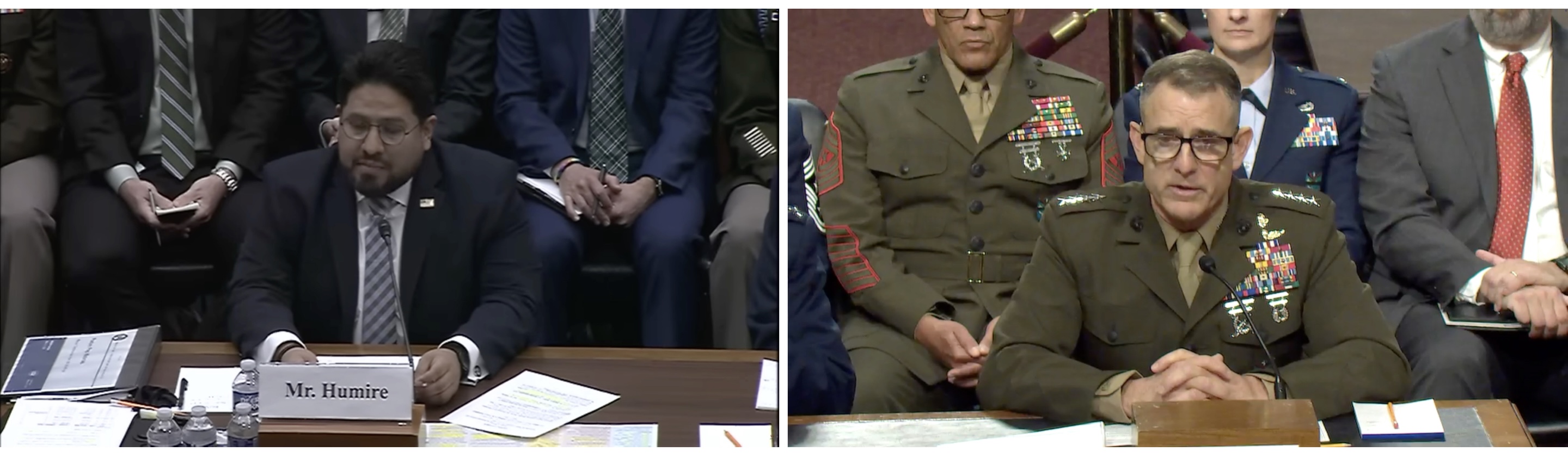
Humire (left) and Donovan (right) testifying in March 2026 before the House and Senate Armed Services Committees, respectively.
2.2. Origins of the boat strikes
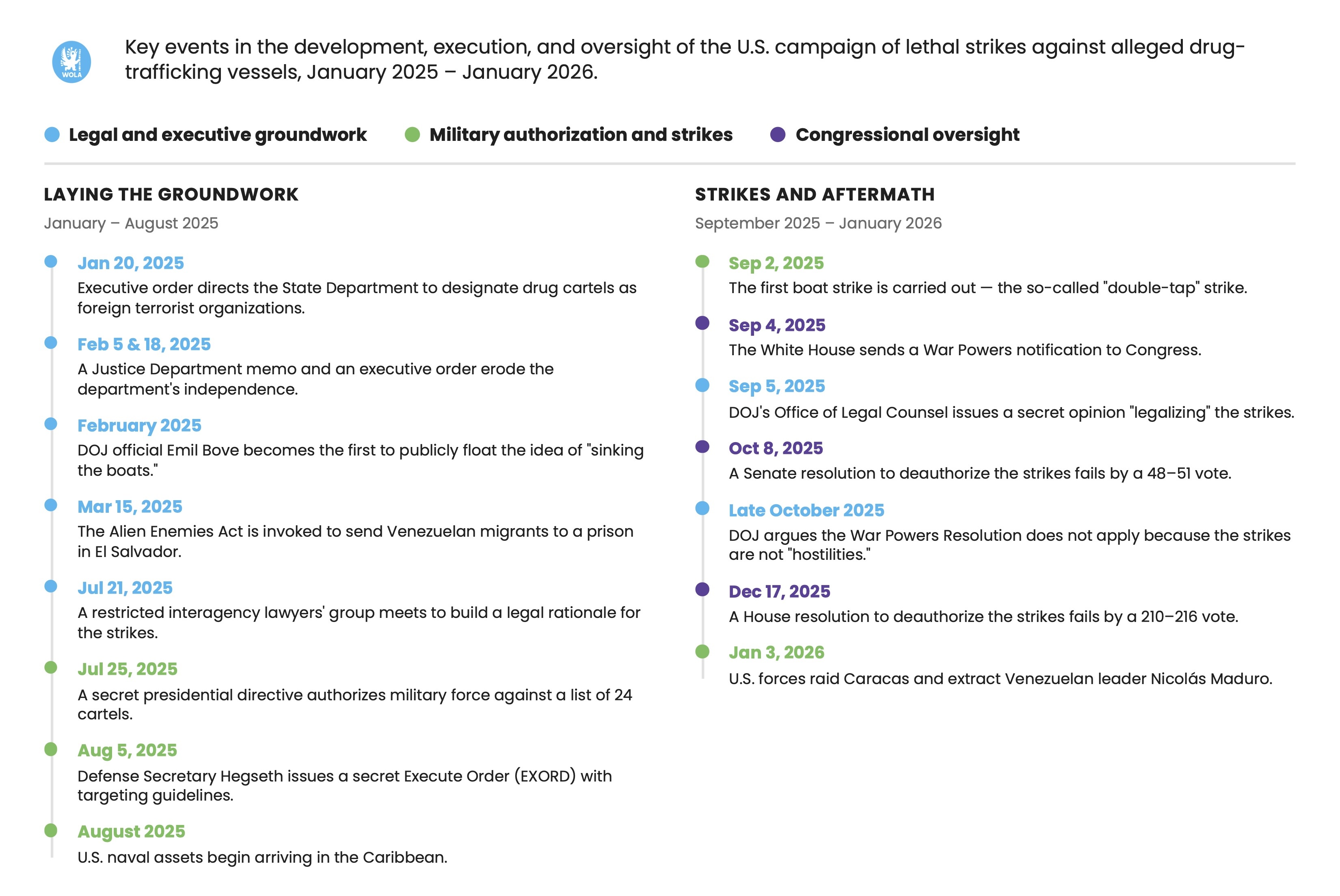
Though the boat strikes did not begin until September 2025, key Trump administration officials began moving as early as January of that year to enable the use of direct U.S. military force against organized crime in the region. A January 20, 2025, White House executive order directed the Secretary of State to designate drug trafficking organizations as “Foreign Terrorist Organizations” and “Specially Designated Global Terrorists.”[35] As Secretary of State Rubio put it in August 2025, the administration views the “terrorist” label as allowing it “to now target what they’re operating and to use other elements of American power, intelligence agencies, the Department of Defense, whatever.”[36]
Among the first criminal groups added to the FTO list, in February 2025, was Venezuela’s Tren de Aragua. This, along with a disputed claim that Tren de Aragua collaborated with the government of Venezuela, created the pretext that the Trump administration employed in March 2025 to use the Alien Enemies Act of 1798 to send 137 Venezuelan men, with zero due process, to a prison in El Salvador, where many credibly told of being tortured.[37] (Another 115 Venezuelan men were deported to El Salvador’s CECOT prison through immigration removals, not the Alien Enemies Act.)
While this was happening, internal administration discussions about targets and uses of force were well underway. Stephen Miller, the White House’s deputy chief of staff, advocated using the Central Intelligence Agency (CIA) to carry out covert strikes on suspected drug trafficking targets within the sovereign territory of nations around the region, particularly Mexico, the Washington Post reported.[38] While the spy agency has reportedly been “ramping up” its counter-drug capabilities, its legal advisors pushed back on the idea of choosing targets or carrying out strikes directly.
Miller, an official known for views considered unusually hardline, instead turned to the Department of Defense. At the “Americas Counter-Cartel Coalition” conference in March 2026, Miller counseled assembled Latin American military leaders: “These organizations can only be defeated with military power. And I see some heads nodding up front because they understand you’re dealing with a lot of lawyers in your own country, I’m sure. You have my permission not to listen to them.”[39]
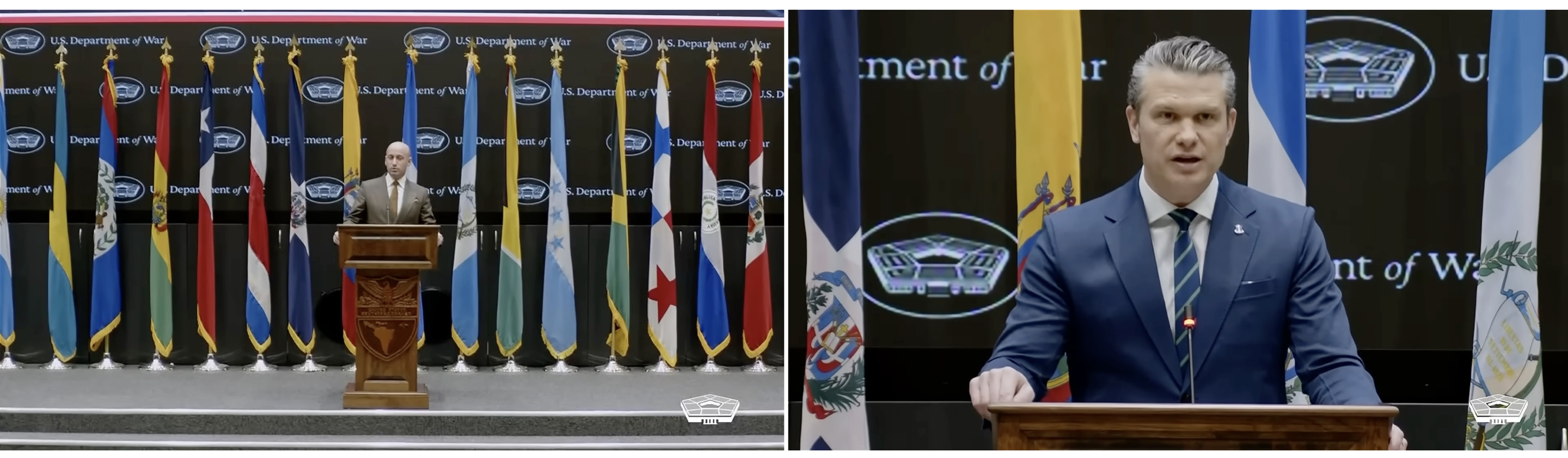
Miller (left) and Hegseth (right) address the March 2026 “Americas Counter-Cartel Coalition” event in Miami.[40]
The first known record of an administration official advocating for strikes on civilian vessels came in February 2025, from Emil Bove, a former personal attorney to Donald Trump who, at the time, was the acting deputy attorney general and has since been named to a federal judgeship. Speaking before a legal conference, Bove voiced skepticism about traditional interdiction operations and told an incredulous audience, “We’re just going to sink the boats,” one attendee told NPR.[41]
Eventually, sources told the Washington Post, “Mexican military operations across the border curbed cartel action” enough for “Miller and his team [to be] looking for another target.” Meanwhile, Defense Secretary Hegseth had fired or purged many judge advocates general (JAGs) and senior commanders and legal advisors who would normally have worked to stop the legally dubious boat strikes.[42] In explaining his late-February 2025 dismissals of senior JAG officers, Hegseth said that he didn’t want military lawyers to be “roadblocks to orders that are given by a commander in chief.”[43]
In response to Hegseth’s abrupt JAG Corps firings, in March 2025 Sen. Reed and other Senate Armed Services Committee Democrats warned, “Such removals create an unmistakable chilling effect, signaling to all judge advocates that their positions are contingent not upon their legal expertise and adherence to the law, but rather upon political or personal loyalty.”[44] Georgetown University Law professor Rosa Brooks, a former Defense and State Department official, pointed to the dangers signaled by the JAG firings: “It’s what you do when you’re planning to break the law: You get rid of any lawyers who might try to slow you down.”[45]
On July 25, 2025, President Trump signed a classified directive authorizing the military to use force against a secret list of 24 “Designated Terrorist Organizations” (DTOs)—a Defense Department term that is distinct from the Department of State’s FTO listing—in Latin America and the Caribbean. “The order provides an official basis for the possibility of direct military operations at sea and on foreign soil against cartels,” the New York Times reported at the time. On August 5, 2025, Hegseth followed up with an “execute order” (EXORD) laying out targeting guidelines, which also remains secret.[46]
The large-scale buildup of U.S. naval assets in the Caribbean began in August 2025. On September 2, Seal Team 6, part of the U.S. military’s elite Joint Special Operations Command (JSOC), carried out the first strike on a vessel carrying 11 people between the coast of Venezuela and the nearby Caribbean nation of Trinidad and Tobago. President Trump celebrated the strike, posting the first of what would be a regular series of videos on his social media platform. Vice President JD Vance took to Twitter to call the attack “the highest and best use of our military.”[47]
2.3. A secret legal memo and a thin rationale
As the discussion further below in sections 3 and 6 makes clear, these strikes are unlawful, and U.S. military personnel continue to have a responsibility to refuse to issue or to carry out illegal orders. As the boat strikes were getting underway, however, the administration underwent a process to “legalize” them.
In early 2025, the White House worked to undo longstanding norms protecting the autonomy and independence of the Department of Justice. In the U.S. system, the nation’s chief prosecutor is not a separate branch of government: it is a cabinet department that reports to the President. Its independence from White House political pressure has been more a matter of tradition than of law, enabling President Trump to unravel it through policy rather than legislation.[48]
A February 5, 2025, Justice Department memo set a general policy requiring U.S. attorneys to “zealously defend the interests of the United States,” which “are set by the Nation’s Chief Executive”; failure to carry out the president’s policies and actions would be considered grounds for dismissal.[49] A February 18, 2025, executive order added that, throughout the executive branch, “the President and the Attorney General’s opinions on questions of law are controlling on all employees in the conduct of their official duties.”[50]
Its independence eroded, the Department of Justice, through its Office of Legal Counsel (OLC), signed a secret memo on September 5, 2025—after the first attack took place—purporting to lay out a rationale for the boat strikes’ legality.[51] The memo spelled out the conclusions of “a restricted interagency lawyers’ group,” the Washington Post and the Guardian reported, made up of two civilian career lawyers, two uniformed military attorneys, and four political appointees, including staff from the CIA, the White House, and the OLC. It met on July 21, 2025.[52] The secret OLC opinion is the administration’s preemptive response to personnel in the chain of command who might object to being ordered to carry out the strikes.
The OLC memo’s legal reasoning, as reported in secondary sources, is badly flawed. That reasoning, drawing mainly from media reports citing unnamed officials, appears to run along the following lines.
First, the memo determines that the United States is in a formal, “non-international armed conflict” (NIAC) with a secret list of 24 Latin American Designated Terrorist Organizations (DTOs).[53] “The full list of DTOs targeted under OSS is not publicly releasable,” the Defense Department Inspector-General reported.[54] President Trump and his appointees, with no input or review from any other branch of government, designated most of these groups. The DTO term “is entirely manufactured as a source of targeting authority with no basis in law,” Rebecca Ingber, a former State Department law-of-war expert, told the Washington Post.[55]
Common Article 3 of the 1949 Geneva Conventions and customary international law define a NIAC as “protracted, intense armed violence” between a state and an organized armed group. The violence must be more intense than, for instance, “riots,” “banditry, unorganized and short-lived insurrections, or terrorist activities.”[56]
Those conditions are not remotely met in the case of drug traffickers.
- No “protracted, intense armed violence” exists because trafficking organizations have not militarily confronted the United States in any sustained way. To do so would destroy their business model. While cartels and gangs do attack personnel of governments that may be aligned with the United States, they do so for money-making purposes—to avoid arrest, or to intimidate those who would interfere with production, transshipment, or other trafficking activities.
- Criminal organizations only sometimes meet the threshold of “organized armed groups” with clear command structures, territorial control, and the ability to enforce discipline.
Second, though the U.S. Constitution prohibits involvement in any armed conflict without Congress declaring war or otherwise authorizing use of military force, the memo argues that congressional approval is unnecessary because “the strikes serve a national interest” and do not meet the definition of “hostilities” because they are not “of a prolonged scope, nature, or duration,” the Guardian reported.[57]
Third, the memo claims that these “terrorist” organizations are seeking to kill U.S. citizens and to politically destabilize allied governments in the Western Hemisphere, and are trafficking drugs to pay for the costs of waging this struggle. In other words, instead of carrying out violent acts in order to profit from illicit markets, the memo depicts criminal groups as profiting from illicit markets in order to carry out violent acts.
While this may be true of guerrilla insurgencies that participate in the drug trade to fund their violent pursuit of political power, like Colombia’s ELN and FARC dissidents, it does not appear to describe cartels, gangs, and other criminal organizations that claim no political agenda, seek to enrich themselves, and seek to corrupt governments at least as often as they seek to fight them. It is not clear whether the OLC and the small “interagency lawyer’s group” reached this remarkable conclusion in agreement with the U.S. intelligence community, or whether they devised it on their own.
Fourth, the drugs believed to be aboard the boats are apparently the strikes’ principal targets. “According to the legal analysis, the strikes are targeting the cocaine, and the deaths of anyone on board should be treated as an enemy casualty or collateral damage if any civilians are killed, rather than murder,” the Guardian reported.[58] This point contradicts Sen. Tim Kaine’s (D-Virginia) revelation, during questioning of Secretary of State Rubio in June 2026 (discussed in Section 4.2 below), that the presence of drugs on board a vessel is not one of the three secret targeting criteria that the Department of Defense is employing.
Still, the administration has not always been clear even about what drugs it is targeting. “The boats get hit, and you see that fentanyl all over the ocean, it’s like floating in bags, it’s all over the place,” President Trump said in October about strikes on boats departing Venezuela.[59] However, “The DEA said that it has not received any information indicating that Venezuela is a source of fentanyl or fentanyl precursor chemicals,” the Defense Department Inspector General reported in May 2026, adding that “the fentanyl and methamphetamine consumed in the United States are produced almost entirely in Mexico, while more than 80 percent of the cocaine in the U.S. market is produced in Colombia.”[60]
Fifth, a lengthy section of the memo reportedly lays out potential future legal defenses if a prosecutor were to charge military personnel for carrying out killings of civilians in international waters for a non-capital crime with no imminent self-defense justification. These appear to rest on the supposed existence of an “armed conflict,” granting personnel “battlefield immunity” for complying with legal orders.
The secret OLC opinion appears to have been controversial even within the administration. “If public reports are to be credited, a number of senior national-security lawyers who doubted the memo’s conclusions have been fired or reassigned,” Paul Rosenzweig, a Bush administration-era deputy assistant secretary for policy at the Department of Homeland Security, wrote at the Atlantic.[61]
“It reads as if you gave a lawyer an assignment: Give me the best possible rationale for why this is legal—be as inventive as you like,” Sen. Adam Schiff (D-California), a former federal prosecutor, said in November. “If that opinion were to be adopted, it would not constrain any use of force anywhere in the world. I mean, it is broad enough to authorize just about anything.”[62] Added Rep. Jason Crow (D-Colorado), who has reviewed the memo, “My general sense is they don’t want to make it public because it’s a pretty farcical analysis.”[63]
As of July 2026, the OLC memo remains secret. The ACLU and the Center for Constitutional Rights filed a Freedom of Information Act request for its release in October 2025. Litigation to compel that release is ongoing.[64]
3. How the strikes violate U.S. and international law
It is rare to find an unclassified opinion that cogently argues the boat strikes are legal. Instead, they violate both U.S. and international law and rest on contorted legal reasoning.
The administration contends that the United States is enmeshed in a non-international armed conflict with criminal groups that President Trump has designated as terrorist organizations, and that all of those killed by the boat strikes, as a result, are combatants.
As this section explains, the argument concocted by the administration, in an effort to justify the boat strikes as lawful, is at once contradictory, fallacious, and dangerous.
- The administration is claiming that the people aboard the boats are enemy combatants: “affiliates”—a vaguely defined term—of the groups that this administration has declared to be terrorists. The administration makes this claim even though (as discussed in Section 4) it often cannot identify the individuals aboard the boats.
- The “combatants” claim rests on the notion that the United States is involved in a “non-international armed conflict” with the designated “terrorist” groups.
- Involving the United States in a conflict, though, would throw the question to the U.S. Congress, which has the constitutional power to declare war or authorize the use of force. It has not done so. The War Powers Resolution of 1973 requires congressional approval within 60 days of the President’s involvement of the U.S. military in “hostilities.”
- The administration is seeking to exclude Congress with a convoluted claim that, since actions like drone strikes do not place U.S. personnel in danger, the boat strikes are a kind of armed conflict that does not constitute “hostilities.” It makes this claim despite portraying the people being targeted on the boats as fearsome terrorists, in the words of Secretary of Defense Hegseth, as “the Al-Qaida of our hemisphere.”[65]
On the question of whether the boat strikes are homicide, the administration sees an armed conflict. On the question of congressional war powers, the administration sees no hostilities. In the few cases when there have been survivors of the strikes, the administration has not sought to detain them, despite having portrayed them as murderous terrorists.
These contradictions at the heart of the policy—conflict without hostilities—test the limits of what a military institution can withstand in a democracy. At a moment when top civilian leaders are seeking to politicize the U.S. military—even suggesting that the armed forces should be targeting Americans that Trump views as the “enemy from within”—that may be the point.
3.1. The boat strikes are homicide under U.S. law, extrajudicial executions under international law, and may constitute crimes against humanity
The premeditated killing of individuals aboard civilian vessels on the high seas fits clearly within the U.S. statutes governing murder.
- “Murder is the unlawful killing of a human being with malice aforethought,” reads Section 1111 of Title 18 of the U.S. Code.[66]
- That section specifies that the charge applies “within the special maritime and territorial jurisdiction of the United States,” which Section 7 of Title 18 defines to include “the high seas.”[67]
- Section 956 of Title 18, meanwhile, calls for up to life in prison for anyone who conspires within the United States to commit murder anywhere outside the United States.[68]
- Military personnel are also subject to Article 118 of the Uniform Code of Military Justice (Title 10, Section 918 U.S. Code), which defines murder as the premeditated killing of a human being “without justification or excuse” involving a “premeditated design to kill” or intent to “kill or inflict great bodily harm,” among other conduct.[69]
- The Torture Victim Protection Act of 1991 (Title 28 U.S. Code Section 1350 Note) makes those who commit extrajudicial killings anywhere in the world liable for civil damages in U.S. courts.[70]
- Section 2.11 of Executive Order 12333, dating from 1981, prohibits U.S. government personnel from engaging, or conspiring to engage in, assassinations.[71]
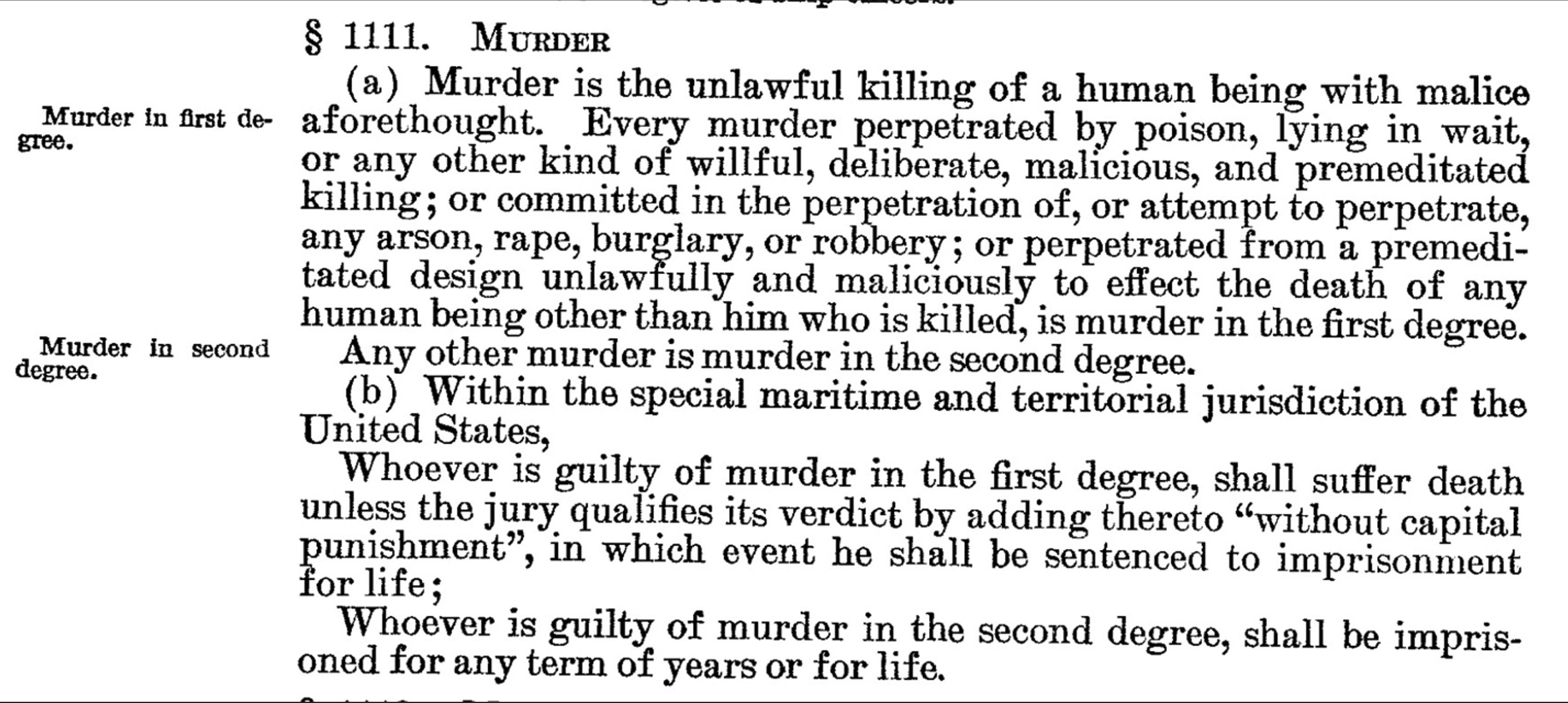
Source: U.S. Code (https://uscode.house.gov/statviewer.htm?volume=62&page=756)
A long list of legal experts has argued that the boat strikes constitute murder under U.S. statutes.[72] “It’s difficult to imagine how any lawyers inside the Pentagon could have arrived at a conclusion that this was legal rather than the very definition of murder under international law rules that the Defense Department has long accepted,” Ryan Goodman, a New York University School of Law professor who worked in the Defense Department’s legal office in 2015 and 2016, told the New York Times.[73] “Plainly speaking, the killings are unjustified summary executions—murder,” three former State and Defense Department attorneys wrote in May.[74]
Under international human rights law, which holds that military personnel cannot kill civilians without a legal justification, the boat strikes meet the definition of “extrajudicial executions.”
- “It is true that no treaty specifically defines extrajudicial killing. But numerous international sources offer details on this well-established norm,” noted William Aceves in a 2018 edition of the Columbia Human Rights Law Review.[75] Aceves listed:
- The Universal Declaration of Human Rights, which states that “everyone has the right to life, liberty and security of person.”
- The International Covenant on Civil and Political Rights, which the United States ratified in 1992, states: “Every human being has the inherent right to life. This right shall be protected by law. No one shall be arbitrarily deprived of his life.”[76]
- In the Western Hemisphere, the American Declaration of the Rights and Duties of Man and the American Convention on Human Rights reaffirm a right to life.
- Although, as argued below, the boat strikes are not occurring in the context of an armed conflict, even if there were an armed conflict, the attacks would violate the principle of distinction under international humanitarian law, codified in protocols to the Geneva Conventions, which prohibit deliberate targeting of civilians.[77]
“These attacks—and their mounting human cost—are unacceptable,” the UN High Commissioner for Human Rights, Volker Türk, stated in October 2025. “The U.S. must halt such attacks and take all measures necessary to prevent the extrajudicial killing of people aboard these boats, whatever the criminal conduct alleged against them.”[78]
Türk recalled that “the intentional use of lethal force is only permissible as a last resort against individuals who pose an imminent threat to life,” and that “none of the individuals on the targeted boats appeared to pose an imminent threat to the lives of others or otherwise justified the use of lethal armed force against them under international law.” Annie Pforzheimer and Luis Moreno, two former U.S. diplomats with long Latin America experience, agreed in a May 2026 column: “There is no clear rationale offered as to why lethal force is needed if no imminent danger is posed and other options (such as non-lethal disabling of the boat or warning shots) have always been available.”[79]
“Extrajudicial execution” might not even be strong enough to describe the gravity of the boat strikes’ violations of international law. Now that the number of dead exceeds 200, in a campaign that has persisted for over 10 months and has included a series of more than 60 separate attacks implementing a policy designed to kill those on board the targeted vessels, some experts say the attacks may be crossing the threshold into “crimes against humanity” or have already crossed that threshold.[80]
Chapter 7 of the Rome Statute, to which the United States is not a party, defines a crime against humanity as being committed “as part of a widespread or systematic attack directed against any civilian population, with knowledge of the attack.” At issue is how to define “widespread” and “systematic.” Former International Criminal Court (ICC) prosecutor Luis Moreno Ocampo argues that this standard has already been met.[81] Notably, a former president of the Philippines, Rodrigo Duterte, faces trial before the ICC on charges of crimes against humanity for his role in the systematic killings of civilians as part of his country’s deadly “war on drugs.”[82]
Challenged on Twitter about the first boat strike’s potential to be a “war crime” (which is an inaccurate term, as discussed below), Vice President JD Vance replied, “I don’t give a s**t what you call it.”[83] But the terminology matters. If the boat-strike campaign is considered a crime against humanity, then universal jurisdiction would apply. (See Section 6.5 below.) Universal jurisdiction would mean that, as with Chile’s Augusto Pinochet in 1998, U.S. officials could find themselves arrested and prosecuted in other countries’ courts that accept universal jurisdiction if a prosecutor dares to bring the case. Such a prospect could significantly limit the future international travel possibilities for certain U.S. officials.
3.2. Other national and international statutes that the strikes may violate
Other norms and statutes that the boat strikes appear to violate include:
- The international law of the sea, which, a group of UN experts wrote after the second boat strike last September, “does not authorize unprovoked attacks on ships, requires criteria to be met to intercept ships, and insists on a law enforcement, not military approach to using force.”[84] That law enforcement approach must be “necessary and proportionate”; the U.S. military’s instant recourse to lethal force without warning is the opposite of that.[85]
- Geneva Convention II for the Amelioration of the Condition of Wounded, Sick and Shipwrecked Members of Armed Forces at Sea, which requires that the shipwrecked be “collected and cared for.”[86] The first strike, on September 2, 2025, which killed 11 people, is often called the “double-tap” strike because, about 45 minutes after bombs first hit the boat, U.S. military commanders ordered a second strike to kill survivors who were clinging to wreckage. Despite the prohibition on such an attack, according to The Intercept, Adm. Frank Bradley, then the commander of Joint Special Operations Command, ordered SEAL Team 6 to carry out the second strike after consulting with the Command’s lead judge advocate general, Col. Cara Hamaguchi.[87] Rep. Adam Smith (D-Washington), who viewed unreleased footage of the strike, described “basically two shirtless people clinging to the bow of a capsized and inoperable boat, drifting in the water — until the missiles come and kill them.”[88]
- Customary international humanitarian law, and U.S. manuals on the law of war, that prohibit “perfidy,” the crime of military personnel pretending to be civilian non-combatants in order to get an adversary to lower its guard before an attack.[89] In the first strike, the New York Times revealed in January that the Department of Defense used a secret aircraft painted to look like a civilian plane.[90] “The military has since switched to using recognizably military aircraft for boat strikes,” the Times added.
3.3. Dissent within the ranks
“Regardless of which laws might have been broken, what’s more alarming, and of greater long-term concern, is that U.S. military personnel crossed a fundamental line the Department of Defense has been resolutely committed to upholding for many decades,” wrote former Deputy Assistant Attorney General Marty Lederman last September.[91] “Namely, that (except in rare and extreme circumstances not present here) the military must not use lethal force against civilians, even if they are alleged, or even known, to be violating the law.”
The sharp turn from legality that the boat strikes represent is causing unease among at least a significant minority of U.S. military personnel. “I have heard from several anguished members of the active-duty military. They feel real moral doubt and are experiencing profound legal confusion,” wrote New York Times columnist David French, a former Army JAG, in November 2025.[92]
The unease extended to the highest levels of SOUTHCOM, at least during the run-up and the initial weeks of the strikes. “According to media reporting, a senior judge advocate general at USSOUTHCOM disagreed that the strikes are legal but was overruled by more senior government officials, including officials at the Justice Department’s Office of Legal Counsel,” the Defense Department Inspector General reported.[93] That JAG, according to NBC News, was Col. Paul Meagher, the top judge advocate general at SOUTHCOM, who raised concerns about the strikes before they began.[94] Although, as NBC noted, the “opinion of the top lawyer for the command overseeing a military operation is typically critical to whether or not the operation moves forward,” Meagher’s concerns were “ultimately overruled by more senior government officials, including officials at the Justice Department’s Office of Legal Counsel.”
In October, just over a month into the boat strikes, the commander of SOUTHCOM, Adm. Alvin Holsey, announced his retirement effective at the end of 2025, about a year into what is usually a three-year tour of duty. “Top officers,” including Holsey, “sought caution on such strikes,” sources told the Washington Post, which added that the Admiral “wanted to make sure any option presented to the president was fully vetted first.”[95]
The boat strikes also caught the attention of the Catholic Archbishop for the U.S. Armed Services, Timothy P. Broglio, who oversees church ministry within the armed forces to more than 1.8 million men, women, and children. Broglio’s December 2025 statement sharply criticized the strikes on ethical and legal grounds, taking direct aim at their unlawfulness:
Due process must apply to everyone, regardless of his or her role in illegal activity. The rule of law must guide all actions; abandoning due process undermines human rights, erodes public trust, and risks harming innocent people. True justice is achieved through transparent legal procedures, accountability, and respect for life—not through violence outside the law.[96]
3.4. Presidential war powers
3.4.1. Law enforcement, not armed conflict
Commentators sometimes refer to the boat strikes as “war crimes.” This is inaccurate, as it is impossible to commit a war crime without a war: none has been declared, and stopping drug smugglers is a law enforcement activity. Personnel carrying out the strikes should be obeying criminal and human rights law, not the somewhat more permissive rules of armed conflict and international humanitarian law.
“The law of war permits violence otherwise prohibited, but only during genuine armed conflict—a threshold the Trump administration has failed to meet, as it has not even identified who the U.S. is supposedly fighting,” Brian Finucane, a former State Department legal advisor now with the International Crisis Group, told El CLIP.[97] “The United States is not in an armed conflict with anyone in Latin America,” the ACLU recalled in March. “That means the people on these boats are civilians. Civilians, including those suspected of smuggling drugs, are not lawful targets.”[98]
The view that fighting drug trafficking is law enforcement, not “war,” is widely held.[99] If the boat strikes are a law enforcement activity, then these killings without due process are murder. If, as the Trump administration falsely insists, the killings are happening in the context of an armed conflict, then they run afoul of the U.S. Constitution and U.S. law.
3.4.2. Eliding Congress
Article I, section 8 of the U.S. Constitution states that only Congress has the power to declare war. While the United States has not been in a congressionally declared war since World War II, it has nearly always passed resolutions authorizing the use of military force for specific purposes.
No such authorization exists for the boat strikes, nor has the Trump administration even proposed such legislation. When involving U.S. personnel in “hostilities” without prior congressional approval, the 1973 War Powers Resolution requires the president to notify Congress within 48 hours. That sets in motion a 60-day period after which troops must be withdrawn unless Congress authorizes the activity. For the boat strikes, that period expired on November 3, 60 days after the White House sent Congress a war powers notification.[100]
On October 8 in the Senate, and on December 17 in the House of Representatives, legislators considered war powers resolutions seeking to terminate further boat strikes. Though both measures had Democratic and Republican sponsors, they failed to pass the Republican-majority chambers on almost entirely party-line votes.[101]
The upshot is that for now, the authority to conduct the boat strikes relies “on the president just waving a magic wand and saying we are in an armed conflict, when the factual predicate does not exist,” former career State Department lawyer Charlie Trumbull, now at the University of South Carolina, told NOTUS.[102]
3.4.3. The administration’s dubious theory
The secret Justice Department Office of Legal Counsel (OLC) memo seeking to “legalize” the boat strikes, discussed in section 2.3 above, uses the Trump administration’s terrorist designations to insist that the United States is in a formal—though undeclared—state of war. More specifically, reporting about the secret memo notes that its argument rests on the existence of a “non-international armed conflict” (NIAC) between the United States and the secret list of DTOs. Section 2.3 lays out the reasons why drug trafficking fails to meet the definition of a NIAC.
The OLC memo argues that organized crime groups designated “terrorist” are attacking allied governments, which places the United States in a state of conflict with them. It further argues that the criminal groups are using drug trafficking to “sustain their war.” Groups, the memo contends, raise money through the drug trade to finance attacks on those allied governments, instead of the other way around: attacking governments sporadically to ease their pursuit of drug money.
Another OLC opinion that is publicly available—the December 23, 2025, memo intending to justify the January 3, 2026, military operation in Venezuela—uses this “war-sustaining” argument to make a disturbing assertion. In the context of the boat strikes, it argues that the United States can kill civilians, under the law of armed conflict, if they are “assisting in war-sustaining activities” like drug trafficking.[103]
This remarkable claim seems to rest on the idea that groups like the Sinaloa Cartel or Tren de Aragua are seeking to seize political power in Mexico or Venezuela to pursue political agendas they have never articulated. This would further imply that instead of enriching themselves, their leaders are plowing their profits into their war effort. No known intelligence analyses uphold this backward logic of how criminal groups operate.
The administration insists that its determination that a non-international armed conflict exists is not reviewable by the judiciary. “That is a recipe for impunity—and if accepted, the government doesn’t even need a legal theory, let alone a plausible one, to do the kinds of things it’s doing,” ACLU attorney Brett Max Kaufman told NOTUS.[104]
To evade congressional war powers restrictions, the Justice Department OLC offers the contorted argument that the boat strikes are a NIAC under the laws of war, but do not qualify as “hostilities” under the War Powers Resolution. That is the message the official heading the OLC, T. Elliot Gaiser, gave in briefings to Congress in late October, as the War Powers Resolution’s 60-day deadline approached. An unnamed senior administration official told the Washington Post that the War Powers Resolution’s definition of hostilities “has been understood to apply to placing U.S. service members in harm’s way.”[105]
“What they’re saying is anytime the president uses drones or any standoff weapon against someone who cannot shoot back, it’s not hostilities‚” Finucane, the former State Department war powers attorney, told the Washington Post. “It’s a wild claim of executive authority.”[106]
3.5. Questions raised by unconditional releases of survivors
The administration’s theory of an “armed conflict” with “terrorists” is further undercut by what has happened on the few occasions when one of the putative “enemy combatants” aboard the boats is captured alive. On two occasions, U.S. forces rescued a total of three individuals who had been aboard struck vessels. All were quickly released, and none have faced any charges.
- On October 16, 2025, after striking their boat and killing two others aboard, U.S. forces rescued Colombian citizen Jonhatan Obando and Ecuadorian citizen Andrés Fernando Tufiño. Both men were badly injured, and both were returned to their home countries, which accepted them.[107]
- On March 19, 2026, after striking his boat and killing two Ecuadorian citizens aboard, U.S. military forces rescued a third individual about whom less is known. The U.S. Coast Guard transferred this individual, who was also injured, to the Costa Rican Coast Guard. It is unclear whether the survivor remains in Costa Rica.[108]
Following these quick handoffs, none has been charged with a crime. In the case of the Ecuadorian survivor, Ecuador government officials told the Washington Post, “U.S. forces didn’t provide any evidence that could be used to detain him—no seized drugs, no phone or GPS records, no videos, none of the intelligence that led them to target his vessel.”[109] Tufiño was released within hours of his return.
“U.S. officials have been directed to send any rescued survivors back to their home countries or to a third country,” the New York Times reported in March, “to avoid potential court cases involving survivors in U.S. jurisdiction that could force the Trump administration to show evidence justifying the lethal boat strikes.”[110] An unnamed former DEA agent told the Washington Post that skipping U.S. court avoids discovery proceedings or having the boat strikes’ architects and managers called in to testify. “The military is not going to let their guys testify. They don’t want to go down that road. It’s better to let the guy go than expose sources and methods.”[111]
Whatever the reason, quick releases without charge are a surprising way for the Trump administration and the U.S. military to treat people whom it has gone to great legal lengths to define as terrorist enemy combatants in an armed conflict. “If these people were drug traffickers and deserving of death, how is it that you would pick them up and just let them go?” wondered Rep. Joaquin Castro (D-Texas), the ranking Democrat on the House Foreign Affairs Subcommittee on the Western Hemisphere.[112] Rep. Smith said that he told his Defense Department briefers, “So what you’re telling us is you need less evidence to kill somebody than you do to hold them.”[113]
3.6. Existential questions for the U.S. military
For the U.S. armed forces, the boat strikes constitute a grim historical milestone. “After the atrocities and discipline difficulties in Vietnam and the demoralization that set in afterwards, the U.S. military sought to restore honor, order, and morale through a commitment to the laws of war,” wrote Jack Goldsmith, a Harvard Law professor and former head of the Justice Department’s OLC.[114] “As far as I’m aware, the military inculcates in all its members the injunction that they must never target civilians with lethal force,” wrote Lederman, the former Justice Department official, after the first boat strike. “The crossing of that sacrosanct line last Tuesday might prove to be an especially fateful event: It could presage a momentous change in DoD practices and possibly establish a troubling precedent for militaries throughout the world.”[115]
The normalization of the boat strikes that appears to be taking hold within at least some sectors of the U.S. military threatens to crash through the legal guardrails and ethical norms constructed in recent decades. With normalization and bureaucratization within Pentagon systems, such attacks might become viewed by U.S. military personnel as not merely permitted but as encouraged.
Ethical erosion within the military is especially dangerous in a context where the U.S. president, addressing all military commanders gathered in Quantico, Virginia, last September, told them to prepare to confront “the enemy from within” and to use U.S. cities “as training grounds for our military.”[116]
Pforzheimer and Moreno, the former diplomats, wrote in May 2026 that the boat strikes could be preparing the U.S. military for further politicization, viewing them as “a ‘starter drug’ for our current wanton disregard for international norms of minimal use of force or clear definition of ‘enemy combatants.’”[117] “Now there are no limits on the president directing our military to murder,” said Sarah Harrison, a former Defense Department attorney now at the International Crisis Group. “It means he can slap a label on whoever in the country—that’s what’s terrifying.”[118]
The boat strikes have provided a model for the President, acting without congressional approval or judicial review, to declare groups to be “terrorist,” then use a memo from a non-independent Department of Justice to order the military to combat that group’s vaguely defined “affiliates.” That is not happening domestically, yet, but the boat strikes are a step toward realizing such a grim scenario.
“I’ll tie a little terrifying connection in for you here,” said Rep. Smith, the top House Armed Services Committee Democrat, in October 2025. “How far are we away from President Trump deciding to use the U.S. military to do a kinetic strike on people within the U.S. because he sees them as a threat, by whatever definition he wants to throw out there?”[119]
Georgetown Law’s Rosa Brooks highlighted the stakes in a November 2025 Daedalus article: “If President Trump follows through on his threats to use the military to suppress domestic political protest, the United States may become the latest society to illustrate that civilian control of the military is no guarantee of democracy or human rights.”[120]
4. Questions about the quality of intelligence and targeting
The press statements and social media posts that follow each boat strike consistently include language like “intelligence confirmed the vessel was transiting along known narco-trafficking routes in the Eastern Pacific and was engaged in narco-trafficking operations.” On no occasion, though, has the administration or any of its components presented evidence that a vessel was carrying drugs or that its deceased crew was affiliated with a criminal or “designated terrorist” organization.
4.1. Intelligence appears to be far from airtight
“Military briefers have admitted to members of Congress that they cannot satisfy the evidentiary burden necessary to hold or prosecute survivors of the boat strikes” on the rare occasions when they are recovered, reported the Intercept’s Nick Turse.[121]
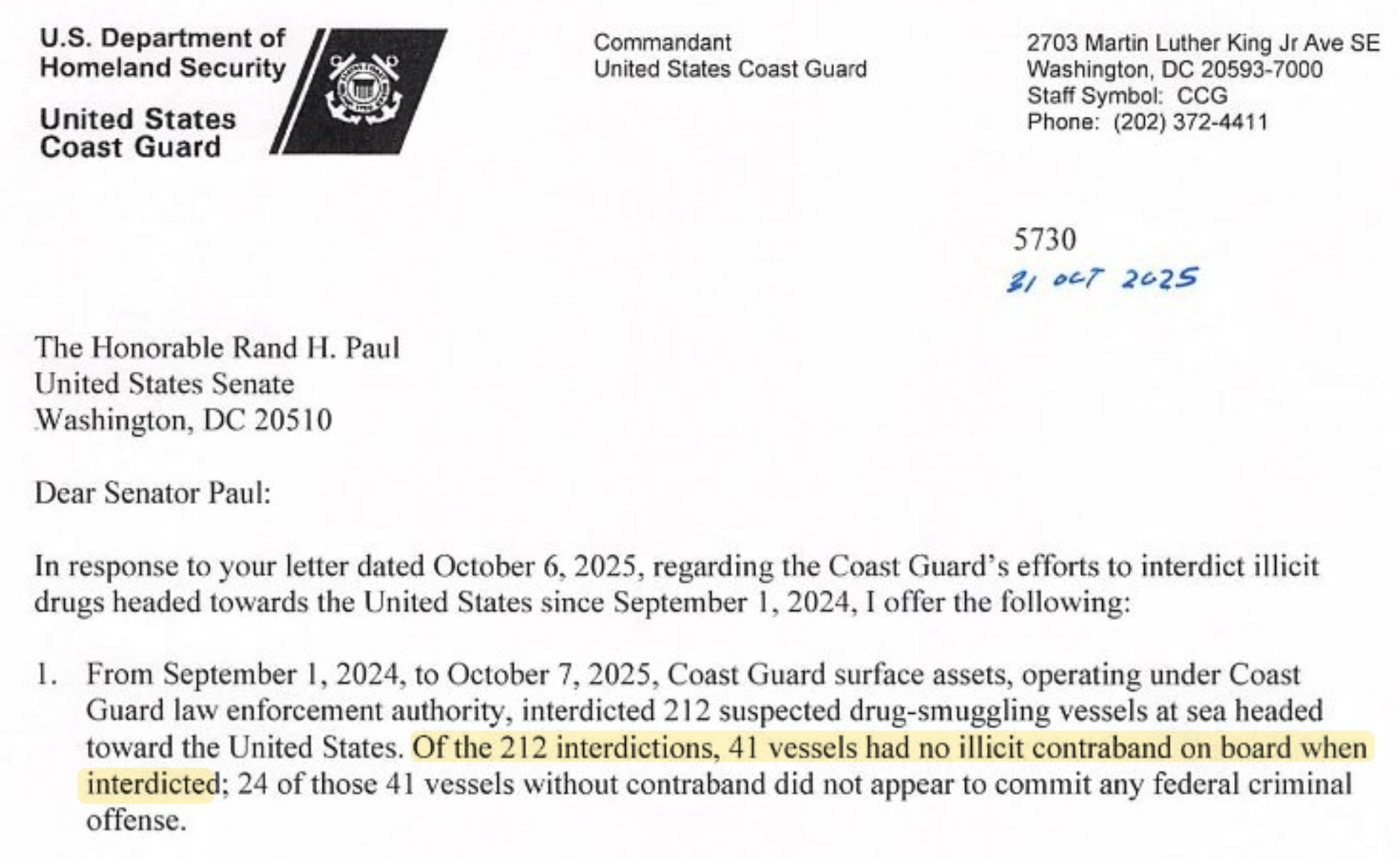
The accuracy of U.S. intelligence on maritime drug transshipment is far from perfect. During 13 months of “traditional,” non-lethal maritime interdictions in 2024-2025, Acting Coast Guard Commandant Adm. Kevin Lunday told Sen. Rand Paul (R-Kentucky) that one in five vessels the Coast Guard stopped en route to the United States on suspicion of carrying contraband had none on board.[122] Unlike the boat strikes, none of these incidents involved loss of life. But 80 percent accuracy is not good enough when the consequence is death. This level of uncertainty calls into serious question the quality of the intelligence on which U.S. authorities are basing their lethal targeting decisions.
4.2. Targeting criteria appear to lack rigor
The criteria that SOUTHCOM and other Defense Department bodies use to determine whether to strike a vessel are not publicly available. In March congressional testimony, though, Gen. Donovan stated that targeting is based on a vessel’s observed activities and whether the people aboard are affiliated with one of the 24 DTOs listed in the secret OLC memo.[123] The Washington Post reported that the August 5 Defense Department Execute Order’s (EXORD) targeting instructions “do not require positive identification of any individual but rather ‘reasonable certainty’ that adult males are members of, or affiliated with,” a DTO.[124]
This leaves much room for reasonable doubt. “Reasonable certainty” is a lower standard than the “near certainty” that the Obama administration used when choosing targets for its controversial drone strikes on suspected al Qaeda-linked militants in Africa, the Middle East, and South Asia. “As a result,” a former U.S. official who has read the EXORD told the Post, “the campaign may be killing individuals who in some cases have a tenuous link to any organized drug-running operation.” That official added, “When you define ‘DTO’ and ‘affiliate’ so loosely and you’re attacking boats, [the guidelines are] basically meaningless.”[125]
The same Washington Post analysis, from December 2025, stated that the Defense Department is assessing DTO “affiliation” according to factors “including the presence of drugs on board the vessel and its route, as well as intercepts of communications.” In June 2026, however, two U.S. senators placed even these criteria in doubt.
Questioning Secretary of State Marco Rubio, Sen. Tim Kaine (D-Virginia) revealed that those carrying out boat-strike targeting are using three criteria that Kaine was not allowed to disclose. He could disclose, though, that “evidence of narcotics on the boat” was not one of the three criteria. Sen. Rand Paul (R-Kentucky), in the same hearing, stated that the presence of arms on the vessel is not a criterion either. “In order to blow them up, we don’t have to say that they’re armed or have drugs. I think a lot of people would have questions, which I still do,” Sen. Paul said.[126]
4.3. Targeting alleged “affiliates”
Those carrying out U.S. targeting, in fact, appear to know little about who is aboard the vessels, according to accounts of classified briefings with Defense Department officials. Of the 11 people killed in the initial strike on September 2, 2025, for example, an official admitted that targets considered only one to be a member of a DTO. They categorized the other 10 as “affiliates.”[127] In that first attack, Pentagon officials claimed that they knew the identities of all people aboard the vessel. But in later strikes, “they don’t know all of the individuals on many of the other boats,” Sen. Mark Warner (D-Virginia), the ranking Democrat on the Senate Intelligence Committee, told ABC News.[128]
The Department of Defense is using vague terms like “affiliate,” “enabler,” or “facilitator” to describe people aboard the boats about whom they know little or nothing.[129] People who received the classified briefing interviewed by the Intercept “said that they were under the impression that little more than a conversation with a DTO member might confer affiliate status.”[130]
Rep. Smith, the top House Armed Services Committee Democrat, said after an October briefing with administration officials, “They did not in any way, shape, manner, or form explain what the ceiling and floor are for ‘affiliated.’ Theoretically, that could go beyond whether they’re in the actual action of moving drugs.”[131] After attending that briefing, Rep. Sara Jacobs (D-California) said she was told “affiliates’” alleged connection to DTOs could be “as much as three hops away”—three degrees of separation from an actual member of the targeted group.[132]
“U.S. officials have told Congress they do not need to identify individual targets before killing them,” CNN pointed out in November 2025.[133] This recalls past administrations’ imprecise targeting choices when ordering drone strikes and similar attacks during the “global war on terror.”[134]
4.4. Some victims may have been passengers, human trafficking victims, or fishermen
Doubts about “affiliation” extend to basic questions like why 11 people would be aboard a boat making a short-hop drug smuggling route, as occurred on September 2, 2025. There is a significant possibility that many who died in that first strike—perhaps including those killed in the “double-tap” while clinging to wreckage—were passengers traveling from Venezuela to Trinidad and Tobago. “Some people who are familiar with boat movements” along the Caribbean coast of Colombia and Venezuela told El CLIP that “it is common for the same boats that carry drugs on the outward journey to bring passengers back. The capitanes, as the boat operators are known, take whatever work they can get.”[135]
The Intercept raised the possibility, acknowledged by a senior military officer, that some of those killed on September 2 may have been migrants or human trafficking victims.
During a classified briefing on Capitol Hill last fall, Rear Adm. Brian H. Bennett—a military officer overseeing Special Operations for the Pentagon’s Joint Staff—was asked if any of the people aboard the boat on September 2 could have been human trafficking victims. “They could be,” Bennett replied, according to two people present at the briefing.[136]
As discussed in Section 5, a significant probability exists that some of those killed in boat strikes were fishermen: residents of fishing communities that dot the Caribbean and Pacific coasts of South and Central America. While fishermen may “take occasional trafficking jobs to get by,” which blurs identities, the likelihood of dying in a strike is scaring people away from getting in boats simply to fish, The New York Times reported from coastal Colombia and Ecuador. “Residents described entire communities abandoning fishing because the small ‘lanchas,’ or speedboats, used by traffickers and fishers are often indistinguishable.”[137]
President Trump has done nothing to dispel suspicions about the strikes killing the unaffiliated: “If I were a fisherman,” he said in September 2025, “I wouldn’t want to go fishing… I think the fishing business [has] probably been hurt.”[138]
To all of these concerns about the quality of intelligence used to target people for lethal boat strikes, we must add recent cases indicating reliance on faulty intelligence, or just hunches, in other contexts. In March 2025, the Trump administration sent 252 Venezuelan men to El Salvador’s feared Terrorism Confinement Center (CECOT) prison, claiming that all were members of the Tren de Aragua organized crime group. Dozens of cases have made clear that the allegations of “terrorist” group membership were based on little or no evidence. The New York Times revealed that an early March raid on a “narco-terrorist” group encampment in northern Ecuador, planned jointly by U.S. and Ecuadorian forces, in fact targeted a dairy farm and resulted in no arrests (although Ecuadorian soldiers allegedly tortured some at the farm).[139] A bombing in Iran that killed students at a school for girls is a very well-known example outside the region.
5. What we know about the victims
What little we know about those killed in the boat strikes adds further reason to doubt the Trump administration’s insistence that every one of them is a “narco-terrorist” or affiliate, and thus a combatant in a non-international armed conflict. While all are innocent of any crime that would be punishable by death in the U.S. criminal justice system, some appear to be innocent of any wrongdoing at all. Others do appear to have been involved in drug trafficking, but only as low-level, non-violent, small-time, or part-time operators. Seeking to erase the victims by annihilating them, or keeping survivors away from U.S. jurisdictions, seems to be part of the Trump administration’s effort to portray an image of righteous strength by eliminating people it describes as menacing “terrorists.”
Obtaining information about the dead and their life stories has been difficult. Loved ones fear coming forward in remote coastal communities dominated by organized crime, and in the case of Venezuela, by a repressive government. “Some relatives of victims in Venezuela and in Santa Marta, Colombia, say they have received threats,” El CLIP reported.[140] Criminal or government control also impedes reporters and investigators from doing fieldwork; “criminal gangs and the Venezuelan government have long repressed the flow of information in the region,” the Associated Press noted.[141] Throughout the region, governments have largely kept quiet about strikes that have killed their citizens, fearing sanctions and other reprisals from the Trump administration. Some governments, as discussed in section 7 below, even support the strikes.
Despite those obstacles, some outlets have carried out on-the-ground reporting. In November 2025, the Associated Press spoke to dozens of people in the coastal state of Sucre, Venezuela.[142] The New York Times has published dispatches from Trinidad and Tobago and from coastal Colombia.[143] Attorneys from the ACLU and the Center for Constitutional Rights have worked with relatives of two victims from Trinidad and Tobago in the Burnley litigation discussed below.[144] In May 2026, El CLIP published a series of articles that at least partially identified 20 subjects, the most comprehensive portrait of boat-strike victims to date.[145]
These glimpses suggest that only a small fraction of the dead had any significant role in drug trafficking organizations, and even then, that role was as a local criminal boss. If they were involved in the illicit business at all, most were drug couriers from impoverished fishing communities. “Traditionally, our counternarcotics efforts have always been targeted at the head of the snake,” Rep. Jim Himes (D-Connecticut), the ranking Democrat on the House Intelligence Committee, told the New York Times. “This is obviously the opposite of that. Now we’re going after the tail of the snake. We’re going after some, you know, poor ex-fishermen who took 300 bucks to run a load of cocaine to Trinidad.”[146]
A 2025 article in the journal Federal Sentencing Reporter, summarized at The Intercept, noted that in an average year before the boat strikes, U.S. authorities detained 455 suspected traffickers. “Most were caught on 10 to 20-foot open boats with three or four occupants. They were on average 42 years old. They were almost always unarmed.” They are rarely the owners of the boats: instead, “they may have been hired by agents for expected payouts of as little as $5,000.”[147]
5.1. Trinidad and Tobago
A Washington Post analysis concluded that drug traffickers use the island nation of Trinidad and Tobago, just off the coast of Venezuela, “far more frequently as a gateway to Europe.”[148] It is there, the New York Times reported in November 2025, that “mangled bodies have begun washing up on the beaches” following Caribbean boat strikes.[149]
Two of those killed were Chad Joseph (26 years old) and Rishi Samaroo (41 years old), both from the village of Las Cuevas, Trinidad. They perished in an October 14, 2025, strike that killed six people aboard a boat that was stopped in the water between Venezuela and Trinidad.[150] “Like many residents of Las Cuevas, a small fishing community located approximately 20 nautical miles from Venezuela, Mr. Joseph often traveled between Las Cuevas and Venezuela for fishing and farm work in Venezuela. During these trips, Mr. Joseph would often stay in Venezuela for weeks, and occasionally months, at a time,” reads the complaint in a lawsuit filed by the two men’s relatives in a Boston federal court on January 27, 2026.[151] They are suing for damages under the Death on the High Seas Act and the Alien Tort Statute; the case is Burnley v. United States.[152]
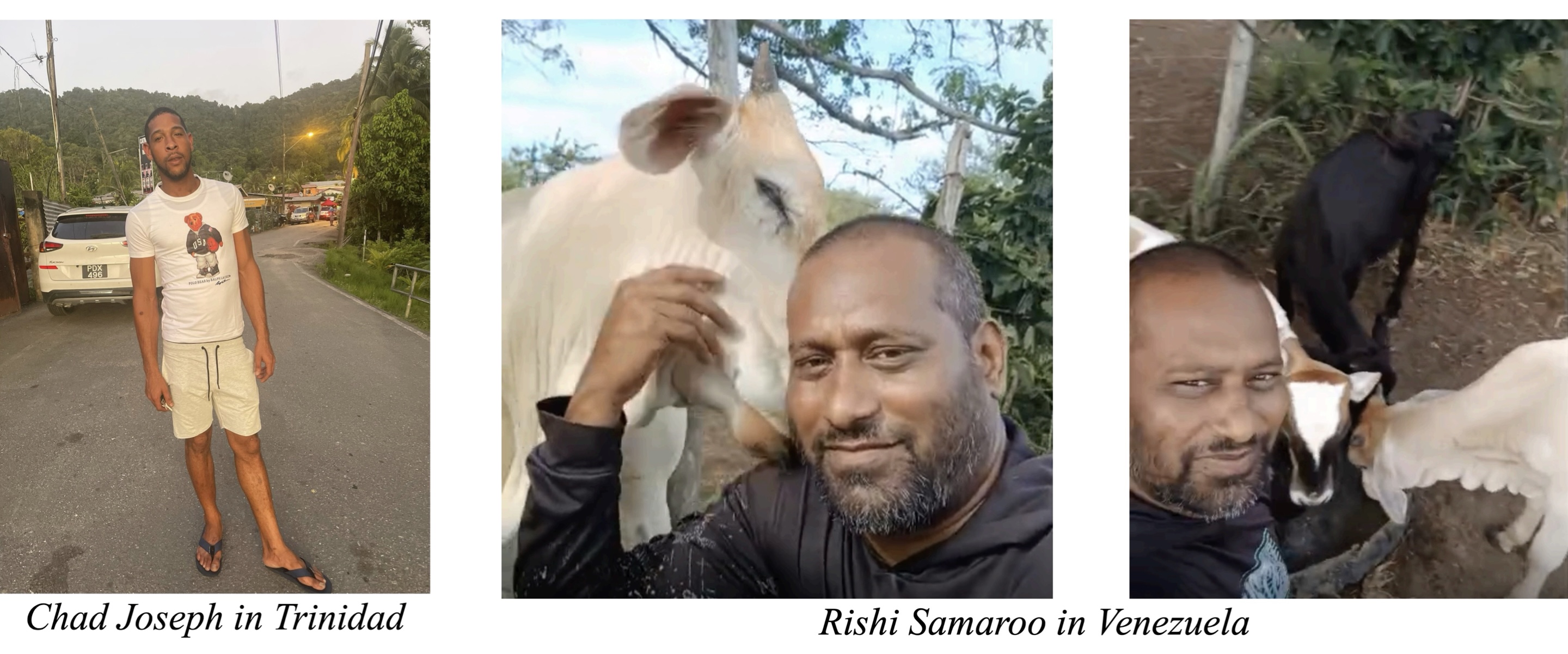
Images of Chad Joseph and Rishi Samaroo from the Burnley complaint.[153]
After working in Venezuela for several months—Samaroo on a dairy farm—where both called their families daily, the two men boarded a boat, telling their wives that they were coming home. Their loved ones never heard from them again.[154]
5.2. Sucre, Venezuela
Some of the first boats that U.S. forces struck departed from the Venezuelan state of Sucre, along the Caribbean coast. This region is a frequent jumping-off point for drug smugglers, and the local population is desperately poor, with 90 percent of residents reported as lacking basic food security. There, El CLIP reported, “The region’s economic collapse, exacerbated by hyperinflation and the deterioration of public institutions, has pushed many locals—particularly young people—to engage in these criminal networks, which now dominate their livelihoods.”[155]
Jeremy McDermott of InSight Crime, which tracks organized crime across the hemisphere, told the Washington Post that the “criminal networks” in Sucre are not the ones listed as DTOs by the Trump administration, although the Tren de Aragua “has had a presence” in the state. They are local gangs that, in fact, “ejected” the Tren de Aragua from Sucre when the criminal syndicate sought to penetrate the area.[156]
Associated Press reporter Regina García Cano interviewed people who knew nine boat-strike victims from Güiria, the largest town on Sucre’s Paria Peninsula. “Most of the nine men were crewing such craft for the first or second time, making at least $500 per trip, residents and relatives” told García Cano. “They were laborers, a fisherman, a motorcycle taxi driver. Two were low-level career criminals. One was a well-known local crime boss who contracted out his smuggling services to traffickers.”[157]
Juan Carlos Fuentes (43 years old) was a driver whose bus had broken down, leaving him in dire financial straits. Luís Ramón Amundaraín (36 years old) was a fisherman and a motorcycle taxi driver. Eduardo Jaime, “a beloved indoor soccer player,” was on the same boat as the Trinidadians Joseph and Samaroo, El CLIP reported.[158]
A few had admittedly moved drugs more than once. Eduard Hidalgo (46 years old) was a fisherman who had migrated to, and been deported from, the United States; a friend said that, after performing a few runs, he was “forced” to keep transporting drugs for criminal bosses in the area. Dushak Milovcic (24 years old) had dropped out of Venezuela’s National Guard Academy and was working with smuggling gangs. The Associated Press described Luis “Che” Martínez (60 years old) as “a longtime local crime boss” who was killed in the first strike, on September 2. No reporting describes him as a member of Tren de Aragua or any other organized crime group that the Trump administration has deemed “terrorist.”[159]
5.3. Santa Marta, Colombia
The second strike, on September 15, 2025, targeted a boat carrying what Donald Trump, in a social media post, called “confirmed narcoterrorists from Venezuela… in International Waters transporting illegal narcotics.”[160] On October 18, Colombian President Gustavo Petro stated on Twitter that the boat was in fact Colombian, while Colombia’s state-run television network identified a victim as Alejandro Carranza (42 years old), a fisherman from the Caribbean coastal city of Santa Marta.[161]
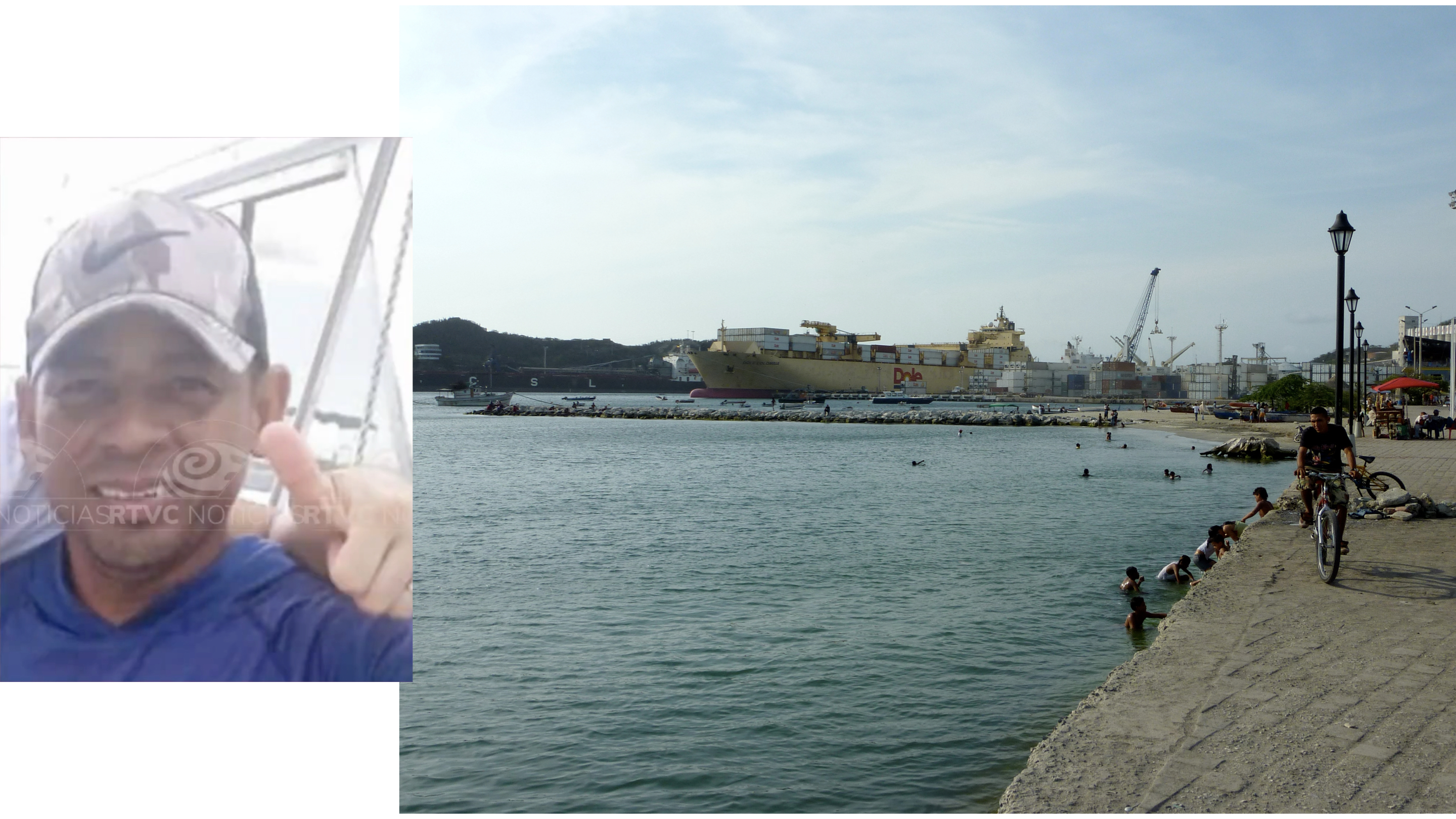
An image, from Colombian state television, of Alejandro Carranza (left); a view of Santa Marta’s port (right) in a photo from WOLA’s Adam Isacson.
The mother of three of Mr. Carranza’s children, Katerine Hernández, insisted to the New York Times that he had never been involved in drug trafficking: “If he was some kind of narco-terrorist,” she said, “then why are we living in misery instead of a mansion?” Times reporter Simon Romero noted that Carranza “occasionally took jobs piloting boats for others in the waters around Santa Marta… raising the possibility that the boat he was in was transporting something illicit with or without his knowledge.”[162] As discussed in section 6.5 below, Carranza’s family filed a complaint with the Inter-American Human Rights Commission in December 2025.
5.4. La Guajira, Colombia
In La Guajira, the second poorest of Colombia’s 32 departments, Erika Palacio Fernández, a witness, showed New York Times reporters a mobile phone video, taken on November 6, 2025, depicting a column of smoke rising from a vessel in the Caribbean Sea.[163] It remains “the only verified and independent video known to date of the aftermath of an airstrike.” Two days later, a burned-out vessel and two “mangled” bodies would wash ashore, among other flotsam, including some packets that reportedly had “traces of a substance that looked and smelled like marijuana.”
A still from Erika Palacio Fernández’s video from the coast of La Guajira, shared with the New York Times.[164]
“Multiple local sources said the bodies belonged to two men from Pedernales, a Dominican province bordering Haiti in the impoverished Enriquillo region, where 72 percent of households live in poverty,” El CLIP reported.[165] The Times reported at the end of May 2026 that Colombia’s government forensics agency still had the bodies in its custody, but had been unable to identify them.[166]
“The cocaine and marijuana market in La Guajira is operated by small community-based ventures as much as it is by armed groups,” Estefanía Ciro, a Colombian expert who led drug policy research for the Colombian government’s Truth Commission, told the Times. “In many places, this is everyday life. One day they carry marijuana, another cocaine, another fish.”[167] An anonymous local official told the CLIP that actual membership in a DTO is rare in La Guajira: “local workers involved in this link of the narcotrafficking chain operate as independent laborers. They are hired by the owners of the shipments according to the needs of each operation.”[168]
By late May, the Times reported, towns near where the destroyed boat came ashore had emptied. “Youth who made their living fishing, you know, selling, buying, they’ve gone to the city now, driving motorcycle taxis, that kind of thing,” said a police inspector in the town of Siapana.[169]
5.5. Elsewhere
Other regions where media reports have identified boat strikes and victims include:
- Tumaco and Buenaventura, two high-poverty port municipalities on Colombia’s Pacific coast, where fishermen “suspended their work out of fear they would never return home” for some time, according to the CLIP.[170]
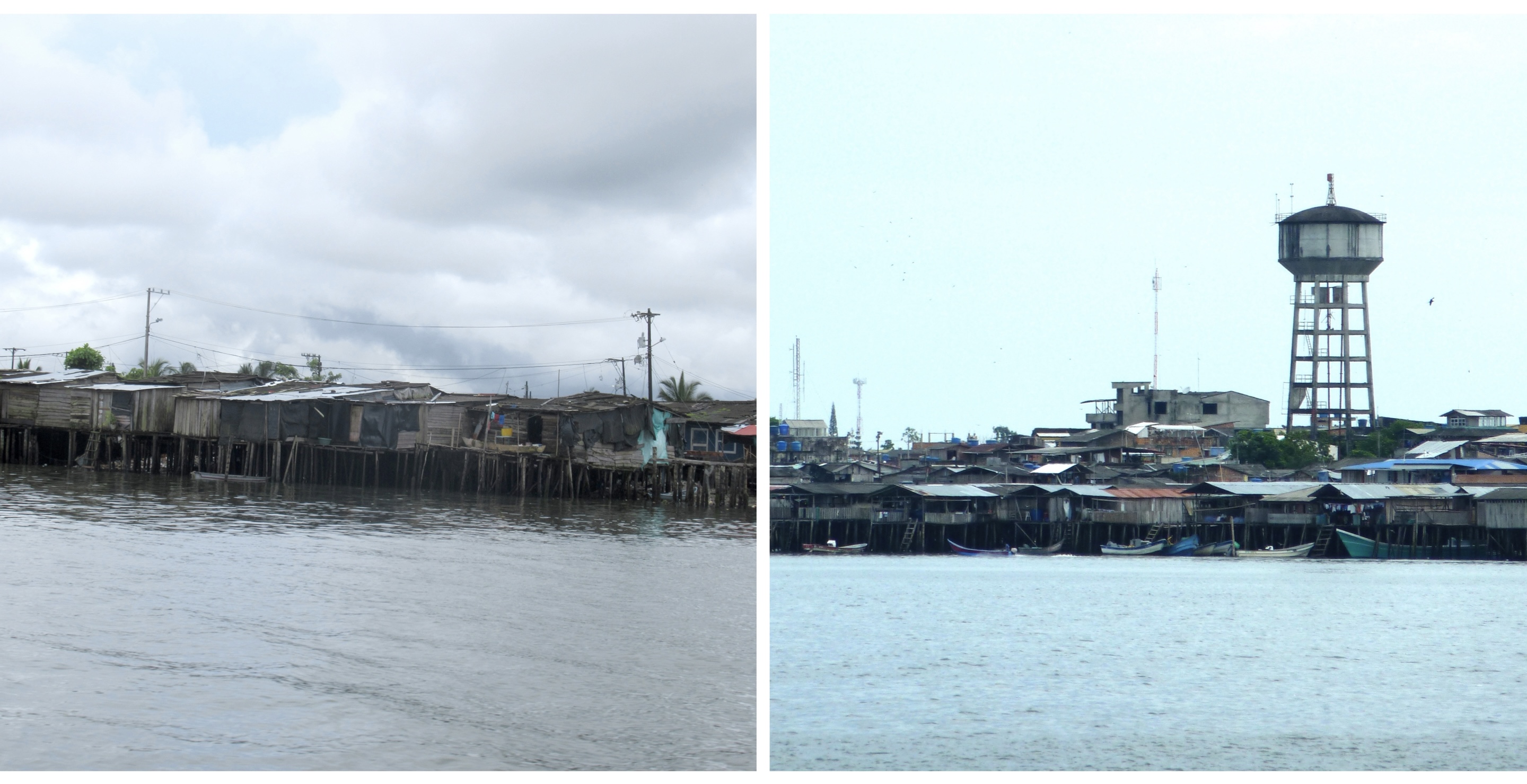
Views of Buenaventura (left) and Tumaco (right), Colombia. Photos by Adam Isacson.
- The port city of Manta, Ecuador, where Pedro Ramón Holguín Holguín, killed by a boat strike off Costa Rica’s Pacific coast, owned a small retail fish business.[171]
- The Mexican Pacific coastal communities of Cruz de Huanacaxtle, Nayarit, and Corrales, Cabo Corrientes, Jalisco, which lost seven people from the first town and one from the second in a February 16, 2026, boat strike. Residents told the daily La Jornada that “the young boatmen were carrying gasoline ‘and they supplied you-know-who.’ One had promised that this would be ‘the last trip, and it truly was.’”[172]
Of the few dead whom journalists and investigators have been able to identify, some appear to have been extremely low-level drug couriers. Their stories indicate that they took part in maritime shipments for a pittance out of financial desperation. Still others appear to have had nothing to do with the drug trade at all: they may just have been passengers aboard the wrong boat at the wrong time.
The more we learn about the victims, their stories will likely confirm grave doubts about the reliability of U.S. targeting. The victims’ relatives, friends, and communities must be given the security and the opportunity to describe what happened: to investigators and reporters, but also to prosecutors.
6. Seeking accountability
“Mark my words: It may take some time, but Americans will be prosecuted for this, either as a war crime or outright murder,” said Rep. Seth Moulton (D-Massachusetts), a Marine Corps veteran and House Armed Services Committee member, as news emerged in November 2025 about the order to kill shipwrecked survivors of the first boat strike.[173] In February 2026, Jack Goldsmith, the former head of the Justice Department’s Office of Legal Counsel, wrote that “Eventually there will be a reckoning… The reckoning will at least include a public airing of what happened—what legally controversial actions the military took, who gave what legal advice blessing those actions, who advised that the actions were legally questionable, and what happened then.[174]
As discussed in Section 3, the boat strikes are serious crimes, under U.S. law as well as international law, and the current administration’s arguments for “legalizing” them are thin, contradictory, and spurious. In a future accountability moment, investigators must identify the crimes committed and determine responsibilities.
Even beyond abstract notions of justice, the sanctity of life, and the dignity of the victims, accountability matters for pragmatic reasons. A major one is the precedent it sets, both for subsequent U.S. administrations that may wish to deploy lethal force outside the law and for other powers. If the world’s most powerful military can be directed to kill civilians on the high seas with impunity, the leaders of other nations may be more emboldened to ignore international law to suit their own purposes. “U.S actions grant tacit permission for China to sink vessels in the high seas in defense of whatever it chooses to define as terrorism or criminal behavior,” noted former diplomats Pforzheimer and Moreno.[175]
6.1. The dilemma of illegal orders
Another grave danger of ignoring accountability for the boat strikes is the harm it could do to the long tradition of democratic civil-military relations in the United States. It is dangerous to make committing murder a matter of standard bureaucratic operating procedure for the U.S. armed forces, and the likelihood of this happening increases with each barely noticed new boat strike.
At issue is how uniformed commanders and servicemembers can respond when issued a plainly unlawful order. Lederman, the former Justice Department official, cites the Judge Advocate General Operational Law Handbook to conclude that
in a “rare” case where “an order seems unlawful,” the subordinate should “not carry it out right away, but [should] not ignore it either.” She should, instead, “immediately and respectfully seek clarification of that order”; and if, after receiving a clarification (or after being informed that no clarification is forthcoming), a reasonable person “would recognize the wrongfulness of the act or order, even in light of a soldier’s general duty to obey, then the order is ‘manifestly illegal,’ and soldiers have a duty to disobey it.”[176]
Lederman added that according to the Commander’s Handbook on the Law of Naval Operations, the expectation that subordinates will obey orders “does not apply to a patently illegal order, such as one that directs the commission of a crime (e.g., an order directing the murder of a civilian [or] a noncombatant).”
In November, as the boat strikes intensified, six Democratic legislators, all of them former military officers or intelligence officials, recorded a video urging military personnel to refuse illegal orders.[177] While this enraged President Trump and led Secretary of Defense Hegseth to unsuccessfully seek a post-retirement demotion of Sen. Mark Kelly (D-Arizona), who appeared in the video, the Catholic archbishop for the U.S. armed services, Timothy Broglio, echoed the “disobey illegal orders” message in January 2026.[178]
Still, the existence of a secret memo from the Justice Department Office of Legal Counsel purporting to “legalize” the boat strikes places military personnel in a tight bind. “The Trump determination, embedded in the OLC opinion, operates as a bludgeon to crush contrary legal views, including in the Pentagon. Military lawyers must accept it, at least formally, in advising their clients,” Goldsmith explained.[179]
Kori Schake, a former George W. Bush administration national security official whose 2025 book The State and the Soldier explores some of these issues, argues that officers are stuck. While the issuance of illegal orders is a sign of systemic failure in U.S. democracy, the military must obey them even if the risk is the institution’s politicization.[180] Schake concludes, “The only options those men and women have when issued a lawful order [meaning “legalized” by an OLC opinion] is either to obey it or resign their commissions.”
That is the conclusion that the top lawyer for the Joint Chiefs of Staff, Gen. Eric Widmar, shared with Joint Chiefs Chairman Gen. Dan Caine in November, after Caine viewed the video from the six Democratic legislators. If given an illegal order, Widmar advised, officers should “request to retire—and refrain from resigning in protest, which could be seen as a political act, or picking a fight to get fired,” as CNN paraphrased him.[181]
Retiring without public comment appears to be what some officers, like Adm. Holsey of SOUTHCOM, have done. Ending one’s career and keeping silent about the reasons for doing so, however, is far from an optimal choice. Active and retired military personnel consulted by CNN “stressed that broadly encouraging servicemembers to quietly retire—if they’re eligible—rather than voice dissent in the face of a potentially illegal order risks perpetuating a culture of silence and lack of accountability.”[182]
The best way out of the present bind, then, is to prepare for the future now. Congress, prosecutors, investigators, the media, and civil society must be ready to seize the first available opportunity to conduct investigations and hold people fully accountable for issuing and carrying out illegal orders. That opportunity may depend on a future electoral outcome.
Several options for accountability exist, though none are simple or straightforward.
6.2. Domestic criminal liability
Since, as discussed in Section 3.1, the boat strikes apparently violate U.S. laws prohibiting murder, the appropriate response would be to prosecute those responsible in the U.S. criminal or military justice systems. Defendants would receive full due process, a privilege denied to the people aboard the struck boats.
Some junior officers appear to be aware of their possible legal exposure. The Washington Post reported in November 2025 that some asked Judge Advocates General “for written sign-off before taking part in strikes” and “are worried they might need attorneys in the future.”[183] Dan Maurer, a former Army JAG now teaching law at the University of Ohio, was among legal experts who told NBC News that “the Trump administration’s legal rationale for the strikes is so tenuous it could put commanders and troops in legal peril after Trump leaves office in 2029.”[184] Sen. Adam Schiff (D-California), a former federal prosecutor who sits on the Senate Judiciary Committee, told reporters that service members participating in the boat strikes could be at risk: “I would certainly not want to rely on the rationale I’ve read.”[185]
Still, the likelihood of prosecution weakens as one moves both up and down the chain of command. Donald Trump, as commander in chief, is unlikely ever to face prosecution: the Supreme Court’s 2024 decision in Trump v. United States granted presidents and former presidents “absolute immunity” from criminal prosecution for actions considered to be constitutional, and “at least presumptive immunity from prosecution for all his official acts.”[186] It is unclear whether that would extend to subordinates carrying out Trump’s orders, though Trump might preemptively pardon them.
Further down the chain of command, the existence of the secret OLC memo “legalizing” the boat-strikes order poses an obstacle to future prosecutions. “Even if a future administration decides the memo is wrong and rescinds it, the fact that it currently exists would severely inhibit future prosecutions,” read an October 2025 analysis by New York Times national security reporter Charlie Savage. “It would be hard to prove anyone intentionally committed a crime if the Justice Department itself had assured officials that their actions were lawful.”[187] Savage also noted that future administrations might not seek to prosecute those following orders “both because of the likely political backlash and to avoid setting a precedent that could inhibit their own actions.”
Others argue, though, that the obstacle posed by the OLC memo to future prosecutions is not insurmountable. Paul Rosenzweig, the former DHS assistant secretary for policy, wrote cogently in the Atlantic in November that the OLC memo may not protect officials from prosecution because it appears to be based on “false factual premises.”[188] He added, “Factually bankrupt opinions don’t make unlawful orders lawful,” warning that “a prosecution could be brought against any individual (and most especially general officers) who purported to rely on this opinion to justify their actions if it can be proved that they knew or reasonably should have known that the factual assumptions of the opinion were false.”
6.3. Litigation
If the U.S. justice system fails to provide victims with redress, then options may exist in the civil courts. As noted in section 5.1, the families of two victims from Trinidad and Tobago already filed a lawsuit in federal court in January. The Burnley v. United States case seeks “pecuniary, compensatory, and punitive damages” under the Death on the High Seas Act, which covers wrongful deaths at sea, and under the Alien Tort Statute, which allows federal courts to rule on international law violations like extrajudicial killings.[189] The Intercept’s Nick Turse noted that “another federal statute, the Suits in Admiralty Act, waives U.S. sovereign immunity—which ordinarily protects the federal government from being sued—over both claims.”[190]
This pathway to accountability could also be complicated, however. Savage’s New York Times analysis notes that a 1982 Supreme Court decision already gives President Trump immunity from civil damages arising from his official actions. His subordinates probably do not enjoy the same protection, especially from a wrongful death lawsuit, “but the Constitution does not give rights to noncitizens abroad.”[191]
6.4. Foreign courts
“Ultimately, we believe that foreign domestic courts have the most potential for the families of victims to receive justice outside of the United States,” read a May 2026 analysis at Just Security by three former State and Defense Department attorneys.[192] The nations whose citizens were killed by U.S. boat strikes have laws prohibiting murder and attempted murder, note Tracey Begley, Benjamin R. Farley, and Sarah Harrison, “and, if they have embraced passive personality jurisdiction, they would be able to prosecute crimes committed against their citizens abroad.”
While Savage cautions that “as a matter of geopolitical reality, it is difficult to imagine a scenario in which” smaller nations pursue officials “of a superpower that dominates the Western Hemisphere militarily and economically,” the calculus could shift over time.[193] Though states like Trinidad, Colombia, or Ecuador might be unwilling to challenge the Trump administration right now, the crimes in question have long statutes of limitation, and their prosecutors “could quietly gather evidence of the crimes and wait to issue indictments until Trump is out of office,” the former government attorneys contend.
If the boat strikes meet the threshold of crimes against humanity, foreign courts could also seek to prosecute U.S. officials under the principle of universal jurisdiction. This is the mechanism that led a Spanish judge to issue an arrest warrant in 1998 for former Chilean dictator Augusto Pinochet, leading to his detention in London. “Ninety-nine United Nations member States have universal jurisdiction statutes that cover crimes against humanity, including the majority of NATO countries,” Begley, Farley, and Harrison observed.[194]
6.5. International courts and the Inter-American system
The former State and Defense Department attorneys’ analysis identifies three other international venues: the International Court of Justice (ICJ) and the International Criminal Court (ICC), both in The Hague, Netherlands; and the Inter-American system composed of two OAS bodies, the Inter-American Commission on Human Rights (IACHR) based in Washington and the Inter-American Court of Human Rights in San Jose, Costa Rica.
The ICJ considers actions committed by states, while the ICC focuses on individuals. While an ICJ decision ruling the boat strikes illegal would set an important precedent, the process for deciding cases is long and complex, taking several years, and there is at least one historic example (the 1986 case in which Nicaragua sued for supporting insurgents and mining harbors) in which the U.S. government refused to pay required reparations.[195]
The United States is not a party to the Rome Statute that created the ICC, which limits the Court’s jurisdiction over U.S. citizens, as does the apparent fact that the attacks took place in international waters. However, several states whose citizens were killed by boat strikes are parties to the Rome Statute, including Colombia, Ecuador, St. Lucia, and Trinidad and Tobago. The ICC could have jurisdiction over these crimes if the victims’ vessels were registered in those states. Confirming that registration, though, “may pose a challenge for the prosecutor” at the ICC, Begley, Farley, and Harrison wrote.[196]
The United States is also not a party to the American Convention on Human Rights, which gives the Inter-American Court of Human Rights jurisdiction over human rights abuses when signatory states’ national remedies are exhausted. “Nevertheless,” the three former State and Defense Department attorneys suggest, “the Inter-American Commission on Human Rights might still be an option for redress.”[197] The Commission cannot order sanctions or enforce compliance with its rulings. But it has developed a reputation as a high-credibility body whose reporting carries important political weight.
In December, the family of Colombian fisherman Alejandro Carranza, who was killed in the September 15, 2025, boat strike (see Section 5.3), filed a non-public complaint with the IACHR. In response, the Commission convened a March 13, 2026, hearing at its regular sessions, held in Guatemala.[198] At that hearing, ACLU attorney Jamil Dakwar asked the Commission to declare the boat strikes in violation of international law; to request disclosure of the secret OLC opinion “legalizing” the boat strikes; to carry out an investigation focusing on the victims and survivors; to create an interdisciplinary group of independent experts (GIEI); to convene affected states and recommend that they avoid aiding and abetting the strikes while improving search and rescue capacity; and to request an advisory opinion on the strikes’ legality from the Inter-American Court of Human Rights.
In response, an official from the State Department Office of the Legal Advisor scolded the Commission for holding the hearing at all. Deputy Legal Advisor Carl Anderson contended that the IACHR lacks jurisdiction over the boat strikes because the law of armed conflict governs them: international humanitarian law, not human rights law. This argument would require the Commission to accept the secret Justice Department OLC opinion’s contention that a “non-international armed conflict” exists between the United States and a secret list of terrorist groups. Anderson accused the IACHR of straying and drifting from its mandate, pointedly noting that the U.S. government is “still the largest contributor of voluntary funding” to the Commission.
7. Other states’ responses
7.1. Other nations’ complicity may carry legal consequences
Accountability extends to other states that may be collaborating with, or contributing intelligence and other assets to, the boat strikes. With notable exceptions, states with territory or assets within the Caribbean and Pacific transit zones have preferred to avoid public pronouncements about the boat strikes, either for or against. But reactions vary widely: some are applauding and even contributing, while others are distancing themselves or even criticizing, if not outright condemning.
Other states’ responses matter. If they are willfully complicit in the boat strikes, they may be partially liable to the victims. “In our view, any State sharing intelligence with the United States about boats or drug trafficking in the Caribbean exposes itself to a high degree of legal risk,” read a November 2025 analysis from three law professors published at Just Security. “If the United States kills someone, and if the intelligence provided facilitates that killing, the State sharing the intelligence is itself violating international law.”
“Third States can incur legal responsibility for aiding or assisting another State in their commission of internationally wrongful acts,” explained a March 2026 analysis by Mina Nur Basmaci and John Ramming Chappell at the Center for Civilians in Conflict (CIVIC) that seeks to place other states “on notice.”[199] It cites “Article 16 of the Articles on Responsibility of States for Internationally Wrongful Acts (ARSIWA)—and domestic and international jurisprudence” as well as “Article 25(3)(c) of the Rome Statute and in the statutes of ad-hoc tribunals and domestic systems.”
Responsibility, CIVIC’s experts argued, means deliberately facilitating the boat strikes while being aware of the reasons why the strikes are “internationally wrongful.” Facilitating the boat strikes could be defined as lending facilities to carry them out or providing material aid, including intelligence.
7.2. Supportive governments
The Defense Department Inspector General’s May 2026 report on Operation Southern Spear names the Dominican Republic, Ecuador, Guyana, Paraguay, Peru, and Trinidad and Tobago as states that “have publicly responded positively to U.S. lethal strikes.”[200] CIVIC’s Basmaci and Chappel rank the Dominican Republic, Ecuador, and Trinidad and Tobago as exhibiting “the strongest convergence of cooperation indicators,” while Guyana, Paraguay, Panama, and El Salvador have shown “partial alignment” with the strikes “through at least two to three indicators.”[201]
- The government of the Dominican Republic helped locate at least one of the boats that U.S. forces went on to destroy (the September 19, 2025, strike).[202] In November 2025, President Luis Abinader temporarily allowed U.S. forces to use restricted areas at the San Isidro Air Base and Las Américas International Airport to refuel aircraft and transport equipment and personnel.[203]
- In El Salvador, the government of President Nayib Bukele, a close ally of the Trump administration, appears likely to support the strikes. Since 2000, SOUTHCOM has maintained a “cooperative security location” at the Comalapa International Airport near San Salvador. A New York Times analysis of satellite imagery, air traffic control communications, and flight-tracking data found that the Comalapa site, which was rarely used during the Biden administration, is now frequently hosting a wider array of U.S. aircraft. These include surveillance planes like the Navy P-8A and Air Force C-40 Clipper, and the AC-130J Ghostwriter attack gunship, a manned plane that, as noted in section 1.3 above, has almost certainly been employed in boat strikes.[204]
- The prime minister of Trinidad and Tobago, Kamla Persad-Bissessar, has vocally backed the boat strikes, while maintaining silence about Trinidadian victims like the plaintiffs in the Burnley litigation. Her government allowed the U.S. Department of Defense to install a new radar system on the island of Tobago and permitted U.S. military aircraft to transit through Trinidadian airports, while U.S. Marines conducted training and improved airport roadways.[205]
- President Daniel Noboa of Ecuador has praised the boat strikes. While his proposal to alter the nation’s constitution to allow foreign military personnel to operate from bases on Ecuadorian soil was defeated in a November 2025 referendum, Noboa’s government has invited U.S. personnel to cooperate closely on operations against the country’s organized crime groups, both at sea and on land.[206] It is not clear, though, whether Ecuador’s cooperation extends to enabling, facilitating, or otherwise contributing to the boat strikes.
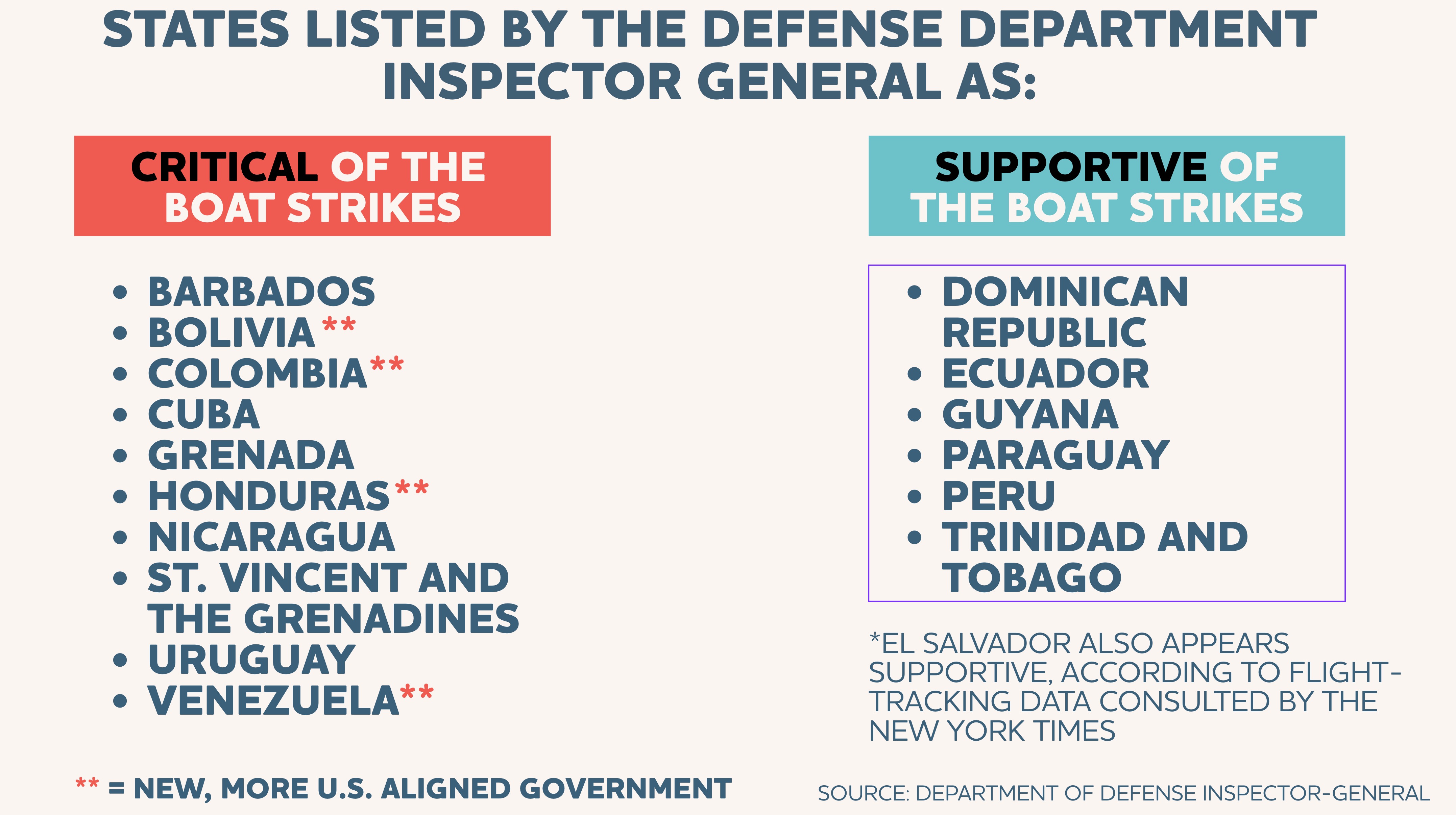
7.3. Governments that have criticized or distanced themselves from the boat strikes
The Defense Department Inspector General’s May 2026 report names Colombia, Cuba, Barbados, Bolivia, Grenada, Honduras, Nicaragua, St. Vincent and the Grenadines, Uruguay, and Venezuela as states that “have expressed negative reactions, ranging from accusations that combating narcoterrorism was not the sincere aim of U.S. military operations to disapproval of lethal strikes as the method to interdict drug traffickers.”[207] Following the first strike, a September 4, 2025 statement from the Community of Latin American and Caribbean States (CELAC) expressing “deep concern” was signed by these nations plus Antigua and Barbuda, Belize, Brazil, Chile, Dominica, the Dominican Republic, Guatemala, Mexico, St. Kitts and Nevis, St. Lucia, and Suriname.[208] Most of those additional states made no further public statements.
Since the strikes began, governments in Colombia, Bolivia, and Honduras have undergone left-to-right electoral transitions, while the government of Venezuela has become more cooperative with the Trump administration following the January 3 U.S. military operation there.
In the Americas
- During their initial months, Colombia was the state that most forcefully criticized the boat strikes. President Gustavo Petro called them “murder” and pointed to the case of Santa Marta fisherman Alejandro Carranza, discussed in section 5.3 above. In November 2025, Petro ordered Colombia’s military intelligence agencies “to suspend communication and other dealings with U.S. security agencies… while the missile attacks on boats in the Caribbean continue.”[209] Petro walked that back a day later, permitting intelligence communications considered unlikely to contribute to human rights abuses.[210] Petro’s tone on the boat strikes, and about much else regarding U.S. foreign policy, softened after he and Donald Trump held a friendly meeting at the White House on February 4, 2026.[211]
- The initial Caribbean boat strikes, and the mammoth U.S. naval deployment to the Caribbean Sea that began in August 2025, were at least in part a Trump administration tactic to menace the regime of Nicolás Maduro in Venezuela, whom U.S. military personnel removed from Caracas on January 3, 2026. Well before “Operation Absolute Resolve,” however, the Maduro regime had muted its criticism of the boat strikes, even as many of the victims were Venezuelan. At first, Maduro even suggested that the videos of the strikes being posted on social media were fabricated using artificial intelligence.[212] The regime that remains in power in Venezuela under former vice president Delcy Rodríguez has said nothing of substance about the strikes.
Europe and NATO
While they have not forcefully or openly criticized the boat strikes, some of the United States’ longtime allies in the North Atlantic Treaty Organization (NATO) have taken steps to distance themselves. The United Kingdom, the Netherlands, and France all have territories in the Caribbean, while Canada is also an OAS member state.
All have cooperated with SOUTHCOM for decades on drug interdiction operations in the hemisphere, most notably through Joint Interagency Task Force South (JIATF-South), its intelligence-sharing and coordination center in Key West, Florida. This unit has operated since 1989 and hosts liaison officers from 19 European and Western Hemisphere states.[213]
- “British officials believe the U.S. military strikes, which have killed 76 people, violate international law,” unnamed sources told CNN in November 2025, adding that the United Kingdom had paused some intelligence sharing a month earlier.[214]
- In a joint interview with a Dutch newspaper, the heads of the Netherlands’ civilian and military intelligence agencies said they “are very alert to the politicization of our intelligence and the violation of human rights,” and had become more cautious about what they share with U.S. forces.[215] The nation’s defense minister said that the Dutch government would not allow facilities in Aruba and Curaçao, including a U.S. Cooperative Security Location, to be used for operations connected to Southern Spear.[216]
- “We have observed with concern military operations in the Caribbean region because they disregard international law and because France has a presence in this region through its overseas territories, where more than a million of our compatriots reside,” French foreign minister Jean-Noël Barrot said in November 2025.[217] “No European country, including France, will send operational intelligence to the Americans under the current circumstances if it could be used as the basis for a military strike against a vessel,” said Dimitri Zoulas, head of the French police anti-narcotics service.[218]
- “In November, the Canadian government said that it will continue to cooperate with the U.S. Coast Guard in drug interdiction operations but does not want its intelligence used in lethal boat strikes, according to media reporting” cited by the Defense Department Inspector General.[219]
- “The European Union’s top diplomat, Kaja Kallas, also said the American strikes lacked any legal basis,” the New York Times reported in November 2025.[220]
These nations continue to participate in JIATF-South and to cooperate with U.S. Coast Guard and Navy operations that lead to “traditional,” non-lethal drug seizures. JIATF-South and JTF-Southern Spear are both within SOUTHCOM and under the command of Gen. Francis Donovan. Some form of firewall appears to exist between the two types of operations, although the details of these arrangements and any new protocols that may exist have not been made public.
8. The strikes’ drug policy failure
8.1. Official claims of deterrence
Among the many aspects of the boat strikes that the Trump administration refuses to disclose is how it measures whether it is even achieving the objectives it has set for itself. “USSOUTHCOM said that it could not publicly release its measures of effectiveness for assessing the conduct of OSS,” the Defense Department Inspector General reported.[221]
Still, top officials claim that the strikes are deterring drug trafficking:
- “Since the first September strike, there has been a 20% reduction of movements of drug vessels in the Caribbean and an additional 25% reduction in the Eastern Pacific,” Joseph Humire, the Defense Department’s “senior official performing the duties of assistant secretary for homeland defense and Americas security affairs,” told a House Armed Services Committee hearing in March.[222]
- An unnamed military official told the New York Times in May that a recent increase in aircraft and assets had reduced the chance of a drug boat evading the military from 50 percent to 25 percent.[223]
- “Some top cartel drug-traffickers in the @SOUTHCOM AOR have decided to cease all narcotics operations INDEFINITELY due to recent (highly effective) kinetic strikes in the Caribbean,” Secretary of Defense Hegseth posted in February; it is unclear to which traffickers he was referring.[224]
- “We haven’t had a strike in the Caribbean Basin in almost five weeks,” Secretary of State Marco Rubio said in December. “Do you know why? It’s not because we stopped looking. It’s because no one wants to get on a boat anymore and do that. So it’s been effective at cutting that down.”[225] There have since been at least seven Caribbean strikes.
- President Trump stated that “98.2% of Drugs coming into the U.S. by Ocean or Sea have STOPPED!” which is plainly untrue: he may have been referring to a 98.2 percent reduction in CBP’s coastal seizures of fentanyl (one agency, one vector, one drug) from an anomalous 387 pounds in February 2026 to 7 pounds in March.[226] At other times, he has claimed a 97 percent drop in drug supplies.[227]
- Trump has also claimed on several occasions that each destroyed boat saves 25,000 U.S. lives by destroying fentanyl and other drugs.[228] This perhaps refers to how many doses above the lethal level might fit in a shipment. If so, Trump appears to be claiming that stopping three boats would save a number of lives exceeding all annual U.S. overdose deaths—most of which result from fentanyl and other opioids, which are not, in fact, smuggled from South America.
None of these statements is backed by any further evidence, much less verifiable, citable data. In March 2026 testimony before the Senate Armed Services Committee, Gen. Donovan instead sought to recalibrate expectations. “Looking forward, Senator, the boat strikes aren’t the answer,” Donovan replied to a question from Sen. Mark Kelly (D-Arizona), seeking to portray the strikes as part of a larger effort against drug trafficking. “I believe that actually kinetic strikes will be one of many tools, and probably not the most effective tool, when we actually look at it as more of a campaign approach.”[229]
8.2. Little evidence of impact on drug availability
While drug seizure and availability data tend not to get reported promptly, the evidence available so far suggests that the boat strikes are having little to no impact on the supply of cocaine reaching the United States. If the lethal attacks were impeding the arrival of cocaine, the law of supply and demand would suggest a rise in the price of the drug sold on the nation’s streets, and a drop in the product’s purity, as supplies dwindled. One would also expect agencies guarding the United States’ borders to seize smaller quantities of cocaine, as less of the drug manages to pass through the deadly maritime gauntlet on its way north.
The data available so far does not indicate that any reduction in cocaine supplies is happening. “Street prices for cocaine remain between $60 to $100 per gram in many U.S. cities, about where they were before the boat strikes began,” the New York Times reported in May, citing addiction scientist Nabarun Dasgupta at the University of North Carolina.[230] Dasgupta has similarly seen no evidence in 2026 of an increase in the chemicals that dealers add to “stretch” cocaine when it is scarcer. “It’s clearly not going in the expected direction,” he told the Times.
Similarly, U.S. Customs and Border Protection (CBP), the agency that guards U.S. borders and ports, has not seen important movement on cocaine seizures. During the ten months before the boat strikes began (November 2024 through August 2025), CBP reported seizing 56,629 pounds of cocaine at the U.S.-Mexico border, U.S.-Canada border, coasts, and the U.S. interior (such as airports). During the ten months following the boat strikes (September 2025 through June 2026), CBP’s reported seizures increased 2 percent, to 57,688 pounds.[231] While this is an inexact measure—what CBP manages to seize at borders doesn’t necessarily indicate supply trends—it certainly does not point to a drought of northbound cocaine, and is consistent with price and purity estimates that suggest cocaine supply and availability have remained stable.
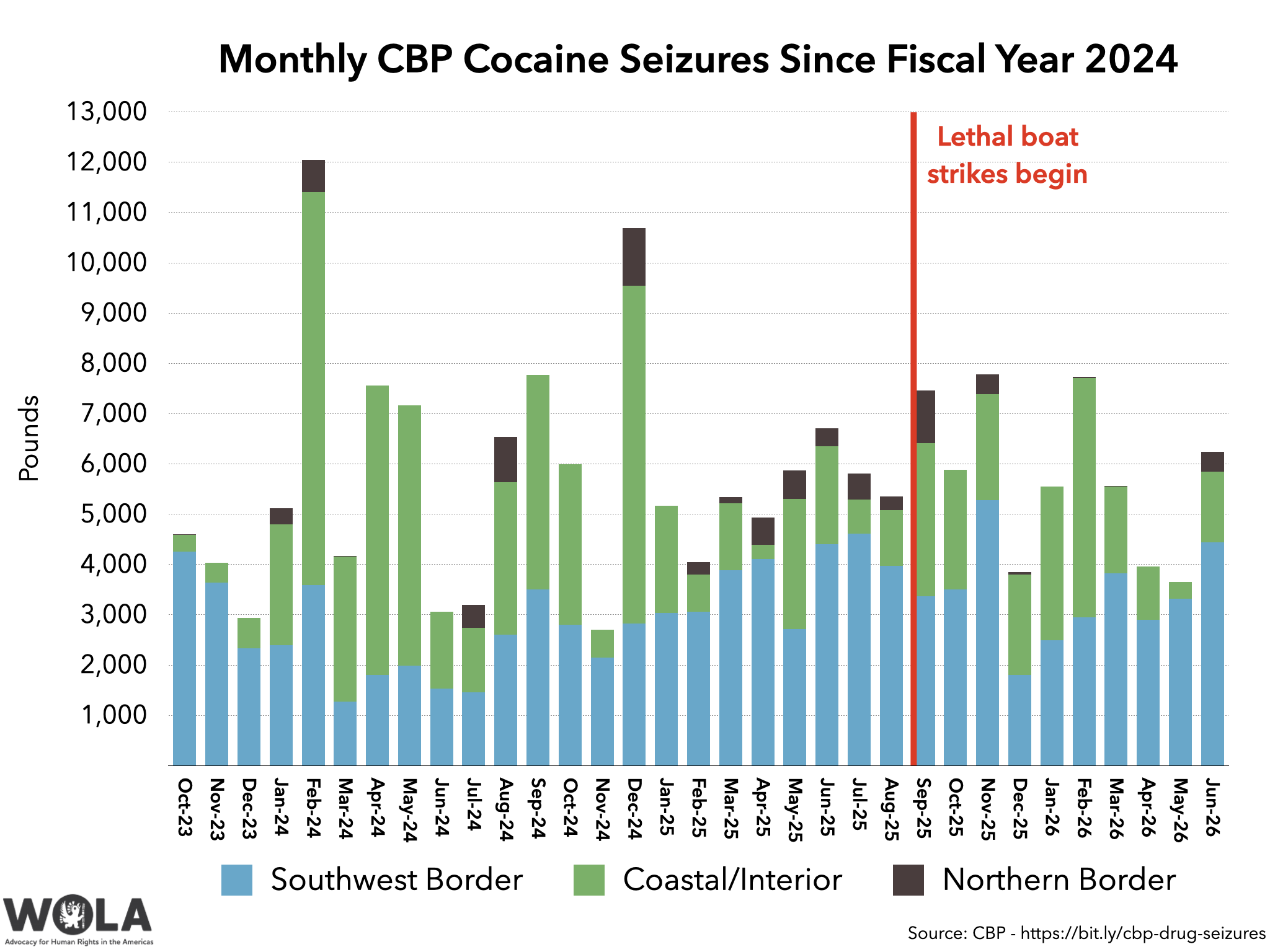
8.3. The chimera of “deterrence”
Drug traffickers in South America do not produce or traffic fentanyl, but they do produce all the cocaine consumed in the United States. “The fentanyl and methamphetamine consumed in the United States are produced almost entirely in Mexico, while more than 80 percent of the cocaine in the U.S. market is produced in Colombia,” the Defense Department Inspector General recalled in May, citing the DEA.[232]
The boat strikes target just one form of cocaine smuggling: in small boats on the high seas. This is a difficult vector to disrupt. The “transit zone” through which cocaine passes—defined in a U.S. Government Accountability Office (GAO) report as “a 6 million square mile area that includes the Caribbean Sea, the Gulf of Mexico, Central America, the northern coast of South America, Mexico, and the Eastern Pacific”—is twice the size of the continental United States.[233] Well over half of that is ocean, through which small craft may travel without passing through bottlenecks or chokepoints. There is no Strait of Hormuz equivalent that creates a blockade against drug smuggling.
Even though cocaine production appears to be at record levels, the product itself is small and hard to detect when scattered across such a vast transit zone. The UN Office on Drugs and Crime (UNODC) estimates that global cocaine production quadrupled in the decade from 2014 to 2023, rising from 869 to 3,708 tons.[234] Conservatively assuming about 500 kilograms per cubic meter, that entire annual supply could fit into about 225 standard 20-foot shipping containers. (To give a sense of scale, a single large container ship carries about 20,000 such containers.) Break that amount across countless shipments, routes, and concealment methods, and interdiction becomes a classic “needle in a haystack” mission.
That metaphor grows more vivid when one considers what can fit on these small boats. Assuming—likely incorrectly and expansively—that each of the 67 boats destroyed so far was carrying cocaine, and that each boat had one ton aboard, then the boat strikes would have taken about 67 tons of cocaine off the market. That would be equivalent to just 1.8 percent of the 3,708 tons that UNODC estimated were produced in 2023.
In March, a regional police chief in Ecuador’s Pacific region told local media that, due to the risk posed by boat strikes, criminal organizations are having to more than double what they pay to entice small boat captains and crews to transport drugs, compared to 2023 and 2024 prices.[235] It is not clear, though, whether forcing traffickers to pay captains $40,000 instead of $20,000 truly dents their profit margins: at the $60 per gram cited above, a ton of cocaine retails for as much as $60 million on U.S. streets. Even if the wholesale price for that ton is in the low tens of millions, an extra $40,000 in crew fees would make little difference to the illicit business model.
It is crucial to recall, too, that “small boats on the high seas,” which the boat strikes aim to target, are just one of many options available to cocaine traffickers moving their illicit product from South America to the United States. Other methods include:
- Smuggling inside shipping containers aboard boats carrying licit cargo. No estimates exist for how many tons of cocaine are smuggled this way each year, because it is impossible to know what has gone undetected. However, large-scale container seizures have become more frequent in recent years, especially at European ports.[236]
- Submarines and semi-submersible craft. These have larger payloads than small boats and are harder to detect. Authorities in Colombia and Ecuador periodically raid sites, often hidden in dense Pacific mangrove estuaries, where traffickers build these vessels.[237]
- Small boats making short hops up the coasts of South and Central America. This is more time-consuming than using the open ocean and probably requires paying off more corrupt authorities along the way. However, it involves less time in international waters and is less vulnerable to interdiction, lethal or otherwise, from U.S. forces.
- Overland transshipment, usually along road networks, perhaps combined with shorter maritime routes. Land routes are the principal vector for migrant smuggling, and drugs are harder to detect and easier to conceal than humans.
- Riverine routes. Traffickers are particularly using the Orinoco and Amazon rivers, and their tributaries, to move cocaine to eastern areas of South America, closer to markets in Europe. The Defense Department’s Humire testified that, in response to the boat strikes, traffickers’ “movements shifted eastward through Venezuela and Guyana into Suriname.”[238]
- Aerial routes. Smuggling via small aircraft appears to be less frequent than it was during the 20th century, as U.S.-backed “airbridge denial” programs in Colombia, Peru, Honduras, and elsewhere—which today rarely kill people aboard civilian planes—have made aircraft easier to detect and intercept at their destinations. Still, a significant portion of cocaine travels at least part of the way by air. During the 2010s, maps produced by SOUTHCOM estimated that aerial trafficking made up about 7 to 20 percent of total drug movement from South America.[239]
“We are seeing some changes” because of the boat strikes, Gen. Donovan told the House Armed Services Committee, “whether that’s additional flows further to the west into the Pacific, or more air traffic, or more in shipping containers… I can’t give you percentages, but we know the enemy is adapting to our actions.”[240]
8.4. The limits of interdiction
In its criticisms of the traditional drug interdiction approach, the Trump administration has surfaced an important issue. U.S. politicians and officials have long tended to overestimate interdiction’s effectiveness in curbing illegal drug supply and availability, and have consequently overvalued its contributions to addressing the country’s drug-related problems. Acknowledging interdiction’s limitations and drawbacks could help promote a constructive debate that can improve drug control policy.
That said, the reckless boat strikes are not the remedy for interdiction’s shortcomings, which are systemic and structural, not a matter of insufficient state violence. To the contrary, the U.S. application of lethal force undercuts interdiction’s possible contributions and exacerbates its drawbacks.
Once illegal drugs reach the level of mature commodity markets—as has been the case for cocaine for decades—law enforcement operations, including interdiction, have very limited capacity to curb supplies and restrict availability.[241] The combination of prohibition with robust consumer demand generates enormous profits for groups willing and able to conduct their business outside the law. When interdiction and enforcement, more generally, dent supplies enough to cause market shortages, those shortages tend to be brief, as rising prices stimulate continued production. To succeed and to turn a profit doesn’t require drug trafficking organizations to get all or even most of their product to market.
Drug traffickers are, of course, human beings who make plenty of mistakes that can leave them exposed, while modern enforcement capabilities are quite impressive. As a result, traditional interdiction missions such as those carried out by the U.S. Coast Guard with Navy support can at least claim the possibility of gathering evidence and intelligence that may help identify and apprehend higher-level criminal leaders. The boat strikes, by design, all but obliterate the possibility of evidence and intelligence gathering by destroying the alleged smuggling vessels, the cargo, and those on board.
Otherwise, the boat strikes do nothing to address the structural limits on interdiction’s effectiveness, while adding new problems. First, the violent spectacles of U.S. military attacks are an especially expensive way to conduct interdiction, with no evidence that the added cost makes them more effective than the traditional interdiction approach. Despite the Trump administration’s claims, these displays of violence are not deterring or otherwise slowing the arrival of cocaine to U.S. communities.
Worse, the theatrical violence of the boat strikes has nothing to do with addressing the very real and growing challenges posed by international drug trafficking and organized crime networks. As aptly described by Brazilian security researchers Matias Spektor and Oto Montagner in a January 2025 New York Times column:
Trying to crush cartels through blunt force rests on a fundamental misunderstanding of how modern criminal organizations actually operate. Organized crime is now one of the most consequential transnational political forces in the region. The world’s most powerful gangs aren’t anchored to a single territory or port. They are embedded in global illicit supply chains that combine trade, finance, and technology, span continents, and can outlast any single government.
Turning Latin America into a theater of war will not weaken transnational crime; it will entrench it. Force may scatter criminal networks in the short term, but it will ultimately make them harder to see, harder to track, and harder to stop.[242]
Beyond their stark failure as a policy to reduce drug supplies or weaken organized crime, the boat strikes campaign is part of a broader fraying of U.S. alliances and erosion of international law, especially during Donald Trump’s second term. Allies, especially long-standing European partners, withholding law-enforcement cooperation to limit their exposure to the boat strikes, further diminishes the effectiveness of drug interdiction and creates mistrust that weakens alliances that have been broadly beneficial to U.S. security and prosperity.
Perhaps even more dangerously, the boat strikes can provide a ready excuse for rival powers to justify the use of lethal force outside the law in pursuit of their own interests. Once such norms are weakened, their collapse can come suddenly, in ways that would make the world less safe, including for American civilians and soldiers. Finally, the boat strikes threaten to aggravate the real risk and growing dangers of a politicized U.S. military that becomes unable or unwilling to resist civilian leaders’ orders to turn their weapons on “the enemy from within” America’s own communities.
Conclusion
Time will tell whether the Trump administration’s boat strikes campaign proves to be a grisly aberration or part of a larger drift toward the unaccountable exercise of lethal military force. Demagoguery can flourish amid real fears of illegal drugs and violent crime. The current U.S. administration has chosen to weaponize such fears into a lawless campaign of violence. If normalization of the boat strikes takes hold and the U.S. president can assert an unlimited “license to kill,” the protections of the rule of law will be gravely weakened for all of us, not just those who are the most immediate targets of state violence.
But we are not passive observers, and there is nothing inevitable about the boat strikes. Indeed, the secrecy in which the Trump administration continues to shroud its purported legal rationale for the boat strikes suggests that even the Trump White House understands how weak its arguments are.
The administration can only proceed on this reckless course if U.S. civil society and our political institutions look the other way. This report has drawn on excellent work from WOLA’s civil society partners, many of them members of active coalitions; on the rigorous work of journalists learning from sources and from the field; and on the careful analyses of legal experts, some in academia and some with years of past government service. They offer vigorous proof that U.S. civil society remains courageous and strong. It deserves the world’s full-throated support.
It is our role as citizens in a democracy to focus intently, not to lose heart, and bring an end to the boat strikes once and for all.
9. Recommendations
The boat strikes have done serious harm to the families and loved ones of those killed; to the long-term goals of U.S. drug policy and counter-organized crime policy; to relations with key partner nations; to the international credibility of the United States’ commitment to the rule of law; to the domestic and international certainty that lethal U.S. actions are guided by properly vetted intelligence; to the future of democratic civil-military relations in the United States; and, so far at least, to the credibility of the U.S. Congress’s ability and willingness to carry out its constitutional war powers and oversight responsibilities.
The process of undoing these harms must begin—robustly, rapidly, and immediately—as soon as political conditions allow. Crucially, civil society and political leaders should do all they can to create the political conditions needed to stop the boat strikes, establish accountability, achieve justice, and implement reforms. Restoring credibility and accountability even to pre-2025 levels may take years of sustained effort. WOLA offers the following recommendations across both timeframes.
9.1. To the executive branch of the U.S. government
Immediate action, executive branch-wide:
- Halt all boat strikes immediately, rescind all orders enabling the boat strikes, shut down Operation Southern Spear, and stand down Joint Task Force Southern Spear.
Transparency:
- Make public, ideally in all cases, but only to Congress where necessary:
- The secret Justice Department Office of Legal Counsel opinion purporting to “legalize” the boat strikes. “Few decisions are more consequential for a democracy than the use of lethal force,” read a November 24 letter from 13 Democratic members of the Senate Armed Services and Foreign Relations Committees. “Significant and noteworthy precedent exists for the public release of OLC opinions related to overseas military action.”[243]
- The secret Execute Order (ExOrd) guiding targeting decisions
- The mission statement of OSS
- The measures of effectiveness for assessing OSS
- A full accounting of all strikes and interdictions conducted under OSS
- Full video of the “double-tap” strikes of September 2, 2025. As the Project on Government Oversight (POGO, which has sued to release the video) has pointed out, “The Pentagon’s refusal to release the video appears to violate a directive which states that the government cannot refuse to declassify information to ‘conceal violations of law’ or ‘prevent embarrassment to a person, organization, or agency.’”[244]
- Criteria used for lethal targeting (there are reportedly three such criteria)
- Criteria for deciding when to use lethal force instead of traditional interdiction operations
- The identities of the commanders of Joint Task Force Southern Spear, and of other units centrally involved in the boat strikes
- Reasons why search-and-rescue assets were not pre-positioned in the vicinity of strikes to attend to survivors
To the Department of Justice (with its customary independence restored):
- Invalidate the OLC opinion because it is based on false factual premises.
- Conduct a full investigation into the boat strikes, determine whether, and if so, which U.S. laws were violated, and initiate prosecutions where warranted.
To the Departments of Justice and State:
- Ensure the safety of boat strike survivors and other witnesses and facilitate their inclusion, as warranted, in investigations into the attacks.
- Establish a procedure to receive and adjudicate applications for compensation submitted by relatives of boat strike victims.
To the Department of Defense (with its Judge Advocates General and Inspector General unfettered):
- Conduct a full investigation into the boat strikes, determine which statutes of the Uniform Code of Military Justice may have been violated, and, where warranted, launch prosecutions.
- Launch an Inspector General probe into the legality of the boat strikes. An Inspector General investigation launched in May 2026, which focuses specifically on the “Joint Targeting Cycle” involving commanders’ “intent, target development, analysis, decision, execution, and assessment,” is important, but its scope is not broad enough.[245]
- Alter targeting criteria to adopt a clearer, more restrictive definition of “affiliates” of terrorist or criminal organizations.
- Permit any military personnel who resigned rather than participate in the boat strikes to be reinstated at their previous rank, if they so choose.
To the Departments of Defense and State:
- Remove profit-seeking criminal groups from the State and Defense Departments’ lists of terrorist organizations. Terrorist groups, motivated by ideology or other non-economic goals, are fundamentally different adversaries with far greater antagonism to U.S.-aligned governments. The way to confront them is significantly different from that of organized crime, which is why criminal groups were absent from official U.S. lists in the past.
- Ensure that U.S. drug interdiction operations comply with U.S. and international law and reassure other governments that cooperating with U.S. interdiction efforts will not subject their personnel or leaders to liability for violations of law.
Beyond the short term, executive branch-wide:
- Address organized crime by devoting U.S. resources to supporting prosecutions, investigations, witness protection, judicial reform, prison reform, police reform, transparency measures, and community-level violence prevention initiatives in Latin America and the Caribbean. Place the highest priority on working with regional governments and civil society to break corrupt links between organized crime and government officials at all levels, thereby depriving organized crime of its strongest source of protection and support.
- Restore diplomacy as a primary tool to promote international cooperation to address problems related to drug trafficking and organized crime.
- Collaborate with Congress to ensure robust funding and comprehensive implementation of evidence-based public health strategies to reduce domestic drug overdose deaths and to prevent and treat substance use disorders and addiction.
- Cooperate with Inter-American system investigations into the boat strikes, including any future interdisciplinary group of independent experts (GIEI), and fully fund the Inter-American Commission on Human Rights regardless of these investigations’ outcomes.
9.2. To the U.S. Congress
- Reassert congressional war powers by passing a resolution, within the framework of the 1973 War Powers Resolution, explicitly prohibiting the boat strikes and Operation Southern Spear.
- Pass legislation prohibiting future use of funds for lethal maritime interdiction operations without the explicit authorization of Congress.
- Amend the 1973 War Powers Resolution to clarify that participation in a non-international armed conflict constitutes “hostilities” for purposes of the resolution.
- Hold hearings, either in relevant standing committees, in ad hoc select committees, or both, to investigate and propose the following, using subpoena power as necessary and publishing all results:
- Ways in which the boat strikes campaign likely violates U.S. law and international commitments;
- Flaws in the Office of Legal Counsel memo purporting to “legalize” boat strike orders;
- Principal officials who ordered and managed the boat strikes campaign;
- Decision-making processes that led to the campaign, and how to prevent such institutional failures in the future;
- Recommendations to the Department of Justice and the judicial branch for prosecutions and other accountability measures;
- The performance of the 119th Congress in response to the boat strikes.
- Issue referrals to federal prosecutors where warranted.
- Ensure robust funding for public health programs and interventions to reduce drug overdose deaths and prevent and treat substance use disorders and addictions.
9.3. For other nations
For as long as the U.S. boat strikes campaign persists:
- Cease or refrain from providing any assistance that could facilitate the U.S. attacks, including intelligence sharing, logistical support, and hosting of U.S. assets involved in the lethal operations.
- Publicly denounce the boat strikes for contravening international law.
- Collect evidence of any harm done by the boat strikes to a country’s citizens and residents.
- Voice public support for multilateral organizations and international organizations pursuing their mandates by investigating and reporting on the boat strikes.
- Ensure the safety of boat strike survivors and other witnesses and facilitate their inclusion, as warranted, in investigations into the attacks.
- Strengthen diplomatic and multilateral cooperation to address drug trafficking networks and organized crime, with or without U.S. participation.
- Increase search-and-rescue capacity in regions where strikes are taking place.
- Consider requesting advisory opinions from the International Court of Justice and/or the Inter-American Court of Human Rights on obligations under human rights and related international laws regarding state policies to conduct extraterritorial attacks based on claims of the existence of armed conflict solely based on the actions of criminal organizations.
Once U.S. boat strikes are halted by a new U.S. administration or by Congress:
- Provide relevant information to support U.S. executive branch or congressional investigations of the boat strikes.
- Voice public support for national and international efforts to use due process of law to seek accountability, justice, and reparations for boat strike victims and their families.
- Consider whether and under what circumstances different nations might provide venues for universal jurisdiction.
- Voice public support for efforts to advance accountability and non-repetition pursued by international mechanisms such as the Inter-American Commission on Human Rights, the Inter-American Court of Human Rights, the International Criminal Court, and the International Court of Justice.
9.4. For the Inter-American system
- Convene an interdisciplinary group of independent experts (GIEI) to investigate the boat strikes’ legality and propose remedies for victims and survivors.
About WOLA:
The Washington Office on Latin America (WOLA) is a leading research and advocacy organization advancing human rights in the Americas. We tackle problems that transcend borders and that call for policy solutions both in the U.S. and in countries in Latin America. Through strategic collaborations, we partner with courageous people who are leading change. Together, we advocate for more just, democratic and inclusive societies in the Americas.
This report was investigated and written by Adam Isacson, Director for Defense Oversight, and John Walsh, Director for Drug Policy and the Andes. Many thanks to WOLA’s individual and institutional donors, who made possible both this report and our research and advocacy on this issue. Please support us at wola.org/donate.
Editors: Maureen Meyer and Corie Welch
Design and Formatting: Lily Sweeting
Notes
[1] Lead Inspector General Report on Operation Southern Spear (Washington: Department of Defense Inspector General, 2026), 28, https://media.defense.gov/2026/May/21/2003935694/-1/-1/1/OSS_Q2_MAR2026_FINAL_508.PDF.
[2] In addition:
- 23 survivors were never recovered; the aerial strikes have tended to occur in areas where no search-and-rescue assets have been nearby or pre-positioned. The Intercept found that following a December 30, 2025, boat strike during which eight people jumped overboard, “a Coast Guard plane did not head toward the site of the attack for almost two days,” and none were rescued. (Turse, Nick, and Tomi McCluskey. “U.S. Sent a Rescue Plane for Boat Strike Survivors. It Took 45 Hours to Arrive.” The Intercept, February 17, 2026. https://theintercept.com/2026/02/17/boat-strike-trump-southcom-survivors-rescue-plane-hours/.)
- Another three survivors, in two incidents, were rescued and released to their countries of origin, where they face no charges. (See section 3.5 below.)
The strikes have tended to cluster temporally, with periods of heavy attacks separated by relative lulls. The densest periods of strikes, so far, were:
- Mid-October to mid-November 2025;
- Mid-December 2025 until just before the January 3, 2026, raid that extracted Venezuelan leader Nicolás Maduro;
- February 13-23, 2026;
- April 11-26, 2026;
- May 26-June 3, 2026.
It is not clear why the tempo fluctuates, though an unnamed U.S. official cited “bad weather” in May 2026 comments to the New York Times. (Schmitt, Eric. “Two Survivors Left at Sea After U.S. Attacks Boat in Pacific.” U.S. The New York Times, May 27, 2026. https://www.nytimes.com/2026/05/27/us/politics/two-survivors-boat-strike.html.) A pause ensued after the June 24 earthquakes that struck Venezuela.
[3] Alex Horton and Ellen Nakashima, “Hegseth Order on First Caribbean Boat Strike, Officials Say: Kill Them All,” The Washington Post, November 28, 2025, https://www.washingtonpost.com/national-security/2025/11/28/hegseth-kill-them-all-survivors-boat-strike/.
[4] Lead Inspector General Report on Operation Southern Spear.
[5] Lead Inspector General Report on Operation Southern Spear.
[6] Lead Inspector General Report on Operation Southern Spear.
[7] Nick Turse, “Trump’s Killing Spree Isn’t Stopping the Flow of Drugs Into the U.S.,” The Intercept, May 4, 2026, https://theintercept.com/2026/05/04/trump-boat-strikes-fentanyl-cocaine-drug-supply/.
[8] John Ismay, Brent McDonald, and Carol Rosenberg, “What the Pentagon’s Attack Videos Reveal About the Boat Strikes at Sea,” U.S., The New York Times, November 26, 2025, https://www.nytimes.com/2025/11/26/us/trump-boat-strike-videos.html.
[9] Ismay, McDonald, and Rosenberg; Hannah Homestead and Jennifer Kavanah, Budgetary Costs of U.S. Military Operations in Venezuela, the Caribbean, and the Eastern Pacific, August 1, 2025 – March 31, 2026 (Providence: Costs of War Project, Brown University, 2026), 18, https://costsofwar.watson.brown.edu/papers/boatstrikes_venezuela.
[10] Eric Schmitt, “Military Quietly Accelerates Boat Strikes, Deploying More Aircraft,” U.S., The New York Times, April 28, 2026, https://www.nytimes.com/2026/04/28/us/politics/us-boat-strikes.html.
[11] Eric Schmitt, “Top U.S. Military Officer to Visit Caribbean as Trump Pressures Venezuela,” U.S., The New York Times, November 23, 2025, https://www.nytimes.com/2025/11/23/us/politics/caribbean-trump-venezuela-military.html.
[12] Ellen Nakashima and Noah Robertson, “Trump Administration Tells Congress War Law Doesn’t Apply to Cartel Strikes,” The Washington Post, November 1, 2025, https://www.washingtonpost.com/national-security/2025/11/01/trump-venezuela-war-drugs-law/.
[13] “Foreignassistance.Gov,” Washington: U.S. Department of State, May 20, 2026, https://foreignassistance.gov/.
[14] Homestead and Kavanah, Budgetary Costs of U.S. Military Operations in Venezuela, the Caribbean, and the Eastern Pacific, August 1, 2025 – March 31, 2026.
[15] Lead Inspector General Report on Operation Southern Spear.
[16] Homestead and Kavanah, Budgetary Costs of U.S. Military Operations in Venezuela, the Caribbean, and the Eastern Pacific, August 1, 2025 – March 31, 2026.
[17] “10 USC 124: Detection and Monitoring of Aerial and Maritime Transit of Illegal Drugs: Department of Defense to Be Lead Agency,” U.S. Code, n.d., accessed June 16, 2026, https://uscode.house.gov/view.xhtml?req=(title:10%20section:124%20edition:prelim)%20OR%20(granuleid:USC-prelim-title10-section124)&f=treesort&edition=prelim&num=0&jumpTo=true.
[18] “Coast Guard’s Helicopter Interdiction Tactical Squadron Completes 1,000th Interdiction,” United States Coast Guard, Jacksonville: U.S. Coast Guard, September 10, 2025, https://www.news.uscg.mil/Press-Releases/Article/4299455/coast-guards-helicopter-interdiction-tactical-squadron-completes-1000th-interdi/.
[19] Lead Inspector General Report on Operation Southern Spear.
[20] Rozo Obregón, “Colombia’s Multinational Orion Strategy: Inception, Evolution, and Future Prospects,” U.S. Naval Institute, November 19, 2025, https://www.usni.org/magazines/proceedings/2025/november/colombias-multinational-orion-strategy-inception-evolution-and.
[21] Petty Officer 2nd Class Taylor Bacon and Petty Officer 2nd Class Jose Hernandez, Coast Guard Stops Non-Compliant Vessels (U.S. Coast Guard, 2025), https://www.dvidshub.net/video/971057/coast-guard-stops-non-compliant-vessels.
[22] William Baumgartner and Dave Petri, “US ‘drug Boat’ Strikes Don’t Just Cross a Line, They’re Legally Indefensible,” USA Today, November 20, 2025, https://www.usatoday.com/story/opinion/2025/11/20/trump-venezuela-drug-boat-strikes-unlawful/87322342007/.
[23] “Coast Guard Cutter Vigilant’s Drug Interdiction Efforts,” DVIDS, July 25, 2025, https://www.dvidshub.net/image/9299195/coast-guard-cutter-vigilants-drug-interdiction-efforts.
[24] Some examples:
- In 2025, Adm. Alvin Holsey said he was able to interdict “about 10 to 20 percent” of what SOUTHCOM sees, because of “lack of assets, a lack of resources, ISR capability.” (To receive testimony on the posture of United States Northern Command and United States Southern Command in review of the Defense Authorization Request for Fiscal Year 2026 and the Future Years Defense Program: Hearing before the Committee on Armed Services, United States Senate (2025), https://www.armed-services.senate.gov/hearings/to-receive-testimony-on-the-posture-of-united-states-northern-command-and-united-states-southern-command-in-review-of-the-defense-authorization-request-for-fiscal-year-2026-and-the-future-years-defense-program.)
- In 2020, Adm. Craig Faller said he could only interdict about 9 percent of total drug movement. (Brian Everstine, “SOUTHCOM Only Getting 20 Percent of Needed ISR,” Air and Space Forces Magazine, January 30, 2020, https://www.airandspaceforces.com/southcom-only-meeting-20-percent-of-isr-need/.)
- In 2015, the House Armed Services Committee lamented that “neither the Navy nor Coast Guard have sufficient assets or capabilities in the Western Hemisphere to provide accurate and timely maritime intelligence information to support these [maritime] operations.” (H. Rept. 114-102 – National Defense Authorization Act for Fiscal Year 2016, legislation (Washington: U.S. House of Representatives, 2015), 2015/2016, https://www.congress.gov/committee-report/114th-congress/house-report/102.)
- A year earlier, Gen. John Kelly told legislators, “I simply sit and watch it go by” for lack of resources. (Henry Shuldiner and Sam Woolston, “Under the Radar: What Hundreds of Narco Sub Seizures Tell Us About Global Cocaine Routes,” InSight Crime, May 16, 2025, 60, https://insightcrime.org/news/under-radar-what-hundreds-ofnarco-sub-seizures-tell-us-about-global-cocaine-routes/.)
[25] “Secretary of State Marco Rubio and Mexican Foreign Secretary Juan Ramón de La Fuente at a Joint Press Availability,” United States Department of State, September 3, 2025, https://www.state.gov/releases/office-of-the-spokesperson/2025/09/secretary-of-state-marco-rubio-and-mexican-foreign-secretary-juan-ramon-de-la-fuente-at-a-joint-press-availability/.
[26] Lead Inspector General Report on Operation Southern Spear; Schmitt, “Military Quietly Accelerates Boat Strikes, Deploying More Aircraft”; Ronderos, Maria Teresa et al., “Humanity behind the nearly 200 bombed by the United States 2026,” El Clip, Latin American Center for Investigative Journalism, May 12, 2026, https://www.elclip.org/bombardeados-sin-derecho-defensa-comando-sur-victimas-caribe-pacifico/.
[27] “Foreign Terrorist Organizations,” United States Department of State, accessed March 13, 2026, https://www.state.gov/foreign-terrorist-organizations/.
[28] Ben Saul, “United Nations Special Rapporteur Ben Saul Remarks to March 2026 Hearing Before Inter-American Commission for Human Rights,” UN Human Rights Council, March 4, 2026, https://www.aclu.org/documents/aclu-iachr-unsrct.
[29] “National Security Strategy of the United States of America,” The White House, December 5, 2025, https://www.whitehouse.gov/wp-content/uploads/2025/12/2025-National-Security-Strategy.pdf.
[30] Donald Trump, “Transcript: President Trump Addresses the Shield of the Americas Summit in Doral, Florida, 3.7.26,” Washington: Senate Democratic Leadership, March 7, 2026, https://www.democrats.senate.gov/newsroom/trump-transcripts/transcript-president-trump-addresses-the-shield-of-the-americas-summit-in-doral-florida-3726; Pete Hegseth, “Remarks by Secretary of War Pete Hegseth at the Americas Counter Cartel Conference,” U.S. Department of Defense, Washington, March 5, 2026, https://www.war.gov/News/Speeches/Speech/Article/4424673/remarks-by-secretary-of-war-pete-hegseth-at-the-americas-counter-cartel-confere/.
[31] Trump, “TRANSCRIPT.”
[32] Quill Lawrence and Steve Inskeep, “Questions Remain over Legality of Trump’s Narcotrafficking Boat Strikes,” National Security, NPR, October 24, 2025, https://www.npr.org/2025/10/24/nx-s1-5583931/questions-remain-over-legality-of-trumps-narcotrafficking-boat-strikes.
[33] U.S. Military Posture & National Security Challenges in the Western Hemisphere: Hearing before the Armed Services Committee, U.S. House of Representatives (2026), https://armedservices.house.gov/calendar/eventsingle.aspx?EventID=6418.
[34] To receive testimony on the posture of United States Northern Command and United States Southern Command in review of the Defense Authorization Request for Fiscal Year 2027 and the Future Years Defense Program: Hearing before the Committee on Armed Services, U.S. Senate (2026), https://www.armed-services.senate.gov/hearings/to-receive-testimony-on-the-posture-of-united-states-northern-command-and-united-states-southern-command-in-review-of-the-defense-authorization-request-for-fiscal-year-2027-and-the-future-years-defense-program.
[35] “Designating Cartels And Other Organizations As Foreign Terrorist Organizations And Specially Designated Global Terrorists,” Washington: The White House, January 21, 2025, https://www.whitehouse.gov/presidential-actions/2025/01/designating-cartels-and-other-organizations-as-foreign-terrorist-organizations-and-specially-designated-global-terrorists/.
[36] Marco Rubio, “Secretary of State Marco Rubio with Raymond Arroyo of EWTN’s The World Over,” United States Department of State, Washington: U.S. Department of State, May 7, 2026, https://www.state.gov/releases/office-of-the-spokesperson/2025/08/secretary-of-state-marco-rubio-with-raymond-arroyo-of-ewtns-the-world-over/.
[37] “‘You Have Arrived in Hell,’” Human Rights Watch (New York), November 12, 2025, https://www.hrw.org/report/2025/11/12/you-have-arrived-in-hell/torture-and-other-abuses-against-venezuelans-in-el.
[38] Ellen Nakashima, Warren P. Strobel, and Alex Horton, “White House Blew Past Legal Concerns in Deadly Strikes on Drug Boats,” The Washington Post, November 22, 2025, https://www.washingtonpost.com/national-security/2025/11/22/drug-boats-strikes-cia-legal-concerns/; Ellen Nakashima, Alex Horton, and Dan Lamothe, “Stephen Miller’s Hard-Line Mexico Strategy Morphed into Deadly Boat Strikes,” The Washington Post, December 18, 2025, https://www.washingtonpost.com/national-security/2025/12/18/stephen-miller-boat-strikes-mexico-venezuela-execute-order/.
[39] Steve Benen, “White House’s Miller Suggests Latin American Military Leaders Ignore Their Lawyers,” MNSBC, March 6, 2026, https://www.msn.com/en-us/news/politics/white-house-s-miller-suggests-latin-american-military-leaders-ignore-their-lawyers/ar-AA1XGK0q.
[40] Department of War, LIVE: Secretary of War Pete Hegseth Speaks at the Americas Counter Cartel Conference, 2026, 02:18:23, https://www.youtube.com/watch?v=dLZM-IfE-7w.
[41] Ryan Lucas, “Justice Department Official Told Prosecutors That U.S. Should ‘just Sink’ Drug Boats,” National Security, NPR, November 17, 2025, https://www.npr.org/2025/11/17/g-s1-97836/venezuela-evidence-doj-strikes-sinking-suspected-drug-boats-assertations.
[42] Nakashima, Strobel, and Horton, “White House Blew Past Legal Concerns in Deadly Strikes on Drug Boats.”
[43] Sarah Fortinsky, “Pete Hegseth: Fired Military Lawyers Were Potential ‘roadblocks’ to Trump Orders,” Text, The Hill, February 24, 2025, https://thehill.com/policy/defense/5162069-pentagon-officers-fired/.
[44] Sen. Mazie Hirono, “Hirono Leads SASC Colleagues in Demanding Answers on Abrupt Firings of JAG Officers,” U.S. Senate, Washington, March 3, 2025, https://www.hirono.senate.gov/news/press-releases/-hirono-leads-sasc-colleagues-in-demanding-answers-on-abrupt-firings-of-jag-officers.
[45] Greg Jaffe, “In Pursuit of a ‘Warrior Ethos,’ Hegseth Targets Military’s Top Lawyers,” U.S., The New York Times, February 22, 2025, https://www.nytimes.com/2025/02/22/us/politics/hegseth-firings-military-lawyers-jag.html.
[46] Helene Cooper et al., “Trump Directs Military to Target Foreign Drug Cartels,” U.S., The New York Times, August 8, 2025, https://www.nytimes.com/2025/08/08/us/trump-military-drug-cartels.html; Nakashima, Horton, and Lamothe, “Stephen Miller’s Hard-Line Mexico Strategy Morphed into Deadly Boat Strikes.”
[47] Benjamin Wittes, “The Situation: ‘The Highest and Best Use of Our Military,’” Lawfare, September 8, 2025, https://www.lawfaremedia.org/article/the-situation-the-highest-and-best-use-of-our-military.
[48] Carol C. Lam, “Opinion | Farewell, Justice Department Independence,” Opinion, The New York Times, February 18, 2025, https://www.nytimes.com/2025/02/18/opinion/eric-adams-trump-doj.html.
[49] “General Policy Regarding Zealous Advocacy on Behalf of the United States,” Washington: Department of Justice, February 5, 2025, https://www.justice.gov/ag/media/1388521/dl?inline.
[50] “Ensuring Accountability for All Agencies,” Washington: The White House, February 19, 2025, https://www.whitehouse.gov/presidential-actions/2025/02/ensuring-accountability-for-all-agencies/.
[51] Nakashima, Horton, and Lamothe, “Stephen Miller’s Hard-Line Mexico Strategy Morphed into Deadly Boat Strikes.”
[52] Nakashima, Strobel, and Horton, “White House Blew Past Legal Concerns in Deadly Strikes on Drug Boats”; Hugo Lowell, “US Justice Department Memo about Boat Strikes Diverges from Trump Narrative,” US News, The Guardian, November 25, 2025, https://www.theguardian.com/us-news/2025/nov/25/trump-caribbean-boat-strikes-memo.
[53] Charlie Savage and Eric Schmitt, “Trump ‘Determined’ the U.S. Is Now in a War With Drug Cartels, Congress Is Told,” U.S., The New York Times, October 2, 2025, https://www.nytimes.com/2025/10/02/us/politics/trump-drug-cartels-war.html.
[54] Lead Inspector General Report on Operation Southern Spear.
[55] Nakashima, Horton, and Lamothe, “Stephen Miller’s Hard-Line Mexico Strategy Morphed into Deadly Boat Strikes.”
The term “DTO” should not be confused with other terms laid out in the Defense Department Inspector General’s quarterly report on Southern Spear, like:
- “Other Terrorist Organization” (a Joint Chiefs of Staff term with a very broad definition),
- “Drug Trafficking Organization” (a term that appears “in reference to detection and monitoring activities and coordination with law enforcement agencies”),
- “Narco-Terrorist Organization” (a colloquial term with no standard definition),
- “Transnational Criminal Organization” (a term used to describe “drug cartels and other illicit trafficking networks that threaten U.S. national security interests”), and
- the State Department’s “Foreign Terrorist Organization” and “Specially Designated Global Terrorist” designations, which have implications for sanctions and financial transactions. (Lead Inspector General Report on Operation Southern Spear.)
[56] “Convention (I) for the Amelioration of the Condition of the Wounded and Sick in Armed Forces in the Field. Geneva, 12 August 1949.,” International Committee of the Red Cross, accessed July 1, 2026, https://ihl-databases.icrc.org/en/ihl-treaties/gci-1949/article-3; “Non-International Armed Conflict (NIAC),” UN Office for Disaster Risk Reduction, June 7, 2023, https://www.undrr.org/understanding-disaster-risk/terminology/hips/so0102.
[57] Lowell, “US Justice Department Memo about Boat Strikes Diverges from Trump Narrative.”
[58] Lowell.
[59] “Trump Says Land Strikes May Be next for Venezuela,” Politico, October 15, 2025, https://www.politico.com/news/2025/10/15/trump-venezuela-cartel-strikes-00610404.
[60] Lead Inspector General Report on Operation Southern Spear.
[61] Paul Rosenzweig, “The DOJ’s Cartels Memo Is Legal Quicksand,” The Atlantic, November 26, 2025, https://www.theatlantic.com/ideas/2025/11/trump-memos-legal-authority/685075/.
[62] Ellen Nakashima et al., “U.S. Troops Not Liable in Boat Strikes, Classified Justice Dept. Memo Says,” The Washington Post, November 12, 2025, https://www.washingtonpost.com/national-security/2025/11/12/trump-drug-boat-venezuela-legal/.
[63] Akbar Shahid Ahmed, “Trump’s ‘License to Kill’ Boat Strike Policy Faces a Reckoning,” NOTUS, May 28, 2026, https://www.notus.org/trump-white-house/boat-strike-justification-lawsuits-investigation.
[64] “American Civil Liberties Union v. Department of Justice, 1:25-Cv-10189 – CourtListener.Com,” CourtListener, accessed June 20, 2026, https://www.courtlistener.com/docket/72008925/american-civil-liberties-union-v-department-of-justice-including-its/.
[65] “Hegseth Outlines New National Defense Strategy During Speech at Reagan Library,” U.S. Department of Defense, Washington, December 6, 2025, https://www.war.gov/News/News-Stories/Article/Article/4351527/hegseth-outlines-new-national-defense-strategy-during-speech-at-reagan-library/.
[66] “18 USC 1111: Murder,” U.S. Code, accessed June 30, 2026, https://uscode.house.gov/view.xhtml?req=(title:18%20section:1111%20edition:prelim)%20OR%20(granuleid:USC-prelim-title18-section1111)&f=treesort&edition=prelim&num=0&jumpTo=true.
[67] “18 USC 7: Special Maritime and Territorial Jurisdiction of the United States Defined,” U.S. Code, accessed June 30, 2026, https://uscode.house.gov/view.xhtml?req=(title:18%20section:7%20edition:prelim)%20OR%20(granuleid:USC-prelim-title18-section7)&f=treesort&edition=prelim&num=0&jumpTo=true.
[68] “18 USC 956: Conspiracy to Kill, Kidnap, Maim, or Injure Persons or Damage Property in a Foreign Country,” U.S. Code, accessed June 30, 2026, https://uscode.house.gov/view.xhtml?req=(title:18%20section:956%20edition:prelim)%20OR%20(granuleid:USC-prelim-title18-section956)&f=treesort&edition=prelim&num=0&jumpTo=true.
[69] “10 USC 918: Art. 118. Murder,” U.S. Code, accessed June 30, 2026, https://uscode.house.gov/view.xhtml?req=(title:10%20section:918%20edition:prelim)%20OR%20(granuleid:USC-prelim-title10-section918)&f=treesort&edition=prelim&num=0&jumpTo=true.
[70] “28 USC 1350: Alien’s Action for Tort,” U.S. Code, Washington, 1991, https://uscode.house.gov/view.xhtml?req=(title:28%20section:1350%20edition:prelim)%20OR%20(granuleid:USC-prelim-title28-section1350)&f=treesort&edition=prelim&num=0&jumpTo=true; William J. Aceves, “When Death Becomes Murder: A Primer on Extrajudicial Killing,” Columbia Human Rights Law Review (New York) 50, no. 1 (2018), https://hrlr.law.columbia.edu/hrlr/when-death-becomes-a-murder-a-primer-on-extrajudicial-killing/.
[71] “Executive Order 12333–United States Intelligence Activities,” National Archives, December 4, 1981, https://www.archives.gov/federal-register/codification/executive-order/12333.html.
[72] Tracey Begley, Benjamin R. Farley, and Sarah Harrison, “International Accountability for U.S. Crimes in the Caribbean and Pacific,” Just Security, May 27, 2026, https://www.justsecurity.org/133689/accountability-us-crimes-caribbean-pacific/; Charlie Savage, “Trump Claims the Power to Summarily Kill Suspected Drug Smugglers,” U.S., The New York Times, September 4, 2025, https://www.nytimes.com/2025/09/04/us/politics/trump-drug-smugglers-military.html; Max Boot, “Opinion | The Trump Administration Ramps up Its Lawlessness on the Seas,” The Washington Post, May 4, 2026, https://www.washingtonpost.com/opinions/2026/05/04/trump-boat-strikes-increase-after-lull-following-maduro-capture/; Andreas Kluth, “Opinion: Hegseth Is Waging War against the Laws of War,” Bloomberg Opinion, October 28, 2025, https://www.adn.com/opinions/national-opinions/2025/10/28/opinion-hegseth-is-waging-war-against-the-laws-of-war/; Brian Finucane, “Asserting a License to Kill: Why the Caribbean Strike Is a Dangerous Departure from the ‘War on Terror,’” Just Security, September 15, 2025, https://www.justsecurity.org/120568/caribbean-strike-departure-war-on-terror/; Tess Bridgeman and Mary B. McCord, “What the Senate Judiciary Committee Should Ask A.G. Bondi on Drug Cartel Strikes,” Just Security, October 3, 2025, https://www.justsecurity.org/121862/ask-bondi-cartel-strikes-judiciary-hearing/; Marty Lederman, “The Many Ways in Which the Caribbean Strike Was Unlawful,” Just Security, September 10, 2025, https://www.justsecurity.org/120296/many-ways-caribbean-strike-unlawful/.
[73] Savage, “Trump Claims the Power to Summarily Kill Suspected Drug Smugglers.”
[74] Tracey Begley, Benjamin R. Farley, and Sarah Harrison, “International Accountability for U.S. Crimes in the Caribbean and Pacific.”
[75] Aceves, “When Death Becomes Murder: A Primer on Extrajudicial Killing.”
[76] “International Covenant on Civil and Political Rights,” Office of the UN High Commissioner for Human Rights, accessed June 30, 2026, https://www.ohchr.org/en/instruments-mechanisms/instruments/international-covenant-civil-and-political-rights.
[77] “The Principle of Distinction between Civilians and Combatants,” International Committee of the Red Cross, accessed June 30, 2026, https://ihl-databases.icrc.org/en/customary-ihl/v1/rule1.
[78] “US Attacks in Caribbean and Pacific Violate International Human Rights Law – UN Human Rights Chief,” Office of the UN High Commissioner for Human Rights, October 31, 2025, https://www.ohchr.org/en/press-releases/2025/10/us-attacks-caribbean-and-pacific-violate-international-human-rights-law-un.
[79] Annie Pforzheimer and Luis G. Moreno, “The Gateway Drug to War in Iran: How America’s ‘War on Narco-Terrorism’ Became a War on Law Itself,” Substack newsletter, The Steady State, May 11, 2026, https://steadystate1.substack.com/p/the-gateway-drug-to-war-in-iran-how.
[80] Charlie Trumbull, “The Administration’s Drug Boat Strikes Are Crimes Against Humanity,” Lawfare, December 16, 2025, https://www.lawfaremedia.org/article/the-administration-s-drug-boat-strikes-are-crimes-against-humanity.
[81] Tom Bateman, “US Boat Strikes Are Crimes against Humanity, Says Former ICC Prosecutor,” BBC, November 6, 2025, https://www.bbc.com/news/articles/cd9kgqwnk8wo.
[82] “Duterte Case: Trial to Open on 30 November 2026,” International Criminal Court, The Hague, May 27, 2026, https://www.icc-cpi.int/news/duterte-case-trial-open-30-november-2026.
[83] JD Vance, “JD Vance @JDVance on Twitter,” Tweet, Twitter, September 6, 2025, https://x.com/JDVance/status/1964341436096057502.
[84] “US War on ‘Narco-Terrorists’ Violates the Right to Life, Warn UN Experts after Deadly Vessel Strike,” Office of the UN High Commissioner for Human Rights, September 16, 2025, https://www.ohchr.org/en/press-releases/2025/09/us-war-narco-terrorists-violates-right-life-warn-un-experts-after-deadly.
[85] Saul, “United Nations Special Rapporteur Ben Saul Remarks to March 2026 Hearing Before Inter-American Commission for Human Rights.”
[86] “Convention (II) for the Amelioration of the Condition of Wounded, Sick and Shipwrecked Members of Armed Forces at Sea. Geneva, 12 August 1949.,” International Committee of the Red Cross, August 12, 1949, https://ihl-databases.icrc.org/en/ihl-treaties/gcii-1949.
[87] Nick Turse, “U.S. Military Killed Boat Strike Survivors for Not Surrendering Correctly,” The Intercept, December 23, 2025, https://theintercept.com/2025/12/23/boat-strikes-venezuela-hegseth-bradley-legal/; Int. Comm. Red Cross, “Convention (II) for the Amelioration of the Condition of Wounded, Sick and Shipwrecked Members of Armed Forces at Sea. Geneva, 12 August 1949.”
[88] Ben Finley, “Pentagon Watchdog to Evaluate US Military’s Boat Strikes in Latin America,” AP News, May 19, 2026, https://apnews.com/article/boat-strike-pentagon-inspector-general-evaluation-targeting-72e9006c57aa2c695744402934e4ca66.
[89] “Perfidy,” International Committee of the Red Cross, accessed June 30, 2026, https://ihl-databases.icrc.org/en/customary-ihl/v1/rule65.
[90] Charlie Savage et al., “U.S. Attacked Boat With Aircraft That Looked Like a Civilian Plane,” U.S., The New York Times, January 12, 2026, https://www.nytimes.com/2026/01/12/us/politics/us-boat-attacks-law.html.
[91] Lederman, “The Many Ways in Which the Caribbean Strike Was Unlawful.”
[92] David French, “Trump Has Put the Military in an Impossible Situation,” Opinion, The New York Times, November 23, 2025, https://www.nytimes.com/2025/11/23/opinion/trump-illegal-war.html.
[93] Lead Inspector General Report on Operation Southern Spear.
[94] Gordon Lubold, Courtney Kube, and Dan De Luce, “Top Military Lawyer Raised Legal Concerns about Boat Strikes,” NBC News, November 20, 2025, https://www.nbcnews.com/politics/national-security/top-military-lawyer-raised-legal-concerns-boat-strikes-rcna243694.
[95] Nakashima et al., “U.S. Troops Not Liable in Boat Strikes, Classified Justice Dept. Memo Says.”
[96] “Archbishop Broglio Issues Statement on U.S. Military Assaults Against Suspected Drug Smugglers,” Archdiocese for the Military, USA, Washington, December 3, 2025, https://www.milarch.org/archbishop-broglio-issues-statement-on-u-s-military-assaults-against-suspected-drug-smugglers/.
[97] Ronderos, Maria Teresa et al., “Bombardeados, sin derecho a la defensa.”
[98] “Legal Experts Underscore Illegality of U.S. Boat Strikes at Inter-American Commission on Human Rights Hearing,” American Civil Liberties Union, March 16, 2026, https://www.aclu.org/press-releases/legal-experts-underscore-illegality-of-u-s-boat-strikes-at-inter-american-commission-on-human-rights-hearing.
[99] Examples:
- “Drug trafficking is a crime, not war,” said Ben Saul, the U.N. special rapporteur for protecting fundamental freedoms while countering terrorism. (“Legal Experts Underscore Illegality of U.S. Boat Strikes at Inter-American Commission on Human Rights Hearing.”)
- “There has to be a line between crime and war,” said John Yoo, a professor at the University of California, Berkeley, who authored highly controversial memos seeking to legalize the G. W. Bush administration’s “enhanced interrogation” torture techniques when serving as deputy assistant attorney general in the early years of the “war on terror” after 9/11. Yoo warned, “We can’t just consider anything that harms the country to be a matter for the military. Because that could potentially include every crime.” (Eli Stokols and Josh Gerstein, “Former GOP Officials Fear US Strikes on Alleged Drug Smugglers Aren’t Legal,” POLITICO, September 16, 2025, https://www.politico.com/news/2025/09/16/trump-gop-officials-strikes-venezuela-00567212.)
- “Drug cartels are despicable and must be dealt with by law enforcement. But now, by the President’s own words, the U.S. military is engaged in armed conflict with undefined enemies he has unilaterally labeled ‘unlawful combatants,’” said Sen. Reed, the ranking Democrat on the Senate Armed Services Committee. “Every American should be alarmed that their President has decided he can wage secret wars against anyone he calls an enemy.” (Nick Turse, “Trump Declares He Can Wage Secret Wars Against Anyone He Calls an Enemy,” The Intercept, October 2, 2025, https://theintercept.com/2025/10/02/venezuela-boat-strike-justification/.)
[100] Jacob Sullum, “Trump Administration Insists Blowing up Boats Is Not ‘Hostilities,’” War on Drugs, Reason.Com, February 2, 2026, https://reason.com/2026/02/02/trumps-drug-strategy-excuses-murder-as-self-defense/.
[101] The Senate measure failed 48-51, with two Republicans voting in favor with Democrats (Murkowski of Alaska and Paul of Kentucky), while the House measure failed 210-216, with two Republicans (Bacon of Nebraska and Massie of Kentucky) and two Democrats (Cuellar and Gonzalez of Texas) crossing party lines. (“H.Con.Res.61 – 119th Congress (2025-2026),” legislation, December 17, 2025, 2025-11-17, https://www.congress.gov/bill/119th-congress/house-concurrent-resolution/61; “S.J.Res.83 – 119th Congress (2025-2026),” legislation, October 8, 2025, 2025-09-18, https://www.congress.gov/bill/119th-congress/senate-joint-resolution/83.)
[102] Ahmed, “Trump’s ‘License to Kill’ Boat Strike Policy Faces a Reckoning.”
[103] “Proposed War Department Operation to Support Law Enforcement Efforts in Venezuela,” Washington: Department of Justice Office of Legal Counsel, December 23, 2025, https://www.justice.gov/olc/media/1423306/dl?inline; Michael Schmitt and Charlie Trumbull, “OLC Maduro Memo: Assisting War vs Participating in Hostilities,” Just Security, February 6, 2026, https://www.justsecurity.org/130603/olc-maduro-memorandum-war-sustaining-activities-hostilities/.
[104] Ahmed, “Trump’s ‘License to Kill’ Boat Strike Policy Faces a Reckoning.”
[105] Nakashima and Robertson, “Trump Administration Tells Congress War Law Doesn’t Apply to Cartel Strikes.”
[106] Nakashima and Robertson.
[107] Pete Hegseth, “Pete Hegseth on X,” X (Formerly Twitter), February 5, 2026, https://x.com/PeteHegseth/status/2019511650282545273; María Martín, “Uno de los dos supervivientes de los bombardeos de Trump en el Caribe: ‘Papi, para esto mejor haberse muerto,’” El País América Colombia, February 28, 2026, https://elpais.com/america-colombia/2026-02-28/uno-de-los-dos-supervivientes-de-los-bombardeos-de-trump-en-el-caribe-papi-para-esto-mejor-haberse-muerto.html.
[108] Chris Cameron and Carol Rosenberg, “U.S. Recovers Man From Pacific Boat Strike Area,” U.S., The New York Times, March 20, 2026, https://www.nytimes.com/2026/03/20/us/politics/pacific-boat-strike-survivor.html; Lead Inspector General Report on Operation Southern Spear.
[109] Arturo Torres, Samantha Schmidt, and Alex Horton, “The U.S. Sank the Alleged Narco-Terrorists’ Boat — and Let Them Go,” The Washington Post, December 27, 2025, https://www.washingtonpost.com/world/2025/12/27/us-drug-strike-survivors/.
[110] Cameron and Rosenberg, “U.S. Recovers Man From Pacific Boat Strike Area.”
[111] Torres, Schmidt, and Horton, “The U.S. Sank the Alleged Narco-Terrorists’ Boat — and Let Them Go.”
[112] Torres, Schmidt, and Horton.
[113] Greg Sargent, “Trump Boat Bombings Worsen as New Horror Shakes Experts: ‘Alarm Bells,’” The New Republic, October 31, 2025, https://newrepublic.com/article/202537/trump-boat-bombings-venezuela-alarm-bells.
[114] Jack Goldsmith, “The Decaying Legal Culture in the Defense Department,” Executive Functions, January 3, 2026, https://www.execfunctions.org/p/the-decaying-legal-culture-in-the.
[115] Lederman, “The Many Ways in Which the Caribbean Strike Was Unlawful.”
[116] “Trump Defends Use of the U.S. Military against the ‘Enemy Within,’” National Security, NPR, September 30, 2025, https://www.npr.org/2025/09/30/nx-s1-5557232/hegseth-generals-trump.
[117] Pforzheimer and Moreno, “The Gateway Drug to War in Iran.”
[118] Ahmed, “Trump’s ‘License to Kill’ Boat Strike Policy Faces a Reckoning.”
[119] Greg Sargent, “Transcript: Trump Boat Bombings Darken as Official Suddenly Resigns,” The New Republic, October 17, 2025, https://newrepublic.com/article/201914/transcript-trump-boat-bombings-darken-official-suddenly-resigns.
[120] Rosa Brooks, “Understanding Current Threats to Democracy: The Limits of the Civil-Military Relations Paradigm,” Daedalus 154, no. 4 (November 2025): 231–57, https://doi.org/10.1162/DAED.a.959.
[121] Ahmed, “Trump’s ‘License to Kill’ Boat Strike Policy Faces a Reckoning.”
[122] Rand Paul, “Tweet from Senator Rand Paul @SenRandPaul,” Tweet, Twitter, December 2, 2025, https://x.com/SenRandPaul/status/1995885169832853966.
[123] Full Committee Hearing.
[124] Nakashima, Horton, and Lamothe, “Stephen Miller’s Hard-Line Mexico Strategy Morphed into Deadly Boat Strikes.”
[125] Nakashima, Horton, and Lamothe.
[126] Review of the fy27 State Department Budget Request: Hearing before the Committee on Foreign Relations, U.S. Senate (2026), https://www.foreign.senate.gov/hearings/review-of-the-fy27-state-department-budget-request; John Haltiwanger, “Two Senators Just Blew Up Trump’s Boat-Strike Justifications,” Foreign Policy, June 23, 2026, https://foreignpolicy.com/2026/06/02/kaine-paul-rubio-trump-drug-boat-strike-justification-latin-america/.
[127] Nick Turse, “Top Pentagon Official Admits Boat Strike May Have Killed Victims of Human Trafficking,” The Intercept, June 10, 2026, https://theintercept.com/2026/06/10/trump-boat-strikes-human-trafficking-victims/.
[128] Nakashima, Horton, and Lamothe, “Stephen Miller’s Hard-Line Mexico Strategy Morphed into Deadly Boat Strikes.”
[129] Ronderos, Maria Teresa et al., “Bombardeados, sin derecho a la defensa.”
[130] Turse, “Top Pentagon Official Admits Boat Strike May Have Killed Victims of Human Trafficking.”
[131] Sargent, “Trump Boat Bombings Worsen as New Horror Shakes Experts.”
[132] Peter Weber and The Week US, “Pentagon Unable to Name Boat Strike Casualties,” The Week, October 31, 2025, https://theweek.com/politics/pentagon-name-boat-strike-casualties.
[133] Cohen, Zachary et al., “‘Enemy KIA’: Trump Revives Playbook from Afghanistan for Campaign Targeting Alleged Drug Boats | CNN Politics,” CNN, November 14, 2025, https://www.cnn.com/2025/11/14/politics/signature-strike-drone-war-latin-america.
[134] Julian E. Barnes, “Intelligence on U.S. Military’s Boat Strikes Is Limited,” U.S., The New York Times, November 27, 2025, https://www.nytimes.com/2025/11/27/us/politics/us-military-boat-strikes.html.
[135] Ronderos, Maria Teresa et al., “Bombardeados, sin derecho a la defensa.”
[136] Turse, “Top Pentagon Official Admits Boat Strike May Have Killed Victims of Human Trafficking.”
[137] Max Bearak and José María León Cabrera, “The U.S. Boat Strike Campaign Has Now Killed Over 200 People,” World, The New York Times, May 31, 2026, https://www.nytimes.com/2026/05/31/world/americas/us-boat-strikes-colombia-ecuador.html.
[138] Tara Copp, Samantha Schmidt, and Dan Lamothe, “U.S. Kills 3 in Strike on Alleged Drug Boat from Venezuela, Trump Says,” The Washington Post, September 15, 2025, https://www.washingtonpost.com/national-security/2025/09/15/trump-venezuela-drug-strike/.
[139] Luis Ferré-Sadurní et al., “The U.S. Said It Helped Bomb a Drug Camp. It Was a Dairy Farm.,” World, The New York Times, March 24, 2026, https://www.nytimes.com/2026/03/24/world/americas/us-ecuador-drug-camp-bombing-dairy-farm.html.
[140] Ronderos, Maria Teresa et al., “Bombardeados, sin derecho a la defensa.”
[141] Regina Garcia Cano, “Trump Has Accused Boat Crews of Being Narco-Terrorists. The Truth, AP Found, Is More Nuanced,” AP News, Associated Press, November 7, 2025, https://apnews.com/article/trump-venezuela-boat-strikes-drugs-cocaine-trafficking-95b54a3a5efec74f12f82396a79617ea.
[142] Garcia Cano.
[143] Simon Romero, Prior Beharry, and Federico Rios, “A Mystery in Trinidad as Bodies Wash Ashore After U.S. Strikes,” World, The New York Times, October 23, 2025, https://www.nytimes.com/2025/10/23/world/americas/trinidad-bodies-us-strike-venezuela.html; Simon Romero and Federico Rios, “Family of Fisherman Killed in U.S. Military Strike Says It Wants Justice,” World, The New York Times, November 13, 2025, https://www.nytimes.com/2025/11/13/world/americas/trump-drug-boat-strikes-colombian-fisherman.html; Max Bearak et al., “Grim Evidence of Trump’s Airstrikes Washes Ashore on a Colombian Peninsula,” World, The New York Times, December 29, 2025, https://www.nytimes.com/2025/12/29/world/americas/trump-boat-strikes-gulf-of-venezuela-wreckage.html.
[144] “Burnley v. United States, 1:26-Cv-10364 – CourtListener.Com,” CourtListener, accessed June 20, 2026, https://www.courtlistener.com/docket/72191479/burnley-v-united-states/.
[145] Ronderos, Maria Teresa et al., “Bombardeados, sin derecho a la defensa.”
[146] Barnes, “Intelligence on U.S. Military’s Boat Strikes Is Limited.”
[147] Kendra McSweeney, Mat Coleman, and Douglas A. Berman, “The Challenge of Just Federal Sentencing for ‘Boat Defendants,’” Federal Sentencing Reporter 37, no. 2 (May 2025): 103–22, https://doi.org/10.1215/10539867-11692698; Matt Sledge, “Venezuela Boat Crews Targeted by Trump Are Low-Level Pawns in the Drug Game,” The Intercept, September 26, 2025, https://theintercept.com/2025/09/26/trump-venezuela-boat-strike-drugs/.
[148] Terrence McCoy, Ana Vanessa Herrero, and Samantha Schmidt, “Officials, Locals Undercut Trump Claims about Venezuela Drug Boats,” The Washington Post, October 20, 2025, https://www.washingtonpost.com/world/2025/10/20/trump-attacks-venezuela-drug-boats/.
[149] Romero and Rios, “Family of Fisherman Killed in U.S. Military Strike Says It Wants Justice.”
[150] Donald Trump, “Post from Donald J. Trump (@realDonaldTrump),” Truth Social, October 14, 2025, https://truthsocial.com/@realDonaldTrump/115373751811822463.
[151] “Burnley v. United States – Complaint,” Boston: U.S. District Court for the District of Massachusetts, January 27, 2026, https://storage.courtlistener.com/recap/gov.uscourts.mad.294916/gov.uscourts.mad.294916.1.0_1.pdf.
[152] CourtListener, “Burnley v. United States, 1.”
[153] “Burnley v. United States – Complaint.”
[154] “Burnley v. United States – Complaint”; “No Justice yet for Chad Joseph after US Strike,” Trinidad and Tobago Guardian, Port of Spain, December 21, 2015, http://www.guardian.co.tt/news/no-justice-yet-for-chad-joseph-after-us-strike-6.2.2476227.31df119986.
[155] Alianza Rebelde Investiga, “Todas las ‘vueltas’ en Güiria,” El Clip, May 12, 2026, https://www.elclip.org/guiria-venezuela-vueltas-narcotrafico-bombardeos-caribe/; Ronderos, Maria Teresa et al., “Bombardeados, sin derecho a la defensa.”
[156] McCoy, Herrero, and Schmidt, “Officials, Locals Undercut Trump Claims about Venezuela Drug Boats.”
[157] Garcia Cano, “Trump Has Accused Boat Crews of Being Narco-Terrorists. The Truth, AP Found, Is More Nuanced.”
[158] Ronderos, Maria Teresa et al., “Bombardeados, sin derecho a la defensa.”
[159] Garcia Cano, “Trump Has Accused Boat Crews of Being Narco-Terrorists. The Truth, AP Found, Is More Nuanced.”
[160] Donald Trump, “Donald J. Trump @realDonaldTrump on Truth Social,” Truth Social, September 15, 2025, https://truthsocial.com/@realDonaldTrump/posts/115210075167747572.
[161] Gustavo Petro, “Gustavo Petro @petrogustavo on Twitter,” X (Formerly Twitter), October 18, 2025, https://x.com/petrogustavo/status/1979692861689053523.
[162] Romero and Rios, “Family of Fisherman Killed in U.S. Military Strike Says It Wants Justice.”
[163] Luis Ortiz, “Estos son los departamentos más pobres del país, según el Dane: más del 60% de sus habitantes están por debajo de la línea de pobreza,” infobae, November 23, 2023, https://www.infobae.com/colombia/2023/11/23/choco-la-guajira-y-sucre-son-los-departamentos-mas-pobres-del-pais-segun-el-dane/; Bearak et al., “Grim Evidence of Trump’s Airstrikes Washes Ashore on a Colombian Peninsula.”
[164] Bearak et al., “Grim Evidence of Trump’s Airstrikes Washes Ashore on a Colombian Peninsula.”
[165] Ronderos, Maria Teresa et al., “Bombardeados, sin derecho a la defensa.”
[166] Bearak and Cabrera, “The U.S. Boat Strike Campaign Has Now Killed Over 200 People.”
[167] Bearak et al., “Grim Evidence of Trump’s Airstrikes Washes Ashore on a Colombian Peninsula.”
[168] César Molinares Dueñas and Ramón Campo Iriarte, “Las víctimas del Comando Sur a las que les echaron tierra en La Guajira,” El Clip, May 12, 2026, https://www.elclip.org/victimas-comando-sur-bombardeos-caribe-guajira/.
[169] Bearak and Cabrera, “The U.S. Boat Strike Campaign Has Now Killed Over 200 People.”
[170] Ronderos, Maria Teresa et al., “Bombardeados, sin derecho a la defensa.”
[171] Ronderos, Maria Teresa et al.
[172] “Afirman que 8 mexicanos murieron en ataques de EU a lanchas en el Pacífico,” February 22, 2026, https://www.jornada.com.mx/2026/02/22/politica/005n4pol.
[173] Horton and Nakashima, “Hegseth Order on First Caribbean Boat Strike, Officials Say.”
[174] Goldsmith, “The Decaying Legal Culture in the Defense Department.”
[175] Pforzheimer and Moreno, “The Gateway Drug to War in Iran.”
[176] Lederman, “The Many Ways in Which the Caribbean Strike Was Unlawful.”
[177] Elissa Slotkin, “Sen. Elissa Slotkin @SenatorSlotkin on X,” Tweet, Twitter, November 18, 2025, https://x.com/SenatorSlotkin/status/1990774492356902948.
[178] Adela Suliman, Anthony Faiola, and Matthew Hay Brown, “‘Morally Acceptable’ for U.S. Troops to Disobey Orders, Archbishop Says,” The Washington Post, January 20, 2026, https://www.washingtonpost.com/world/2026/01/20/us-trump-greenland-military-church-disobey/.
[179] Goldsmith, “The Decaying Legal Culture in the Defense Department.”
[180] Kori Schake, “Avoiding Praetorianism in Civil-Military Relations,” Lawfare, June 3, 2025, https://www.lawfaremedia.org/article/avoiding-praetorianism-in-civil-military-relations.
[181] Zachary Cohen and Natasha Bertrand, “Exclusive: Top Lawyer for Military Joint Chiefs Told Chairman That Officers Should Retire If Faced with an Unlawful Order | CNN Politics,” CNN, December 19, 2025, https://www.cnn.com/2025/12/19/politics/unlawful-order-caine-widmar-retire.
[182] Cohen and Bertrand.
[183] Nakashima, Strobel, and Horton, “White House Blew Past Legal Concerns in Deadly Strikes on Drug Boats.”
[184] Lubold, Kube, and De Luce, “Top Military Lawyer Raised Legal Concerns about Boat Strikes.”
[185] Nakashima et al., “U.S. Troops Not Liable in Boat Strikes, Classified Justice Dept. Memo Says.”
[186] “23-939 Trump v. United States,” Washington: Supreme Court of the United States, July 1, 2024, https://www.supremecourt.gov/opinions/23pdf/23-939_e2pg.pdf.
[187] Charlie Savage, “Why Trump’s Boat Killings Would Be Hard to Prosecute,” U.S., The New York Times, October 30, 2025, https://www.nytimes.com/2025/10/30/us/politics/trump-boat-killings-prosecutions.html.
[188] Rosenzweig, “The DOJ’s Cartels Memo Is Legal Quicksand.”
[189] “Burnley v. United States – Complaint.”
[190] Nick Turse, “State Department Tells Human Rights Watchdog to Ignore Trump’s Extrajudicial Killings,” The Intercept, April 13, 2026, https://theintercept.com/2026/04/13/trump-boat-strikes-iachr/.
[191] Savage, “Why Trump’s Boat Killings Would Be Hard to Prosecute.”
[192] Tracey Begley, Benjamin R. Farley, and Sarah Harrison, “International Accountability for U.S. Crimes in the Caribbean and Pacific.”
[193] Savage, “Why Trump’s Boat Killings Would Be Hard to Prosecute.”
[194] Tracey Begley, Benjamin R. Farley, and Sarah Harrison, “International Accountability for U.S. Crimes in the Caribbean and Pacific.”
[195] “Nicaragua v. United States,” Wikipedia, May 27, 2026, https://en.wikipedia.org/w/index.php?title=Nicaragua_v._United_States&oldid=1356348449.
[196] Tracey Begley, Benjamin R. Farley, and Sarah Harrison, “International Accountability for U.S. Crimes in the Caribbean and Pacific.”
[197] Tracey Begley, Benjamin R. Farley, and Sarah Harrison.
[198] “IACHR 195 Period of Sessions Hearing No. 30,” Inter-American Commission on Human Rights (IACHR), Guatemala, March 13, 2026, https://www.oas.org/en/iachr/sessions/hearing.asp?Hearing=3896.
[199] Nina Nur Basmaci and John Ramming Chappell, “On Notice: Third State Responsibility and U.S. Airstrikes in the Caribbean and Pacific,” Opinio Juris, March 22, 2026, https://opiniojuris.org/2026/03/22/on-notice-third-state-responsibility-and-u-s-airstrikes-in-the-caribbean-and-pacific/.
[200] Lead Inspector General Report on Operation Southern Spear.
[201] Basmaci and Chappell, “On Notice.”
[202] “DNCDRD on Instagram,” Instagram, September 19, 2025, https://www.instagram.com/dncdrd/reel/DO36lmjj6dN/.
[203] Danica Coto, “Dominican Republic Grants US Access to Restricted Areas for Its Deadly Fight against Drugs,” AP News, November 26, 2025, https://apnews.com/article/dominican-republic-hegseth-us-drugs-deal-4c98841f8b2a1222ff0514014d0baf4f.
[204] Riley Mellen, “U.S. Sends Attack Aircraft to El Salvador Amid Regional Troop Buildup,” World, The New York Times, November 6, 2025, https://www.nytimes.com/2025/11/06/world/americas/us-military-planes-el-salvador.html.
[205] Anselm Gibbs, “Trinidad’s Leader Backtracks and Says US Marines Are in the Country Working on Airport Radar,” AP News, November 28, 2025, https://apnews.com/article/trinidad-us-marines-airport-radar-strikes-drugs-fefb259c1f235cd37f25db0716f066eb; Basmaci and Chappell, “On Notice”; Coto, “Dominican Republic Grants US Access to Restricted Areas for Its Deadly Fight against Drugs.”
[206] Carrie Kahn, “Ecuador Rejects U.S. Military Bases in Major Defeat for President Noboa,” The Americas, NPR, November 17, 2025, https://www.npr.org/2025/11/17/nx-s1-5610974/ecuador-referendum-u-s-military-bases-noboa.
[207] Lead Inspector General Report on Operation Southern Spear.
[208] Jay Watts, “CELAC Unity Shattered by Minority Siding with US Imperialism,” Mexico Solidarity Media, September 5, 2025, https://mexicosolidarity.com/celac-unity-shattered-by-minority-siding-with-us-imperialism/.
[209] Maria Alejandra Gonzalez Duarte, “Presidente Gustavo Petro ordenó a inteligencia militar suspender el envío de comunicaciones a agencias de seguridad estadounidenses,” El Tiempo, November 11, 2025, https://www.eltiempo.com/politica/gobierno/presidente-gustavo-petro-ordeno-a-inteligencia-militar-suspender-el-envio-de-comunicaciones-a-agencias-de-seguridad-estadounidenses-3508122.
[210] Valentina Gutiérrez Restrepo, “Lucha contra el narcotráfico: los riesgos de condicionar la inteligencia con EE.UU.,” Text, El Espectador, Bogotá, November 14, 2025, https://www.elespectador.com/judicial/lucha-contra-el-narcotrafico-los-riesgos-de-condicionar-la-inteligencia-con-eeuu/.
[211] “Destrucción de lanchas en el Caribe y el Pacífico no ha cesado; denuncias del chavismo sí,” Efecto Cocuyo, May 5, 2026, https://efectococuyo.mystagingwebsite.com/politica/destruccion-lanchas-caribe-pacifico-no-cesado-denuncias-chavismo-si/.
[212] Zach Kaplan, “Venezuelan Official Questions Validity of Recent US Strike, Citing AI,” NewsNation, September 3, 2025, https://www.newsnationnow.com/us-news/immigration/border-coverage/venezuelan-questions-u-s-strike-ai/.
[213] Lead Inspector General Report on Operation Southern Spear.
[214] Natasha Bertrand, “Exclusive: UK Suspends Some Intelligence Sharing with US over Boat Strike Concerns in Major Break,” CNN, November 11, 2025, https://www.cnn.com/2025/11/11/politics/uk-suspends-caribbean-intelligence-sharing-us.
[215] Andy Bounds, “Netherlands Curtails Intelligence-Sharing with US over ‘Human Rights,’” Financial Times, October 20, 2025, https://www.ft.com/content/af8042f0-5de9-4509-bcb2-2d98d26a3d21.
[216] Chris Lunday, “Netherlands Dials Back on US Caribbean Drug Missions amid Venezuela Tensions,” Politico, January 6, 2026, https://www.politico.eu/article/netherlands-pulls-out-us-caribbean-drug-missions-amid-venezuela-tensions/.
[217] Patrick Wintour, “US Strikes against Boats in Caribbean ‘Disregard International Law’, French Minister Says,” World News, The Guardian, November 12, 2025, https://www.theguardian.com/world/2025/nov/12/us-strikes-against-boats-in-caribbean-disregard-international-law-french-minister-says.
[218] Agence France Presse, “Troubled by US Venezuela Operation, Europeans Limit Intel Sharing,” Euractiv, November 23, 2025, https://www.euractiv.com/news/troubled-by-us-venezuela-operation-europeans-limit-intel-sharing/.
[219] Lead Inspector General Report on Operation Southern Spear.
[220] Michael Crowley, “Rubio Shrugs Off Allies’ Concerns Over U.S. Drug Strikes,” World, The New York Times, November 13, 2025, https://www.nytimes.com/2025/11/12/world/americas/rubio-g7-caribbean-drug-boat-strikes.html.
[221] Lead Inspector General Report on Operation Southern Spear.
[222] Joseph M. Humire, “Statement by Joseph M. Humire Performing the Duties of the Assistant Secretary of War for Homeland Defense and Americas Security Affairs** Before the 119th Congress Committee on Armed Services U.S. House of Representatives March 17, 2026,” Washington: U.S. House of Representatives Committee on Armed Services, March 17, 2026, https://armedservices.house.gov/uploadedfiles/ptdo_asw_hdasa_writen_posture_statement.pdf.
[223] Bearak and Cabrera, “The U.S. Boat Strike Campaign Has Now Killed Over 200 People.”
[224] Hegseth, “(3) Pete Hegseth on X.”
[225] Marco Rubio, “Secretary of State Marco Rubio Remarks to the Press,” United States Department of State, Washington, accessed June 29, 2026, https://www.state.gov/releases/office-of-the-spokesperson/2025/12/secretary-of-state-marco-rubio-remarks-to-the-press-6/.
[226] Melissa Goldin, “FACT FOCUS: Trump Says Drug Trafficking by Sea Is down 98.2%. The Numbers Don’t Show That,” AP News, April 17, 2026, https://apnews.com/article/fact-check-trump-drug-trafficking-ocean-sea-3a43c6b41f513510aeb786a8097e7e0d; “Drug Seizure Statistics,” U.S. Customs and Border Protection, Washington, 2026, https://www.cbp.gov/newsroom/stats/drug-seizure-statistics.
[227] Maria Ramirez Uribe, “Drugs Entering the US by Sea down 97% since Vessel Strikes?,” PolitiFact, February 23, 2026, https://www.politifact.com/factchecks/2026/feb/23/donald-trump/drug-water-down-97-percent-cocaine-seizures-sea/.
[228] Maria Ramirez Uribe, “Have U.S. Strikes on Venezuelan Boats Saved 25,000 Lives?,” PolitiFact, October 16, 2025, https://www.politifact.com/factchecks/2025/oct/16/donald-trump/US-military-drug-boat-strike-Venezuela-save-25000/.
[229] Open/Closed, 2026.
[230] Simon Romero, “Blowing Up Boats Hasn’t Slowed Cocaine Traffic to U.S., Experts Say,” World, The New York Times, May 29, 2026, https://www.nytimes.com/2026/05/29/world/americas/us-boat-strikes-cocaine-trump-south-america.html.
[231] US Cust. Bord. Prot., “Drug Seizure Statistics.”
[232] Lead Inspector General Report on Operation Southern Spear.
[233] Drug Control: Difficulties in Measuring Costs and Results of Transit Zone Interdiction Efforts, GAO-02-13 (Washington: U.S. Government Accountability Office, 2002), 50, https://www.gao.gov/products/gao-02-13.
[234] World Drug Report 2025 (Vienna: UN Office on Drugs and Crime, 2025), https://www.unodc.org/unodc/data-and-analysis/world-drug-report-2025.html.
[235] “Por Ataques de Estados Unidos a Lanchas, Las Mafias Elevan El Pago a Pescadores Para Llevar Droga Desde Ecuador,” Primicias, March 31, 2026, https://www.primicias.ec/seguridad/ofensiva-lanza-sur-ataques-estados-unidos-lanchas-rapidas-pacifico-pago-pescadores-traslado-droga-ecuador-centroamerica-119288/.
[236] Samantha Schmidt, Arturo Torres, and Anthony Faiola, “A Global Boom in Cocaine Trafficking Defies Decades of Anti-Drug Efforts,” The Washington Post (Washington), December 28, 2024, https://www.washingtonpost.com/world/2024/12/28/cocaine-consumption-soars-europe-asia/; “Cocaine ‘worth Billions’ Seized in Record Germany and Belgium Haul,” February 24, 2021, https://www.bbc.com/news/world-europe-56177177; “The Cocaine Pipeline to Europe,” InSight Crime, February 9, 2021, https://insightcrime.org/investigations/cocaine-pipeline-europe/.
[237] Gerardo Reyes, “Los cárteles usan cada vez más submarinos de Colombia a México. Univisión viaja al fondo del mal,” Univision, December 2, 2019, https://www.sinembargo.mx/3688562/los-carteles-usan-cada-vez-mas-submarinos-de-colombia-a-mexico-univision-viaja-al-fondo-del-mal/.
[238] Joseph M. Humire, “Statement by Joseph M. Humire Performing the Duties of the Assistant Secretary of War for Homeland Defense and Americas Security Affairs** Before the 119th Congress Committee on Armed Services U.S. House of Representatives March 17, 2026.”
[239] Adam Isacson, “Trafficking Routes over Time,” Uncategorized, Adam Isacson, June 15, 2017, https://adamisacson.com/trafficking-routes-over-time/; Gustavo Fallas M, “Ninguna playa de Costa Rica se salva de ofensiva del narco,” La Nación, San Jose, May 15, 2017, https://www.nacion.com/sucesos/narcotrafico/ninguna-playa-de-costa-rica-se-salva-de-ofensiva-del-narco/MRDTAFGXCVHNJD4L6ZF4MFYGOE/story/.
[240] Full Committee Hearing.
[241] Jonathan Caulkins and Peter Reuter, “Stopping Fentanyl at the Border Won’t Work. We Must Reimagine Drug Law Enforcement,” Scientific American, April 17, 2023, https://www.scientificamerican.com/article/stopping-fentanyl-at-the-border-wont-work-we-must-reimagine-drug-law-enforcement/.
[242] Matias Spektor and Oto Montagner, “This Is How the Cartels Win,” Opinion, The New York Times, January 12, 2026, https://www.nytimes.com/2026/01/12/opinion/trump-venezuela-organized-crime-cartels.html.
[243] “Letter to Attorney-General Pam Bondi and Defense Secretary Pete Hegseth,” Washington: U.S. Senate, November 24, 2025, https://www.kaine.senate.gov/imo/media/doc/2025-11-24_declassify_olc_opinion_southcom_strikes_letter.pdf.
[244] “Pentagon Refuses Legal Demand to Release Video That Reportedly Shows U.S. Military Killing Shipwrecked Survivors,” May 20, 2026, https://www.pogo.org/press-center/release/pentagon-refuses-legal-demand-to-release-video-that-reportedly-shows-u-s-military-killing-shipwrecked-survivors.
[245] Ben Finley, “Pentagon Watchdog to Evaluate US Military’s Boat Strikes in Latin America,” AP News, May 19, 2026, https://apnews.com/article/boat-strike-pentagon-inspector-general-evaluation-targeting-72e9006c57aa2c695744402934e4ca66; John Ismay, “Pentagon Inspector General to Assess U.S. Boat Strikes,” U.S., The New York Times, May 19, 2026, https://www.nytimes.com/2026/05/19/us/politics/pentagon-boat-strikes.html.