January 3, 2026 changed the course of history in Venezuela, and there are different perspectives on whether or not the country is undergoing a transition. Even if it were classified as a transition, labeling it “democratic” at this point does not seem possible. Despite some openings, the structures of the authoritarian government that Nicolás Maduro has led since 2013, consolidated amid a profound democratic decline and breakdown under his predecessor, Hugo Chávez, remain in place.
On March 5, after seven years of broken relations, the United States and Venezuela reestablished diplomatic and consular ties. On March 8, during the “Shield of the Americas” summit, and on the same weekend that he met with María Corina Machado, Donald Trump recognized Delcy Rodríguez as president of Venezuela and praised her administration. Furthermore, Trump called her “president-elect,” despite her not being elected to the position, and despite sufficient evidence of the illegitimacy of the government of Nicolás Maduro, of which she was vice president.
In the current context, which remains unstable and uncertain, a path toward democracy could open up, or, conversely, a new form of authoritarianism could be consolidated. The passage of time favors those who seek to preserve power through cosmetic changes alone. Two months after the capture of Nicolás Maduro and Cilia Flores by the U.S., WOLA offers an analysis of events and insists on what is required for a genuine democratic transition in the country. The coming months will determine whether the U.S. positions itself as an accelerator of democratic transition or a stabilizer of reconfigured authoritarianism.
What has changed in Venezuela with Maduro out of power
Amid multiple contradictions, there has been a shift in the previous balance. This shift has brought about some opportunities and openings that Venezuelans are greeting with optimism and caution.
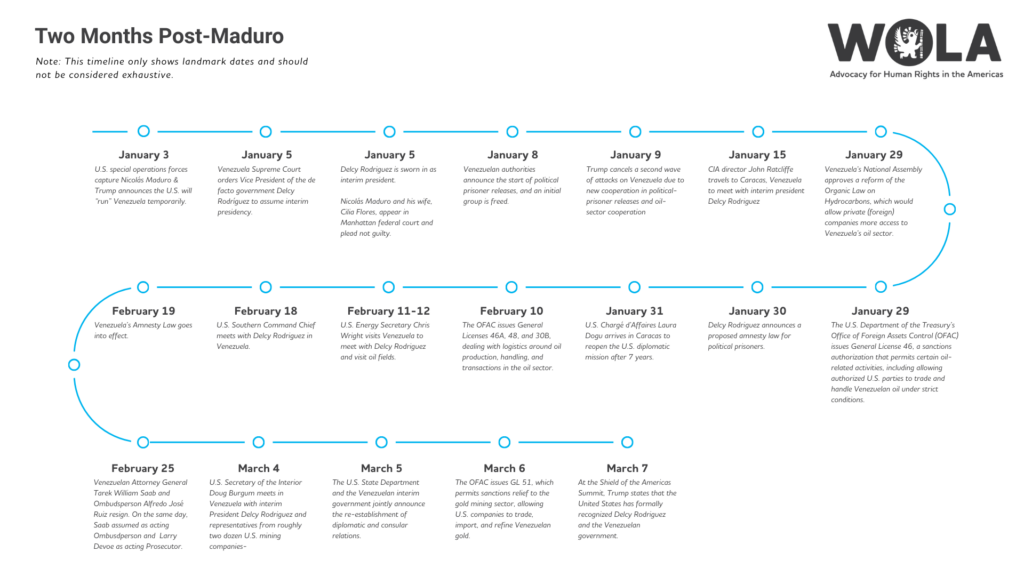
It is noteworthy how quickly the regime changed its tune after the removal and arrest of Nicolás Maduro, and how easily the U.S. went from being the great “enemy of the Revolution” to being a strategic ally and even reestablishing diplomatic and consular relations. The images of Delcy Rodríguez, now the de facto interim president, shaking hands with CIA Director John Ratcliff, receiving Chargé d’Affaires Laura Dogu at Miraflores, touring oil fields with Energy Secretary Chris Wright, and closing a mining agreement with Interior Secretary Doug Burgum were unthinkable in 2025.
The rapprochement with the U.S. government contrasts with the silence of the Venezuelan authorities on the Venezuelan and Cuban military personnel who died during the operation. This is not the result of a change of conviction, but rather a survival strategy in the face of a real threat of the use of force, the legality of which has been seriously questioned by international bodies and organizations. For his part, Secretary of State Marco Rubio announced, without further details, a three-phase plan for Venezuela consisting of stabilization, recovery, and transition, and in that process, there has been a huge easing of sanctions and a transformation of trade relations between the two countries.
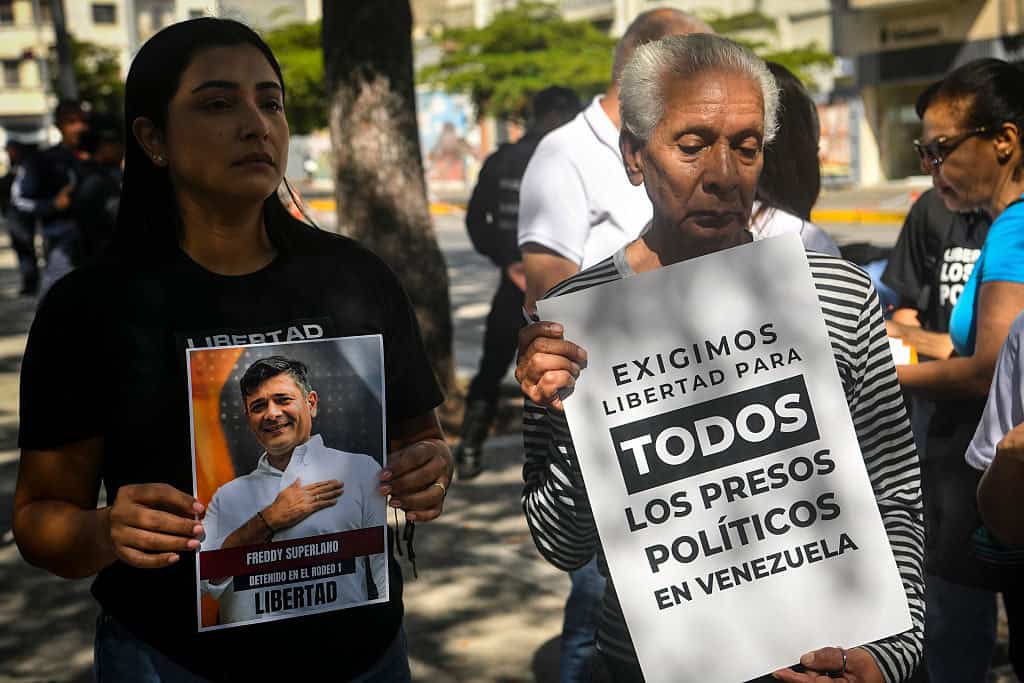
On the other hand, between January 8 and March 8, 2026, human rights organizations have verified the release from prison of at least 659 people. Among those released are journalists, human rights defenders, and opposition leaders, some of whom have returned to public life. Some leaders who were in hiding have resumed their activism. Civil society has reclaimed some of its spaces, testing how far it can go, and reclaiming the role of universities, unions, and the media. Faculty deans and human rights organizations have responded to calls from the National Assembly to provide their observations on some regulatory changes.
What has not changed in Venezuela
The departure of Nicolás Maduro did not mean the end of authoritarianism in Venezuela. So far, there has been no institutional dismantling of the authoritarian model or the repressive architecture. The aforementioned openings are incomplete and insufficient.
Although the National Assembly received comments from human rights organizations on the draft Amnesty Law, it was approved on February 19 without incorporating essential adjustments. While the law is a first step in the right direction and would allow many people to be released, it does not recognize the victims of repression, does not hold the state accountable, and does not offer guarantees for truth, justice, and reparations. Nor is it a law that adopts measures to ensure non-repetition. Furthermore, the implementation of the law is left to the very judiciary that was part of the repressive apparatus. Beyond the law, it is essential to address the dismantling of democratic institutions and the urgent need to return to the rule of law, with the independence and impartiality of justice operators.
Repression in Venezuela has been so systematic and disproportionate that human rights organizations have always explained that the verified case figures were only “the tip of the iceberg” and, at the time of this publication, reflect that there are still at least 759 people deprived of their liberty for political reasons. The process of release from prison has been deeply revictimizing for family members, especially those who are still waiting for their loved ones to be freed. The de facto authorities, who do not maintain transparent records, have shifted the burden of verifying information on those deprived of liberty to the very organizations they have targeted and criminalized in the past. Although the Amnesty Law provides for the extinction of criminal, disciplinary, or civil actions against persons benefiting from amnesty, it applies only to certain acts and crimes. For those to whom the amnesty does not apply or has not been granted, due process guarantees continue to be flouted: in most cases of those released from prison, the case has not been dismissed or closed, the appointment of private defense counsel is not allowed, and access to the case file is not provided. There are cases of individuals who are still deprived of their liberty and are not allowed visits from family members in detention centers.
The laws used to justify repression remain in force. Among many others, these include the Organic Law against Organized Crime and Terrorism Financing, the Law against Hate, for Peaceful Coexistence and Tolerance, and the Law on the Oversight, Regularization, Action, and Financing of Non-Governmental Organizations and Non-Profit Social Organizations. The political disqualifications imposed by the Comptroller General’s Office have not been lifted. Political parties remain under intervention. The National Electoral Council has not regained its independence. There are no guarantees for the independent work of the media and journalists.
Then there are some movements in power that need to be watched closely, although they do not constitute, a priori, a change. The departure of Tarek William Saab from the Attorney General’s Office and his appointment as Ombudsman diminishes his power, although his replacement, Larry Davoe, has long served as the State’s representative to international organizations, denying the State’s responsibility and stigmatizing human rights defenders. The apparent deprivation of liberty of Alex Saab and Raúl Gorrín, figures close to the government and accused of participating in the legitimization of assets, is also a fact that must be monitored. Although the structure of corruption and repression remains in place, it is necessary to observe shifts in the balance of power and to bear in mind the U.S. Department of Justice’s ongoing accusations against senior officials such as Diosdado Cabello and Vladimir Padrino López.
Finally, although Delcy Rodríguez has complied with U.S. economic demands and there are enormous expectations for improved conditions next year, inflation in Venezuela remains at 60 percent, and the exchange rate gap between the Venezuelan Central Bank rate and the parallel dollar is close to 50 percent, which continues to affect those living in Venezuela. According to economist Jesús Palacios, the basic basket of goods costs $550 per month, while the average income is $270, highlighting the fragility of purchasing power. Restoring public services and addressing the complex humanitarian emergency requires not only money and political will, but also the restoration of democratic and transparent institutions, which have not yet happened.
The latent risk: adaptive authoritarianism
The worst-case scenario for Venezuela is the stabilization of a reconfigured authoritarianism: the preservation of absolute control of power under different faces, without a democratic transformation. Whether this scenario materializes will depend on several factors: the pressure exerted by civil society and democratic forces both inside and outside Venezuela; the convergence that may occur between the interests of the United States and those seeking a true transition to democracy; and the pressure that other influential actors, such as the private sector and European governments, may exert in the same direction.
In this convergence of actors, the U.S.’s role is central. It can act as an accelerator of the transition or as a stabilizer of authoritarianism. The signals sent by the Trump administration have been mixed and difficult to interpret: the Secretary of State has spoken on several occasions about the need for a return to democracy and for elections to be held, while President Trump insists on how productive the relationship with Delcy Rodríguez has been and avoids talking about democratic transition. For its part, there is bipartisan understanding in the U.S. Congress of a crisis in Venezuela and a call for a genuine democratic transition. If the U.S. priority is merely economic relations and reducing migration, democratic transition could take a back seat. However, as Francisco Monaldi and other experts have explained, without institutional change, the hope of an oil bonanza will be unviable.
Venezuelan civil society as the main promoter of the democratic transition
After 26 years with the same party in power, amid a deep humanitarian crisis, a human rights crisis, and a crisis of the rule of law, the goal cannot be, a priori, a perfect democratic transition, but rather a viable and sustainable one. Without sustained pressure, both internal and external, the current window could close, favoring a new authoritarian equilibrium.
As noted by academic and analyst Guillermo Aveledo, the return of political leaders and activists in exile could be a source of pressure on both Trump and Delcy Rodríguez, presenting them with a dilemma: if the de facto government in Venezuela opts for repression, it increases the political cost for Trump of continuing to call it an ally; while if Rodríguez tolerates their return, pressure will be exerted to open up civic space. This is the kind of dilemma that democratic forces must pose to the leaders of both countries.
The democratic transition in Venezuela must be inclusive and rely primarily on the momentum of civil society and victims of human rights violations, who have resisted authoritarianism and continue to mobilize. This is the moment for the human rights movement and social movements, and it requires the support of international organizations that, for years, have documented the situation in the country and built international standards that will serve as a guide for the transition. Venezuela needs an agenda for the country’s reinstitutionalization and continued work to open up civic space, while demanding that the US condition its foreign policy and economic flexibility on democratic openings and guarantees of transparency in the management of resources. A group of organizations has already published a list of 10 urgent actions to guide the transition in Venezuela. These minimal openings, which are only a starting point, should serve as a minimum acceptable route for the US government and the rest of the international community.
In this fragile political moment, which stems from a highly questionable action by the US, the question is not whether something has changed in Venezuela, but whether that change will pave the way for democracy or end up stabilizing a new authoritarianism.