
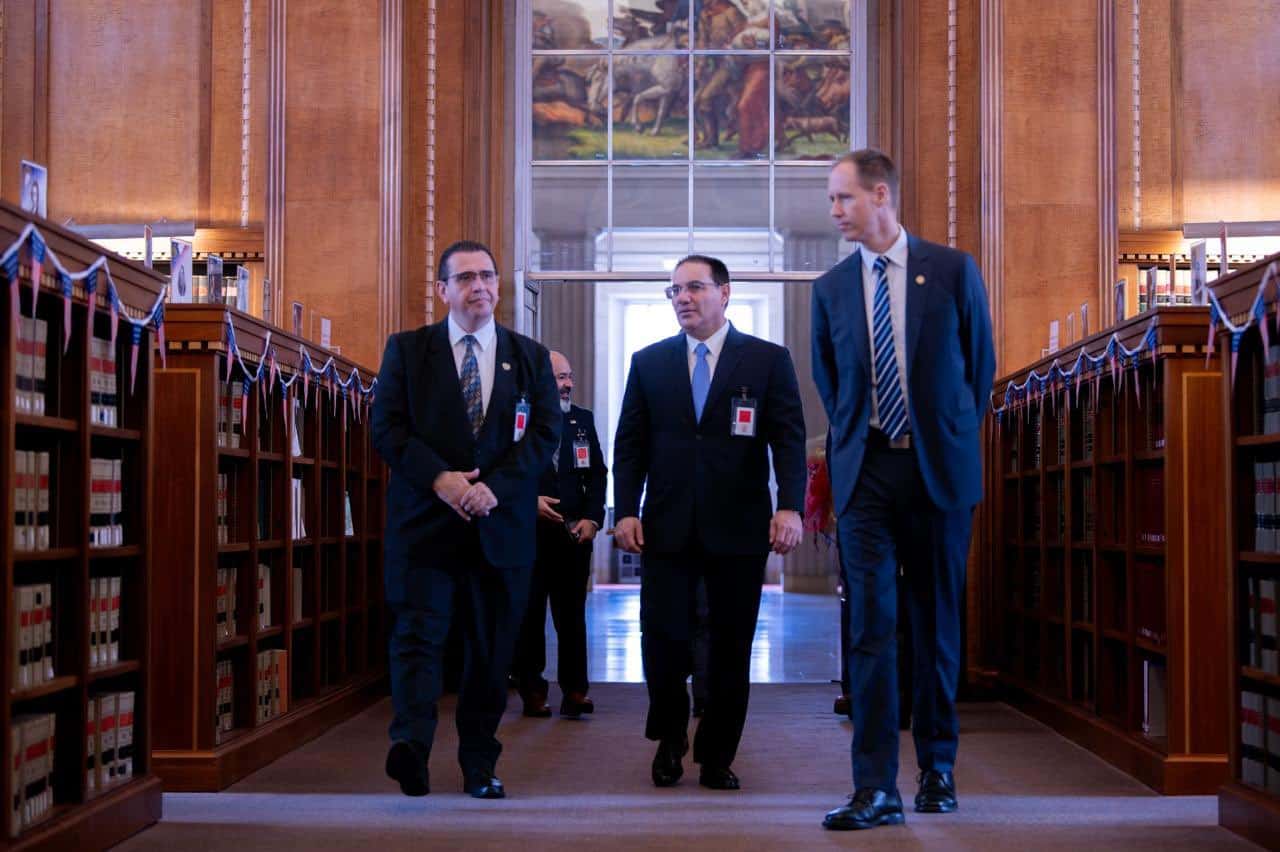


The recent visit to Washington by Guatemala’s Attorney General, Gabriel García Luna, accompanied by the Minister of the Interior, Marco Antonio Villeda Sandoval, marks an important shift in the relationship between Guatemala’s Public Prosecutor’s Office (MP) and U.S. security and justice agencies. After several years in which institutional cooperation was limited due to concerns about the deterioration of the rule of law and the political use of the justice system, the meetings held with officials from the Departments of Justice and Homeland Security suggest a willingness on both sides to reestablish channels of collaboration in priority areas such as combating drug trafficking, human trafficking, money laundering, and other forms of transnational organized crime.
For the United States, cooperation with Guatemala is essential to advancing its regional security agenda. Criminal networks operating in Central America have a direct impact on flows of drugs, weapons, and illicit money, affecting both countries. Likewise, the joint participation of the Attorney General and the Minister of the Interior in the visit is a positive signal of coordination between the institutions responsible for criminal prosecution and public security, as well as of the Guatemalan government’s willingness to deepen bilateral cooperation in these areas. However, recent experience shows that technical and operational cooperation alone will hardly yield sustainable results without serious efforts to strengthen institutions and restore judicial independence.
The Guatemalan state’s capacity to effectively confront organized crime depends not only on better investigative tools or greater international coordination, but also on the existence of independent, professional justice institutions free from political interference. Bilateral cooperation faces the challenge of operating in a context where there is an urgent need to rebuild the credibility of Guatemala’s justice institutions after years of allegations of institutional capture, persecution of independent justice operators, and weakening of anti-corruption mechanisms.
For this reason, the resumption of cooperation should be seen as a first step, not a destination. Guatemala continues to need a comprehensive reform of the justice sector that strengthens judicial independence, professionalizes the institutions responsible for criminal prosecution, and guarantees effective accountability mechanisms. Without these changes, there is a risk that progress achieved through bilateral cooperation will be temporary and vulnerable to future political shifts.
Likewise, any serious cooperation strategy to combat drug trafficking and criminal structures must include robust anti-corruption measures. In Guatemala, it is well documented how illicit networks have sought to influence public institutions to ensure impunity and protect criminal interests. These dynamics are not limited to a single institution and may involve actors at different levels of the state, including national authorities and local governments. International cooperation will be more effective if it incorporates efforts to strengthen institutional controls, transparency, and the investigation of corruption structures linked to organized crime.
For foreign policy officials in Washington, reestablishing cooperation with the Public Prosecutor’s Office offers an opportunity to support concrete advances in security and justice, but also requires maintaining an approach grounded in democratic principles and human rights. The success of this new phase should be measured not only by the number of operations or arrests carried out, but also by indicators related to institutional independence, protection of due process, reduction of impunity, and the strengthening of the rule of law.
In this context, we present the following recommendations to the various actors involved in bilateral cooperation.
Recommendations
U.S. Congress
- Strengthen oversight of U.S. assistance to Guatemala, including periodic hearings that examine the results of the various security and justice cooperation programs implemented by the Departments of State, Justice, and Homeland Security.
- Include in the cooperation requirements the development of performance indicators linked to institutional strengthening — not solely operational metrics such as arrests or seizures — that incorporate criteria related to judicial independence, due process, and the reduction of impunity.
- Incorporate human rights safeguards in all cooperation programs, including independent monitoring and impact evaluation mechanisms.
- Maintain and evaluate the use of accountability tools, including individual sanctions for significant corruption or attacks on the rule of law where sufficient evidence exists.
- Request periodic reports from the Department of State on corruption risks and institutional capture in institutions receiving U.S. assistance.
The Trump Administration
- Maintain cooperation with the Public Prosecutor’s Office and other security institutions, but condition the expansion of such cooperation on verifiable progress in transparency, judicial independence, and respect for human rights.
- Support a comprehensive reform of the justice sector, including strengthening investigative capacities, internal control systems, the prosecutorial career track, and meritocratic selection mechanisms for judicial authorities.
- Prioritize anti-corruption strategies as a central component of the security agenda, recognizing that combating drug trafficking and organized crime requires confronting the political and institutional protection networks that enable their operation.
- Support independent actors within the justice system, civil society, and investigative journalism, whose work is essential for transparency and accountability.
Guatemala’s Public Prosecutor’s Office
- Implement an institutional-strengthening and internal-review process to identify practices, appointments, and structures that have contributed to the institution’s loss of independence and credibility.
- Promote accountability mechanisms for potential abuses of power, the instrumentalization of criminal prosecutions, and the obstruction of investigations into corruption or organized crime, in accordance with due process and constitutional guarantees.
- Review cases of alleged criminalization of justice operators, journalists, human rights defenders, and community leaders, to ensure that criminal action responds exclusively to legal rather than political criteria.
- Strengthen specialized units investigating corruption, money laundering, political-criminal networks, and organized crime, ensuring their technical autonomy and adequate resources.
- Rebuild public trust through transparency policies, including the publication of data, case prioritization criteria, and external oversight mechanisms.
- Prioritize investigations into corruption linked to drug trafficking and organized crime at the national and local levels, particularly in areas where there are indications of the capture of public institutions by criminal structures.
- Guarantee the protection and reintegration of technical expertise within the justice system, including the recovery of institutional knowledge lost following the departure of specialized prosecutors, judges, and other justice operators.
Renewed cooperation between Washington and the Public Prosecutor’s Office can yield significant advances in the fight against transnational organized crime. The coordinated participation of the Public Prosecutor’s Office and the Ministry of the Interior in this bilateral engagement offers an opportunity to strengthen a comprehensive security and justice strategy. However, without parallel efforts to reverse institutional capture, strengthen judicial independence, and ensure accountability for past abuses, results will likely be limited and difficult to sustain over the long term.