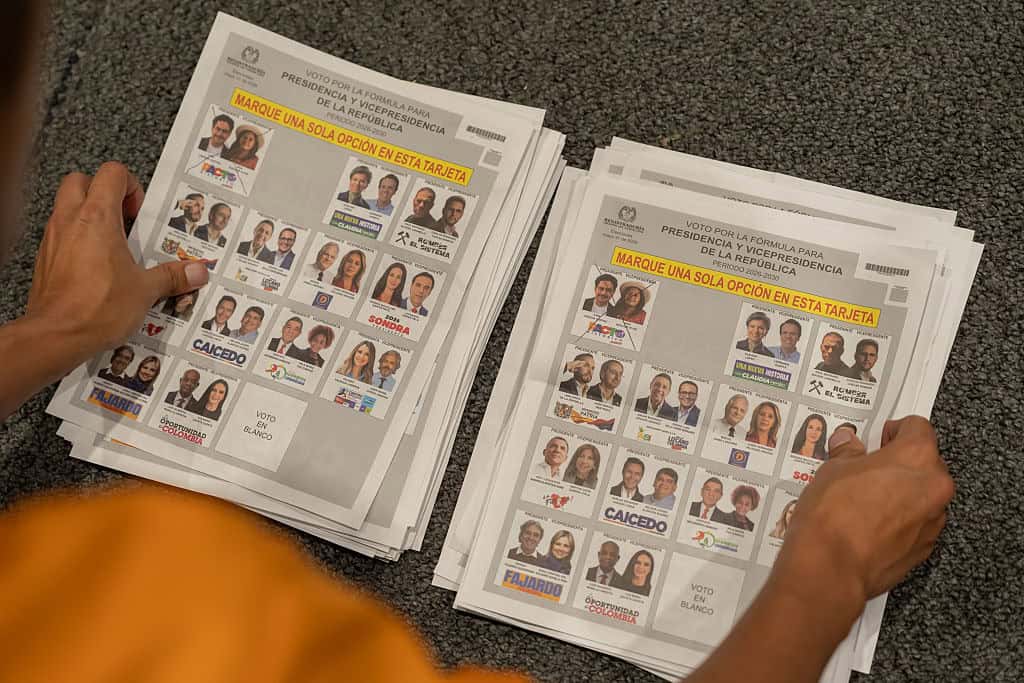
On May 31, Colombians voted in the first round of their presidential elections. Here are some of the main takeaways.
The Outsider Candidate’s Surprise Win
Of the five presidential contenders, far-right outsider candidate Albelardo de la Espriella secured 43.74% of the vote in Colombia’s first-round presidential election, setting up a June 21 runoff against leftist candidate Ivan Cepeda, who received 40.9% of the vote, following a collapse in center-right support. De la Espriella finished three percentage points ahead of Cepeda, a margin of approximately 670,000 votes. While polls were accurate in predicting Cepeda’s numbers, de la Espriella’s numbers surpassing those of Cepeda were not foreseen.
A geographic analysis of the results reveals a clear territorial divide. Colombia’s central regions, the areas less affected by violence and armed conflict, largely supported de la Espriella, while rural, conflict-affected, and peripheral areas predominantly backed Cepeda.
In the final weeks of the campaign, the candidacy of Uribista opposition candidate Paloma Valencia, who had been considered another leading candidate, unraveled. Her campaign struggled to present a coherent message. Tensions within her ticket and de la Espriella’s rise as an alternative candidate on the right further undermined her appeal. Valencia’s vice-presidential running mate, Juan Daniel Oviedo, a centrist and openly gay politician, publicly disagreed with her on several key issues, including adoption for same-sex couples, drug policy and the proposal to appoint former President Alvaro Uribe as Defense Minister. These contradictions, plus outdated rhetoric popular during the 2000s, contributed to voter confusion and weakened credibility at a critical stage of the race.
Petro Claims an Unwanted Spotlight
Sitting President Gustavo Petro rejected and dismissed the preliminary count results of the elections, arguing possible irregularities in the counting software and a discrepancy in the electoral census. Petro affirmed he would only accept the results if they were validated by judges in the final review. Gregorio Eljach, Colombia’s Inspector General, reminded Petro that Colombia’s legal system does not allow the president to validate or reject electoral results and stated that what Petro was doing was “unhelpful” and “unhealthy.” The European Union’s Electoral Observation Mission and the Electoral Observation Mission of Colombia dismissed Petro’s claims of fraud.
Petro has become a central figure in the runoff campaign, actively promoting Cepeda’s candidacy while attacking de la Espriella. His prominent role has complicated Cepeda’s efforts to distance himself from the president and to appeal to moderate and centrist voters.
In an effort to distance himself from Petro, Cepeda stated, “there are no irregularities significant enough to warrant a finding of fraud.” While Cepeda has sought to broaden his coalition, abandoning calls for a constituent assembly and reaching out to centrist political leaders, Petro has intensified his inflammatory rhetoric on social media, often dominating public debate.
As a result, Cepeda finds himself in a difficult political position. He cannot distance himself too sharply from Petro without risking the support of the left-wing base that remains essential to the campaign. Yet his continued association with the president, particularly as Petro’s rhetoric becomes more polarizing, makes it harder for Cepeda to attract the moderate and independent voters he needs to win the runoff.
Two Very Different Visions for Colombia
The two contenders to be Colombia’s next President present very different professional profiles and visions for the country. Abelardo de la Espriella is a high-profile Colombian criminal defense lawyer, businessman, and right-wing politician who has built a celebrity-like public image through his aggressive rhetoric, social media presence, and highly theatrical campaign style. Born in Bogotá and raised in Montería, Córdoba, he comes from an influential family connected to Colombia’s political and economic elite. As a founder of a successful law firm with operations in Colombia and the United States, he gained notoriety representing controversial figures, including former President Álvaro Uribe Velez and businessman Alex Saab. Beyond law, he owns luxury lifestyle brands and is known for his extravagant lifestyle. Presenting himself as a political outsider, he has campaigned through his “Defenders of the Homeland” movement, emphasizing nationalism, strong leadership, and opposition to Colombia’s political establishment.
Esperilla’s platform centers on a hardline security agenda inspired by leaders such as Nayib Bukele, including ending peace negotiations with armed groups, expanding prisons, increasing military spending, authorizing tougher police tactics, and potentially using emergency powers to restore territorial control. He strongly opposes the 2016 peace agreement with the FARC and has pledged to dismantle the Special Jurisdiction for Peace (JEP). Economically, he advocates a market-oriented agenda modeled partly on Javier Milei’s reforms, proposing major reductions in government spending, deregulation, tax cuts, and renewed investment in hydrocarbons. Socially conservative, he opposes abortion, same-sex adoption, and “gender ideology”, while promising to eliminate the Ministry for Equality. In foreign policy, he aligns closely with the United States and Israel, supporting a tougher stance on migration, and has proposed reconsidering Colombia’s participation in some international institutions, including the United Nations and the Inter-American Court of Human Rights. With the U.S., he plans to advance a Plan Colombia 2.0 and join the Shield of the Americas.
Meanwhile, Ivan Cepeda is a Colombian senator, human rights advocate, and leading figure of the country’s progressive left whose identity has been shaped by Colombia’s history of political violence and armed conflict. The son of murdered Patriotic Union senator Manuel Cepeda, he spent part of his youth in exile and later dedicated his career to defending victims of State violence and promoting human rights. Trained in philosophy and international humanitarian law, Cepeda gained national and international recognition through his leadership of the Movement of Victims of State Crimes (MOVICE) and later as a legislator. Known for his calm, intellectual style, he has been one of the country’s most prominent critics of former President Álvaro Uribe and a key architect of peace-building initiatives, including support for the 2016 peace accord with the FARC and subsequent negotiations with armed groups.
Cepeda’s vision centers on deepening the implementation of the 2016 peace agreement, advancing negotiations with illegal armed groups, and addressing the structural causes of conflict through rural development, land reform, and social investment. He advocates an approach to security focused on human rights, state presence, and the dismantling of illegal criminal economies, rather than relying primarily on military force. Economically, he supports a transition away from extractive industries toward a more sustainable and productive economy, including agrarian reform, renewable energy development, and expanded support for cooperative and community-based enterprises. He also favors a stronger state role in healthcare, expanded public services, and policies aimed at reducing inequality. In foreign affairs, Cepeda promotes diplomatic engagement, Latin American integration, and adherence to international law, including dialogue-based approaches to regional crises.
U.S. Directly Endorses a Candidate
For over two centuries, the United States and Colombian governments carefully avoided interfering in each other’s elections. This relationship was widely regarded as a model of bipartisanship: regardless of which party held power in either country, U.S. policymakers committed to working with whoever won Colombia’s presidency, and Colombia reciprocated. That tradition frayed after Gustavo Petro—Colombia’s first left-wing president- took office in 2022. A small group of Republican lawmakers rejected him for being a former guerrilla, his ties to Cuba and Venezuela, and disagreed with his domestic and international policies, and a series of clashes between Petro and Trump on social media triggered several diplomatic crises. The fallout was significant: the U.S. decertified Colombia on drug policy, revoked Petro’s visa, and placed him on the Office of Foreign Assets Control (OFAC) sanctions list. A White House meeting between the two leaders in February eased the immediate tension, but the relationship has remained strained.
Before the first-round elections, U.S. Secretary of State Rubio made it clear that the U.S. was closely monitoring the elections to guarantee the process was free and fair. Before traveling to Colombia as an officially accredited international observer joining a U.S. mission consisting of 80-plus observers, Colombian-American Senator Berni Moreno stated that he would not recognize the results if armed groups intimidated voters.
In a move similar to the role played in Honduras, Argentina, and Brazil, President Donald Trump posted an endorsement of Abelardo de la Espriella on his Truth Social two days after the first round. He stated, “the results of this election are very important to the future of Colombia and its relationship to the United States.” Such a direct endorsement of a candidate forms part of the Trump Administration’s strategy to dominate the region. The direct endorsement of a candidate was countered by representatives Gregory Meeks, Delia Ramirez, and Adelita Grijalva.
A Violent and Polarized Context
The first-round presidential elections took place amid significant concerns about political violence and worsening insecurity. The civil society Electoral Observation Mission (MOE) documented 565 acts of political violence since January 2025, including the assassination of a presidential candidate, kidnappings, attacks against candidates and campaign staff, vandalism of campaign offices, and death threats.
The broader security and humanitarian situations were also alarming. The number of members of illegal armed groups rose from about 22,000 in 2024 to 27,000 by the end of 2025. The forced recruitment of minors has become a growing concern. According to the International Crisis Group (ICG), kidnappings and extortion doubled between 2024 and 2025, while homicides increased significantly in conflict-affected regions.
The International Committee of the Red Cross (ICRC) has warned that Colombia’s humanitarian crisis has reached its most severe level in a decade, driven by escalating hostilities and the failure of armed groups to comply with international humanitarian law.
In response to these concerns, WOLA joined 34 international organizations in issuing a public statement prior to the elections warning about political violence, electoral intolerance, and voter intimidation. Fortunately, election day itself was largely peaceful, with no major incidents of violence.
The Colombian people deserve fair elections free from violence. With the second round fast approaching on June 21 and in light of security concerns and political polarization, U.S. policymakers should support Colombia’s democratic institutions and a free and fair election process. International actors should refrain from statements or actions that could be perceived as favoring one candidate over another.